



Ever wondered how scientists get such exact chemical measurements? It’s all thanks to a special tool called a burette.
So, what are burettes? They are super accurate measuring devices used in science. They help scientists do detailed chemical tests with great precision, especially in titration.
Burettes have come a long way since the 19th century. They’ve changed from simple glass tubes to advanced tools. Now, they’re key in chemical analysis, letting scientists measure liquids with amazing accuracy.
The term “burette” is more than just a tool. It’s a complex device that helps scientists find the exact amounts of chemicals in solutions. This is done by carefully controlling how much liquid is dispensed.
Key Takeaways
- Burettes are precision laboratory instruments for measuring liquid volumes
- Used extensively in scientific research and chemical analysis
- Critical for titration experiments and solution concentration measurements
- Available in various materials including glass and plastic
- Essential for achieving high-accuracy experimental results
Understanding the Basics of Burettes
Burettes are precise tools used in labs for measuring liquids. They are key in scientific research, especially in chemical analysis and titration.
Scientists use burettes to measure and deliver liquids with great accuracy. They are essential for tasks like quantitative analysis, titration, and precise liquid dispensing.
Definition and Core Purpose
A burette is a long, cylindrical glass or plastic tube. It has graduated markings for accurate liquid volume measurement. Key features include:
- Transparent design for clear volume readings
- Precise graduated scale
- Stopcock for controlled liquid release
- Narrow bore for enhanced measurement precision
Key Components of Burettes
Knowing the parts of a burette is important for lab use. The main parts are:
| Burette Part | Function |
|---|---|
| Graduated Tube | Displays precise volume measurements |
| Stopcock | Controls liquid flow rate |
| Tip/Nozzle | Directs liquid dispensing |
| Support Clamp | Stabilizes burette during experiments |
Types of Burettes
There are many burette types for different needs:
- Glass Burettes: Traditional, high-precision instruments
- Plastic Burettes: Lightweight and chemical-resistant
- Digital Burettes: Advanced, motor-controlled dispensing
- Micro Burettes: Specialized for ultra-small volume measurements
Each type has its own benefits for various scientific tasks. This lets researchers pick the best one for their needs.
The Role of Burettes in Laboratory Settings
Burettes are key tools in science labs. They help researchers measure liquids with great precision. This is important in many fields, like chemistry and quality control.
Scientists use burettes for many important tasks. Their ability to measure liquids accurately is crucial. This makes them essential in today’s labs.
Common Applications Across Industries
Burette experiments are used in many areas. They show how useful these tools are:
- Analytical Chemistry: Precise solution concentration measurements
- Pharmaceutical Research: Quality control and ingredient verification
- Environmental Science: Gas and liquid volume analysis
- Food and Beverage Industry: Acidity and mineral content testing
- Cosmetic Manufacturing: Ingredient concentration verification
Importance in Titration Processes
Titration is a big use of burettes. It helps scientists find out how strong solutions are. The controlled addition of reagents enables accurate chemical analysis.
| Titration Type | Primary Application | Industry Use |
|---|---|---|
| Acid-Base Titration | pH Level Determination | Pharmaceutical, Food |
| Redox Titration | Oxidation State Analysis | Chemical Research |
| Precipitation Titration | Chemical Compound Identification | Materials Science |
Digital burettes have made things even better. They cut down on mistakes and make measurements more accurate. This is great for all kinds of science.
How to Properly Use a Burette
Precision is key in laboratory experiments. Scientists need accurate techniques for successful chemical analysis. Knowing how to use a burette well can greatly improve your experiment’s quality.
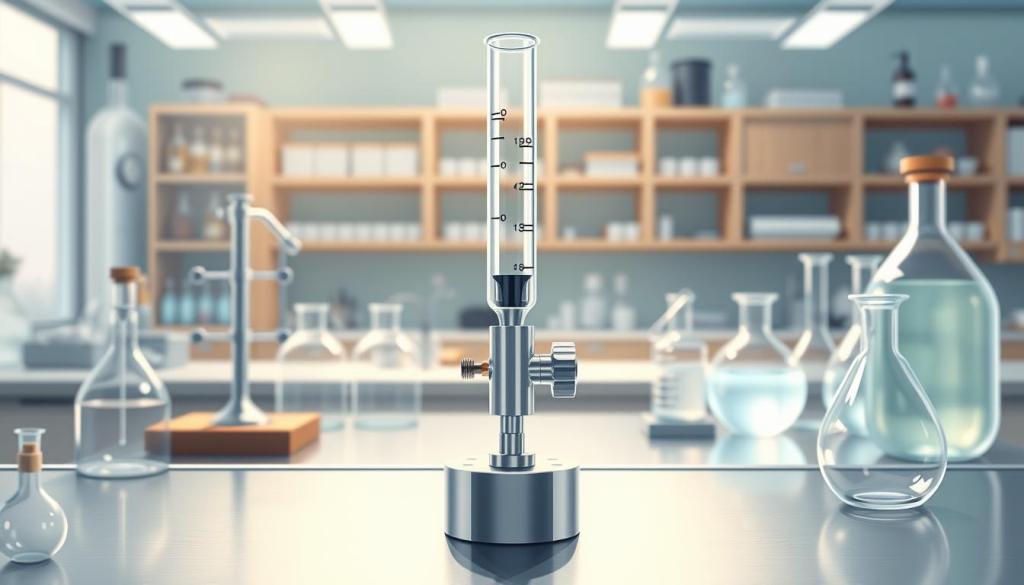
Using a burette well requires attention to detail and careful preparation. Here’s a step-by-step guide to help you master burette measurement techniques:
- Clean the burette thoroughly with the right cleaning solutions.
- Rinse the burette several times with the titration solution.
- Check for air bubbles in the burette tip.
- Adjust the liquid level to the zero mark.
- Record the initial volume before starting the titration.
Ensuring Accurate Measurements
Accurate measurements depend on several key factors. Researchers must align their eyes correctly when reading volume markings. This helps avoid parallax errors. Also, read the liquid meniscus from the bottom of the curve for the best precision.
Best Practices for Burette Experiments
Professional labs follow these important practices for reliable measurements:
- Use Class A Glass Burettes for precise work.
- Make sure the burette is mounted vertically.
- Release titrant solution slowly and consistently.
- Remove all air bubbles before starting.
- Keep the room temperature stable during measurements.
Precision in burette measurements can make the difference between successful and inconclusive scientific research.
Maintenance and Care for Burettes
Keeping laboratory burettes in good shape is key for accurate measurements. Lab workers need to clean and store them right to keep them precise. This also helps them last longer.
Cleaning Procedures
Cleaning burettes well is the first step to accurate calibration. Scientists should clean them carefully to remove old chemicals and stop contamination.
- Rinse burettes with the right cleaning solutions
- Use distilled water for the final rinse
- Avoid harsh chemicals that could harm the glass
- Use special lab detergents
Storage Recommendations
Storing burettes right is crucial to keep them accurate and safe. Handling them with care can prevent damage and contamination.
- Store them vertically in special racks
- Keep them away from direct sunlight
- Keep the temperature and humidity steady
- Use covers when not in use
Calibration Best Practices
Calibrating burettes regularly is important for accurate volume measurements. Lab techs should check them often to make sure they’re working right.
- Calibrate them at set intervals
- Use standard reference solutions
- Check the meniscus reading for accuracy
- Keep a record of all calibration results
Remember, careful maintenance is essential for reliable scientific results and longer-lasting laboratory burettes.
Materials Used in Burette Construction
Choosing the right material for a burette is key for accuracy and lab performance. Scientists need to think about their experiment’s needs when picking between glass and plastic.
In labs, you’ll often find glass and plastic burettes. Each has its own benefits for different scientific tasks.
Glass Burettes: Precision and Reliability
Glass burettes are known for their high precision. They have several advantages:
- Superior chemical resistance
- High transparency for easy volume reading
- Excellent dimensional stability
- Minimal chemical interaction with test solutions
Plastic Burettes: Modern Alternative
Plastic burettes are popular for being light and durable. They offer:
- Reduced breakage risk
- Lightweight design
- Resistance to mechanical shock
- Lower cost compared to glass alternatives
When choosing between glass and plastic, consider your experiment’s needs. Think about chemical compatibility, precision, and mechanical stress.
Material Performance Characteristics
Materials affect burette accuracy differently. Class A burettes can be up to 0.1 percent accurate. Class B are up to 0.2 percent accurate. The material’s quality affects these levels.
The choice between glass and plastic depends on your lab’s needs. It ensures the best performance and reliable results.
Comparing Burettes to Other Measuring Instruments
Laboratory tools are key in science. Burette measurements are known for their precision and flexibility. Knowing how burettes compare to other tools helps pick the right one for each experiment.

In labs, many measuring tools are used. The choice between burettes, pipettes, and graduated cylinders depends on the experiment’s needs and the desired accuracy.
Burettes vs. Pipettes: Precision and Application
Pipettes and burettes are used for different tasks. Both are good for precise liquid handling but serve different purposes:
- Pipettes are great for quickly moving specific amounts
- Burettes are better for controlled titration
- Pipettes are more precise for small amounts
Burettes vs. Graduated Cylinders: Measurement Capabilities
Graduated cylinders measure a wide range of volumes. But, burettes are more accurate for scientific tests.
| Characteristic | Burettes | Graduated Cylinders |
|---|---|---|
| Accuracy | Up to 0.1% (Class A) | ±1-5% typical |
| Precision | High | Moderate |
| Best Used For | Precise titrations | General volume measurements |
Choosing between these tools depends on the experiment’s needs. Researchers must think about volume, accuracy, and complexity when picking their tool.
Safety Considerations When Using Burettes
Laboratory safety is crucial when using burettes. Taking the right precautions keeps researchers safe and ensures accurate results. By following safety rules, we can avoid risks from handling chemicals.
Personal Protective Equipment (PPE)
Researchers need to wear the right protective gear when using burettes. Important safety items include:
- Chemical-resistant safety goggles
- Long-sleeved lab coat
- Acid-resistant gloves
- Closed-toe shoes
“Safety is not an option in laboratory settings—it’s a requirement.” – Laboratory Safety Expert
Handling Hazardous Chemicals
When working with burettes, handling chemicals safely is key. Researchers should:
- Work in a well-ventilated area or fume hood
- Use chemical splash guards
- Know emergency eyewash and shower locations
- Have neutralizing agents nearby
Following these steps is vital to avoid chemical exposure and keep experiments safe. Knowing how to handle chemicals properly is essential for both safety and scientific integrity.
Troubleshooting Common Issues with Burettes
Laboratory experts often face problems with burettes. These issues can harm the accuracy of their work. It’s key to know how to fix these problems to keep measurements precise.
Getting accurate results in labs depends on well-calibrated and maintained burettes. Scientists need to be ready to solve several common issues that can mess up measurements.
Resolving Air Bubbles and Blockages
Air bubbles can really mess up the accuracy of burettes. To fix this, researchers should:
- Tap the burette gently to get rid of air bubbles
- Use a clean, lint-free cloth to wipe the inside
- Make sure to fill it right to avoid air pockets
- Check the stopcock for smooth, unblocked movement
Addressing Calibration Challenges
Calibrating burettes is crucial for keeping measurements accurate. Problems include:
- Volume readings that don’t match up
- Distorted or unclear markings on the graduated scale
- Sticky liquid on the burette walls
- Leaky or uneven liquid flow from the stopcock
Regular cleaning, careful use, and professional calibration help keep burettes accurate. This is important for lab work.
Innovations and Advances in Burette Technology
The world of lab equipment is always changing. Digital burettes are now a big part of scientific research. They bring new levels of precision and reliability to chemical analysis.
Digital burettes use advanced tech to cut down on mistakes. They have motor-controlled pistons, touch screens, and can dispense at different speeds. This makes them much more accurate than old methods.
Today’s labs use electronic burettes that manage data well. These devices store results, show data in real time, and document experiments fully. They also have secure software to keep important data safe and easy to access.
The future of burette tech looks even more exciting. Labs will get tools that are smarter and more connected. These tools will make research easier and more precise, thanks to new automation and predictive maintenance features.
FAQ
What is a burette and what is its primary purpose in a laboratory?
A burette is a precise tool used in labs for measuring liquids. It’s key in titration, helping scientists add small amounts of reagents. This is crucial for chemical analysis and research.
What are the main components of a burette?
A burette has a long, graduated tube, a stopcock at the bottom, and a narrow tip. It also has a calibration mark for standard measurements. The graduations help in precise volume readings.
What types of burettes are available in laboratories?
Labs use glass, plastic, and digital burettes. Glass ones are traditional and durable. Plastic ones are lighter and less breakable. Digital ones offer precision and electronic tracking.
How do I read measurements accurately on a burette?
To read a burette accurately, stand at eye level with the meniscus. Make sure the lighting is right. Read the bottom of the curved liquid surface. Always use the graduated markings and avoid parallax errors.
What are the most common applications of burettes?
Burettes are used in titration, analytical chemistry, and more. They help in precise liquid addition and chemical concentration. They’re key in various scientific studies.
How should burettes be maintained and cleaned?
Clean burettes with lab detergents and rinse with distilled water. Dry them carefully. Regular calibration and proper storage are essential. This keeps them accurate and reliable.
What safety precautions are necessary when using burettes?
Always wear safety goggles, lab coats, and gloves when using burettes. Handle chemicals with care. Work in well-ventilated areas. Follow safety protocols.
What are common troubleshooting issues with burettes?
Issues like air bubbles, tip blockages, and stopcock leaks can occur. Fix these by using proper filling techniques and regular cleaning. Replace worn parts and check calibration often.
How do digital burettes differ from traditional glass burettes?
Digital burettes offer electronic tracking and precision. They have automatic data logging and reduce human error. They provide consistent measurements and integrate well with modern systems.
What factors should be considered when selecting a burette?
Consider the experiment’s needs, chemical compatibility, precision, budget, and environment. Material resistance, volume range, graduation precision, and application are key factors.






Leave a Comment
Your email address will not be published. Required fields are marked *