



Designing molecular biology experiments is key to finding microbial biomarkers in clinical diagnostics. It’s vital to follow a strict approach to get accurate and reliable results. This is especially true when dealing with the complex task of identifying microbes.
Thanks to fast progress in molecular diagnostics, careful planning is more important than ever. By using solid methods, researchers can make their findings more trustworthy. This helps improve patient care and outcomes.
Key Takeaways
- Understanding the importance of precise molecular biology experiment design.
- Identifying microbial biomarkers demands a systematic approach.
- Advancements in clinical diagnostics require rigorous planning and execution.
- Complexity of microbial detection necessitates reliable methodologies.
- Thorough experiment design leads to better data quality and success rates.
Understanding Molecular Biology Experiments
Molecular biology is a key part of biology that looks at how molecules work in living things. It studies DNA, RNA, and proteins to understand life’s basics. By changing these molecules, scientists learn more about how cells work and genes are expressed.
What is Molecular Biology?
The molecular biology definition is about studying life at the molecular level. It looks at how different molecules interact and their roles in life. The central dogma shows how genetic information moves from DNA to RNA and then to proteins. This is key to understanding how genes work and are expressed.
Key Principles in Molecular Biology
There are a few main ideas in molecular biology:
- The central dogma shows how genetic information is passed on.
- Enzymes are important for starting and stopping molecular actions.
- How genes are turned on or off affects how cells react.
Knowing these ideas helps make experiments better and research more reliable.
Importance of Experiment Design
Good experimental design is very important in molecular biology. Well-designed experiments make sure results can be trusted. Important steps include controlling variables and choosing the right methods.
Planning experiments carefully helps avoid mistakes and makes tests more accurate. This is especially true in medical tests. By sticking to proven methods, scientists can draw solid conclusions, showing the importance of molecular biology in medicine.
Defining Research Objectives in Experiment Design
Setting clear research objectives is key in molecular biology experiments. It lays the groundwork for the experiment’s purpose and guides the research stages. Specific goals help everyone understand the focus and what’s expected.
Identifying the Purpose of Your Experiment
The purpose of an experiment can be different. It might involve testing hypotheses, exploring new areas, or confirming old findings. Knowing your molecular biology aims makes your research more relevant and useful. Each purpose affects the methods and techniques used.
Setting Clear, Measurable Goals
Creating measurable goals before starting is vital. These goals help track progress and make data analysis easier. They act as standards to judge the success or failure of the experiment. Without clear goals, it’s hard to measure success, which slows down scientific progress.
| Objective Type | Description | Example |
|---|---|---|
| Hypothesis Testing | Testing a specific prediction based on existing knowledge. | Determine if a particular gene influences resistance to a drug. |
| Exploratory Research | Investigating unknown areas without a specific hypothesis. | Identifying novel microbial species in a given environment. |
| Validation | Re-examining previously published results for reliability. | Confirming prior findings on a biomarker’s association with disease. |
Selecting the Appropriate Experimental Models
Choosing the right experimental models is key to biomarker research success. It’s important to understand the differences between in vivo and in vitro experiments. Each model has its own benefits that help in finding and validating microbial biomarkers.
In Vivo vs. In Vitro Models
In vivo experiments are done in living organisms, giving a full view of biological interactions. They can mimic complex environments, showing how factors affect microbes and biomarkers. In contrast, in vitro experiments offer controlled settings. This allows for precise changes, crucial for studying microbial strains.
Choosing Microbial Strains for Biomarker Research
Choosing the right microbial strains is vital for biomarker discovery. Important factors include:
- Pathogenicity: Knowing how the strain interacts with hosts is key.
- Genetic characteristics: The strain’s genetics affect its behavior and interactions.
- Relevance to research goals: The strain must match the study’s objectives for useful results.
By focusing on these strain characteristics, researchers can target biomarker research. This approach boosts the chances of finding and using biomarkers in medical diagnostics.
Choosing the Right Techniques for Molecular Analysis
In molecular diagnostics, picking the right techniques is key for good research. Different methods offer special benefits for studying microbes and their interactions. They help us understand complex microbial communities.
Polymerase Chain Reaction (PCR)
PCR is a basic tool in molecular biology. It helps amplify specific DNA parts. By using different strategies, scientists can improve their detection skills.
Real-time PCR, for example, boosts sensitivity and lets us measure DNA amounts. This greatly helps in molecular diagnostics.
Next Generation Sequencing (NGS)
NGS changes the game in genome sequencing. It offers high speed and accuracy in genetic analysis. This tool looks at whole genomes, finding mutations and genetic changes.
It’s vital for understanding microbial biomarkers. NGS helps us grasp the complexity of microbial communities. It’s a must-have in today’s molecular diagnostics.
Microarray Analysis
Microarray tech is great for studying gene expression. It looks at many genes at once. This is crucial in microbial diagnostics, especially for finding disease biomarkers.
By looking at gene expression, scientists gain insights into microbial infections. This helps us understand the genetic side of diseases.
Establishing a Robust Experimental Framework
Creating a solid experimental framework is key for any molecular biology project. It’s crucial to focus on how samples are prepared. This ensures the biological materials are reliable and intact.
The methods used in preparing samples greatly affect the results of molecular biology tests. Understanding different protocols and the importance of controls and replicates helps improve experimental design.
Sample Preparation Techniques
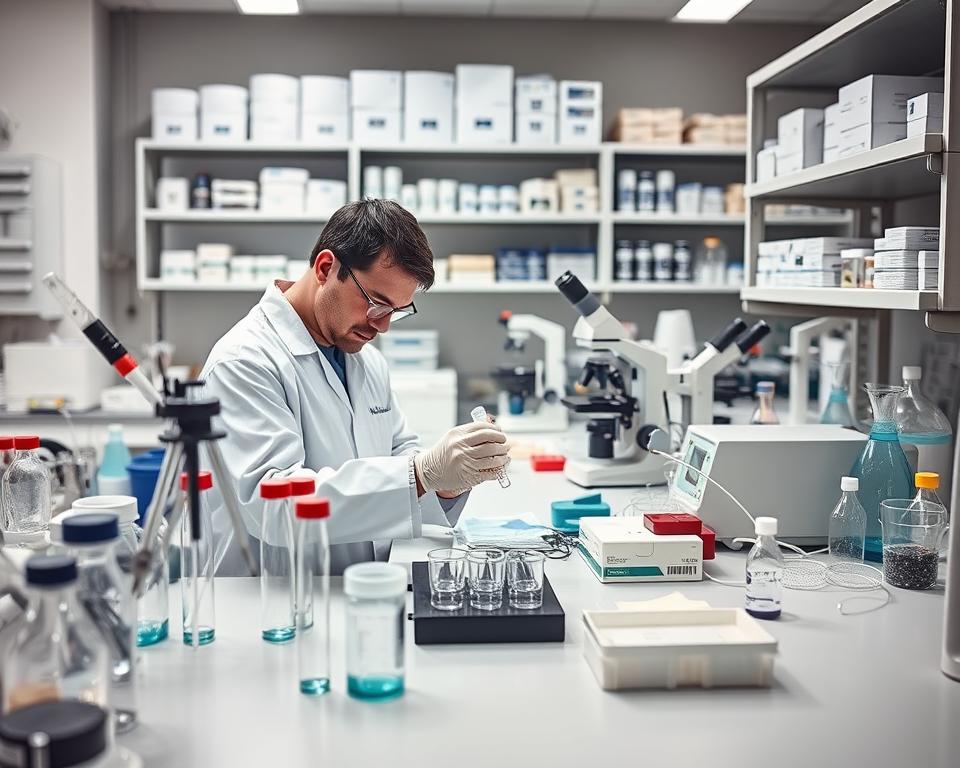
Effective sample preparation techniques are crucial for molecular biology success. Key methods include:
- Extraction: This involves isolating nucleic acids from biological samples, ensuring that the samples maintain their integrity throughout the process.
- Purification: The purified nucleic acids should be free from contaminants that could interfere with downstream applications.
- Quantification: Evaluating the concentration and quality of nucleic acids is critical for accurate experimental results.
Controls and Replicates in Experimental Design
Using the right controls in experiments helps detect errors and makes the study more reliable. Controls set a baseline for measurements. Replicates make results more consistent, leading to stronger conclusions.
A good design validation includes:
- Positive Controls: These confirm that the experimental conditions yield expected results.
- Negative Controls: These help in identifying any non-specific effects that might bias outcomes.
- Technical Replicates: Conducting multiple assessments on the same sample can uncover variability within the biological system.
| Technique | Purpose | Outcome |
|---|---|---|
| Extraction | Isolate nucleic acids from samples | Preserved integrity for analysis |
| Purification | Remove contaminants | Enhanced accuracy in results |
| Quantification | Measure nucleic acid concentration | Inform experimental dosage |
| Positive Controls | Validate expected outcomes | Confidence in experimental reliability |
| Negative Controls | Identify non-specific results | Clarify experiment interpretation |
| Technical Replicates | Assess variability | Improve reproducibility |
Data Collection Strategies for Molecular Biology
Getting good data is key in molecular biology, especially for finding microbial biomarkers. A mix of numbers and descriptions is best. This way, researchers get a full picture of how microbes work and how they interact with their hosts.
Quantitative vs. Qualitative Data
Quantitative data is all about numbers and stats. It helps us draw clear conclusions. For example:
- Gene expression levels
- Cell counts
- Protein concentrations
Qualitative data, on the other hand, is about what things look like and how they act. It’s great for understanding the big picture but might not be as exact. For instance:
- Morphological observations
- Behavioral patterns of microbes
- Interactions with their environment
Using Bioinformatics Tools for Data Analysis
Bioinformatics tools are vital for handling big data from molecular biology. These data analysis tools make it easier to understand and molecular data interpretation. They help find important connections in the data.
Here’s how to use these tools well:
- Start by checking the data quality
- Combine different datasets for a complete view
- Use statistical models for reliable results
In summary, using both numbers and descriptions in data collection makes research in molecular biology better. Bioinformatics tools help analyze this data. This leads to new discoveries in clinical diagnostics and finding biomarkers.
Safety and Ethical Considerations
Keeping molecular biology experiments safe and ethical is key. Researchers must follow strict rules to protect everyone involved. This includes lab workers, the environment, and people in studies. It’s important to follow biosafety levels to manage risks in microbial research.
This section looks at safety protocols and ethical duties in biomarker studies.
Biosafety Levels in Microbial Research
Biosafety levels help decide how safe it is to work with microorganisms. They range from 1 to 4, based on the danger of the pathogens. For example, level 1 is for low-risk agents, while level 4 is for the most dangerous.
Following safety protocols is crucial to avoid exposure and contamination.
| Biosafety Level | Risk Group | Examples |
|---|---|---|
| 1 | Low risk | Bacillus subtilis |
| 2 | Moderate risk | Salmonella spp. |
| 3 | High risk | Mycobacterium tuberculosis |
| 4 | Extreme risk | Ebola virus |
Ethical Implications of Biomarker Studies
Doing ethical research is crucial when working with people. It’s important to get informed consent from participants. This ensures they know their rights and how their data will be used.
Handling sensitive biometric data requires extra care. Keeping patient privacy builds trust in science. Researchers must also follow rules and respect ethical limits in using human materials.
For more on ethical research, check out ethical research guidelines. These guidelines help scientists act responsibly.
Common Challenges in Molecular Biology Experiments
In molecular biology, several challenges can affect experiments. Knowing these common issues helps make results more reliable and reproducible. Using good troubleshooting techniques can help researchers overcome these problems.
Troubleshooting Experimental Errors
Poor primer design often leads to experimental errors. This can cause incomplete or multiple products. It’s important to design primers around 30 bp long, place the mutation in the middle, and change only one base at a time.
Using software for primer design can help avoid mistakes. Other issues include inefficient transformations, missing controls, and wrong reagent amounts.
Addressing Variability in Biological Samples
Biological sample consistency is key to good results. Variability comes from different handling methods, changing environments, and biological differences. This can make it hard to get consistent results.
Using better methods for collecting and storing samples can help. Also, careful experimental design is crucial for reliable results.
Understanding these challenges is vital for improving molecular biology experiments. By addressing these issues with careful design and analysis, research findings can be more reliable.
Evaluating Experimental Outcomes and Results
It’s key to check experimental results well in molecular biology. Using the right statistical methods helps us understand data better. This makes sure our findings are correct and meet our research goals.
Statistical Analysis of Experimental Data
Using stats on data shows us trends and patterns. Advanced tools help researchers in many ways:
- Ensure unbiased outcomes through randomization and blinding techniques.
- Control variability by choosing the right sample sizes, making results more reliable.
- Facilitate descriptive statistics like means and standard deviations for summarizing results.
Also, power calculations help figure out the needed sample sizes. This makes our results more believable. For more on good experiment design, check out key elements of experiment design.
Interpreting Results in the Context of the Research Question
Understanding results in relation to the research question is crucial. Researchers need to see how their findings match up with their goals. This means:
- Contextual analysis to see if results back up what we thought.
- Considering the implications of our findings on the bigger picture in science.
- Addressing limitations and uncertainties that might affect our conclusions.
This approach deepens our understanding and helps move research forward. Knowing how to use stats and apply them to our findings is key for meaningful discussions and further study.
Case Studies of Successful Molecular Biology Experiments
Molecular biology experiments have led to big discoveries and improvements in diagnostics. They show how important it is to design experiments carefully. Many case studies highlight successful projects that have found microbial biomarkers. This has helped lay the groundwork for new uses in medicine.
Notable University Research Projects
Many universities have done molecular research that has shown amazing results. These case studies show how innovative techniques have helped us understand microbial biomarkers better:
- Stanford University: Researchers used advanced sequencing to find microbial signs linked to gut health. This has opened up new ways to diagnose.
- Harvard Medical School: A project created special molecular probes to spot rare pathogens. This has greatly improved how we diagnose in clinics.
- Johns Hopkins University: This study used CRISPR to find specific genes that act as biomarkers for infections. It shows how molecular diagnostics are advancing.
Innovations in Clinical Diagnostic Applications
Recent breakthroughs in diagnostics come from successful molecular research projects. These advancements focus on making diagnostics more practical for clinics:
- Next Generation Sequencing: It’s fast and accurate in finding microbial strains. This is changing how we diagnose in clinics.
- Liquid Biopsies: This technology lets us detect biomarkers without invasive tests. It makes monitoring diseases easier.
- Bioinformatics Tools: These tools are key for understanding complex molecular data. They are making diagnostics better.
Thanks to these university projects and diagnostic innovations, we see how molecular diagnostics are changing medicine.
Future Trends in Molecular Biology Experimentation
As we explore the changing world of molecular biology, new technologies play a key role. Tools like CRISPR, single-cell sequencing, and high-throughput screening are changing research. They help find microbial biomarkers more accurately and open up new uses in medical tests.
Artificial intelligence (AI) is also making a big impact in biology. AI tools help make experiments better, predict results, and make data easier to understand. This shows how AI is changing how we do experiments and understand genes and diseases.
The future of molecular biology looks bright. With new techniques and smart systems, scientists can do more precise and effective research. For more on DNA and RNA advancements, check out this article. Also, see how tools like the Quick-DNA Miniprep Plus Kit are improving at Ucallm Labs.
References and further readings:
1.Chiroi, P., Pop, L. A., Zanoaga, O., Nuțu, A., & others. (2021).
Microarrays and NGS for drug discovery. In Drug Design: Novel Advances, Applications and Perspectives. IntechOpen.
Retrieved from https://www.intechopen.com/chapters/76454
2.Barh, D. (2017).
Bioinformatics strategies for identification of cancer biomarkers and targets in pathogens associated with cancer. Universidade Federal de Minas Gerais Repository.
Retrieved from https://repositorio.ufmg.br/handle/1843/BUOS-ARNHEM
3.Rupp, S., & Lemuth, K. (2015).
Microarrays as research tools and diagnostic devices. In RNA and DNA Diagnostics (pp. 273–288). Springer.
https://link.springer.com/chapter/10.1007/978-3-319-17305-4_13
4.Paster, B. J., & Dewhirst, F. E. (2009).
Molecular microbial diagnosis. Periodontology 2000, 51(1), 38–44.
Retrieved from https://pmc.ncbi.nlm.nih.gov/articles/PMC3070264/
5.Be, N. A., McLoughlin, K., Thissen, J. B., Gardner, S., & others. (2019).
Axiom Microbiome Array: The next generation microarray for high-throughput pathogen and microbiome analysis. PLOS ONE, 14(2), e0212045.
https://journals.plos.org/plosone/article?id=10.1371/journal.pone.0212045
FAQ
What is the significance of designing molecular biology experiments for identifying microbial biomarkers?
Designing molecular biology experiments is key for finding microbial biomarkers. This is because detecting microbes is complex and sensitive. Good planning makes results more accurate and reliable.
What are the key principles of molecular biology that should be understood when designing experiments?
Understanding the basics is crucial. This includes how DNA turns into RNA and proteins, the role of enzymes, and how genes work. These principles help design better experiments.
How do I define clear objectives for my molecular biology experiment?
First, know why you’re doing the experiment. Is it to test a hypothesis, explore something new, or confirm previous findings? Having clear goals helps track progress and aligns your methods with your research.
What are the differences between in vivo and in vitro models in molecular biology research?
In vivo models study living organisms, offering insights into biological interactions. In vitro models, on the other hand, allow for controlled experiments outside the body. Both are important for biomarker research.
Why is sample preparation important in molecular biology experiments?
Good sample preparation is essential for maintaining nucleic acid quality. This affects the results of your analysis. Techniques like extraction and purification are crucial for reliable data.
What are typical data collection strategies used in molecular biology experiments?
Good data collection uses both numbers and descriptions. This mix is key for designing strong experiments and understanding results.
What safety guidelines should be followed in microbial research?
Always follow biosafety levels when working with pathogens. This protects you and the environment. Safe practices are a must in molecular biology.
What common challenges arise in molecular biology experiments, and how can they be addressed?
Troubleshooting errors and dealing with sample variability are common issues. Identifying and fixing these problems improves your results’ reliability and reproducibility.
How do I interpret experimental results in the context of my research question?
To interpret results well, relate them to your research goals. Use the right statistics to draw solid conclusions. This advances your research in microbial biomarkers.
What emerging technologies could influence future molecular biology experiments?
New tools like CRISPR, single-cell sequencing, and high-throughput screening will help find biomarkers. Artificial intelligence could also improve experimental design and data analysis.
Leo Bios
Hello, I’m Leo Bios. As an assistant lecturer, I teach cellular and
molecular biology to undergraduates at a regional US Midwest university. I started as a research tech in
a biotech startup over a decade ago, working on molecular diagnostic tools. This practical experience
fuels my teaching and writing, keeping me engaged in biology’s evolution.

Leave a Comment
Your email address will not be published. Required fields are marked *