


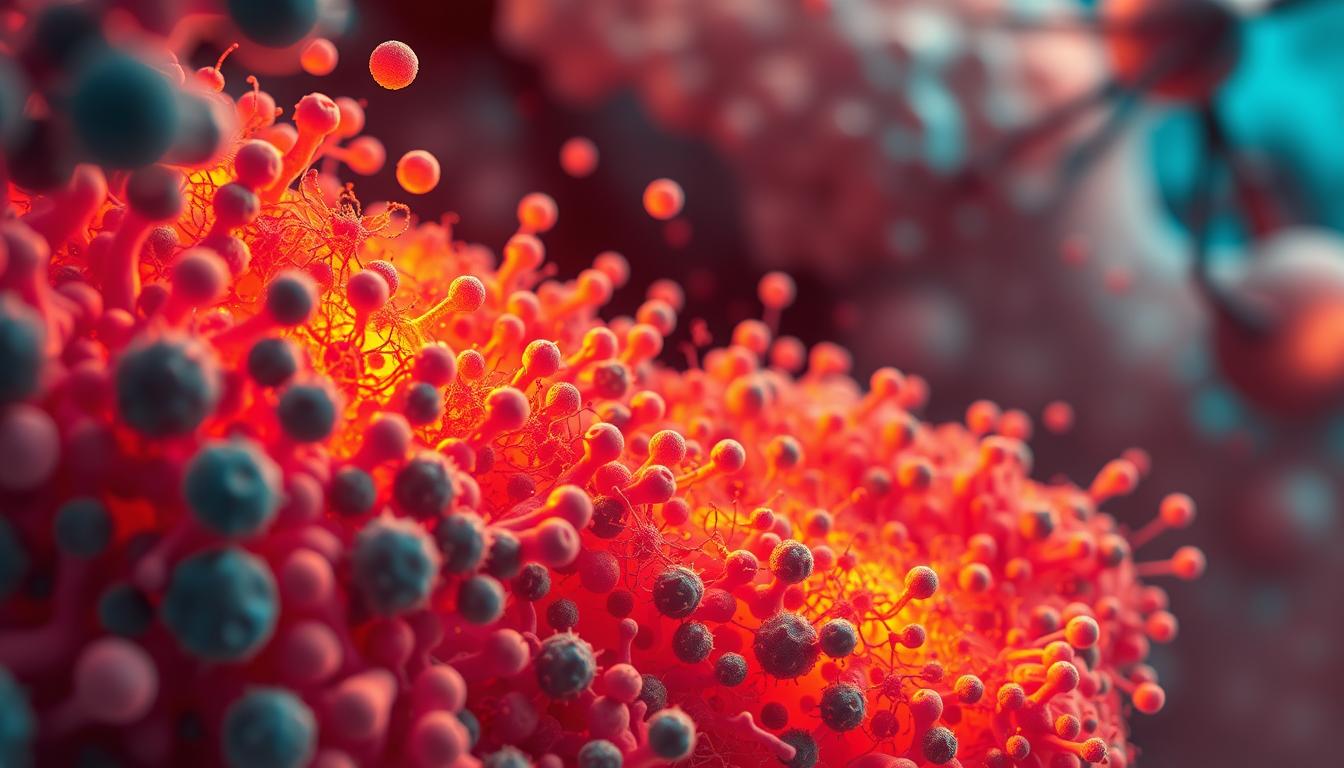
Have you ever thought about how tiny a single bacterial cell is? It’s incredibly small, usually around one picogram (10^-12 g). This size is hard to wrap your head around.
Looking into bacterial cell mass opens up a world of tiny complexity. The mass of a bacterial cell changes a lot. It depends on the type of bacteria, how it grows, and its environment. Scientists use special tools to measure this mass very accurately. This helps us learn more about tiny life forms.
The mass of a bacterial cell is very important in studying microbes. Scientists can measure the dry weight of bacterial cells pretty accurately. They use advanced tools that can even detect masses as small as 0.7 femtograms (10^-15 g).
Water is a big part of a bacterial cell’s mass. It makes up 60% to 80% of the cell’s total weight. This shows how delicate and balanced tiny life forms are.
Key Takeaways
- Bacterial cell mass is typically around one picogram (10^-12 g)
- Water content contributes 60-80% to bacterial cell mass
- Advanced measurement techniques can detect masses as low as 0.7 femtograms
- Cell mass varies by species, growth conditions, and environment
- Precise mass measurement provides critical insights into bacterial biology
Understanding Bacterial Cells
Bacterial cells are tiny but very important in our world. They are single-celled organisms without a nucleus. Their size and shape affect how much they weigh and how much mass they have.
Bacteria vary in shape and size. This affects their features. The main parts are:
- Cell membrane
- Cell wall
- Cytoplasm
- Genetic material
Structural Composition of Bacterial Cells
The mass of a bacterial cell depends on several key parts. For example, Escherichia coli weighs about 1 picogram. Its dry part makes up about 23% of that.
| Cell Component | Percentage of Total Mass |
|---|---|
| Proteins | 55% |
| RNA | 20% |
| DNA | 2-3% |
| Lipids | 10% |
Types of Bacterial Cells
Bacterial cells come in different shapes. They are mainly:
- Bacilli (rod-shaped)
- Cocci (spherical)
- Spirochetes (spiral-shaped)
Knowing about these shapes helps scientists understand their biology. It shows how their weight and mass are important.
Importance of Cell Mass in Microbiology
Understanding prokaryotic cell mass is key in microbiology. Bacterial cells have unique traits that make studying their mass vital. They make up about 14% of global biomass, showing their big role in nature.
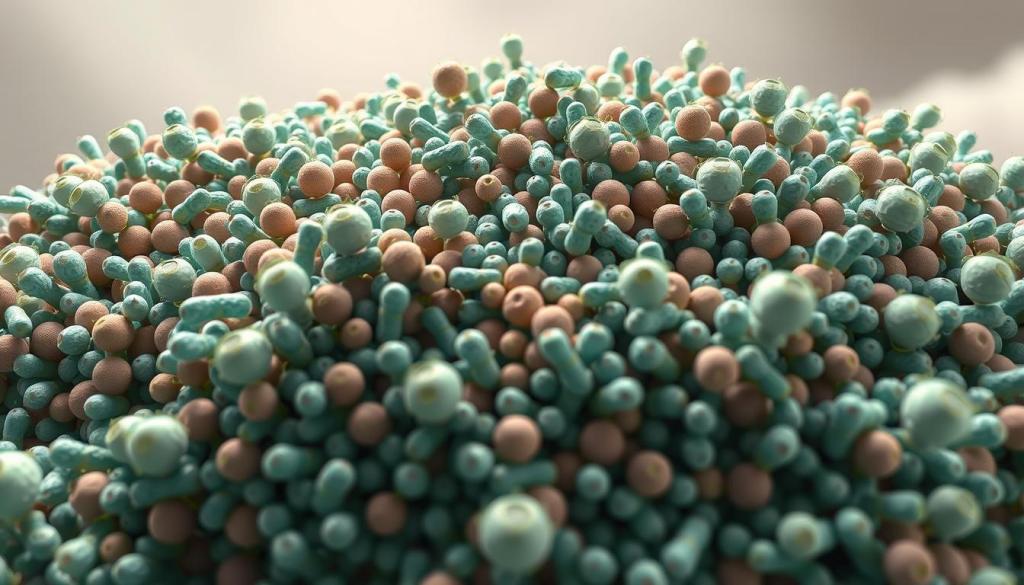
Cell mass and function are closely linked. This gives scientists deep insights into how microbes work. Their small size helps them work more efficiently.
Role of Mass in Cell Function
Prokaryotic cell mass is vital for what cells can do. It affects:
- Nutrient absorption efficiency
- Metabolic rate regulation
- Energy conversion processes
- Cellular reproduction mechanisms
Mass and Bacterial Growth
Bacteria grow by making more cells, not by getting bigger. They split in two, showing how cell mass and growth are linked.
The growth curve shows how bacteria numbers change in four phases:
- Lag Phase: Getting ready and making enzymes
- Log/Exponential Phase: Fast cell division
- Stationary Phase: Growth and death balance
- Death Phase: Fewer living cells
These phases show how cell mass affects bacterial growth and survival.
Measuring the Mass of Bacterial Cells
Understanding how to measure bacterial cell mass is key in microbial research. Scientists have come up with different ways to do this. Each method has its own strengths and weaknesses.
Researchers use many methods to figure out microbial biomass. They choose based on what they want to find out, what tools they have, and the sample’s nature.
Key Measurement Techniques
- Spectrophotometry: A fast and cost-effective method
- Flow cytometry: Provides detailed cellular analysis
- Microscopic examination: Offers precise visual confirmation
- Buoyant mass measurements: Enables high-precision tracking
Factors Influencing Mass Measurements
Several important factors affect how accurate mass measurements are:
- Sample preparation techniques
- Growth environmental conditions
- Bacterial strain characteristics
- Measurement instrument calibration
Spectrophotometry stands out as a strong method. It can measure tiny samples and detect bacteria at 10^7 cells/ml. This makes it a reliable tool for measuring cell mass.
Advanced Measurement Strategies
New tools like the Archimedes system can measure particle buoyant mass very precisely. It can reach a resolution of 1 femtogram. These advanced tools help researchers track bacterial growth with great accuracy.
Average Mass of Common Bacterial Species
Bacterial cell mass is key to understanding microbes. Scientists have found precise ways to measure it. This has given us new insights into the tiny world of bacteria.

The mass of bacterial cells changes a lot between species. Scientists have found specific mass ranges. These help us understand these tiny organisms better.
Escherichia coli: A Typical Bacterial Model
Escherichia coli is a great example of measuring microbe mass. This common bacterium has some key features:
- Average cell mass: About 1 picogram
- Approximate cell count: 1,600,000,000 cells per gram
- Cell size: Usually 0.5-2.0 micrometers long
Staphylococcus aureus: Another Fascinating Species
Staphylococcus aureus has its own special cell weight features:
- Average cell mass: About 0.5-1.5 picograms
- It has a round shape
- Its mass can change based on how it grows
Scientists keep studying the world of bacterial cell mass. They see how these tiny beings are important in many biological processes.
Variability in Bacterial Mass
Bacterial cell mass changes due to many factors. These include the environment and the cell’s genes. To understand bacterial cell mass, we must look at how these factors interact.
The mass of a bacterial cell can change a lot. Scientists have seen big differences in mass in different places.
Environmental Influences on Bacterial Cell Mass
Things around a bacterial cell affect its mass. Important factors include:
- Temperature changes
- How much food is available
- The pH level
- The pressure from outside
Genetic Factors Determining Cell Mass
Each type of bacteria has its own mass. Studies show that genes play a big part in how big a cell is.
Looking at bacterial cell mass gives us interesting facts:
- Dry weight can be from 83 to 1,172 femtograms
- Volume can range from 0.1 to 3.5 cubic micrometers
- About 40-50% of cells weigh less than 20 femtograms dry
The relationship between dry weight and volume is complex. It follows an equation: DW = 435 · V^0.86. This shows that smaller bacteria have a higher dry weight to volume ratio than bigger ones.
Relationship Between Bacterial Mass and Metabolism
Bacterial cells show a strong link between their size and how they process nutrients. This connection gives us a peek into how they survive and grow.
The size of bacterial cells affects their metabolism. Their small size and big surface area help them process nutrients better. This leads to unique advantages in how they handle nutrients.
- Rapid nutrient uptake across cell membranes
- Efficient intracellular nutrient distribution
- Quick metabolic response to environmental changes
Impact on Metabolic Rates
The amount of nutrients affects how fast bacterial cells grow and their metabolic rate. Nutrient-rich environments make cells grow faster, leading to quicker doubling times and bigger sizes. On the other hand, not enough nutrients slows growth and makes cells smaller.
Energy Requirements
The size of bacterial cells is key in determining how much energy they need. Fast-growing cells can start many chromosome replication rounds at once. This shows how complex energy use is in bacterial cells.
Important metabolic traits include:
- Replication starts based on carbon availability
- Growth rate affects metabolic machinery
- Amino acid availability impacts replication processes
Studying the relationship between bacterial cell size and metabolism is vital. It helps researchers in microbiology, biomedical science, and biotechnology.
Bacterial Cell Mass and Antimicrobial Resistance
Exploring the link between prokaryotic cell mass and antimicrobial resistance is key. It shows how bacteria fight off treatments. Microbiology studies have found interesting ways bacteria handle antibiotics.
How Cell Mass Influences Antibiotic Effectiveness
The size of bacterial cells affects how well antibiotics work. Studies show that how cells look and act changes how they react to drugs. Important points include:
- Changes in cell surface-to-volume ratio affect drug penetration
- Morphological variations influence antibiotic uptake mechanisms
- Cell size directly impacts resistance potential
Implications for Treatment Strategies
Microbiology studies show complex links between cell mass and antibiotic success. Different antibiotics cause different changes in cell shape:
| Antibiotic Type | Cell Volume Impact | Surface-to-Volume Ratio |
|---|---|---|
| DNA/RNA Targeting | Increases Cell Volume | Decreases Ratio |
| Membrane Targeting | Reduces Cell Size | Increases Ratio |
| Ribosome Targeting | Increases Cell Volume | Decreases Ratio |
This knowledge is crucial for making better antibiotics. Scientists can now create treatments that work better against bacteria.
Understanding how cell size affects resistance helps scientists fight bacterial infections better.
Applications of Knowledge on Bacterial Mass
Understanding microbial biomass has changed many fields. It helps scientists find new ways to solve problems in different areas.
Discoveries about bacterial cell mass are more than just interesting facts. They are changing how we approach important areas:
Biomedical Research Breakthroughs
Scientists use this knowledge to create new diagnostic tools and treatments. Some key uses are:
- Designing targeted drug delivery systems
- Creating precision medical interventions
- Understanding disease progression at the cellular level
Industrial Biotechnology Innovations
Knowledge about microbial biomass is leading to big improvements in industrial processes. Researchers and engineers are working on:
- Fermentation techniques
- Bioproduct manufacturing
- Sustainable biological production methods
The details of bacterial cell mass are opening up new possibilities in research and industry. They promise exciting new ways to understand biological systems.
Future Research Directions
The study of microorganism cell weight is growing, offering new ways to understand bacteria at the cellular level. New technologies are changing how we measure microbe mass, opening up new areas for research.
New research is focusing on several key areas. These areas promise to change how we see bacterial cell characteristics:
- Advanced microscopy techniques for precise cell mass measurements
- Development of innovative biosensors
- High-throughput computational analysis methods
- Integration of machine learning algorithms in cell mass studies
Technological Advancements in Measurement
Deep learning algorithms, like U-Net, are making cell segmentation much better. Automated software tools now help researchers get accurate cell-cycle parameters.
Potential Medical Applications
Advanced microorganism cell weight research has huge medical potential. Researchers hope to create personalized treatments based on detailed bacterial mass profiles. This could change how we diagnose and treat infectious diseases.
Key research areas include:
- Rapid diagnostic tool development
- Personalized antimicrobial treatments
- Enhanced understanding of bacterial growth mechanisms
- Improved tracking of cellular metabolic processes
As technology advances, the study of bacterial cell mass is revealing more about microbes. This research promises to bring new insights into microbial behavior and medical treatments.
Summary and Conclusion
Exploring the mass of a bacterial cell opens a world of tiny wonders. These tiny organisms are key in scientific studies. A typical bacterial cell weighs about one picogram, with its wet mass being around 1 pg and dry mass about 0.2 pg. Despite their small size, they show amazing complexity.
Studying bacterial cell mass gives us insights into how they work and interact. Bacterial cells are much smaller than human cells, with a diameter of just 1 μm compared to human cells’ 10 μm. This size difference affects their ability to process things, making them more efficient.
Key Takeaways
Research on bacterial cell mass is important for many fields. It helps scientists understand how cells work and develop new ways to measure things. It also opens doors for new uses in medicine and biotechnology.
Importance of Understanding Bacterial Mass
Studying bacterial cell mass brings new insights into microbiology. It allows scientists to make more precise treatments and improve industrial processes. This study shows how understanding the smallest parts of life can lead to big discoveries.
References and further readings:
1.Milo, R., Jorgensen, P., Moran, U., Weber, G., & Springer, M. (2010). Bionumbers—the database of key numbers in molecular and cell biology. Nucleic Acids Research, 38(Database issue), D750–D753.
https://academic.oup.com/nar/article/38/suppl_1/D750/3112244?login=false2.Kubitschek, H. E. (1990). Cell volume increase in Escherichia coli after shifts to richer media. Journal of Bacteriology, 172(1), 94–101.
https://journals.asm.org/doi/10.1128/jb.172.1.94-101.19903.Basan, M., Hui, S., Okano, H., et al. (2015). Overflow metabolism in Escherichia coli results from efficient proteome allocation. Nature, 528(7580), 99–104.
https://www.nature.com/articles/nature15765
4.Volkmer, B., & Heinemann, M. (2011). Condition-dependent cell volume and concentration of Escherichia coli to facilitate data conversion for systems biology modeling. PLoS ONE, 6(7), e23126.
https://journals.plos.org/plosone/article?id=10.1371/journal.pone.0023126
FAQ
What is the typical mass of a bacterial cell?
The mass of bacterial cells can vary. For common bacteria like Escherichia coli, it’s usually between 1 to 2 picograms per cell. Some bacteria are smaller, with masses around 0.1 picograms. Others can be larger, up to 5 picograms per cell.
How do researchers measure bacterial cell mass?
Scientists use several methods to measure bacterial cell mass. They can directly measure it with tools like microscopy and flow cytometry. Or they can use indirect methods like spectrophotometry and dry weight measurements. Each method has its own strengths and weaknesses, so researchers often use a combination to get accurate results.
Why is understanding bacterial cell mass important?
Knowing the mass of bacterial cells is key for many reasons. It helps us understand how cells work and grow. It’s also important for making medical tests, studying biotechnology, and fighting antibiotic resistance. Plus, it helps in industrial applications.
Do environmental conditions affect bacterial cell mass?
Yes, environmental factors greatly impact bacterial cell mass. Things like temperature, nutrients, and pH can change cell size and mass. Bacteria adjust their size and mass to survive and grow better in different conditions.
How does bacterial cell mass relate to antimicrobial resistance?
Cell mass plays a role in how bacteria resist antibiotics. Larger or smaller cells may have different drug penetration and metabolic rates. This affects their ability to resist antibiotics and other antimicrobial agents.
Can bacterial cell mass be used in medical research?
Absolutely. Knowing about bacterial cell mass is very useful in medical research. It helps in making diagnostic tools, understanding diseases, designing drugs, and creating targeted treatments. It gives us important insights into how bacteria behave and interact in our bodies.
Do different bacterial species have different cell masses?
Yes, different bacterial species have different cell masses. For example, Escherichia coli and Staphylococcus aureus have different masses. These differences come from genetic factors, cell structure, and environmental adaptations unique to each species.
What future developments are expected in bacterial cell mass research?
New research is focused on improving microscopy, creating more precise biosensors, and finding better measurement methods. The goal is to get more accurate mass profiles. This could lead to personalized medical treatments and a better understanding of bacterial behavior.
Leo Bios
Hello, I’m Leo Bios. As an assistant lecturer, I teach cellular and
molecular biology to undergraduates at a regional US Midwest university. I started as a research tech in
a biotech startup over a decade ago, working on molecular diagnostic tools. This practical experience
fuels my teaching and writing, keeping me engaged in biology’s evolution.




Leave a Comment
Your email address will not be published. Required fields are marked *