



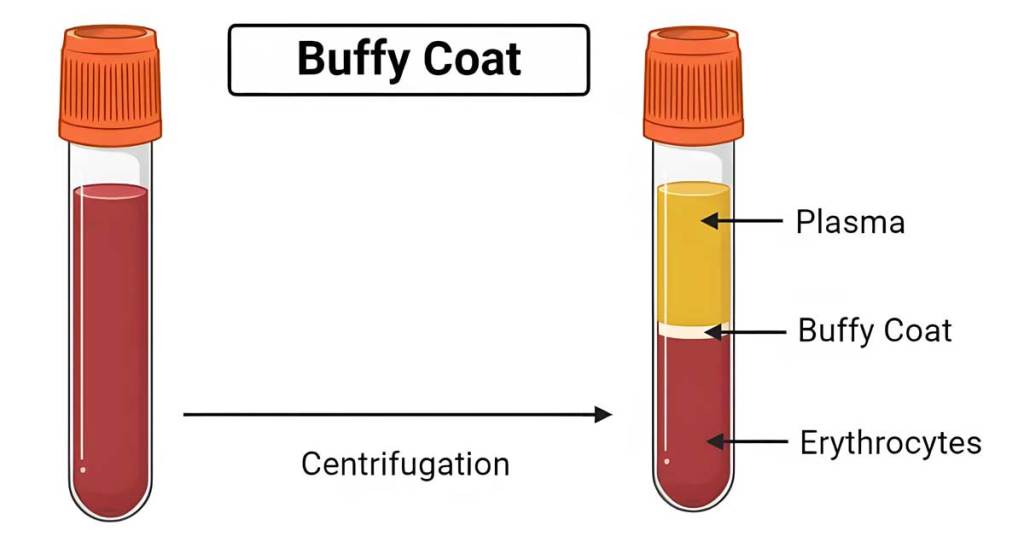
Understanding what’s in the buffy coat is key for many medical and research uses. This layer, made when whole blood is spun, holds important parts. It’s packed with cells like leukocytes and platelets, vital for tests, studies, and treatments.
The buffy coat is just a small part of whole blood, making up less than 1%. But it’s rich in white blood cells, about 10-20 times more than in whole blood. Its yellowish to whitish color comes from lots of immune cells and platelets. Knowing what’s in the buffy coat helps us learn about diseases and improve medical care, like in malaria detection.
Key Takeaways
- The buffy coat mainly contains leukocytes and platelets.
- It is formed through centrifugation of whole blood.
- Buffy coat contents are crucial for diagnostics and therapeutic research.
- This layer is significantly more concentrated in immune cells.
- Historical research has highlighted its role in diseases like malaria.
Cellular Composition and Function within Buffy Coat
The buffy coat is key to understanding how our bodies fight off infections and heal. It’s filled with different types of cells, like white blood cells and platelets. Each plays a big role in keeping us healthy.
Leukocytes: Neutrophils in Acute Inflammatory Responses (e.g., Appendicitis Case Study)
Leukocytes, especially neutrophils, are found in the buffy coat. They are vital in fighting off infections. In cases like appendicitis, they quickly move to the infected area to help fight the infection.
Lymphocytes: Role in Adaptive Immunity (HIV Infection as an Example)
Lymphocytes are another important part of the buffy coat. They help our body adapt to specific infections, like HIV. How well lymphocytes work is crucial in controlling the virus.
Monocytes: Macrophage Differentiation in Wound Healing (Burn Wound Scenario)
Monocytes in the buffy coat are vital for healing wounds. After a burn, they turn into macrophages. These cells help clean up the area and start the healing process.
Platelets: Thrombosis Formation in Coronary Artery Disease (Myocardial Infarction Case)
Platelets in the buffy coat are important for stopping bleeding. But, in diseases like coronary artery disease, they can cause clots. This can lead to heart attacks. Understanding this helps doctors manage heart disease better.
| Cell Type | Function | Clinical Relevance |
|---|---|---|
| Neutrophils | Respond to infections | Acute inflammation example: Appendicitis |
| Lymphocytes | Adaptive immune response | Impact on HIV infection management |
| Monocytes | Differentiation into macrophages | Critical for wound healing processes |
| Platelets | Clot formation | Thrombosis in coronary artery disease |
Isolation and Analysis Techniques of Buffy Coat
To understand the buffy coat, scientists use different methods. These techniques help separate and study the important cells in this layer.
Density Gradient Centrifugation: Application in Clinical Laboratories
Density gradient centrifugation is key in labs. It separates blood parts, focusing on mononuclear cells. This makes it easier to study the analysis of buffy coat contents for many research needs.
This method helps isolate cells well. It lets scientists deeply examine the buffy coat’s markers.
Flow Cytometry for Buffy Coat Cell Phenotyping (Leukemia Diagnosis Example)
Flow cytometry is a top tool for buffy coat cell study. It helps identify and understand leukocytes. This is very useful in medical tests.
In leukemia cases, it spots disease markers. This helps doctors make better treatment plans. It’s a big help in analysis of buffy coat contents.
| Technique | Application | Benefits |
|---|---|---|
| Density Gradient Centrifugation | Separates blood components | Concentration of mononuclear cells for analysis |
| Flow Cytometry | Cell phenotyping | Identification of leukemia markers |
For more on buffy coat isolation and analysis, check out this resource.
Buffy Coat in Diagnostic Biology
The buffy coat is very important for diagnosing diseases. It helps in understanding hematological disorders and infectious diseases. The information it provides is key to treating patients effectively.
Hematological Disorders Detection
Using buffy coat samples is crucial for diagnosing blood-related diseases. It helps identify different types of leukemia. This allows doctors to create specific treatment plans for each patient.
This targeted approach improves patient care. It makes treatment more effective by matching it to the patient’s needs.
Infectious Disease Diagnosis
Buffy coat analysis is also vital for diagnosing infections. For example, it helps detect malaria parasites more accurately than old methods. This quick and precise detection is crucial for starting treatment right away.
buffy-coat
Buffy Coat in Therapeutic Biology
The buffy coat is key in improving healthcare, especially in stem cell and immunotherapy. Scientists are working hard to find important parts in the buffy coat. These parts can greatly improve how we treat diseases.
Stem Cell Therapy: Harnessing Buffy Coat-Derived Stem Cells (e.g., for Aplastic Anemia Treatment)
Stem cell therapy uses cells from the buffy coat to treat aplastic anemia. These cells can help make new blood. This shows how important the buffy coat is for healing.
Immunotherapy: Manipulating Buffy Coat Immune Cells (CAR-T Cell Therapy for Lymphoma)
Immunotherapy, like CAR-T cell therapy, uses immune cells from the buffy coat to fight lymphoma. It targets and kills cancer cells. This shows how the buffy coat is crucial for making personalized cancer treatments.
Looking into the buffy coat helps make treatments better and opens up new research areas. For more on the buffy coat in therapy, check out this resource. You can also learn about isolating CD4+ T cells from the buffy coat here.
Buffy Coat in Translational Research
Translational research in buffy coat is key to improving our medical knowledge and treatments. The buffy coat is rich in biomarkers and helps test drug effectiveness.
Biomarker Discovery from Buffy Coat (Predicting Cardiovascular Disease Risk)
Studies using the buffy coat find biomarkers for heart disease risk. These findings could lead to better prevention and care for patients. By studying the buffy coat, researchers look for signs of heart health, helping to improve screenings.
Pre-Clinical Model Utilization of Buffy Coat Components (Drug Efficacy Testing in Animal Models)
The buffy coat’s parts are vital for testing drugs in animal models. This method speeds up the use of research in treatments. The buffy coat’s diverse cells, like leukocytes and platelets, give valuable data for drug development.
Using the buffy coat in research shows its value in moving lab findings to practical use. We’re dedicated to finding more ways the buffy coat can help in medical research. For more on its uses, see this detailed study.
Buffy Coat and Microbiome Interactions
Exploring how the buffy coat interacts with the microbiome is a big deal in medicine. Recent studies highlight the importance of these connections. They show how gut and skin microbes affect buffy coat cells.
This knowledge helps us understand health issues better. It shows how complex health problems can be.
Gut-Blood Axis: Impact of Gut Microbiota on Buffy Coat Cell Function
Research has looked closely at how gut microbes affect buffy coat cells. This is especially true for inflammatory bowel disease (IBD). It’s found that gut microbes can change how immune cells work in the buffy coat.
This connection shows how gut health affects buffy coat cells. It’s a key area of study.
Skin Microbiome – Blood Communication
New studies are uncovering how skin microbes talk to blood. This is especially true for atopic dermatitis. These findings show how skin health is connected to the immune system.
Learning more about these links could lead to new treatments. It could help us tackle complex health issues in new ways.
References and further readings:
1.Koshy, L., Madhuma, M., Vyshak, Y., et al. (2024).
Peripheral Blood Mononuclear Cells Isolation from Whole Blood of Heart Failure Patients using Density-Gradient Centrifugation.
Heart Failure Journal of India, 9(3).
https://journals.lww.com/hfji/fulltext/2024/09000/peripheral_blood_mononuclear_cells_isolation_from.3.aspx
2.Weiss, R., Gerdes, W., Berthold, R., Sack, U., Koehl, U. (2021).
Comparison of three CD3-specific separation methods leading to labeled and label-free T cells.
Cells, 10(11), 2824.
https://www.mdpi.com/2073-4409/10/11/2824
3.Xhaxho, S., Chen-Wichmann, L., Kreissig, S., et al. (2024).
Efficient chimeric antigen receptor T-cell generation starting with leukoreduction system chambers of thrombocyte apheresis sets.
Transfusion Medicine and Hemotherapy, 51(2), 110–121.
https://karger.com/tmh/article/51/2/110/861829
4.Jahan, F., Penna, L., Luostarinen, A., et al. (2024).
Automated and closed clinical-grade manufacturing protocol produces potent NK cells against neuroblastoma cells and AML blasts.
Scientific Reports,
https://www.nature.com/articles/s41598-024-76791-2
FAQ
What is the buffy coat?
The buffy coat is a layer in blood after it’s spun down. It’s made of white blood cells, platelets, and a bit of other cells. It’s found between the plasma and red blood cells and has more immune cells than regular blood.
What components are found in the buffy coat?
The buffy coat is packed with immune cells and platelets. It’s a small part of blood but has lots of immune cells.
What is the significance of examining the buffy coat?
The buffy coat is key for diagnosing and research. It’s rich in immune cells and platelets. This helps find blood disorders, diagnose infections, and aid in treatments like stem cell therapy.
How are the contents of the buffy coat analyzed?
Scientists use special methods like density gradient centrifugation and flow cytometry. These help separate and study the cells in the buffy coat. This is important for medical tests and research.
What role do leukocytes in the buffy coat play in health and disease?
Leukocytes, like neutrophils and lymphocytes, are vital for fighting infections. They help with inflammation and are key in the immune system. They’re especially important in fighting off infections and in diseases like HIV.
What therapeutic applications utilize buffy coat components?
The buffy coat is used in stem cell therapy for diseases like aplastic anemia. It’s also used in immunotherapy for cancer, like CAR-T cell therapy for lymphoma.
How does the buffy coat contribute to translational research?
The buffy coat helps find biomarkers for diseases like heart disease. It’s also used to test new drugs in animal studies. This helps bring research to the clinic.
What is the relationship between the buffy coat and the microbiome?
Studies show the buffy coat and microbiome interact, especially through the gut-blood axis. This affects our immune system and health. It’s linked to diseases like inflammatory bowel disease and atopic dermatitis.
Leo Bios
Hello, I’m Leo Bios. As an assistant lecturer, I teach cellular and
molecular biology to undergraduates at a regional US Midwest university. I started as a research tech in
a biotech startup over a decade ago, working on molecular diagnostic tools. This practical experience
fuels my teaching and writing, keeping me engaged in biology’s evolution.




Leave a Comment
Your email address will not be published. Required fields are marked *