


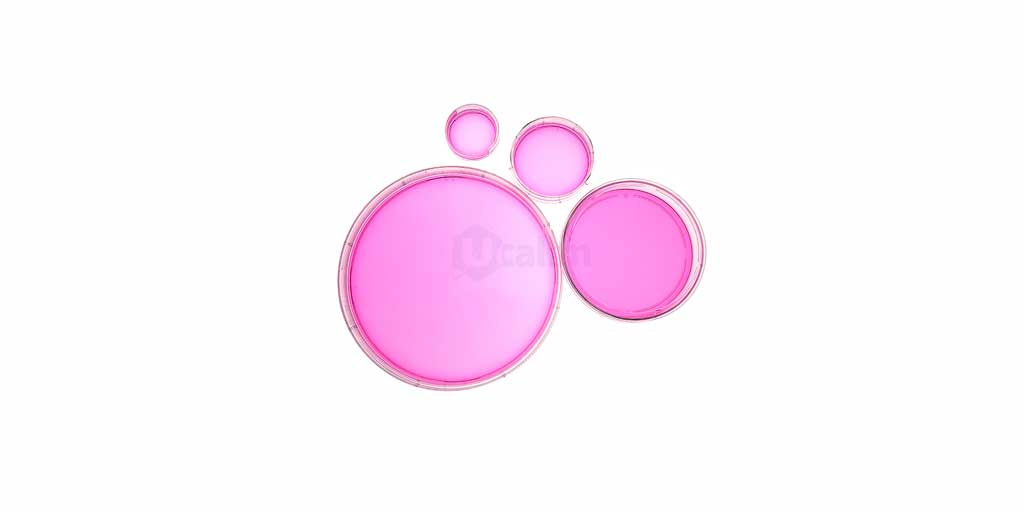
Cell Culture is a fundamental research technique in life sciences and has become an important means of modern biomedical research. Cell culture Dish are commonly used and important laboratory consumables in cell culture experiments. Choosing the appropriate cell culture Dish has a crucial impact on the growth of cells and the accuracy of experimental results.Cell culture dishes are classified by diameter into 35mm, 60mm, 100mm and 150mm. There are TC treatment and non-TC treatment surface treatment methods. It is divided into Stackable and Easy Grip style according to the style design. So, how to choose a suitable cell culture dish for the experiment from so many specifications?
Selection of Diameter
Cell culture dishes are available in three specifications: 35mm, 60mm and 100mm. The larger the diameter, the greater the surface area for cell growth and the more cells can be cultured. 35 mm petri dishes suitable for small cell culture experiment, 60 mm petri dishes suitable for medium-sized cell culture experiments, 100 mm petri dishes suitable for large-scale cell culture experiments. The selection of the appropriate specification also needs to take into account the type of cells to be cultured. For instance, fibroblasts and hepatocytes usually choose larger-sized culture dishes (such as 60mm or 100mm), while for cells that require low-density cell growth (such as neuron cells and lymphocytes), smaller-sized culture dishes (35mm) are typically selected.The number of cells that can be cultured in culture dishes of different culture areas varies (see Table 1)
Cell Cultrue Dish | Base Area(cm²) | Add the amount of culture medium(mL) | Available cell quantity |
35 mm Cell Cultrue Dish | 8 | 3 | 2.0×10⁶ |
60 mm Cell Cultrue Dish | 21 | 5 | 5.2×10⁶ |
90 mm Cell Cultrue Dish | 49 | 10 | 12.2×10⁶ |
100 mm Cell Cultrue Dish | 55 | 10 | 13.7×10⁶ |
Table 1 General Information of Different Types of Cell Culture Dish
Selection of Surface Treatment
The main treatment methods for cell culture dishes include TC treatment and non-TC treatment. Which surface treatment method to choose mainly depends on whether the cultured cells are adherent cells or conventional cells. The raw material generally used for cell culture plates is polystyrene, which is hydrophobic. For adherent cells, they need to adhere to the hydrophilic surface and grow laterally. Cell culture dishes treated with TC, after surface modification, are more suitable for adherent cell culture.
Selection of Dish Style
Cell Culture dishes are available in the style with Easy Grip, which enables laboratory personnel to grasp the dishes more stably and reduces the risk of experimental contamination. Meanwhile, when stacking, the ring-shaped protrusions can be closely combined with the bottom to ensure the stability of the stacking.
Order Information
Catalog Number | Product Name | Diameter | Qty/Pk | Qty/Cs |
35mm | 10/Pk | 50/Cs | ||
60mm | 10/Pk | 50/Cs | ||
100mm | 10/Pk | 30/Cs | ||
100mm | 10/Pk | 30/Cs | ||
150mm | 5/Pk | 12/Cs | ||
150mm | 5/Pk | 12/Cs | ||
35mm | 10/Pk | 50/Cs | ||
60mm | 10/Pk | 50/Cs | ||
100mm | 10/Pk | 30/Cs | ||
100mm | 10/Pk | 30/Cs | ||
150mm | 5/Pk | 12/Cs | ||
150mm | 5/Pk | 12/Cs |




Leave a Comment
Your email address will not be published. Required fields are marked *