



A serological pipette is a precision instrument used in laboratories for accurately measuring and transferring liquid volumes. It is a crucial tool in scientific research and clinical settings, allowing professionals to handle small volumes with high accuracy.
The primary function of a serological pipette is to deliver or aspirate specified volumes of liquid, typically ranging from less than 1 milliliter to 50 milliliters. Understanding the function of serological pipettes is essential for anyone working in biological sciences, clinical diagnostics, or pharmaceutical research.
These specialized instruments have evolved from traditional glass models to modern plastic versions, maintaining their critical role in laboratory workflows. By providing accurate measurements, serological pipettes play a vital role in ensuring experimental accuracy and reproducibility.
Key Takeaways
- Serological pipettes are essential laboratory instruments for precise measurement and transfer of liquids.
- They allow laboratory professionals to handle small volumes with high accuracy.
- Understanding serological pipette function is crucial for biological sciences, clinical diagnostics, and pharmaceutical research.
- Serological pipettes have evolved from glass to modern plastic versions.
- They play a vital role in ensuring experimental accuracy and reproducibility.
Understanding Serological Pipettes
Understanding serological pipettes is essential for laboratory professionals who require precise liquid handling. We will delve into the definition, basic components, and historical development of these crucial laboratory instruments.
Definition and Basic Components
A serological pipette is a specialized laboratory instrument used for accurate measurement and transfer of liquids. The basic components include a graduated tube body, volume markings, a tapered tip for liquid delivery, and a wider opening at the top for connection to pipette controllers or bulbs.
Serological pipettes are designed to handle liquids ranging from less than 1 milliliter to 50 milliliters, making them versatile tools in laboratory settings.
Historical Development: From Glass to Plastic
Originally made of glass, serological pipettes have evolved to be manufactured from plastic, specifically medical-grade polystyrene. This transition has brought several advantages, including reduced costs, improved safety, and minimized risk of cross-contamination.
The use of disposable plastic pipettes has become widespread in laboratories, replacing the traditional glass serological pipette
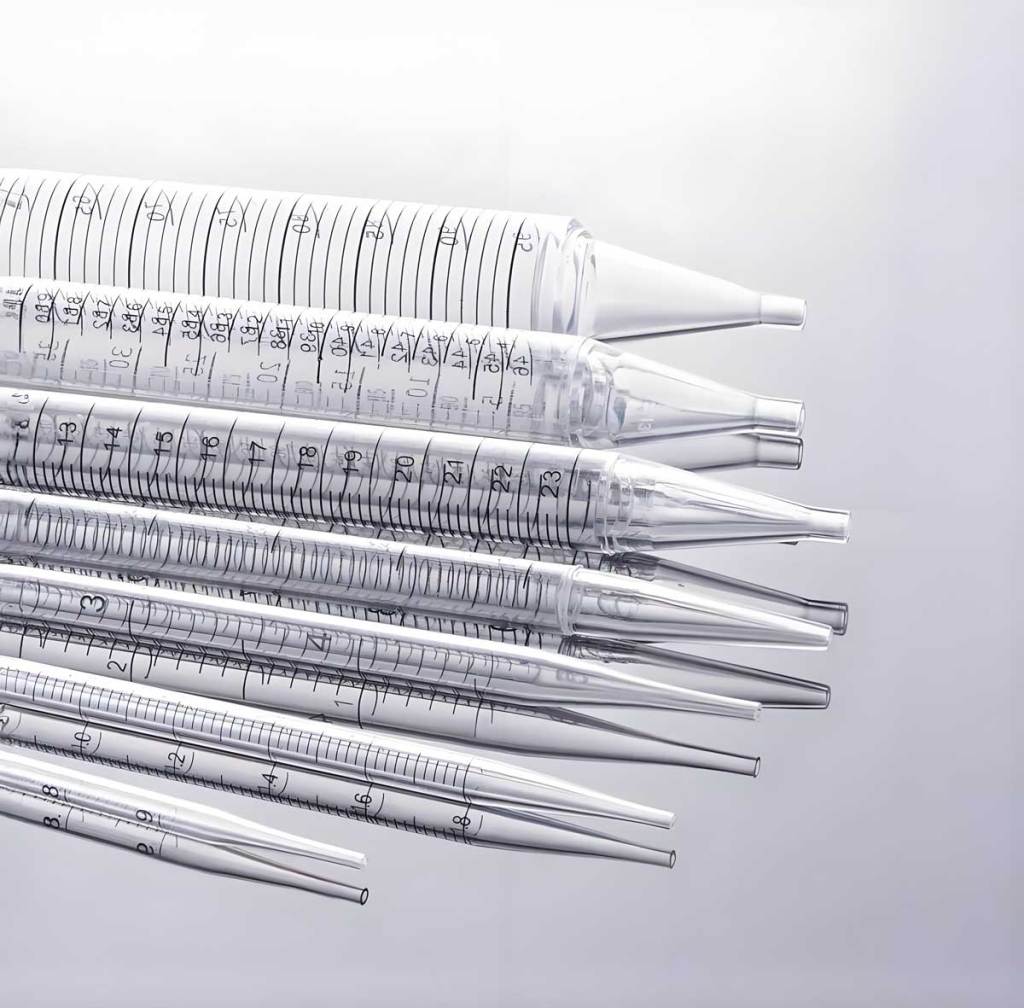
Serological pipette types
The Primary Function of Serological Pipettes
The primary function of serological pipettes is to enable laboratory professionals to handle specific volumes of liquids with high accuracy. These specialized instruments are designed to provide precise measurements and transfers of liquids in laboratory settings.
Precise Measurement and Transfer of Liquids
Serological pipettes are engineered to accurately measure and transfer liquids, particularly volumes ranging from a few milliliters to tens of milliliters. They feature graduated markings along their length, enabling laboratory professionals to measure exact volumes. The pipette is typically used in conjunction with a pipet-aid or pipette controller, which aids in the aspiration and dispensing of liquids.
When used correctly, serological pipettes provide high accuracy and reproducibility in laboratory applications. This is crucial in sensitive experimental procedures where maintaining sterility and preventing cross-contamination is essential.
Volume Range Capabilities
Serological pipettes offer a range of volume capabilities, typically spanning from 1ml to 50ml. Common sizes include 1ml, 2ml, 5ml, 10ml, 25ml, and 50ml, accommodating different experimental needs. The choice of pipette size depends on the specific application, with smaller volume pipettes providing greater precision for exact measurements.
| Pipette Size (ml) | Precision Level | Application |
|---|---|---|
| 1-5 | High | Exact measurements |
| 10-50 | Medium to High | Efficient transfer of larger quantities |
Understanding the volume range capabilities of different serological pipettes helps laboratory professionals select the appropriate tool for specific applications, optimizing both accuracy and efficiency in experimental procedures.
Types of Serological Pipettes
In laboratory settings, serological pipettes are available in multiple types, each serving a unique purpose in experiments and tests. We will explore the different categories of serological pipettes and their specific applications.
Aspirating Pipettes
Aspirating pipettes are designed for mixing fluids during experiments or laboratory tests. These single-use pipettes are gamma-sterilized and non-pyrogenic, minimizing the risk of contamination. They are ideal for applications where preventing contamination is critical.
Open-ended Serological Pipettes
Open-ended serological pipettes feature fiber filter plugs that minimize contamination while allowing for the measurement and transfer of highly viscous liquids. They are available in various sizes, including 1 mL, 2 mL, 5 mL, and 10 mL, with some manufacturers offering larger capacities.
Bacteriological Pipettes
Bacteriological pipettes are specialized for microbiological applications, particularly for transferring and mixing biological samples. They typically come in smaller sizes, such as 1.1 mL and 2.2 mL, to accommodate precise measurements needed in microbiological testing.
| Type of Pipette | Application | Common Sizes |
|---|---|---|
| Aspirating Pipettes | Mixing fluids during experiments | Various sizes |
| Open-ended Serological Pipettes | Measuring and transferring viscous liquids | 1 mL, 2 mL, 5 mL, 10 mL |
| Bacteriological Pipettes | Microbiological applications | 1.1 mL, 2.2 mL |

how to use a serological pipette
How to Use a Serological Pipette
Using a serological pipette effectively is crucial in laboratory settings for accurate liquid measurements. We will guide you through the proper handling techniques and step-by-step usage guide to ensure precise measurements.
Proper Handling Techniques
Proper handling of serological pipettes is essential for accurate measurements. You should always use a pipette controller or bulb to create the necessary vacuum for drawing liquids into the pipette. Hold the pipette vertically to maintain measurement accuracy and avoid touching the lower portion to prevent contamination.
Step-by-Step Usage Guide
To use a serological pipette, follow these steps:
- Select a pipette that matches the volume of liquid you need to transfer.
- Secure the pipette filler onto the top of the serological pipette.
- Draw a small amount of liquid into the pipette to remove any air bubbles.
- Adjust the liquid level to the exact volume needed.
| Step | Description |
|---|---|
| 1 | Select the appropriate serological pipette size. |
| 2 | Attach the pipette controller securely. |
| 3 | Draw liquid slightly above the desired volume mark. |
| 4 | Adjust to the exact volume needed. |
For more detailed information on draining a serological pipette, you can visit our guide on what to do when draining a serological.
Applications and Benefits in Laboratory Settings
Serological pipettes play a crucial role in laboratory settings, facilitating various applications with precision and ease. We utilize these pipettes for a range of tasks, from cell culture to reagent preparation.
Cell Culture and Microbiology Applications
In cell culture and microbiology, serological pipettes are essential for handling cell suspensions and bacterial cultures. They enable precise transfer and mixing, minimizing contamination risk.
Reagent Preparation and Transfer
For reagent preparation, serological pipettes offer the accuracy needed for creating solutions with exact concentrations. Their graduated markings allow for precise measurement of components.
Advantages Over Other Liquid Handling Tools
The advantages of serological pipettes include their wide volume range capabilities and compatibility with automated pipetting systems. Unlike fixed-volume pipettors, they allow for variable volume measurements.
| Feature | Serological Pipettes | Fixed-Volume Pipettors |
|---|---|---|
| Volume Range | Variable | Fixed |
| Accuracy | High | High |
| Compatibility with Automated Systems | Yes | Limited |
Conclusion
Ultimately, the use of serological pipettes is fundamental to achieving reliable experimental results in various laboratory disciplines. These pipettes remain indispensable instruments in modern laboratory settings, providing the precision and reliability needed for accurate liquid measurements ranging from 1 to 50 milliliters.
The evolution from traditional glass to modern polystyrene plastic serological pipettes has significantly improved laboratory safety and reduced contamination risks. By understanding the different types of pipettes and their specific applications, laboratory professionals can select the appropriate tools for their particular needs, ensuring accuracy in their work.
Proper handling techniques, including correct meniscus reading at level and careful tip positioning, are essential for maximizing the accuracy of measurements. As laboratory technology continues to advance, serological pipettes have adapted with improvements in materials and compatibility with automated systems.
References and further readings:
1.Sanders, E. R. (2012). Aseptic laboratory techniques: volume transfers with serological pipettes and micropipettors. Journal of Visualized Experiments (JoVE).
https://pmc.ncbi.nlm.nih.gov/articles/PMC3941987/2.Neilson, A. P. (2024). Laboratory Standard Operating Procedures. In Nielsen’s Food Analysis Laboratory Manual. Springer.
https://link.springer.com/chapter/10.1007/978-3-031-44970-3_13.Schauwers, W. (2019). The Veterinary Laboratory and Field Manual (3rd ed.).
https://books.google.co.jp/books?id=_iESEAAAQBAJ&pg=PT79&redir_esc=y#v=onepage&q&f=false
FAQ
What is the primary use of a serological pipette in laboratory settings?
We use serological pipettes for precise measurement and transfer of liquids, such as reagents and cell cultures, in various laboratory applications.
How do I properly handle a serological pipette to avoid contamination?
You should handle the pipette by the top portion, avoiding contact with the tip, and ensure that the pipette is properly sterilized before use to prevent contamination.
What are the different types of pipettes available for laboratory use?
We offer various types, including aspirating pipettes, open-ended pipettes, and bacteriological pipettes, each designed for specific laboratory tasks and applications.
What is the typical volume range for serological pipettes?
Serological pipettes are available in various sizes, typically ranging from 1 to 100 milliliters, allowing for the transfer of different liquid volumes.
Can serological pipettes be used with both aqueous and non-aqueous solutions?
Yes, you can use our pipettes with a variety of solutions; however, it’s essential to ensure that the pipette material is compatible with the liquid being handled.
How do I ensure accurate measurements when using a serological pipette?
To achieve accurate measurements, you should follow proper handling techniques, use the correct pipette size for the volume being measured, and verify that the pipette is calibrated correctly.
What are the benefits of using plastic pipettes over glass pipettes?
Plastic pipettes, made from materials like polystyrene, offer advantages such as reduced risk of breakage, lower cost, and disposability, making them a convenient option for laboratory use.
Are filter tips necessary for all pipette applications?
Filter tips are recommended for applications where contamination is a concern, such as when handling cell cultures or sensitive reagents, to prevent cross-contamination and ensure sample integrity.
Leo Bios
Hello, I’m Leo Bios. As an assistant lecturer, I teach cellular and
molecular biology to undergraduates at a regional US Midwest university. I started as a research tech in
a biotech startup over a decade ago, working on molecular diagnostic tools. This practical experience
fuels my teaching and writing, keeping me engaged in biology’s evolution.




Leave a Comment
Your email address will not be published. Required fields are marked *