


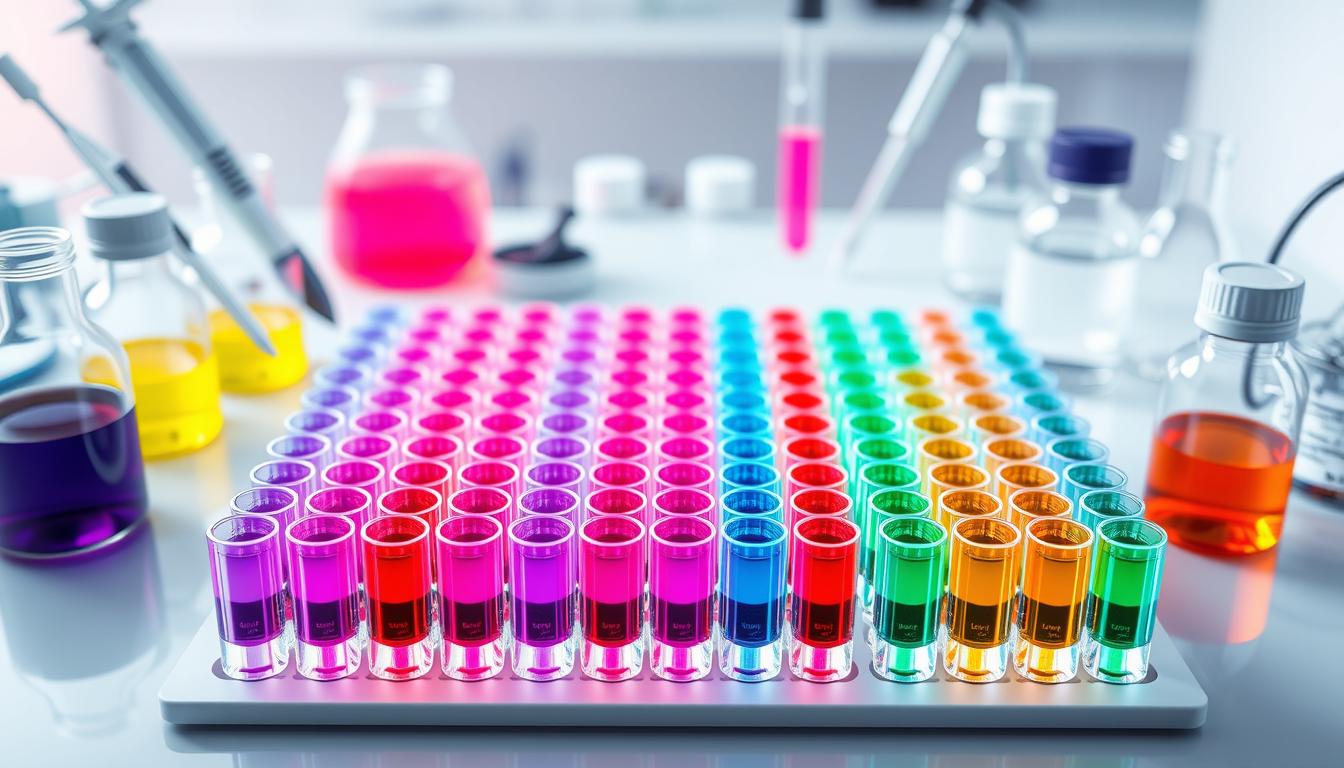
Ever wondered how scientists find tiny amounts of proteins with great accuracy? The 96 well ELISA is a key tool in this field. It’s a method that leads in high-throughput screening in biological research.
This technique is a strong diagnostic tool. It lets researchers test many samples at once. It’s a way to find and measure different biomolecules with high precision. This changes how scientists study molecules.
Scientists use these advanced methods to study complex biological interactions. They track disease markers and develop important diagnostic methods. The 96 well ELISA is a key tool in many scientific fields.
Key Takeaways
- 96 well ELISAs enable simultaneous detection of multiple biomolecules
- High-throughput screening allows rapid and precise molecular analysis
- Enzyme-linked immunosorbent assays provide exceptional sensitivity
- Versatile technique applicable across various scientific research domains
- Critical for understanding complex biological interactions
Introduction to 96 Well ELISAs
Enzyme-Linked Immunosorbent Assay (ELISA) is a key method in biological research. It has changed how scientists find and measure specific molecules. ELISAs are vital for many researchers in different fields.
ELISA works by using precise antibody-antigen interactions. This lets researchers accurately find and measure target molecules. A microplate reader can check 100-200 samples in a few hours. This makes ELISA a fast and effective way to diagnose.
What is an ELISA?
An ELISA is a sensitive method that uses enzyme-linked antibodies to find proteins or molecules. It involves several steps:
- Capturing target molecules on a special surface
- Binding specific antibodies to the captured molecules
- Using enzyme-linked secondary antibodies for detection
- Measuring enzymatic reactions using a microplate reader
Importance of ELISA in Biological Research
ELISAs are crucial in many research areas because of their accuracy and versatility. Scientists use this technique for:
- Immunology studies
- Molecular biology research
- Clinical diagnostic tests
- Disease detection and tracking
| Research Domain | ELISA Application |
|---|---|
| Medical Research | Disease biomarker detection |
| Pharmaceutical Development | Drug efficacy testing |
| Environmental Science | Toxin and pollutant identification |
The first ELISAs were safer than Radiometric Immuno-Assays. They quickly became a top choice for researchers globally. Today, ELISA kits are available for over 3,000 targets. This technique keeps driving discoveries in many fields.
Types of ELISA Formats
Enzyme-Linked Immunosorbent Assays (ELISA) are key tools in biological research. They help detect and measure proteins with high accuracy. Each ELISA format has its own strengths and uses, making them essential for precise research.
- Direct ELISA: The simplest format with minimal steps
- Indirect ELISA: Offers enhanced signal amplification
- Sandwich ELISA: Provides highest specificity
- Competitive ELISA: Ideal for small molecule detection
Direct ELISA
Direct ELISA is the simplest method. It directly attaches an enzyme-labeled antibody to the antigen. This simplicity reduces experimental errors, making it a favorite among researchers.
Indirect ELISA
Indirect ELISA boosts sensitivity with a two-step process. It uses multiple secondary antibodies to enhance the signal. This method is chosen for its high sensitivity in quantitative analysis.
Sandwich ELISA
Sandwich ELISA is the most specific format. It uses two antibodies targeting different parts of the protein. This ensures high specificity, making it vital for precise research in complex samples.
Competitive ELISA
Competitive ELISA is great for detecting small molecules. It measures how much an antibody binds to an antigen. This method offers precise quantification in various biological systems.
Components of 96 Well ELISA Kits
ELISA kits are key in clinical diagnostics and research. They combine advanced parts for accurate results. These systems support testing many samples at once, helping researchers get detailed data.
A 96 well ELISA kit has important parts for finding and measuring antigens.
Microplates: The Foundation of ELISA Testing
The microplate is the base of ELISA tests. It has:
- 96 uniform wells for consistent testing
- Polystyrene for better antibody binding
- Flat-bottom for precise readings
Reagents: Precision Molecular Tools
Reagents are the heart of ELISA kits. They help detect things in a detailed way. Key ones are:
- Capture antibodies
- Detection antibodies
- Enzyme conjugates
- Substrate solutions
- Washing and blocking buffers
Assay Controls: Ensuring Experimental Reliability
Control samples are vital for checking results. They help by:
- Adjusting for differences between plates
- Checking kit quality
- Setting a starting point for measurements
Together, these parts help with advanced testing. This lets researchers find many things at once in labs and clinics.
| Component | Primary Function | Key Characteristics |
|---|---|---|
| Microplate | Sample capture and analysis | 96 wells, polystyrene, flat-bottom |
| Capture Antibodies | Target molecule detection | High specificity, monoclonal preference |
| Enzyme Conjugates | Signal generation | Catalyze substrate reaction |
| Control Samples | Result validation | Positive and negative references |
“The power of ELISA lies not just in its components, but in their precise interaction and calibration.” – Research Immunology Quarterly
Step-by-Step Procedure for Conducting ELISAs
ELISA techniques are key for analyzing biological samples. They help scientists find and measure specific proteins and antibodies with great accuracy.
The ELISA process has many steps that need careful attention. This ensures the results are reliable. Scientists must follow a detailed plan to get the most from their research.
Sample Preparation
Getting your samples ready is crucial for ELISA success. Here are important steps to follow:
- Centrifuge biological samples to remove particulates
- Dilute samples appropriately in recommended buffers
- Avoid repeated freeze-thaw cycles
- Maintain consistent sample handling protocols
Incubation Steps
Getting the incubation right is key for accurate analysis. Here’s what to do:
- Coat the plate with capture antibodies (3 hours at room temperature or overnight at 4°C)
- Block non-specific binding sites (2 hours at room temperature)
- Incubate the sample and detection antibody (60 minutes at specified temperature)
Detection Methods
There are many ways to detect in ELISAs. Colorimetric and fluorescent methods let researchers choose how to measure signals.
Interpretation of Results
To understand your results, create a standard curve. This curve plots antibody dilutions against their concentrations. Use a wavelength of 450 nm to read plate results. This method helps in precise analysis across different research areas.
Common Applications of 96 Well ELISAs
96 well ELISAs have changed the game in many scientific fields. They offer high-throughput screening. This means researchers can test many samples at once with great accuracy.
These ELISAs are key in many important research and diagnostic areas. They help scientists answer complex biological questions quickly and efficiently.
Clinical Diagnostics
In hospitals, 96 well ELISAs are crucial for spotting and tracking many health issues. They help quickly find:
- Infectious disease markers
- Hormone levels
- Autoimmune disorders
- Cancer biomarkers
Environmental Testing
Environmental scientists use 96 well ELISAs to study complex samples. They help find:
- Pollutant concentrations
- Toxic chemical residues
- Microbial contamination
- Water and soil quality indicators
Food Safety Testing
The food industry counts on 96 well ELISA tech for safety and quality checks. These tests allow for detailed checks of:
- Allergen presence
- Bacterial contamination
- Pesticide residues
- Nutritional protein content
The amazing sensitivity and accuracy of 96 well ELISAs keep pushing research forward in many fields.
Advantages of Using 96 Well ELISAs
96 well ELISAs are a big step forward in science, helping researchers and doctors a lot. They make it easier to find and measure tiny things in the body. This makes science work faster and more accurately.
- They can handle a lot of work at once.
- They are very good at finding and identifying things.
- They save money because they use less stuff.
- They make it easier to do experiments.
High Throughput Capabilities
The 96 well microplate reader lets scientists check many samples at once. This means they can do a lot of work quickly. It’s much faster than old ways of doing things.
Sensitivity and Specificity
Today’s 96 well ELISAs can find tiny amounts of things in the body. They can spot things in amounts as small as nanograms or micrograms. This means scientists get very accurate and reliable results.
Cost-Effectiveness
96 well ELISAs use less stuff and can do more tests at once. This makes them cheaper for big projects. They help save money without sacrificing quality in science.
Troubleshooting Common Issues in ELISAs
Research labs often face problems during enzyme-linked immunosorbent assays (ELISAs). These issues can affect the accuracy of their work. It’s important to know these challenges to improve assay performance and ensure reliable antibody-antigen interactions.
Researchers need to tackle several key problems that can affect ELISA results:
- Non-specific binding
- Low signal-to-noise ratios
- Inconsistent experimental results
Non-Specific Binding Challenges
Non-specific binding is a big challenge in getting accurate immunoassay results. To overcome this, several strategies can be used:
- Increasing salt concentrations in buffer solutions
- Using blocking agents like BSA or casein
- Optimizing antibody dilution protocols
Signal-to-Noise Ratio Optimization
To improve low signal-to-noise ratios, careful attention to detail is needed. Important steps include proper plate washing, fresh substrate solutions, and consistent reagent temperatures.
Maintaining Result Consistency
To get consistent ELISA results, strict technique is essential. Researchers should:
- Calibrate pipettes regularly
- Prepare samples with precise dilution ratios
- Load standards within a 10-minute window
- Use uniform plate washing procedures
By using systematic optimization techniques, scientists can greatly enhance the reliability of their antibody-antigen interactions and results.
Advanced Techniques in ELISA Development
The world of immunoassay technology is always changing. Scientists are finding new ways to make ELISA better. They want to make it more sensitive, efficient, and able to collect more data.
Today, ELISA is getting a big boost from three key advancements. These changes are making it easier to screen many samples at once.
Multiplex ELISA: Revolutionizing Analyte Detection
Multiplexing is a big step forward in immunoassay tech. It lets you find many things in one sample at the same time. This saves a lot of time and resources.
- Increased experimental efficiency
- Reduced sample volume needs
- Enhanced data generation capabilities
- Improved statistical reliability
Nanoparticle Integration
Nanoparticles are becoming key in ELISA. Nano-enhanced immunoassays are super sensitive. They use tiny materials to make signals stronger.
- Amplify signal detection
- Improve assay precision
- Enable detection of trace quantities
- Expand dynamic measurement ranges
Automation in ELISAs
Automation is changing how we do high-throughput screening. Robots and special readers help labs work faster and more accurately. They can handle lots of samples at once.
- Minimize human error
- Increase reproducibility
- Process multiple samples simultaneously
- Reduce overall experimental time
These new methods show how ELISA tech keeps getting better. They promise more accurate and detailed research for scientists.
Regulatory Considerations for ELISA Validation
Ensuring the reliability of clinical diagnostics and research applications requires strict regulatory oversight. ELISA validation is a key process that must follow established guidelines and standards carefully.
Understanding the complex regulatory landscape is crucial. It ensures the accuracy and reproducibility of immunoassay testing.
FDA Guidelines for ELISA Development
The Food and Drug Administration offers detailed guidelines for ELISA validation in clinical diagnostics. These rules aim to:
- Ensure consistent analytical performance
- Guarantee reproducibility of test results
- Accurately detect target analytes
ISO Standards for Quality Assurance
International Organization for Standardization (ISO) standards are vital for maintaining high-quality research applications. Important aspects include:
- Measuring precision and accuracy
- Documenting validation protocols
- Implementing quality control mechanisms
Good Laboratory Practices (GLP)
Good Laboratory Practices ensure the integrity of scientific research. GLP principles include detailed documentation, standardized procedures, and strict quality management systems.
“Regulatory compliance is not just a requirement, but a commitment to scientific excellence” – Research Methodology Expert
Researchers must follow these regulatory frameworks closely. This ensures the highest standards in scientific investigation and clinical diagnostics.
Future Trends in 96 Well ELISA Technology
The world of immunoassay technology is changing fast. New discoveries are set to change how we do high-throughput screening and research. Scientists are exploring new ways to improve traditional ELISA methods.
New trends in ELISA technology show great promise for science. The mix of digital tech and microfluidic platforms is changing how we test. This is a big step forward for immunoassay testing.
Innovations in Assay Design
Recent breakthroughs aim to make ELISAs better through design:
- Nano-ELISA technologies can detect tiny amounts, down to picograms.
- Microfluidic devices cut sample volume by about 5 times.
- New detection methods can finish an assay in just 16 minutes.
Integration with Digital Technology
Digital changes are making ELISA platforms smarter. New tech is leading to more advanced, automated systems. These systems improve:
- Data analysis accuracy
- Quick, real-time result interpretation
- Efficient high-throughput screening
Emerging Applications in Biotechnology
Biotechnology is getting a big boost from advanced ELISA tech. Microarray-based ELISA platforms are opening up new research areas. This includes:
- Early disease detection
- Personalized medicine
- Finding environmental pollutants
The future of ELISA technology is about getting more precise, fast, and detailed results.
These new technologies will change research in many fields. They promise to give us deeper insights into complex biological systems.
Conclusion: The Role of ELISAs in Modern Science
The enzyme-linked immunosorbent assay (ELISA) is key in science and medicine. Introduced in 1971 by Eva Engvall and Peter Perlmann, it has changed how we study proteins. It’s used in many fields of science.
ELISA has greatly changed medical testing. It helps find disease markers and track antibodies in complex conditions. It can even spot proteins at very low levels, helping in medical research and tests.
ELISA is set to get even better. New technologies are making it more sensitive and specific. This means we can find tiny amounts of proteins in small samples. As we learn more, ELISA will keep helping us understand and find diseases.
Key Insights
Expect better ELISA methods soon. We’ll see better detection, more automation, and use in more areas. The future of testing looks bright, with more ways to understand and find diseases.
FAQ
What is an ELISA and how does it work?
An Enzyme-Linked Immunosorbent Assay (ELISA) is a precise test. It finds and measures specific proteins or antibodies. It uses enzyme-linked antibodies and color-changing reactions.
It relies on the exact match between antibodies and antigens. This makes it useful in research and diagnostics.
What are the different types of ELISA formats?
There are four main ELISA types: Direct, Indirect, Sandwich, and Competitive ELISA. Each type is chosen based on the research needs and the target molecule. They vary in sensitivity for measuring amounts.
Why are 96 well plates important in ELISA testing?
96 well plates help in testing many samples at once. They make it easier to analyze lots of samples quickly. This setup also helps in keeping conditions the same for all tests.
How sensitive are ELISA tests?
ELISA tests are very sensitive. They can spot tiny amounts of biomolecules in complex samples. The exact amount they can detect depends on the assay and detection method used.
What are common applications of ELISA?
ELISAs are used in many areas. They help in diagnosing diseases, monitoring health, testing the environment, and checking food safety. They are also used in immunology research, detecting hormones, and identifying pathogens.
What challenges might researchers encounter during ELISA?
Researchers might face issues like non-specific binding and low signal-to-noise ratios. They might also get inconsistent results or cross-reactivity. These problems can be solved by optimizing the assay and following strict protocols.
How are ELISA technologies evolving?
New ELISA technologies are coming up. These include multiplex assays for detecting many things at once, and using nanoparticles for better sensitivity. There are also automated systems and digital tools for analyzing data.
What regulatory considerations are important for ELISA validation?
It’s important to follow FDA guidelines and ISO standards. Researchers must ensure reproducibility and maintain quality control. They also need to validate their ELISAs thoroughly for both clinical and research use.
What equipment is needed to perform an ELISA?
You’ll need 96 well microplates, microplate readers, and precision pipettes. Other important items include wash stations, incubators, specific antibodies, and software for data analysis.
How long does a typical ELISA procedure take?
A typical ELISA takes 2-6 hours. The time depends on the format, washing steps, incubation times, and detection method. Some tests might need longer times, like overnight incubation.




Leave a Comment
Your email address will not be published. Required fields are marked *