


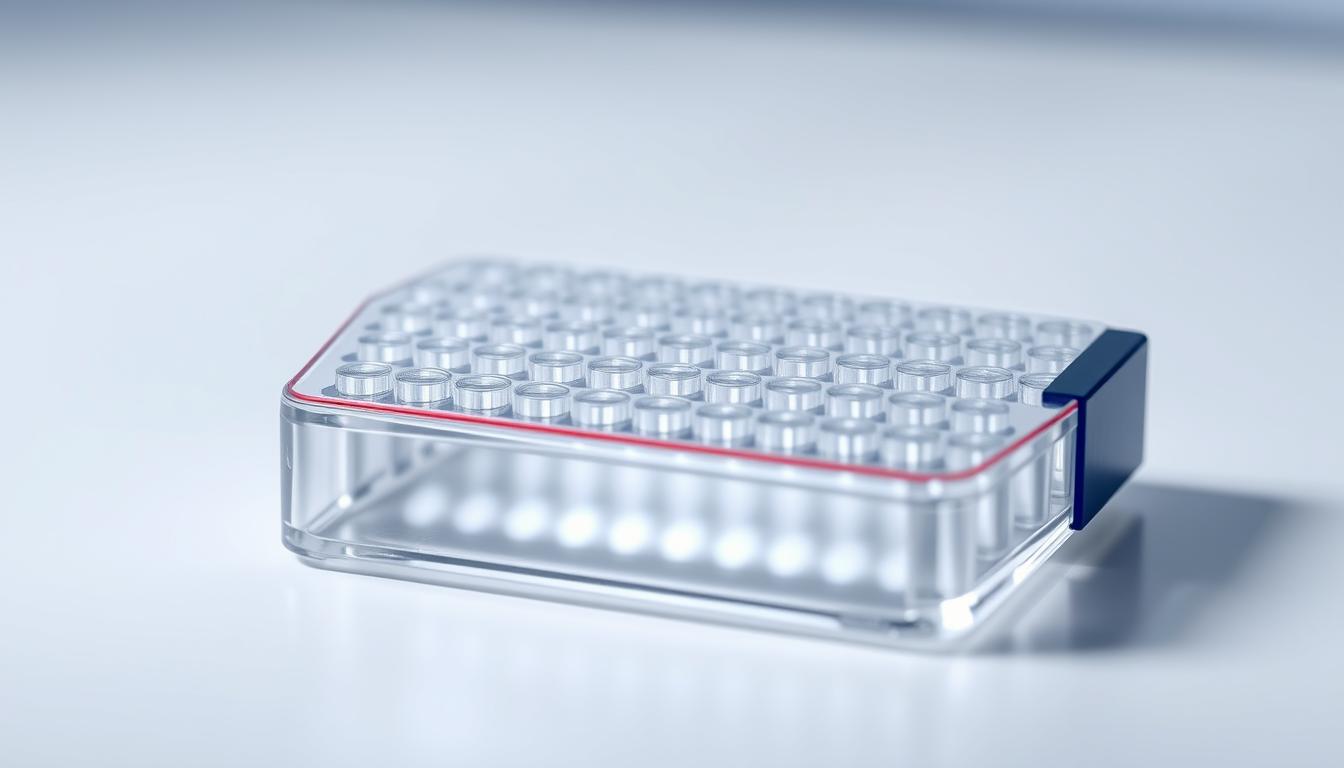
Ever wondered how scientists do hundreds of experiments at once? It’s all thanks to the 96 well microplate.
These assay plates are key in today’s science. They help researchers do complex tests in many fields. The 96 well microplate makes lab work easier, offering a common ground for all kinds of science.
These microplates are super versatile. They’re used for cell tests and biochemical studies. Their design lets scientists run many tests at once, using very little sample. This makes research much faster and more efficient.
Key Takeaways
- 96 well microplates enable high-throughput experimental research
- Supports multiple scientific disciplines and research protocols
- Allows simultaneous testing of numerous samples
- Reduces research time and increases experimental efficiency
- Provides standardized testing platform across laboratory settings
Understanding 96 Well Microplates
Modern science uses special lab tools for precise and efficient tests. The 96 well microplate is a key tool for cell culture and biochemical studies. It changes how scientists work.
A cell culture plate is great for many scientific tasks. It lets researchers work on many samples at once. This is done with high precision and uses less resources.
Definition and Fundamental Purpose
A 96 well microplate is a plate with 96 wells in an 8×12 grid. It helps scientists:
- Do many experiments at once
- Use less sample
- Work more efficiently
- Follow the same steps in research
Common Uses in Laboratories
Scientists use 96 well microplates in many fields, like:
- Cell-based tests
- Biochemical screening
- Immunology studies
- Drug discovery
| Microplate Type | Primary Application | Key Characteristics |
|---|---|---|
| Polystyrene | Standard Cell Culture | Versatile, optical transparency |
| Black Pigmented | Fluorescent Assays | Minimizes background interference |
| White Pigmented | Luminescence Detection | Enhanced signal reflection |
“The 96 well microplate has transformed scientific research, enabling unprecedented levels of experimental precision and efficiency.” – Scientific Research Quarterly
These tools help with fast screening of many samples. This speeds up finding new research discoveries.
The Structure of 96 Well Microplates
The 96 well microplate is a key tool in labs, with a detailed design and material choice. Scientists pick these plates for many studies, focusing on their design to fit their needs.
Material Composition
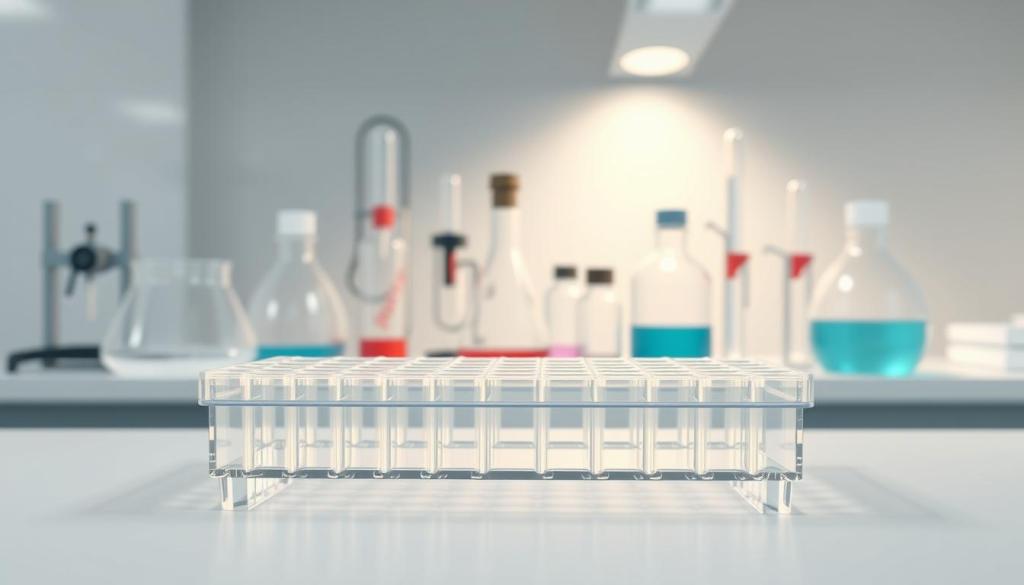
Microtiter plates are made from special materials for the best results. Polystyrene is the main choice because it’s clear and versatile. There are different types:
- Clear polystyrene for better light
- White polystyrene for clearer signals
- Black polystyrene for less background noise
- Polypropylene for handling hot or cold temperatures
Design Variations
There are many designs for well plates to meet different needs. The usual 96 well plate has certain features:
- High flange skirt for strength
- Low flange pinchbar for easy handling
- Standard 8 x 12 well layout
- Well spacing of 9 mm
The precise engineering of microplates ensures consistent performance across scientific disciplines.
Dimensional Specifications
| Parameter | Specification |
|---|---|
| Footprint Dimensions | 127.76 mm × 85.48 mm ± 0.5 mm |
| Plate Height | 14.35 mm ± 0.76 mm |
| Well Volume Capacity | 0.1 mL to 0.3 mL per well |
| Well Shape Options | Round (6.96 mm or 8.3 mm diameter) |
Knowing how well plates are made helps researchers choose the right ones for their studies.
Types of 96 Well Microplates
Researchers use special microplates to make their work better. The right plate can really change how well experiments work in many fields.
There are many 96 well microplates to pick from, each made for different needs. Knowing the differences between them is key to good experiments.
Flat-Bottom Microplates
Flat-bottom microplates are great for many uses. They work well for:
- Microscopic measurements
- Optical analysis techniques
- ELISA plate protocols
- PCR plate experiments
Round-Bottom Microplates
Round-bottom microplates are best for liquid work. Their shape helps with:
- Better liquid mixing
- Improved sedimentation
- Less surface tension
V-Bottom Microplates
V-bottom microplates are perfect for precise work. They’re great for:
- Immunological research
- Biological sample prep
- Special diagnostic tests
“Choosing the right microplate is as important as the experiment itself.” – Research Laboratory Protocols
Each type of microplate has its own benefits. The right choice can make a big difference in research success.
Applications in Research and Development
96-well microplates have changed the game in scientific research. They offer new ways to handle complex lab tasks. These tools are key in many research areas, making experiments more efficient.

High-Throughput Screening Capabilities
High-throughput screening is a big leap in science. It uses 96-well microplates to test many compounds fast. This speeds up finding new drugs and treatments.
- Enables simultaneous testing of multiple samples
- Reduces experimental time and resource requirements
- Provides statistically robust research outcomes
Cell Culture Applications
Cell culture has evolved with 96-well microplates. Scientists can now do detailed cell studies with great accuracy.
| Culture Type | Key Characteristics | Research Applications |
|---|---|---|
| 2D Cell Culture | Typical cell thickness: 3 µm | Basic cellular studies |
| 3D Cell Culture | Cell dimensions: 10-30 µm | Advanced drug screening |
Assay Development
The assay plate is vital for creating detailed research plans. It lets scientists design complex tests. These tests give deep insights into how cells work and how molecules interact.
The 96-well microplate market is projected to reach USD 1.8 Billion by 2030, underscoring its critical importance in scientific research.
96-well microplates keep leading to new discoveries. They are used in many fields, from finding new medicines to studying molecules.
Choosing the Right 96 Well Microplate
Choosing the right cell culture plate is key for good research. The right plate can greatly affect your results. So, picking the right one is very important.
When picking a 96 well microplate, researchers need to think about many things. They must understand what makes a plate good for their research.
Key Considerations for Experimental Selection
- Surface treatment characteristics
- Optical properties of the plate
- Compatibility with specific assay types
- Cell culture requirements
Surface Treatment Compatibility
Surface treatments are important for different research needs. There are many options to choose from:
| Surface Type | Recommended Application |
|---|---|
| Non-treated hydrophobic | Suspension cell cultures |
| Treated adhesive surface | Adherent cell growth |
| Collagen I coated | Specific cell type attachment |
| Poly-D-lysine coating | Enhanced biomolecule attachment |
Assay Compatibility Factors
Choosing the right 96 well microplate means knowing what your assay needs. Think about:
- Optical density measurements
- Fluorescence sensitivity
- Luminescence performance
- Cell visualization needs
The right microplate can make the difference between successful and compromised experimental results.
Today’s cell culture plates have special features for different research areas. By carefully looking at these features, researchers can get the best results in their studies.
Cleaning and Sterilization Techniques
Keeping 96 well microplates clean is key for good lab work. The right cleaning and sterilization methods help keep experiments accurate. They also stop contamination that could mess up results.
Importance of Sterile Microplate Handling
Lab workers need to be very careful when cleaning 96 well microplates. Any contamination can ruin an experiment. So, making sure they are sterilized is very important.
- Prevents cross-contamination between samples
- Maintains experimental reliability
- Reduces risk of false research results
Recommended Cleaning Methods
There are many ways to sterilize 96 well microplates, each for different needs:
| Sterilization Method | Effectiveness | Best Used For |
|---|---|---|
| Chemical Disinfection | High | Sensitive Biological Samples |
| UV Sterilization | Moderate | Surface Decontamination |
| Autoclaving | Very High | Heat-Resistant Materials |
Here are the main steps for cleaning 96 well microplates:
- Rinse thoroughly with the right cleaning solution
- Use 70% isopropyl alcohol for surface disinfection
- Let them air dry completely before using again
“Precision in cleaning is the foundation of reliable scientific research.” – Laboratory Safety Expert

Using pre-sterilized 96 well microplates adds extra safety for important experiments. It lowers the chance of contamination. Always stick to the maker’s instructions and lab rules when cleaning equipment.
Innovations in 96 Well Microplate Technology
The world of lab research is always changing, with 96 well microplates leading the way. New breakthroughs are changing how scientists do high-throughput screening and complex assays.
Advances in Material Sciences
New discoveries in material science are changing microplate design. Scientists have made surfaces that cut down on background noise and improve how light is seen. Some key improvements include:
- Enhanced surface treatments for better signal detection
- Advanced polymers that reduce contamination
- Special coatings for different research needs
Automation and Robotics Integration
Today’s microplates work well with advanced lab automation systems. This integration boosts precision in high-throughput screening. It helps researchers work more efficiently than ever before.
The first 96 well microplate marked a big moment in science, opening the door to today’s tech advancements.
| Technological Feature | Performance Specification |
|---|---|
| Luminescence Detection | Crosstalk levels as low as 0.7 x 10⁻⁶ |
| Signal Dynamic Range | Up to 8 decades of linear measurement |
| Readout Modes | Photon counting, integration, micro-integration |
Now, microplates have custom barcodes for better tracking. This lets researchers manage complex experiments with great precision in high-throughput settings.
Troubleshooting Common Issues
Laboratory researchers often face challenges with microtiter plates. Knowing how to solve these problems can greatly improve their work. It makes their results more reliable.
Addressing Contamination Risks
Contamination is a big worry for scientists using well plates. Studies show that up to 25% of lab problems come from contamination. To avoid this, scientists need to take careful steps:
- Use sterile technique during sample handling
- Implement proper storage protocols
- Select appropriate well plate materials
- Utilize protective plate seals
“Contamination prevention is not just a protocol, it’s a mindset in scientific research.”
Managing Evaporation Challenges
Evaporation can ruin experiments in microtiter plates. To fight this, researchers use several methods:
- Use specialized plate lids with tight seals
- Control ambient humidity in laboratory environments
- Select appropriate well plate materials with low evaporation rates
- Minimize exposure time during experiments
Temperature is key in keeping samples safe. Recommended storage temperatures range from -20°C to 25°C for dry well plates, and -20°C to -80°C for plates containing sensitive reagents.
By following these tips, researchers can reduce contamination and evaporation risks. This ensures their results are more reliable and consistent.
Regulatory Standards for Lab Equipment
Laboratory equipment, like ELISA and PCR plates, must meet strict standards. This ensures research quality and consistent results. The American National Standards Institute (ANSI) sets guidelines for labs to follow.
- Equipment must meet exact performance standards.
- Keeping detailed records is essential.
- Quality control must be strict.
- Equipment must be validated regularly.
Compliance Requirements
Labs have to follow specific rules for microplates. These standards cover several key areas:
- Equipment and materials must be traceable.
- Quality control certificates must be kept up to date.
- Material certifications are also required.
Importance of Proper Documentation
Keeping accurate records is key to staying compliant. Labs need to track:
- Lot numbers for ELISA plates.
- Calibration records for PCR plates.
- Results of performance tests.
*Proper documentation ensures reproducibility and scientific credibility in research.*
| Standard | Key Requirements | Compliance Focus |
|---|---|---|
| ANSI/SBS 1-2004 | Equipment Performance | Microplate Specifications |
| ISO/IWA 15 | Liquid Handling Systems | Volumetric Performance Testing |
| Good Laboratory Practice (GLP) | Research Quality | Procedural Integrity |
Labs must keep up with changing standards. This ensures the highest scientific precision and reliability.
Future Trends in 96 Well Microplates
The world of science is changing fast, with 96-well microplates leading the way. These tools are making research faster and more efficient, especially in finding new medicines and tests. The market is expected to grow to USD 1.8 billion by 2030, showing how important these tools are.
Now, making labs more eco-friendly is a big goal. Scientists are working on making assay plates that are better for the planet without losing quality. This move towards green practices is helping to cut down on plastic waste and make research more sustainable.
Emerging Technological Innovations
New tech is changing how we do science with microplates. Digital tools and robots are making research more precise and quick. This change is marking a new era in science, with microplates at the heart of it all.
Global Market Dynamics
Different parts of the world are growing at different rates. North America and Asia-Pacific are leading the charge in innovation. More money going into life sciences and healthcare is driving the creation of better microplate tech. As scientists and drug makers keep exploring, 96-well microplates will keep playing a key role.
FAQ
What is a 96 well microplate?
A 96 well microplate is a tool for labs. It has 96 wells in an 8×12 grid. It’s made of polystyrene and used for many experiments at once.
What are the most common applications of 96 well microplates?
They’re used in drug discovery, cell culture, and more. They help researchers do many experiments at once. This saves time and reduces the amount of sample needed.
What different types of 96 well microplates exist?
There are flat-bottom, round-bottom, and V-bottom plates. Each is made for different needs, like cell adhesion or liquid handling.
How do I choose the right 96 well microplate for my experiment?
Choosing the right plate depends on several things. Look at surface treatment, well shape, and optical properties. Also, think about the type of cells and the assay you’re doing.
How should 96 well microplates be cleaned and sterilized?
Cleaning and sterilizing plates is important. Use chemical treatments, autoclaving, or UV sterilization. Pre-sterilized plates are also an option to keep experiments clean.
What recent innovations exist in 96 well microplate technology?
New advancements include better materials and surface treatments. There are also improved optical properties and better integration with automation systems. These help with accuracy and efficiency.
What are common challenges when using 96 well microplates?
Challenges include contamination and evaporation. Use strict handling, sealers, and control conditions. Also, avoid edge effects to keep experiments consistent.
Are there regulatory standards for 96 well microplates?
Yes, plates must follow standards from organizations like ANSI. They also need to meet GLP and GMP guidelines. This ensures quality and reliability in research.
What are the future trends in 96 well microplate technology?
Future trends include eco-friendly materials and microfluidics. There will also be advancements in 3D cell culture and biocompatibility. These support new areas like personalized medicine.
How do 96 well microplates support high-throughput screening?
They allow for testing many samples at once. This quickens the process of testing compounds. They work well with automated systems and advanced screening tech.





Pingback: What are the Optimal Conditions for Culturing Adherent Cells in 96 - Well Plate Templates?
Pingback: What are the dimensions of a 96 well plate?
Pingback: How to Select Cell Viability Assay Kits Compatible with 96 - Well Plate Templates?
Pingback: Optical Genetics with Optical Fibers in 96 Well Plate
Pingback: What is the size of a 96 well plate?
Pingback: What is the surface area per well of a 96 - well plate?
Pingback: 96 Microwell Plates: Essential Lab Testing Solutions
Pingback: 96 Microwell Plate: Laboratory Research Essentials
Pingback: 96 Well Plate Templates: Essential Lab Planning Tools