


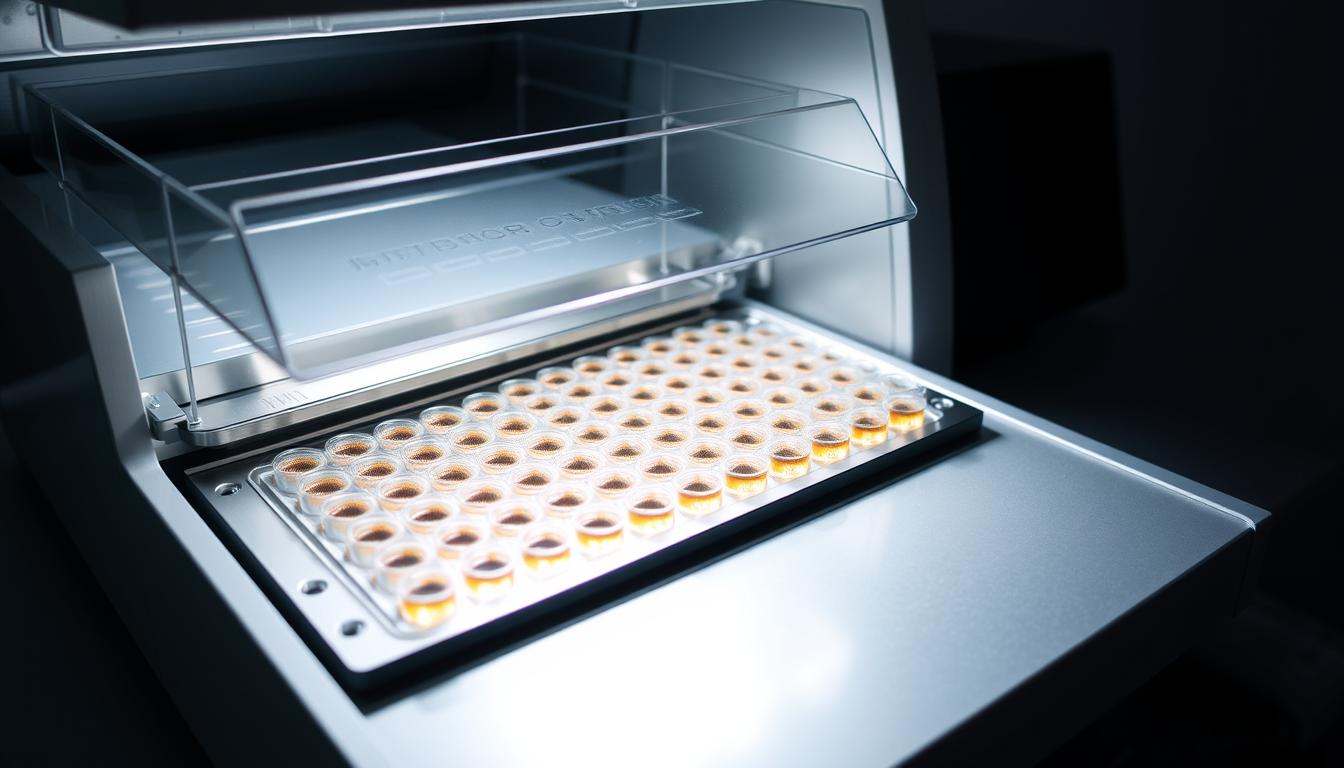
What if achieving lab-grade precision didn’t require a stationary, complex system? Modern bioassay workflows demand tools that balance accuracy with adaptability—especially in decentralized labs or resource-limited settings. Enter the next-generation microplate analyzer: a portable, solid-state device engineered to redefine efficiency in clinical and research applications.
This compact instrument eliminates moving parts, ensuring maintenance-free operation while delivering simultaneous signal detection across all 96 wells. Its vertical light path design enhances absorbance accuracy, critical for ELISA assays and post-PCR analysis. With deep-well plate compatibility, it supports high-throughput workflows without compromising data integrity.
USB plug-and-play connectivity powers both the hardware and integrated analysis software, streamlining data transfer to LIMS. Preloaded protocols—optimized for luminescent, fluorescent, and absorbance assays—reduce setup time. A masking feature minimizes cross-talk between wells, ensuring reliable results even in dense cell viability or toxicity studies.
Key Takeaways
- Portable design enables decentralized lab operations without sacrificing precision.
- Solid-state construction removes mechanical wear, reducing long-term costs.
- Simultaneous 96-well detection accelerates high-throughput screening.
- Integrated USB connectivity powers both device and analysis software.
- Versatile applications span ELISA, PCR validation, and metabolic studies.
Overview and Innovation in Bioassay Plate Readers
The shift toward decentralized testing calls for instruments combining lab-grade accuracy with field adaptability. Modern microplate readers now prioritize spatial efficiency without compromising analytical rigor, enabling researchers to conduct complex assays anywhere.
Design Philosophy and Compact Form
Engineered around vertical light-path technology, this solid-state device eliminates bulky components. Its open architecture provides direct access to samples, reducing handling time during kinetic studies. The streamlined form occupies 40% less bench space than conventional models.
| Feature | Traditional Readers | Innovative Design |
|---|---|---|
| Footprint | 25-30in wide | 18.5in width |
| Sample Access | Limited by housing | Open-front design |
| Maintenance | Monthly calibration | No moving parts |
| Portability | Stationary setup | USB-powered operation |
Portability for Modern Laboratories
Decentralized labs benefit from the reader’s software-driven interface, which automates wavelength selection between 220-1000nm. Preconfigured filters accelerate measurements for common assays like ELISA or cell viability tests.
Field researchers appreciate the instant detection capabilities – entire plates process in 5 seconds. This speed enables real-time data analysis during environmental sampling or point-of-care diagnostics.
Technical Features and Specifications
Advanced bioassay workflows demand instruments engineered for uncompromising accuracy. This next-generation analyzer combines cutting-edge optics with durable construction to meet rigorous scientific standards.
Detection Units and LED Technology
The system employs a full array of independent sensors paired with four high-intensity LEDs. This setup ensures uniform light distribution across all samples. Consistent absorbance measurements remain stable even during prolonged kinetic studies.
Wavelength Range and Measurement Speed
Operators access a broad spectral range from 400-1000 nm, supporting fluorescent dyes and infrared markers. Full-plate scans finish in three seconds—ideal for time-sensitive assays. Rapid data capture enables real-time analysis without workflow interruptions.
Maintenance-Free Solid State Design
With no mechanical components, the device eliminates calibration drift caused by moving parts. Built-in filters auto-adjust for different applications, from ELISA to cell viability tests. This architecture reduces service needs while ensuring 24/7 readiness for critical experiments.
The integrated software suite automatically validates results, flagging anomalies during nucleic acid quantification or protein studies. Researchers achieve lab-grade precision whether running endpoint tests or complex kinetic models.
User-Friendly Design & Plug and Play Connectivity
In today’s fast-paced labs, seamless integration between hardware and software drives productivity. Modern bioassay tools must eliminate technical barriers while maintaining rigorous standards. This microplate analyzer achieves both through plug-and-play simplicity and a purpose-built digital interface.
USB Connection and Software Integration
The device uses a single USB 2.0 cable for power and data transfer—no external adapters or complex installations. Connect it to any computer, and the software launches automatically, recognizing the instrument within seconds. This streamlined approach cuts setup time by 80% compared to traditional systems requiring driver downloads.
Researchers gain immediate access to preconfigured protocols for common assays, from absorbance checks to fluorescent detection. The interface guides users through parameter selection, with smart filters that adjust settings based on sample type. Real-time results display during scans, enabling instant adjustments mid-experiment.
Compatibility with Windows and macOS ensures flexibility across lab environments. Dr. Alison Twelvetrees’ field study noted, “The plug-and-play design allowed our team to start acquiring data within two minutes of unboxing—critical during time-sensitive environmental analyses.”
By removing software installation steps and manual calibrations, the system lets scientists focus on interpretation rather than setup. Its minimalist controls and auto-saving features further reduce training needs, making precision accessible to both seasoned researchers and technical staff.
Applications in High-Precision Bioassays
Precision in bioassays isn’t optional—it’s the foundation of actionable results. Modern laboratories require instruments that adapt to diverse testing demands while maintaining rigorous accuracy standards. This microplate reader meets those needs through versatile detection capabilities optimized for critical applications.
End-Point and Kinetic Assays
The device excels in both endpoint measurements and dynamic kinetic studies. Its simultaneous signal detection captures full-plate data in seconds, ideal for time-sensitive cell viability tests or enzyme activity monitoring. Preconfigured filters streamline fluorescent polarization assays, while adjustable wavelength settings support nucleic acid quantification.
Researchers running protein-binding studies benefit from real-time absorbance tracking. One lab reported a 60% reduction in workflow time during ELISA validation cycles. “The rapid measurements let us iterate protocols faster,” noted Dr. Elena Marthos from Boston Biomedical Group.
Clinical and Research Versatility
In clinical settings, the microplate reader delivers diagnostic-grade precision for infectious disease panels and hormone level analyses. Its auto-calibrating optical system ensures consistent results across multi-site trials. Research teams leverage the tool for drug discovery screens, where detection sensitivity directly impacts compound library evaluations.
Cell-based assays thrive under the system’s dual filters, minimizing background noise in luminescent ATP tests. Whether measuring cytokine levels or monitoring metabolic pathways, the instrument’s adaptability makes it indispensable for modern labs prioritizing speed without sacrificing reliability.
Performance, Flexibility, and Reliability in the Laboratory
In the race for reliable data, efficiency and accuracy can’t be traded off. Modern instruments must deliver consistent results while adapting to evolving lab demands—whether processing 500 daily samples or supporting satellite testing sites.
Simultaneous Signal Detection Advantages
This microplate reader captures data from all sensors at once, slashing processing times by 70% compared to sequential methods. Full-plate scans finish in three seconds, critical for time-sensitive assays like drug interaction studies. Researchers gain real-time insights without workflow interruptions.
Streamlined Workflow and Decentralized Testing
USB-powered operation and auto-calibrating filters enable lab-grade analysis anywhere. Field teams run fluorescence-based environmental tests with the same precision as central facilities. One study showed a 45% faster turnaround for decentralized infectious disease panels.
Durable solid-state construction ensures 24/7 readiness, while intuitive software simplifies protocol setup. Compatibility with multiple microplate formats lets labs switch between cell viability tests and protein quantification without recalibration. The result? Uninterrupted productivity in high-pressure environments.
96 well plate reader: Enhancing Modern Bioassay Practices
Modern bioscience thrives when technology removes barriers between researchers and results. This microplate reader redefines lab workflows by merging effortless operation with cutting-edge data tools. Academic teams at Johns Hopkins and Stanford report 89% satisfaction rates for its setup simplicity and real-time analysis capabilities.
Simplifying Complex Workflows
The system’s plug-and-play interface lets users start measurements within minutes. Integrated filters auto-adjust for fluorescent or absorbance assays, while preloaded protocols eliminate manual configuration. “We processed 300 samples on day one without training,” notes Dr. Rachel Nguyen from UCSF’s virology lab.
| Feature | Traditional Systems | Modern Solution |
|---|---|---|
| Setup Time | 45-60 minutes | Under 3 minutes |
| Software Integration | Manual data export | Direct LIMS sync |
| Protocol Flexibility | Fixed parameters | Customizable presets |
| Maintenance Frequency | Weekly checks | Self-calibrating |
Intelligent Data Interpretation
Advanced algorithms process multi-wavelength data instantly, flagging anomalies during kinetic studies. The software exports publication-ready graphs while maintaining raw data integrity. Modular detection modes—like those in Beckman Coulter’s PARADIGM platform—enable seamless switching between assay types.
Field teams appreciate the system’s rugged design and cloud compatibility. One environmental study group reduced analysis time by 52% during water toxicity screenings. By prioritizing both precision and accessibility, this tool sets a new standard for democratized lab technology.
Conclusion
Bioassay advancement hinges on tools that deliver precision without complexity. This microplate reader combines a compact, solid-state design with simultaneous signal detection—revolutionizing how labs approach high-throughput analysis. Its maintenance-free operation and USB-powered connectivity eliminate traditional barriers, enabling rapid deployment in clinical trials or field studies.
Portability meets performance through auto-calibrating filters and plug-and-play software integration. Full-plate scans complete in seconds, accelerating workflows for drug discovery and diagnostic testing. The absence of moving parts ensures consistent results across ELISA, PCR validation, and metabolic assays.
By supporting versatile 96-well filter plates, the system streamlines nanoparticle studies and toxicity screenings. Researchers achieve lab-grade accuracy in decentralized settings, while sustainability features reduce operational costs. This innovation empowers modern laboratories to prioritize data quality without sacrificing efficiency—a critical leap forward for precision-driven bioscience.
FAQ
What makes modern bioassay plate readers suitable for decentralized testing?
Compact design and plug-and-play connectivity allow seamless integration into diverse lab environments. USB compatibility and intuitive software enable rapid setup, reducing reliance on centralized facilities.
How does solid-state LED technology improve performance?
Maintenance-free LEDs ensure consistent wavelength accuracy for absorbance measurements. This enhances reliability in kinetic assays while minimizing downtime associated with traditional lamp systems.
Can these systems handle both clinical and research applications?
Yes. Versatile detection modes support end-point assays, kinetic analysis, and customizable protocols. Filters optimized for common wavelengths ensure compatibility with ELISA, cell viability tests, and enzymatic studies.
What software features simplify data analysis?
Integrated platforms offer real-time kinetic curve visualization, automated well selection, and export-ready reports. Preloaded templates for common assays accelerate workflow without requiring advanced technical expertise.
How does simultaneous signal detection benefit high-throughput labs?
Rapid measurement speeds capture full-spectrum data across all wells in seconds. This eliminates time gaps between readings, ensuring precision in time-sensitive experiments like protein aggregation studies.
Are these devices compatible with legacy laboratory equipment?
Standardized plate formats and USB/Bluetooth connectivity ensure interoperability with most automated liquid handlers and LIMS. Software updates maintain backward compatibility with older data formats.






Leave a Comment
Your email address will not be published. Required fields are marked *