



Imagine a tool that changes how scientists do their work. The 96 well plate is a big step forward in lab tools. It makes doing complex research easier.
Scientists use 96 well plates a lot in cell culture, biotech, and drug research. Each well has about 0.32 cm² for cells to grow. The whole plate has 32 cm². This lets scientists test many things at once.
The 96 well plate is a key tool for scientists. It lets them do lots of experiments at once. This makes labs work better and keeps results accurate and the same.
Key Takeaways
- 96 well plates offer 0.32 cm² growth surface per well
- Total plate surface area reaches 32 cm²
- Supports average cell yield of 3.2 x 10⁴ cells
- Recommended medium volume ranges 100-200 μL
- Critical for high-throughput scientific research
Introduction to 96 Well Plates
96 well plates are key in today’s science, especially for quick tests and cell studies. They help labs do many tests at once, making work faster and more efficient.
These plates are made with care and follow a set design. They’re often made of polystyrene, giving scientists a solid base for their research.
Overview of 96 Well Plate Characteristics
Here are some important features of 96 well plates:
- Standard footprint size: 127.76 x 85.48 mm
- Total number of wells: 96
- Well spacing: 9.02 mm (center to center)
- Flange height: 2.5 mm
Importance in Scientific Research
96 well plates are vital in many areas of science, especially in quick tests and large-scale screenings. They help scientists:
- Do more tests at once
- Use less sample
- Get accurate data
- Work with automated tools
“96 well plates have transformed scientific research by providing a standardized, efficient platform for complex experimental protocols.” – Laboratory Research Quarterly
| Plate Type | Mathematical Volume | Working Volume Range |
|---|---|---|
| Flat Bottom | 392 μl | 25-340 μl |
| U-bottom | 234 μl | 40-200 μl |
| V-bottom | 382 μl | 25-340 μl |
| Half Area | 199 μl | 15-75 μl |
Thanks to their design and flexibility, 96 well plates keep pushing the boundaries in biotech, pharma, and medical fields.
Dimensions of a 96 Well Plate
Knowing the exact size and volume of wells in microplates is key for scientists. 96 well plates are vital in scientific research. Their specific dimensions affect how experiments are set up.
Standard Plate Measurements
A standard 96 well plate has precise sizes for both the outside and inside. These dimensions ensure it works well in many research settings. The main measurements are:
- Total plate length: 127.60 mm
- Total plate width: 85.75 mm
- Plate height: 14.30 mm
- Well-to-well center distance: 9.00 mm
Well Depth and Volume Characteristics
The shape of the wells is crucial for research results. Scientists need to think about well size and depth when planning their experiments.
| Parameter | Specification |
|---|---|
| Well Bottom Area | 30 mm² |
| Maximum Volume per Well | 0.35 mL |
| Recommended Working Volume | 100-200 μL |

The well volume affects how precise experiments can be. Scientists must pick plates with the right well geometry. This helps reduce errors and keeps samples safe.
Precision in microplate design ensures reproducible scientific results across diverse research disciplines.
Surface Area Calculation of 96 Well Plates
Understanding how to calculate surface area is key in lab work and science. Scientists need exact measurements to get the best results and help cells grow well.
The area of a 96-well plate is very important. It helps decide how many cells to put in each well. Usually, each well has about 0.32 cm² for cells to grow.
Formula for Surface Area Calculation
To find the surface area, follow these steps:
- Measure each well’s size
- Find the area of one well by multiplying its length and width
- Then, multiply that area by the number of wells (96)
“Accurate surface area measurement is the foundation of successful cell culture experiments.” – Research Laboratory Protocols
Factors Affecting Surface Area
Several things can change how you calculate surface area:
- How plates are made
- What’s on the plate’s surface
- The shape of the wells
- The material of the plate
| Plate Type | Surface Area (cm²) | Cell Yield |
|---|---|---|
| Standard 96-Well Plate | 0.32 | 0.01 x 10^6 cells |
| Half Area 96-Well Plate | 0.16 | 0.005 x 10^6 cells |
| V-Bottom 96-Well Plate | 0.38 | 0.012 x 10^6 cells |
When picking plates for lab work, remember these small differences matter a lot.
Applications in Biotechnology
The 96 well plate is key in modern biotechnology. It changes how we find new drugs and test them. It helps scientists do detailed studies in many fields.
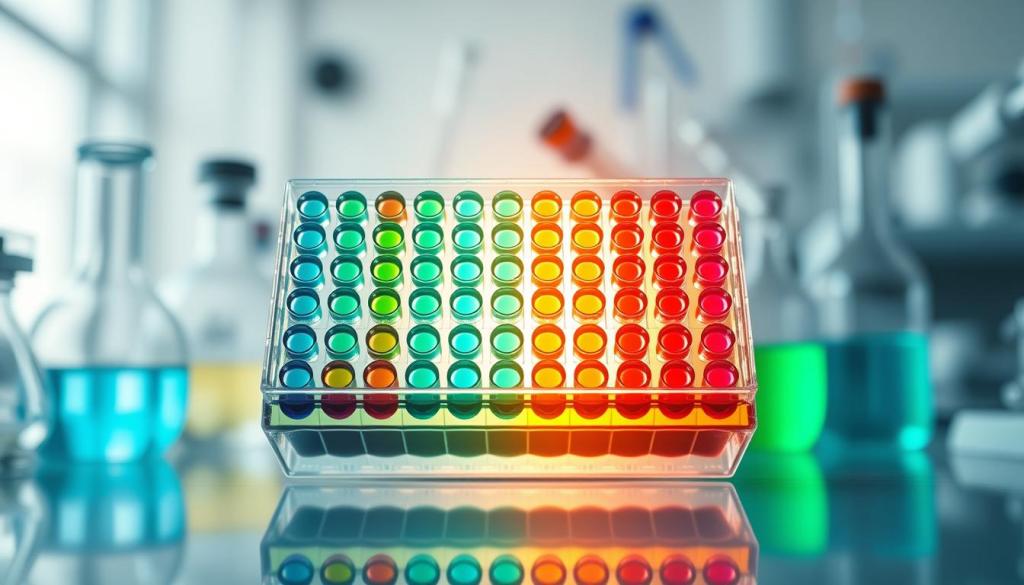
Scientists use 96 well plates for many important studies. These include:
- Testing many drugs at once
- Studying cells in a controlled way
- Using the same methods for all research
Cell Culture Studies
Cell culture studies get a big boost from 96 well plates. Advanced biotechnology tools let scientists study cells in new ways. The plates help keep experiments the same, which makes results more reliable.
*”The 96 well plate represents a transformative technology in cell biology research”* – Biomedical Research Institute
High-Throughput Screening
High-throughput screening is vital for finding new medicines. Scientists can test many drugs quickly with 96 well plates. This makes finding new medicines faster and cheaper.
| Research Parameter | Performance Metric |
|---|---|
| Screening Efficiency | 67,000 experimental accesses |
| Visibility Index | 3 Altmetric scores |
96 well plates help scientists do fast, reliable tests. They are key to finding new ways to understand life’s complex systems.
The Role of Surface Coatings
Surface coatings are key in cell culture assays and bioassay development. The right coating can change how cells behave and the results of experiments.
Scientists use different coatings to help cells stick and grow better. These changes make the surface perfect for various experiments.
Types of Surface Treatments
There are many coatings that affect how cells work. The main types are:
- Polymer-based coatings
- Protein-based treatments
- Synthetic biomimetic coatings
- Nanostructured surface modifications
Impact on Cell Adhesion
Coatings greatly affect how well cells grow in culture. The right coating can:
- Help cells stick better
- Make cells grow faster
- Lower the chance of mistakes in experiments
- Meet the needs of different cell types
*”The right surface treatment can make the difference between successful and failed cell culture experiments.”*
| Coating Type | Cell Adhesion Performance | Typical Applications |
|---|---|---|
| Tissue Culture Treated | Excellent | General cell culture |
| Collagen Coated | High | Epithelial and stem cell research |
| Poly-D-Lysine | Very Good | Neuronal cell cultures |
| Laminin | Superior | Specialized neural research |
Choosing the right coating is crucial for cell culture assays and bioassay development. The coating’s makeup, texture, and how it’s applied all play a part in the success of experiments.
Comparative Analysis of 96 Well Plates
Researchers use precise microplate dimensions and lab automation to improve their work. The right materials and designs are key to good results.
Material Comparison: Polystyrene vs. Polypropylene
Polystyrene and polypropylene are main materials for microplates. Each has its own benefits for cell culture and research:
- Polystyrene: Great for seeing things clearly
- Polypropylene: Best for handling chemicals
- How the surface is treated affects cell sticking
Microplate Design Variations
Different microplate shapes are important for precise research. Each shape is made for specific research needs:
| Well Type | Primary Application | Surface Area Impact |
|---|---|---|
| Flat-bottom | Adherent cell cultures | Maximum contact area |
| Round-bottom | Suspension cell studies | Reduced surface interaction |
| V-bottom | Immunological assays | Concentrated sample volume |
Labs use standardized microplate sizes for better results. This helps with different tests.
“The right microplate can transform research efficiency and data quality.” – Laboratory Automation Expert
Choosing the right microplate is crucial for success and reliable results.
Choosing the Right 96 Well Plate
Choosing the right 96 well plate is key for good scientific research. It’s especially important in high-throughput screening and drug discovery. Researchers must look at many factors to get the best results.
Critical Considerations for Experimental Success
Scientists need to check a few important things when picking a 96 well plate. These things affect how well the research goes:
- Cell type compatibility
- Specific assay requirements
- Detection method sensitivity
- Laboratory equipment specifications
Strategic Selection Criteria
The selection process involves understanding unique plate characteristics. These characteristics can greatly affect how well the experiment works. Different surface treatments can change how cells stick and how the results turn out.
| Plate Type | Surface Treatment | Recommended Application |
|---|---|---|
| Low Protein Binding | Minimal surface modification | Suspension cell studies |
| Medium Protein Binding | Partial surface treatment | Mixed cell culture techniques |
| High Protein Binding | Advanced surface modification | Adherent cell research |
Supplier Recommendations
Researchers should look for suppliers that offer good technical support. They should also choose plates made with consistent standards. High-throughput screening needs precision, so the supplier’s reputation matters a lot.
Quality and reproducibility are paramount in scientific research.
Modern drug discovery needs careful plate selection. This ensures experiments run smoothly and data is reliable.
Maintenance and Handling of 96 Well Plates
Keeping 96 well plates in good shape is key for lab success. Researchers must stick to strict rules to get the best results and avoid contamination.
Handling cell culture vessels right is very important. It affects how reliable and repeatable your research can be. Doing it correctly can make a big difference.
Cleaning Protocols for 96 Well Plates
Cleaning methods depend on the plate type and what you plan to use it for:
- Disposable plates: Use once only, must be very clean
- Reusable plates: Need a deep clean and disinfecting
- Chemical sterilization: Use alcohol-based solutions
- Heat sterilization: Autoclave for some materials
Storage Conditions for Optimal Performance
Storing plates right is crucial for keeping them in top shape:
| Storage Parameter | Recommended Condition |
|---|---|
| Temperature | 37°C in 5% CO2 humidified incubator |
| Humidity | Controlled environment (85-90%) |
| Duration | Maximum 1 month after preparation |
“Precision in maintenance directly correlates with the quality of cell culture assays” – Laboratory Research Guidelines
Experts say careful handling is vital to avoid contamination. Pay close attention to maintenance details to greatly enhance your research results.
Innovations in 96 Well Plate Design
The world of scientific research is changing fast. 96 well plate technologies are leading the way in bioassay development and drug discovery. Now, researchers can use advanced microfabrication techniques to improve their work.
Advances in Microfabrication Techniques
Modern microfabrication has brought new ideas to plate design. Scientists can now change surface properties with great detail. This allows for more complex experiments.
- Laser-etched precision surfaces
- Ultra-low adherence coatings
- Advanced chemical surface treatments
Customizable Plate Configurations
Customizable 96 well plates have changed drug discovery research. Now, researchers can pick plates that fit their specific needs.
| Plate Feature | Research Application |
|---|---|
| Round Bottom Wells | Spheroid Formation |
| Laser-Etched Membranes | Chemotaxis Studies |
| Ultra-Low Adherence Surface | 3D Cell Culture |
The future of bioassay development lies in our ability to create increasingly sophisticated and adaptable research tools.
Recent tech advances support complex experiments. For example, the BIOFLOAT™ surface helps form spheroids quickly. This gives researchers reliable results with different cell lines.
The Incucyte® Clearview 96-well Plate is another big step forward. It has 96 laser-etched pores for 1,000-5,000 cells. This is great for working with rare or limited cell samples in drug discovery.
Regulatory Standards and Quality Control
Quality control is key in scientific research, especially in high-throughput screening and lab automation. It ensures results are reliable and can be repeated.
Scientific research relies on strict rules for lab equipment and processes. These rules help labs work the same way everywhere.
Compliance with ASTM and ISO Standards
ASTM International and ISO set rules for making 96-well plates. They focus on important things like:
- Material composition and quality
- Dimensional accuracy
- Surface treatment specifications
- Manufacturing consistency
Importance of Quality Assurance
Quality assurance in making 96-well plates means checking many things. This ensures experiments are reliable. Makers test plates to make sure they meet standards.
| Quality Control Parameter | Verification Method | Acceptable Range |
|---|---|---|
| Surface Uniformity | Optical Inspection | ±0.05 mm |
| Material Purity | Spectroscopic Analysis | 99.9% Pure |
| Sterility | Microbial Testing | Zero Contamination |
“Precision in manufacturing translates directly to reliability in scientific research.” – Laboratory Standards Institute
Contamination in cell culture labs can be as high as 5-10%. This shows how important strict quality control is in lab work.
Conclusion: Optimizing Research with 96 Well Plates
The use of 96 well plates has changed science a lot, especially in cell culture and drug discovery. Since 1998, these plates have made research better and faster. They help scientists do many tests at once with great accuracy.
Knowing how 96 well plates work is key to good results. The size of each well, about 0.32 cm², affects how cells grow and behave. Today, scientists must pick the right plates carefully. They look at things like the plate’s material, coating, and how it’s made to get reliable results.
Best Practices for Researchers
Choosing the right microplates is important. For drug research, scientists need plates that work well together and are good for cells. They also need to think about how the plates are made. This can affect how well the tests work and how consistent the results are.
Future Trends in 96 Well Plate Usage
New technologies are making 96 well plates even better. They’re working on making the plates last longer, cost less, and do more tests at once. As science keeps moving forward, 96 well plates will get even more advanced. They’ll help scientists make new discoveries faster in medicine and drug making.
FAQ
What is a 96 well plate and why is it important in scientific research?
A 96 well plate is a tool used in many scientific studies. It lets researchers do lots of experiments at once. This helps them study cells, test drugs, and more, all in a controlled way.
How do I calculate the surface area of a 96 well plate?
To find the surface area, first measure the bottom of each well. Then, multiply that by the number of wells. For a 96 well plate, use the formula πr² for each well’s area and then multiply by 96. Remember, small changes can affect the exact area.
What materials are commonly used for 96 well plates?
Most plates are made of polystyrene or polypropylene. Polystyrene is best for growing cells because it’s clear and helps cells stick. Polypropylene is better for handling chemicals and is used in many lab tests.
How do surface coatings affect cell culture experiments?
Coatings on plates can change how cells grow and behave. Different coatings, like collagen or special treatments, can help cells stick and grow better. This is important for research.
What factors should I consider when selecting a 96 well plate?
When choosing a plate, think about the type of cells you’re working with and what tests you’ll do. Also, consider how you’ll detect results and if the plate works with your lab equipment. Look at the plate’s design and material to get the best results.
What are the standard dimensions of a 96 well plate?
A standard 96 well plate is about 127.76 mm × 85.48 mm. It has 8 rows and 12 columns of wells. Each well is about 6.4 mm in diameter, and they’re 10.4 to 11.2 mm deep.
How do I maintain and store 96 well plates?
To keep plates in good shape, store them in a clean, cool place away from light. Follow the maker’s instructions for disposable plates. Reusable plates need to be cleaned and sterilized carefully to avoid contamination.
What innovations are emerging in 96 well plate technology?
New advancements include better ways to make plates and designs for special uses. These changes help with more detailed studies and working with automated systems. They also make it easier to create complex cell cultures.






Leave a Comment
Your email address will not be published. Required fields are marked *