



Ever wondered how scientists get such precise measurements? The key is the blank solution in spectrophotometry. But what makes this simple element so vital in science?
A spectrophotometer blank is essential for accurate scientific measurements. It helps researchers calibrate their tools and remove background noise. This ensures their results are reliable and true.
This blank does more than just adjust settings. It’s a quality control tool that removes unwanted interference. This makes sure experiments are consistent and trustworthy across many fields.
Key Takeaways
- Blanks provide a reference point for accurate measurements
- They help eliminate background interference in spectrophotometric analysis
- Crucial for ensuring reproducibility of scientific experiments
- Used across multiple research disciplines
- Essential for maintaining high-quality data collection
Understanding Spectrophotometry
Spectrophotometry is a key analytical technique used in many scientific fields. It helps researchers understand how light interacts with substances. This gives insights into what materials are made of and how much of them there is.
Scientists use UV-Vis spectroscopy for detailed chemical analysis. It measures how substances absorb or reflect light at different wavelengths. This helps scientists understand the chemical makeup of samples.
Core Principles of Spectrophotometric Analysis
The core idea of spectrophotometry is about light absorption. When light goes through a sample, molecules react with it. This creates unique patterns that show important chemical details.
- Measures light absorption at different wavelengths
- Provides quantitative data about chemical concentrations
- Works across multiple scientific domains
Critical Research Applications
Colorimetric assays use spectrophotometry to find and measure certain chemicals. This method is used in:
- Biochemical research
- Environmental monitoring
- Pharmaceutical development
- Material science investigations
| Scientific Field | Spectrophotometry Application |
|---|---|
| Medical Research | Enzyme activity measurement |
| Environmental Science | Pollutant concentration tracking |
| Chemistry | Reaction kinetics analysis |
Spectrophotometry is crucial in today’s science. It turns complex chemical interactions into clear, measurable data. This helps scientists make accurate discoveries.
The Role of Blanks in Spectrophotometry
Spectrophotometry needs precise measurements. Blank samples are key to getting accurate results. They act as a reference point to remove background noise and calibrate instruments.
Scientists use blank samples to find a baseline without the substance they’re studying. This method helps remove background noise. It makes experimental results more reliable.
What Constitutes a Blank?
A blank in spectrophotometry is a solution without the substance being analyzed. It has all other components of the setup. The main features of a blank are:
- No target analyte present
- Identical chemical composition to the sample matrix
- Prepared using the same solvent and conditions as the experimental samples
Types of Blank Solutions
There are different types of blank solutions for various experiments. Researchers pick the right blank based on their cuvette reference and needs.
| Blank Type | Purpose | Typical Use |
|---|---|---|
| Solvent Blank | Measures solvent background | Chemical analysis |
| Matrix Blank | Represents sample environment | Complex biological samples |
| Reagent Blank | Checks reagent interference | Analytical chemistry |
Choosing the right blank sample is crucial. It helps researchers remove background signals. This ensures precise and reproducible results in many scientific fields.
Calibration and Standardization
Calibration is key in spectrophotometric analysis. It makes sure measurements are precise and reliable. Analytical chemistry needs accurate calibration for consistent results.
The calibration process sets up a solid baseline for measurements. Scientists use standard solutions and blanks to create a benchmark. This helps in their analytical work.
Ensuring Accurate Measurements
Accurate measurements need a few important things:
- Precise preparation of reference solutions
- Consistent instrument settings
- Regular equipment maintenance
- Careful handling of sample materials
The Calibration Curve
A calibration curve is vital in spectrophotometric analysis. It lets researchers:
- Determine concentration of unknown samples
- Validate instrument performance
- Establish a linear relationship between absorbance and concentration
Researchers make calibration curves by measuring standards with known concentrations. They plot their absorbance values. This line helps them find the concentration of unknown samples accurately.
Using strict calibration methods ensures spectrophotometric measurements are strong and consistent. This is true across many scientific fields.
Eliminating Background Interference
Spectrophotometric measurements need precise techniques for accurate results. Background interference can greatly affect the quality of biochemical analysis. This makes baseline correction a key step in scientific research.
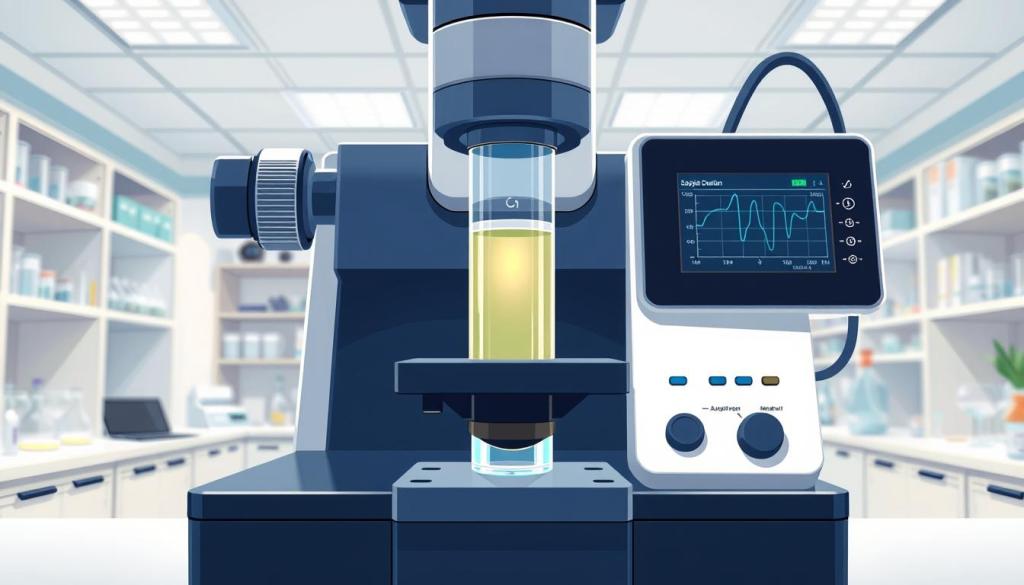
Scientists use several strategies to reduce unwanted signal variations in spectrophotometric experiments. Baseline correction helps remove systematic errors. It also makes data more reliable from measurements.
Understanding Baseline Correction
Baseline correction involves subtracting background noise from spectrophotometric readings. This ensures only the true signal of interest is analyzed during biochemical analysis.
- Identifies and removes instrumental background signals
- Increases measurement precision
- Reduces potential sources of experimental error
Techniques for Background Subtraction
Researchers use many approaches for effective baseline correction:
- Linear interpolation method
- Polynomial fitting techniques
- Advanced computational algorithms
The aim of these techniques is to create a clean, interference-free signal. This allows for precise quantitative analysis. By carefully implementing baseline correction, scientists can greatly improve their experimental results’ quality and reproducibility.
Enhancing Measurement Precision
Precision is key in analytical chemistry. It helps scientists get accurate data. This is crucial for reliable results.
Spectrophotometry needs careful attention. It’s important to get the same results every time.
Strategies for Minimizing Measurement Variations
Scientists use several ways to improve precision:
- Consistent blank preparation techniques
- Standardized calibration protocols
- Rigorous quality control procedures
- Advanced instrumental calibration
Improving Reproducibility in Research
Reproducibility is vital in science. By managing blank solutions well, scientists can lower variability.
| Precision Parameter | Impact on Results | Improvement Strategy |
|---|---|---|
| Instrumental Drift | High Variability | Regular Calibration |
| Solution Preparation | Moderate Variability | Standardized Protocols |
| Environmental Factors | Low Variability | Controlled Conditions |
Using these methods helps scientists rely on their spectrophotometry results. This moves science forward in many fields.
Types of Blanks Used
Spectrophotometry uses various blanks to get accurate results and avoid mistakes. Knowing about these blanks is key for scientists to get precise data.
Blanks play a big role in spectroscopy. There are three main types to improve measurement accuracy.
Solvent Blanks
Solvent blanks are the starting point for spectroscopy. They have everything but the target substance. This helps scientists deal with solvent effects and background noise.
- Eliminate solvent-related optical effects
- Provide baseline correction mechanism
- Standardize measurement conditions
Sample Blanks
Sample blanks are like the real samples but without the specific compound. They help spot any issues with the sample itself and how it’s measured.
- Control for sample preparation artifacts
- Validate experimental methodology
- Detect potential interference sources
Control Blanks
Control blanks are very important in complex studies, especially in biology and chemistry.
| Blank Type | Primary Purpose | Key Characteristics |
|---|---|---|
| Solvent Blank | Baseline Correction | Pure Solvent Reference |
| Sample Blank | Matrix Effect Assessment | Experimental Condition Simulation |
| Control Blank | Experimental Validation | Negative Reference Standard |
Choosing the right blanks is crucial for precise spectrophotometry results. It makes the data more reliable and consistent.
Procedure for Preparing a Blank
Preparing a blank for UV-Vis spectroscopy is key to getting accurate results. A well-made cuvette reference boosts the precision of spectrophotometric analysis.
Researchers need to follow a detailed process to make blanks for spectrophotometric experiments. This requires careful attention and specific lab techniques.
Steps for Proper Preparation
- Select an appropriate clean cuvette free from scratches or residue
- Choose a solvent matching the sample solution exactly
- Fill the cuvette to the standard measurement line
- Wipe the exterior of the cuvette with a lint-free tissue
- Ensure no air bubbles are present in the solution
Common Mistakes to Avoid
- Using contaminated glassware
- Selecting incorrect solvent for blank solution
- Overlooking potential chemical interactions
- Improper handling of cuvette reference
Spectrophotometric analysis needs careful technique. By following these preparation steps, researchers can reduce errors and improve data reliability.
Analyzing Absorbance Data
Spectrophotometric analysis needs careful reading of spectral data for accurate results. Scientists use advanced methods to get useful info from absorbance measurements.
Understanding spectral data involves several important steps. These steps turn raw data into useful scientific insights. Colorimetric assays help measure chemical amounts by how much light they absorb.
Interpreting Spectral Data
Interpreting spectral data requires focus on a few key areas:
- Identifying peak wavelengths
- Calculating absorbance values
- Recognizing spectral patterns
- Evaluating signal intensity
Adjusting for Blank Readings
Blank readings are vital for better absorbance measurements. Scientists use blank solutions as a starting point. This helps remove background noise and boosts accuracy.
Adjusting for blank readings involves:
- Preparing a reference blank solution
- Measuring the blank’s absorbance
- Subtracting blank values from sample measurements
- Calculating net absorbance
Proper blank reading adjustment ensures that researchers can confidently interpret spectrophotometric data across various scientific disciplines.
Applications of Blanks in Research
Spectrophotometric blanks are key in many scientific fields. They help make sure research is precise and reliable. Scientists use them to get rid of background noise and set up accurate starting points.
Use in Biochemical Assays
In biochemical research, blanks are crucial for getting exact numbers. Scientists use them to:
- Measure protein amounts accurately
- Study how enzymes work
- Understand complex molecular interactions
For example, the Bradford and Lowry assays need blanks to avoid interference from other substances.
Implications in Environmental Science
Environmental scientists use blanks to check water, soil, and air quality. They help scientists:
- Find tiny amounts of chemicals
- Reduce errors in measurements
- Confirm their findings
| Research Field | Blank Application | Key Benefit |
|---|---|---|
| Biochemistry | Protein Assays | Accurate Concentration Measurement |
| Environmental Science | Water Quality Analysis | Contaminant Detection |
| Materials Science | Chemical Composition | Precise Elemental Mapping |
By following strict protocols for making blanks, researchers can make their findings more trustworthy and reliable.
Conclusion: Importance of Blanks in Spectrophotometry
Knowing why blanks are important in spectrophotometry is key for scientists. Blanks help make sure measurements are accurate. They remove background noise, making results more reliable in many fields.
Summary of Key Points
Blanks are vital in spectrophotometry for standardizing tests and cutting down on mistakes. They act as reference points, helping scientists adjust instruments and remove background noise. This ensures data is consistent and reliable.
By using blanks correctly, scientists can reduce errors and improve their research quality. This makes their findings more trustworthy.
Best Practices for Reliable Results
To get accurate results, scientists must prepare blanks carefully. They need to use the right blank solutions and materials. They also need to follow strict preparation steps.
Training and paying attention to detail are crucial. Understanding spectrophotometry well helps scientists get reliable results.
Using blanks is a key part of spectrophotometry research. It helps scientists get precise measurements in fields like biochemistry and medicine. By understanding their role, scientists can make their measurements more accurate and reliable.
References and further readings:
1.Armbruster, D. A., & Pry, T. (2008). Limit of blank, limit of detection and limit of quantitation. The Clinical Biochemist Reviews, 29(Suppl 1), S49–S52.
https://pmc.ncbi.nlm.nih.gov/articles/PMC2556583/2.Morgan, B. R., Artiss, J. D., & Zak, B. (1991). Spectrophotometric study of hemoglobin as an interference in serum total protein blanking. Microchemical Journal, 44(3), 345–351.
https://www.sciencedirect.com/science/article/abs/pii/0026265X9190050Y3.Oliveira, T. A. C., Mesquita, R. B. R., & Lima, J. L. F. C. (2005). Blank signal correction in spectrophotometry using flow injection-multisite detection. Journal of AOAC International, 88(5), 1511–1517.
https://www.academia.edu/download/87205415/jaoac1511.pdf
FAQ
What exactly is a blank in spectrophotometry?
A blank in spectrophotometry is a sample with all parts of the solution except the analyte. It’s used for calibration and to remove background interference. This makes measurements more accurate and precise in scientific studies.
Why are blanks crucial in spectrophotometric measurements?
Blanks are key because they help subtract background noise and set a baseline. They account for solvent effects, instrumental variations, and other interference. This ensures the accuracy of measurements in research.
How do you prepare a proper blank for spectrophotometry?
To make a blank, use the same solvent and conditions as the sample but without the compound of interest. Place it in a clean cuvette and use it to zero the spectrophotometer before measuring the sample.
What are the different types of blanks used in spectrophotometry?
There are several types of blanks. Solvent blanks are pure solvent without the analyte. Reagent blanks have all reagents except the sample. Sample blanks have the sample matrix without the specific compound. Instrument blanks correct for instrumental background.
Can improper blank preparation affect research results?
Yes, wrong blank preparation can harm research results. It can cause systematic errors, reduce precision, and lead to false conclusions. This is true in fields like biochemistry, environmental science, and analytical chemistry.
How often should blanks be prepared in spectrophotometric analysis?
Blanks should be made for each set of measurements or experimental run. This ensures that any changes in conditions, reagent quality, or environment are accounted for.
What common mistakes should researchers avoid when using blanks?
Researchers should avoid contaminated cuvettes, wrong solvents, not zeroing the instrument, and not making fresh blanks for each set. Consistency and careful preparation are crucial for reliable measurements.
In what scientific fields are blanks most commonly used?
Blanks are vital in many fields, including biochemistry, environmental science, pharmaceutical research, food analysis, water quality testing, and clinical diagnostics. They ensure the accuracy of quantitative measurements in these areas.
Leo Bios
Hello, I’m Leo Bios. As an assistant lecturer, I teach cellular and
molecular biology to undergraduates at a regional US Midwest university. I started as a research tech in
a biotech startup over a decade ago, working on molecular diagnostic tools. This practical experience
fuels my teaching and writing, keeping me engaged in biology’s evolution.





Leave a Comment
Your email address will not be published. Required fields are marked *