



Ever wondered why the Erlenmeyer flask is key in science? It’s been a game-changer in labs since 1860, thanks to Emil Erlenmeyer.
This flask does more than hold liquids. Its special shape and wide base are crucial for many lab tasks. Scientists use it for mixing, experiments, and precise measurements in chemistry and biology labs.
The Erlenmeyer flask is great for growing microbes and handling complex reactions. Its design lets researchers mix and heat safely and efficiently. Its shape also cuts down on spills and keeps things stable during tests.
Key Takeaways
- Essential tool in scientific research and laboratory settings
- Unique conical design prevents spillage and enhances mixing
- Versatile equipment used in chemistry and biology labs
- Available in multiple sizes for diverse experimental needs
- Named after Emil Erlenmeyer, invented in 1860
- Supports various scientific processes from mixing to culturing
Overview of the Erlenmeyer Flask
Scientific tools have changed a lot since the 19th century. Laboratory glassware is key in research and experiments. The Erlenmeyer flask is a must-have in chemistry and biology labs.
History and Development
In 1861, German chemist Emil Erlenmeyer created a special flask. It became a must-have in labs. Its design was loved for being useful and versatile in chemistry.
“A well-designed scientific instrument can transform research capabilities.” – Scientific Innovation Magazine
Key Features of Erlenmeyer Flasks
Erlenmeyer flasks have special features:
- Broad flat base for stability
- Conical body for better mixing
- Narrow neck to stop spills
| Flask Type | Material | Volume Range | Primary Use |
|---|---|---|---|
| Standard Erlenmeyer | Borosilicate Glass | 50-2000 mL | General Laboratory Work |
| Culture Flask | Polypropylene | 25-250 mL | Microbiology Research |
| Shake Flask | Glass/Plastic | 125-500 mL | Cell Culture Experiments |
The Erlenmeyer flask is great for optimal liquid handling. It’s best to fill it to one-fifth of its total volume. This helps with gas exchange and makes experiments more efficient.
Primary Function of an Erlenmeyer Flask
Scientists use the Erlenmeyer flask for many important tasks in labs. It’s a special type of flask that helps with research and experiments. It’s very important in chemistry and biology labs.
Liquid Containment Capabilities
The Erlenmeyer flask is great at holding liquids. Its shape helps prevent spills during experiments. It’s better than other flasks in many ways:
- Less liquid evaporation
- Stays stable during tests
- Keeps dust out
- Protects samples well
Mixing Solutions with Precision
Researchers often mix solutions in the Erlenmeyer flask. Its shape allows for smooth mixing without spills. This is very useful in:
- Chemical titration
- Mixing solutions gently
- Controlling chemical reactions
“The Erlenmeyer flask’s design transforms simple liquid containment into a precise scientific instrument.” – Laboratory Research Quarterly
The flask has markings that show volume with an error of plus or minus 5%. This makes it very useful in labs where accuracy is key. It’s a must-have for mixing and measuring liquids.
Advantages of Using an Erlenmeyer Flask
Chemistry lab equipment has many types, but the Erlenmeyer flask is special. Its design and benefits make it a top choice for scientists. These containers are reliable for many experiments.
Stability and Design Excellence
The Erlenmeyer flask’s shape makes it very stable in labs. Its flat bottom keeps it upright, even in tricky experiments. This reduces spills. Knowing how an Erlenmeyer flask works shows its key role in science.
- Flat bottom provides exceptional stability
- Narrow neck minimizes liquid exposure
- Tapered design enhances mixing capabilities
Reduced Risk of Spillage
The flask’s design cuts down spill risks. Its narrow neck stops liquids from splashing out during chemical work.
“In precision science, every drop matters” – Laboratory Safety Handbook
Borosilicate glass Erlenmeyer flasks also have big pluses. They can handle extreme temperature changes well and last longer. Their flexibility makes them essential in chemistry and biology labs.
| Feature | Benefit |
|---|---|
| Flat Bottom | Prevents Tipping |
| Narrow Neck | Reduces Spillage |
| Tapered Design | Improves Mixing |
Key takeaway: Erlenmeyer flasks are a top example of lab glassware design. They offer unmatched stability and safety for scientific work.
Applications in Scientific Research
Erlenmeyer flasks are key in scientific labs. They help with many research tasks. These flasks are great for precise and reliable experiments.
Titration Processes
In analytical chemistry, Erlenmeyer flasks are vital for titration. Their design offers several benefits:
- Stable base for accurate chemical measurements
- Narrow neck prevents liquid splashing
- Easy mixing of chemical solutions

Cultivating Microorganisms
Scientists use Erlenmeyer flasks to grow microorganisms. The flask’s shape is perfect for bacteria and yeast growth.
| Microorganism Type | Cultivation Requirements |
|---|---|
| Bacteria | Controlled nutrient environment |
| Yeast | Consistent temperature and aeration |
| Cell Cultures | Sterile conditions with minimal contamination risk |
The Erlenmeyer flask’s design transforms simple laboratory glassware into a sophisticated scientific instrument for complex research processes.
Researchers love these flasks for their role in delicate experiments. The conical shape helps with mixing and keeps things clean.
Differences Between Erlenmeyer Flasks and Other Lab Glassware
Scientific labs use many types of glassware for different tasks. Flasks for chemistry are key, and Erlenmeyer flasks are special because of their design and use.
Comparing Erlenmeyer Flasks with Beakers
Erlenmeyer flasks are different from beakers in important ways:
- Shape: Their conical shape helps mix better
- Stability: The wide base makes them less likely to tip over
- Condensation: The tapered neck keeps liquids in better
“The unique design of Erlenmeyer flasks makes them superior for precise scientific work.”
Comparing with Volumetric Flasks
Even though both are important in labs, titration flasks and volumetric flasks are used for different things:
| Feature | Erlenmeyer Flask | Volumetric Flask |
|---|---|---|
| Precision | ±5% volume accuracy | <0.2% volume accuracy |
| Primary Use | Mixing, heating, storing | Precise measurement |
Scientists pick between these flasks based on what they need for their experiments. They know the best glassware for each task.
Materials Used in Erlenmeyer Flasks
Chemistry lab equipment includes many tools, with Erlenmeyer flasks being key. These flasks are made from different materials, each suited for various research tasks.

Exploring Glass and Plastic Flask Options
Scientists have two main choices for Erlenmeyer flasks:
- Borosilicate Glass Flasks
- Plastic Flasks
Characteristics of Borosilicate Glass Flasks
Borosilicate glass is known for its outstanding features:
- It can handle extreme temperatures (-196°C to 450°C)
- It’s highly resistant to chemicals
- It can withstand sudden temperature changes well
| Material | Temperature Range | Chemical Resistance | Typical Use |
|---|---|---|---|
| Borosilicate Glass | -196°C to 450°C | Excellent | High-temperature experiments |
| Plastic | Up to 121°C | Limited | Low-temperature procedures |
Advantages of Plastic Flasks
Plastic flasks have benefits for certain lab tasks:
- They are light
- They won’t break easily
- Some can be sterilized in an autoclave
The choice of flask material depends entirely on the specific experimental requirements and conditions.
When picking Erlenmeyer flasks, researchers must think about the material’s properties. Borosilicate glass is usually the top pick for precise and high-temperature work in chemistry labs.
Cleaning and Maintenance Guidelines
Keeping laboratory glassware clean is key for an Erlenmeyer flask’s function and reliable results. Cleaning and care can make these tools last longer.
To keep Erlenmeyer flasks in good shape, follow a detailed plan. This protects their structure and stops contamination. Scientists need to stick to certain steps to keep these tools in top condition.
Recommended Cleaning Methods
- Rinse right after use with warm water to stop residue buildup
- Use gentle laboratory detergents made for glassware
- Use soft brushes to avoid scratching the glass
- Rinse well with deionized water to get rid of chemical traces
- Optional sterilization methods include:
- Autoclaving
- Chemical disinfection
- Dry heat sterilization
Storage Best Practices
Storing Erlenmeyer flasks right is crucial for their function and safety. Good storage tips are:
- Keep them in a dry, dust-free spot
- Use glassware racks to avoid breakage
- Make sure there’s good air flow around them
- Don’t overcrowd storage areas
“Meticulous cleaning and careful storage are the cornerstones of maintaining high-quality laboratory equipment.”
Knowing how to use an Erlenmeyer flask is more than just holding things. By following these cleaning and storage tips, scientists can keep their glassware in top shape. This makes it ready for detailed scientific work.
Safety Considerations When Using Erlenmeyer Flasks
Working with chemistry lab equipment needs careful attention to safety. Erlenmeyer flasks are key lab tools that require careful handling. This is to avoid accidents and keep experiments accurate.
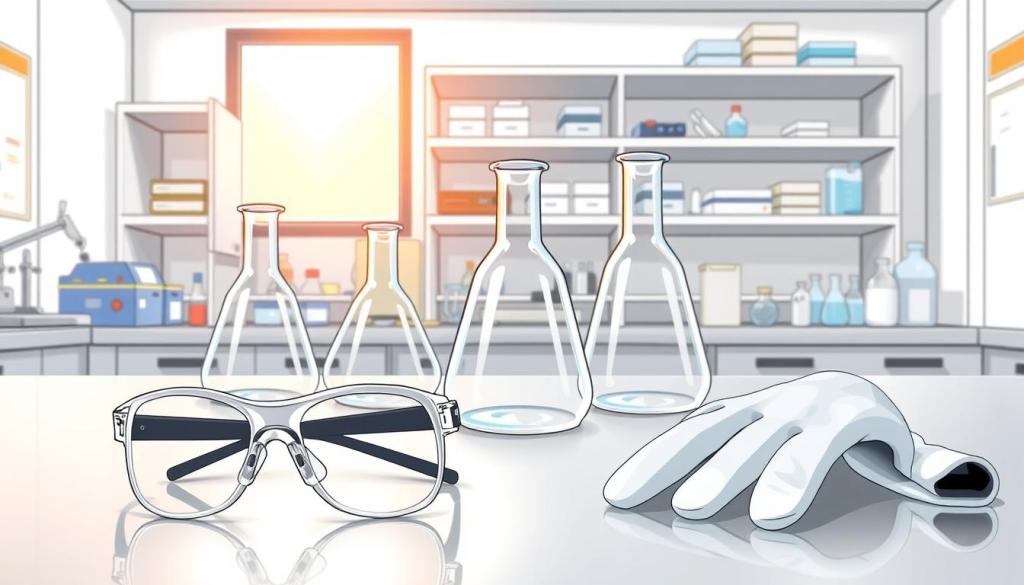
Starting with safety in scientific research is key. It’s about knowing how to use lab glassware right. Researchers must follow strict safety rules when using flasks. This keeps them safe and ensures experiments are precise.
Personal Protective Equipment
Keeping yourself safe is crucial when dealing with chemicals. You need:
- Chemical-resistant safety goggles
- Thick, impermeable laboratory gloves
- Lab coat with long sleeves
- Closed-toe shoes
Critical Handling Guidelines
Handling Erlenmeyer flasks right is vital for safety:
- Never heat a closed flask to avoid explosion risks
- Check glassware for cracks before use
- Use the right supports when heating
- Control stirring speed to avoid spills
“Safety is not an accident, but a deliberate choice in scientific research.” – Laboratory Safety Expert
Working with dangerous chemicals means keeping your workspace clean and organized. Erlenmeyer flasks should be stored upright and cleaned well after each use.
Knowing how lab glassware works helps reduce risks. Always put safety first to make a safe place for experiments.
Innovations in Erlenmeyer Flask Design
Scientific tools are always getting better, and Erlenmeyer flasks are no different. Today’s lab gear needs new features to help scientists do their work better and more precisely.
Modern Enhancements in Scientific Glassware
New designs in Erlenmeyer flasks have changed these key tools. Scientists get to use advanced features that make their work better and more accurate.
- Vented closures for better gas exchange during cell growth
- Special coatings for stronger chemical resistance
- Ergonomic shapes for easier use and less strain
Eco-Friendly Options in Laboratory Equipment
Erlenmeyer flasks now do more than just hold liquids. They’re made with green materials and processes that are kinder to our planet.
Innovation in lab tools is about doing well and doing good.
Today’s Erlenmeyer flasks come with cool features like:
- Recyclable materials to cut down on waste
- Energy-saving making methods
- Long-lasting designs to reduce waste
These updates show a big push towards making scientific tools that work great and are good for the Earth.
Summary and Conclusion
Erlenmeyer flasks are key in scientific research, showing great versatility in many fields. They are used for precise titration and complex microbiology experiments. Their conical shape is crucial for advancing science and improving experiments.
The design of the volumetric flask helps scientists conduct detailed chemical reactions safely. These flasks are stable, durable, and can handle different conditions. Their borosilicate glass makes them resistant to chemicals and heat, essential in labs.
Importance in Laboratory Settings
Research labs rely on Erlenmeyer flasks for their many uses. They are vital for microbiology, chemical analysis, and managing research. Their adaptability makes them a cornerstone in scientific work.
Future Trends in Lab Equipment Usage
New technologies will likely improve Erlenmeyer flasks, making them even better. They might become more durable, precise, and even smart. As science evolves, these tools will stay essential for research.
FAQ
What is an Erlenmeyer flask and what is its primary function?
An Erlenmeyer flask is a special piece of lab glassware. It has a conical shape with a narrow neck and flat bottom. It’s used to hold, mix, and heat liquids safely in experiments. This makes it more stable and less likely to spill than other containers.
Who invented the Erlenmeyer flask?
German chemist Emil Erlenmeyer invented the Erlenmeyer flask in the 19th century. He designed it to make lab work better. It’s more stable and functional for chemical experiments and solution preparation.
What makes the Erlenmeyer flask different from other lab containers?
Erlenmeyer flasks have a unique conical shape. This shape improves mixing, reduces evaporation, and helps with heat distribution. It also lowers the risk of spills during experiments.
What are the most common uses of an Erlenmeyer flask in a laboratory?
Erlenmeyer flasks are used in many ways in labs. They’re used for titration, mixing solutions, growing microorganisms, and more. They’re key in chemistry, biology, and medical research.
What materials are Erlenmeyer flasks typically made from?
Most Erlenmeyer flasks are made from borosilicate glass. This glass is strong and resistant to chemicals and heat. Some are also made from plastic, depending on the lab’s needs.
How do I properly clean an Erlenmeyer flask?
First, rinse the flask with distilled water. Then, use a cleaning solution like chromic acid. Use soft brushes for cleaning, avoiding scratches. Rinse well and let it dry before storing.
What safety precautions should be taken when using an Erlenmeyer flask?
Always wear safety goggles and gloves when using an Erlenmeyer flask. Make sure the area is well-ventilated. Use heat-resistant gloves for hot flasks. Check for damage before use and follow chemical handling guidelines.
Can Erlenmeyer flasks be used with heat sources?
Yes, borosilicate glass Erlenmeyer flasks can handle heat from hot plates and burners. But, use flasks designed for heating and follow safe heating methods to avoid breakage.
Are there different sizes of Erlenmeyer flasks available?
Erlenmeyer flasks come in many sizes, from 50 mL to 2000 mL or more. The size you need depends on your experiment and the amount of solution required.
What are the recent innovations in Erlenmeyer flask design?
New designs include flasks with vented closures for better gas exchange. There are also chemical-resistant coatings and ergonomic designs for easier use. Plus, there are more eco-friendly materials and production methods.




Leave a Comment
Your email address will not be published. Required fields are marked *