



Ever thought about how scientists measure a substance’s concentration with just light? Spectrophotometry shows us a world where light and molecules talk to each other in secret. It’s all about unlocking important scientific secrets.
In spectrophotometry, high absorbance means a substance takes in more light. This tells us a lot about its concentration and what it’s made of. The light we see, from 380 to 750 nanometers, helps us analyze samples in detail.
Scientists use spectrophotometry in many fields, like checking the environment and in medical tests. By studying how substances react to light, they learn a lot about what’s in a sample.
Key Takeaways
- Spectrophotometry measures how much light a substance absorbs
- High absorbance indicates greater light absorption by a sample
- Wavelength plays a critical role in analyzing light interactions
- Concentration directly influences absorbance values
- Scientific applications span multiple research fields
Understanding Absorbance in Spectrophotometry
Spectrophotometry is a key analytical tool that studies how light interacts with chemicals. It helps scientists understand materials by measuring light absorption at different wavelengths.
The heart of spectrophotometry is absorbance. This key measure shows how much light a substance absorbs when light passes through it.
Definition of Absorbance
Absorbance is the ratio of incoming to outgoing light intensity. It’s calculated as A = log(Io/It), where:
- Io is the initial light intensity
- It is the light that passes through
The Role of Light in Spectrophotometry
Light of different wavelengths interacts differently with substances. This creates unique absorption patterns. The Beer-Lambert law explains this, linking absorbance to concentration and path length.
| Absorbance Value | % Transmittance |
|---|---|
| 0 | 100% |
| 1 | 10% |
| 2 | 1% |
| 3 | 0.1% |
“Absorbance is the key to understanding how light interacts with matter.” – Analytical Chemistry Experts
Scientists usually measure absorbance between 0.05 and 1.0. This range gives the most reliable results, making it useful in many research and industrial settings.
The Relationship Between Concentration and Absorbance
Spectrophotometry connects concentration and light absorption. Scientists use the Beer-Lambert Law to see how chemical amounts affect light in solutions.
The Beer-Lambert Law is key for measuring amounts. Its main formula, A = εbc, shows how absorbance ties to important factors:
- A: Absorbance value
- ε: Molar absorptivity
- b: Path length
- c: Concentration of the solution
Understanding Molar Absorptivity
Molar absorptivity shows how well a substance absorbs light at certain wavelengths. Higher values mean:
- More light absorption
- Lower detection limits
- More precise concentration measurements
Factors Influencing Absorbance
Many factors affect spectrophotometry’s concentration measurements:
- Temperature changes
- pH variations
- Presence of interfering substances
- Wavelength of radiation
“Accurate concentration determination requires careful consideration of multiple environmental and chemical parameters.”
Researchers make standard curves with 3-5 known concentration solutions. This linear plot confirms measurements and ensures accurate results.
What Constitutes High Absorbance?
Spectrophotometry measures light absorption with clear criteria for high absorbance. Knowing these criteria is key for accurate scientific results.
Criteria for High Absorbance Measurements
In spectrophotometry, high absorbance is defined by specific ranges. Values between 0.05 and 1.0 are trusted by researchers. Beyond this, accuracy drops.
- Optimal absorbance range: 0.05 to 1.0
- Path length impacts absorbance readings
- Concentration directly influences absorption
Implications of High Absorbance Values
Scientists look at several factors when dealing with high absorbance. High absorbance means a lot of light is absorbed. This can be due to:
- Concentrated sample solutions
- Longer path length
- Molecular interaction characteristics
An absorbance of 1 signifies that 90% of light at a specific wavelength has been absorbed.
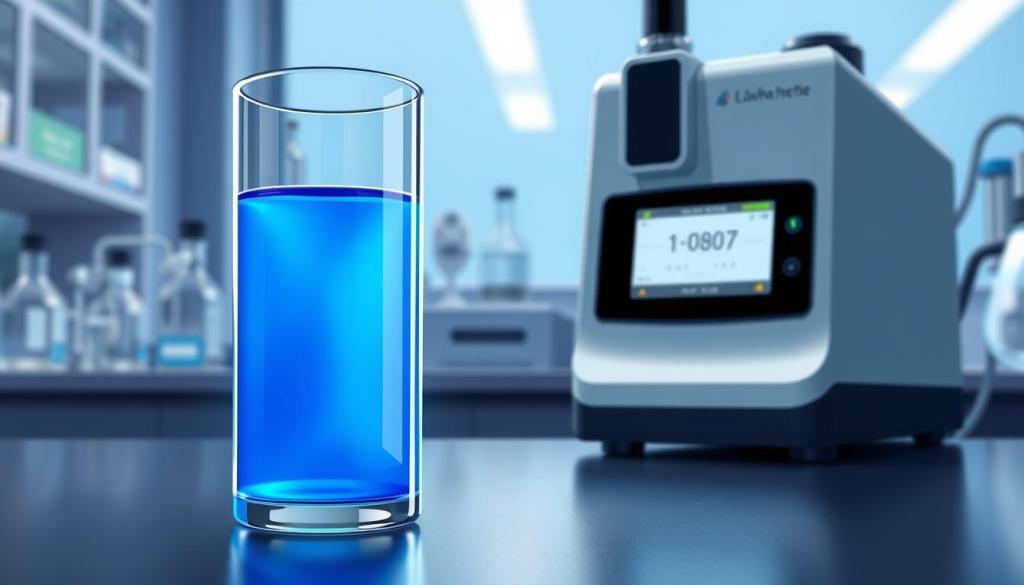
The path length is crucial in absorbance. The same solution in a 1 cm container might show different absorbance than in a 100 cm container. This shows why standard measurements are vital.
| Absorbance Value | Light Transmission | Interpretation |
|---|---|---|
| 0 | 100% | No light absorption |
| 0.3 | 50% | Moderate absorption |
| 1.0 | 10% | High absorption |
To grasp high absorbance, we must consider many factors. This ensures accurate spectrophotometric results in various fields.
Applications of High Absorbance Measurements
Spectrophotometry is key in many fields, offering detailed analysis. It uses advanced methods to study complex systems. This tool helps scientists understand chemical and biological processes.
Environmental Analysis Techniques
Environmental scientists use spectrophotometry to find and measure pollutants. It helps them track:
- Heavy metal levels in water
- Air pollution signs
- Gas emissions
Spectrophotometers can spot small changes in absorbance. This is crucial for environmental checks. It helps scientists find pollutants at very low levels, aiding in important research.
Clinical Diagnostic Applications
In medical labs, spectrophotometry gives vital information. It helps in:
- Checking blood chemistry
- Finding specific biomarkers
- Spotting metabolic changes
“Spectrophotometry transforms complex biological data into actionable medical insights.”
| Field | Typical Measurement Range | Key Application |
|---|---|---|
| Environmental Analysis | 0-4 Absorbance Units | Pollutant Detection |
| Clinical Diagnostics | 0-3 Absorbance Units | Biomarker Quantification |
The accuracy of spectrophotometry allows for thorough analysis in many areas. It shows the technology’s wide use and importance in today’s science.
Interpreting Spectrophotometry Data
Spectrophotometry is a powerful tool for colorimetric assays and quantitative analysis. It helps researchers understand how to read spectra. This is key for getting valuable insights from their data.
When analyzing spectral data, scientists need to pay close attention. They must look for specific absorption peaks. These peaks are important in both chemical and biological studies.
Techniques for Spectral Analysis
There are several ways to interpret spectra effectively:
- Identifying wavelength-specific absorption characteristics
- Recognizing peak intensity variations
- Evaluating baseline corrections
- Understanding concentration relationships
Peak Identification Strategies
For quantitative analysis, researchers should keep these points in mind:
- Examine peak location across the visible spectrum (380-750 nm)
- Analyze peak height and width
- Compare experimental data with reference spectra
- Apply mathematical smoothing techniques
“Precise spectral interpretation transforms raw data into meaningful scientific knowledge.”
The wavelength range and absorption characteristics are very important. They tell us about molecular structure and concentration. By carefully identifying peaks, researchers can get the most out of their spectrophotometric measurements.
| Peak Characteristic | Interpretation Significance |
|---|---|
| Wavelength Position | Indicates molecular composition |
| Peak Intensity | Reflects concentration levels |
| Peak Width | Suggests molecular environment |
By learning these techniques, researchers can make their colorimetric assays more accurate. This is true across many scientific fields.
Instruments Used in Spectrophotometry
Spectrophotometry uses advanced tools to measure light absorption. These tools are key in many scientific fields. They help us understand how materials react with light.
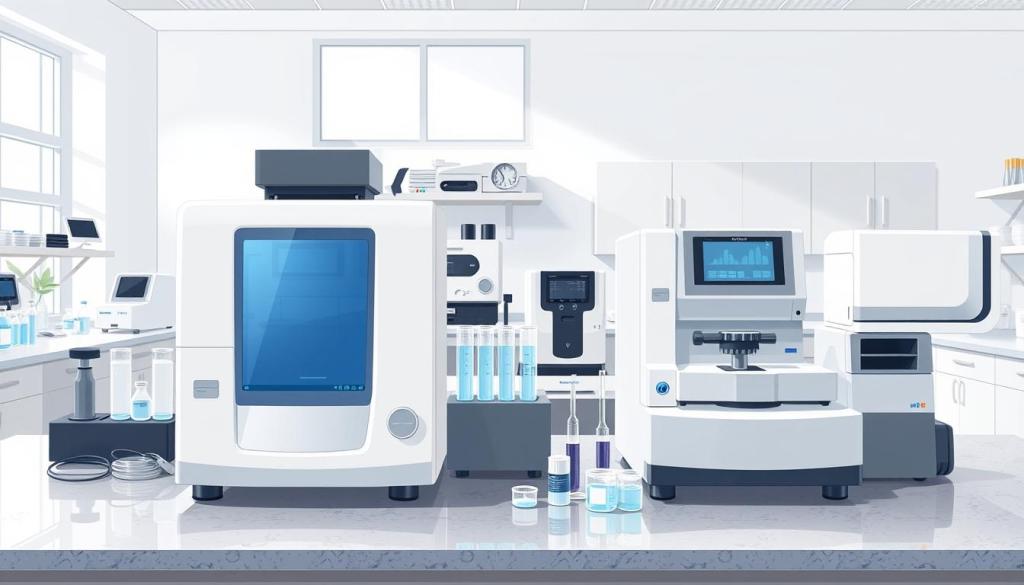
Scientists use various spectrophotometers to study light absorption. Each tool has special features for different studies.
Types of Spectrophotometers
- Single-Beam Spectrophotometers: Compact instruments sensitive to light variations
- Double-Beam Spectrophotometers: Provide stable measurements by comparing reference and sample intensities
- Array Spectrophotometers: Advanced systems capable of simultaneous wavelength analysis
Key Features to Consider
Choosing a spectrophotometer requires looking at important features. These features affect how accurate the measurements are:
| Feature | Importance | Impact on Measurements |
|---|---|---|
| Wavelength Range | Determines analysis spectrum | Broader range enables more comprehensive research |
| Spectral Bandwidth | Defines resolution | Narrower bandwidth provides higher precision |
| Detector Sensitivity | Measures light detection capability | Higher sensitivity allows detecting minute absorption changes |
Today’s spectrophotometers use new techniques like derivative spectroscopy and multicomponent analysis. These methods help scientists study complex samples in great detail.
The power of spectrophotometry lies not just in measuring light absorption, but in understanding the intricate interactions between matter and electromagnetic radiation.
Common Mistakes in Measuring Absorbance
Spectrophotometry needs precise light absorption and sample analysis. Scientists often face challenges that can affect their accuracy. Knowing these issues is key for reliable research.
Calibration Errors in Spectrophotometry
Calibration is a crucial step for accurate spectrophotometry. A study by the College of American Pathologists found big differences in lab measurements:
- Coefficients of variation in absorbance reached up to 22% in initial tests
- Wavelength accuracy can be stated within 6-7 significant digits
- Refractive indices can be measured to within 5 decimal points
Sample Preparation Challenges
Good sample preparation is essential for reliable absorbance readings. Important points include:
- Ensuring consistent solvent conditions
- Minimizing particulate interference
- Selecting appropriate reference solutions
*Precision in sample analysis requires meticulous attention to detail and understanding of potential measurement limitations.*
The Beer-Lambert Law is very helpful, but it has its limits. Absorbance measurements work best when concentrations are between 0 and 2 absorbance units.
| Error Type | Potential Impact | Mitigation Strategy |
|---|---|---|
| Stray Light | Reduces measurement accuracy | Use high-quality instruments |
| Wavelength Deviation | Introduces systematic errors | Calibrate instrument regularly |
| Sample Contamination | Skews absorption readings | Implement strict cleaning protocols |
By knowing and fixing these common mistakes, researchers can greatly improve their spectrophotometry results.
Troubleshooting High Absorbance Readings
Spectrophotometry can be tricky when you get high absorbance readings. Knowing what causes these issues helps keep your measurements accurate and reliable.
Identifying Background Interference
Background interference can really mess up your spectrophotometry readings. Several things can lead to these problems:
- Light scattering from suspended particles
- Stray light contamination
- Optical system imperfections
Assessing Sample Conditions
Many things about your sample can cause high absorbance readings:
- Temperature variations affecting molecular interactions
- pH level changes disrupting chemical equilibrium
- Solvent effects modifying light absorption characteristics
“Precise sample preparation is crucial for accurate spectrophotometric analysis.”
To fix these issues, researchers need to take a few steps. Calibration, careful sample prep, and regular checks can make your measurements much better.
The Importance of Accuracy in Absorbance Measurements
Precision in spectrophotometric measurements is key in science and quality control. It’s vital for accurate colorimetric assays. These need to be done with great care.
Experts know that small errors in absorbance can change results and product quality. This shows how important it is to get it right.
Impacts on Scientific Research
Getting accurate absorbance measurements is crucial for science. It helps researchers:
- Check if their results are correct
- Make sure studies can be repeated
- Reduce uncertainty in experiments
- Make data more reliable
Quality Control in Industries
Industries need precise spectrophotometry for quality. Here are some important metrics:
| Measurement Parameter | Accuracy Requirement |
|---|---|
| Absorbance Values Below 1.0 A | ± 0.005 from certified value |
| Absorbance Values Above 1.0 A | ± 0.005 multiplied by A |
| Precision Standard Deviation | Must not exceed 0.5% |
“Precision is the soul of scientific measurement” – Anonymous Researcher
Keeping high accuracy standards helps industries. It ensures quality, meets rules, and reduces risks from errors.
Future Trends in Spectrophotometry
The world of spectrophotometry is changing fast. New technologies and teamwork between fields are leading the way. Scientists are exploring new ways to measure light absorption in many areas of science.
Emerging Technological Innovations
Today’s spectrophotometers are getting better and better. They can detect things more accurately than before. Here are some of the latest advancements:
- Ultraviolet light (UV) spectrophotometers
- Multi-beam detection systems
- Portable and miniaturized devices
- High-resolution optical sensors
Integration with Analytical Techniques
Spectrophotometry is now part of a bigger team. Scientists are mixing it with other methods to get better results. This teamwork makes data more precise and detailed.
| Analytical Technique | Integration Benefits |
|---|---|
| Chromatography | Enhanced compound separation and identification |
| Mass Spectrometry | Improved molecular weight determination |
| Machine Learning | Advanced data interpretation and prediction |
Advanced Data Processing
The future of spectrophotometry is in smart data handling. Artificial intelligence and machine learning are changing how we understand complex data. This leads to more accurate and detailed analysis of light absorption.
“The next generation of spectrophotometers will transform scientific research through unprecedented precision and intelligent data interpretation.” – Scientific Innovation Journal
These new technologies will make spectrophotometry even more powerful. It will help in environmental studies, medical tests, and materials science. This means we can measure light absorption in new and exciting ways.
The Role of High Absorbance in Quality Control
Quality control is key in today’s manufacturing and research. Spectrophotometry helps ensure products are consistent and meet high standards. It does this through precise analysis and concentration checks.
Many industries use high absorbance to keep their products top-notch. They follow several steps:
- Real-time monitoring of manufacturing processes
- Detecting subtle deviations in product composition
- Ensuring compliance with regulatory requirements
Monitoring Manufacturing Processes
Spectrophotometry lets us track product features closely. It’s used in fields like pharmaceuticals and food production to check for consistency. Every day, labs do over 1,000,000 spectrophotometric measurements, showing how vital this tech is.
Ensuring Compliance with Standards
To follow rules, we need to measure carefully. High absorbance gives us the data needed to:
- Check product quality
- Record manufacturing performance
- Keep up with industry standards
“Precision in measurement is the cornerstone of quality control” – Scientific Quality Management Principle
Research shows clinical chemistry is growing at about 15% each year. This highlights the need for accurate ways to measure concentration.
| Industry | Typical Measurement Focus | Precision Requirements |
|---|---|---|
| Pharmaceutical | Active Component Concentration | ±0.1% variation |
| Food & Beverage | Nutrient Content | ±0.5% variation |
| Environmental | Contaminant Levels | ±0.2% variation |
These measurements give manufacturers important insights. They help manage quality and improve production.
Conclusion: The Significance of High Absorbance
Spectrophotometry gives us deep insights into the world of analytical measurement. Knowing what high absorbance means in spectrophotometry is key. It helps scientists get precise information about chemicals and molecules in many fields.
Understanding high absorbance needs a good grasp of light and how molecules interact. It’s known that values between 0 and 1 are the most reliable for accurate analysis. As absorbance goes up, the amount of light that gets through decreases a lot.
Key Measurement Insights
Science depends on spectrophotometry to study concentration, molecular properties, and chemical reactions. The Beer-Lambert law shows how absorbance is linked to concentration. This makes it possible to do precise measurements in many areas, like the environment, health, and research.
Future Research Directions
New spectrophotometric methods are making big strides, improving how we detect things and understanding molecules. Scientists hope for even better tools soon. These will make measurements even more precise and open up new uses for high absorbance spectroscopy.
FAQ
What is absorbance in spectrophotometry?
Absorbance measures how much light a sample absorbs at a certain wavelength. It’s found using the Beer-Lambert Law. This law shows the ratio of light before and after passing through the sample. It’s key for detailed analysis in chemistry, biology, and environmental science.
How does high absorbance relate to sample concentration?
High absorbance means a sample has a lot of substance. The Beer-Lambert Law shows a direct link between absorbance and concentration. But, very high values can cause problems with spectrophotometer limits and non-linear effects.
What factors can affect absorbance measurements?
Many things can change absorbance readings. These include:
– Temperature – pH of the sample
– Solvent composition
– Interfering substances – Path length of the sample container
– Wavelength of light used
– How the sample is prepared
What is the Beer-Lambert Law?
The Beer-Lambert Law is a key rule in spectrophotometry. It links absorbance, concentration, and path length. It says absorbance goes up with concentration and path length. The formula is A = ε * c * l, where A is absorbance, ε is molar absorptivity, c is concentration, and l is path length.
When should I dilute a sample with high absorbance?
Dilute a sample if its absorbance is too high for the spectrophotometer. This is usually above 0.1 to 1.0 absorbance units. Dilution ensures:
– Accurate measurements – Follows the Beer-Lambert Law – Avoids detector overload – Better precision
What are common applications of spectrophotometry?
Spectrophotometry is used in many areas. These include:
– Clinical diagnostics – Environmental monitoring – Pharmaceutical quality control – Food and beverage analysis – Materials science – Chemical research – Forensic science
How can I improve the accuracy of absorbance measurements?
To get better absorbance readings:
– Regularly calibrate instruments – Use clean, high-quality cuvettes – Carefully prepare samples – Use the right blank solutions – Control the environment – Choose the correct wavelength – Use statistical quality control




Leave a Comment
Your email address will not be published. Required fields are marked *