


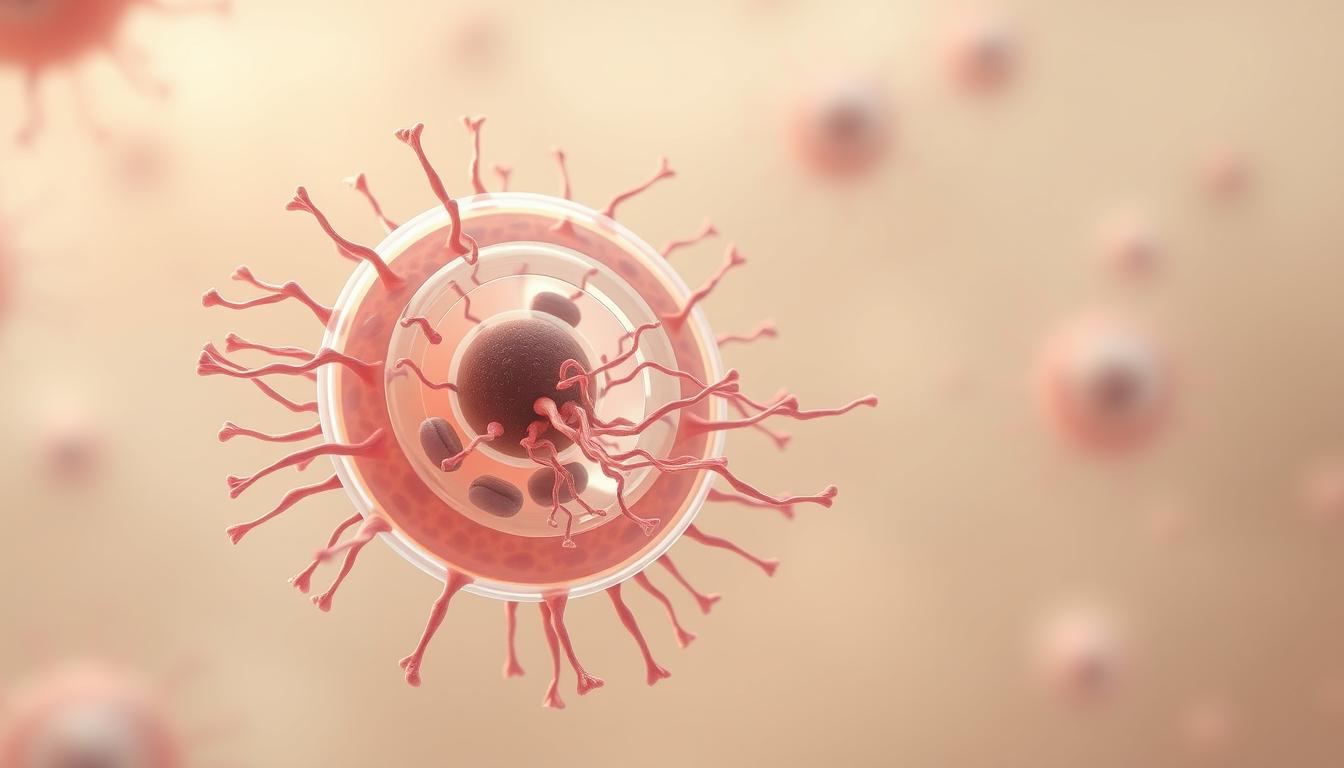
Ever thought about how your body fixes itself and stays strong? It’s all thanks to fibroblast cells, the hidden stars of our body’s structure.
Fibroblasts are the most common cells in connective tissues. They are key in building our body’s framework. These cells make many important parts of our connective tissue, like collagen, which gives strength and flexibility.
They are vital for healing wounds and keeping organs in shape. Fibroblasts create the extracellular matrix (ECM) that holds everything together. They make nonrigid matrices rich in collagen and respond to signals, helping in tissue repair and growth.
Key Takeaways
- Fibroblasts are primary producers of connective tissue components
- They secrete critical extracellular matrix proteins like collagen
- Fibroblasts can migrate and proliferate during tissue repair
- These cells are responsive to chemical signals in the body
- Fibroblasts contribute to wound healing and tissue regeneration
Introduction to Fibroblast Cells
Fibroblasts are key cells in our body’s complex system. They are the main part of connective tissue. They help keep our body’s structure strong and support many body functions.
Defining Fibroblast Cells
Fibroblasts come from mesenchymal cells. They have a long, spindle shape. Their special shape lets them work well with the stuff around them.
- Originate from mesenchymal stem cells
- Most abundant cell type in connective tissue
- Possess remarkable adaptability in various physiological conditions
Critical Role in Connective Tissue Components
In connective tissue, fibroblasts are the main builders. They make and keep the extracellular matrix strong. This helps the tissue stay strong and flexible.
“Fibroblasts are the cellular sculptors of our body’s structural framework.” – Cellular Biology Research
| Fibroblast Function | Key Contribution |
|---|---|
| Matrix Production | Synthesize collagen, elastin, glycosaminoglycans |
| Tissue Maintenance | Regulate structural integrity and repair mechanisms |
| Cellular Signaling | Secrete growth factors and cytokines |
These cells are very flexible and important. They help keep our body balanced and ready for challenges.
Major Products of Fibroblast Cells
Fibroblast cells are amazing factories in our bodies. They make key parts for keeping tissues healthy and strong. They create the extracellular matrix, which supports and talks to cells.
Collagen Production
Collagen is a big deal for fibroblast cells. They make types I, III, and IV collagen. These collagens are vital for keeping tissues together.
The process of making collagen is complex. It involves many steps to create the right proteins.
- Type I Collagen: Primary structural protein in skin, tendons, and bones
- Type III Collagen: Found in soft tissues and blood vessels
- Type IV Collagen: Critical component of basement membranes
Elastin Synthesis
Elastin is another important product of fibroblast cells. It makes tissues stretchy and strong. Elastin lets skin and blood vessels stretch and bounce back.
Glycosaminoglycans
Glycosaminoglycans are complex sugars. They help keep tissues moist and strong. Fibroblasts keep making these molecules to keep tissues hydrated and cushioned.
| Product | Function | Tissue Location |
|---|---|---|
| Collagen | Structural support | Skin, bones, tendons |
| Elastin | Tissue elasticity | Blood vessels, skin |
| Glycosaminoglycans | Hydration, cushioning | Connective tissues |
Fibroblasts are the primary architects of our body’s structural framework, continuously generating and maintaining the extracellular matrix.
The Importance of Collagen
Collagen is key to our skin’s structure, keeping it strong and healthy. It’s vital for skin repair and overall health.
Creating collagen is a complex process. It makes our skin flexible and strong. Fibroblasts, special cells, produce this protein.
Types of Collagen Produced
Fibroblasts make different types of collagen. Each type has its own role:
- Type I Collagen: Makes up most of our skin’s dry weight
- Type III Collagen: Helps our skin stay elastic
- Type V Collagen: Helps form complex fibers
Role in Skin and Tissue Repair
Collagen is crucial for healing and skin repair. It helps in:
- Closing wounds and rebuilding tissues
- Keeping our skin’s structure intact
- Helping cells talk to each other
Collagen’s half-life is about 15 years. This shows its long-term role in skin health.
| Collagen Type | Primary Function | Skin Contribution |
|---|---|---|
| Type I | Primary structural support | 90% of skin composition |
| Type III | Tissue elasticity | Supports skin flexibility |
| Type V | Fiber network formation | Enhances structural complexity |
Knowing about collagen becomes more important as we get older. Our body makes less collagen over time. Things like UV rays, what we eat, and how we live affect our skin’s collagen.
Elastin and Its Functions
Fibroblast cells are key in making elastin, a protein that lets skin stretch and bounce back. Knowing how elastin works helps us understand skin renewal and aging.

Elastin is a special protein that makes tissues flexible. It’s mostly in the dermis and makes up 2% to 4% of the skin’s dry weight. Its structure lets it stretch up to 1,000 times more than collagen.
Importance of Elasticity in Tissues
Elastin’s elasticity is vital for many body systems. It helps:
- skin go back to its shape after stretching
- blood vessels stay flexible
- lungs expand during breathing
- joints move freely
Impact on Aging and Skin Health
Elastin production changes a lot with age. In early life, making new elastin is at its highest. But as we get older, making new elastin almost stops, affecting skin renewal.
“Elastin is the body’s natural elastic band, providing resilience and flexibility to tissues.” – Dermatological Research Institute
As we age, elastin’s structure and function change. Things like too much sun can break down elastin, causing:
- wrinkles
- skin sagging
- less skin elasticity
- skin that’s more fragile
| Age Group | Elastin Production | Skin Elasticity |
|---|---|---|
| Childhood | High | Excellent |
| Young Adult | Moderate | Very Good |
| Middle Age | Low | Declining |
| Senior Years | Minimal | Significantly Reduced |
Knowing about elastin helps us choose better skin care and treatments as we age.
Glycosaminoglycans: The Unsung Heroes
Fibroblasts are key in making glycosaminoglycans (GAGs). These are important parts of the extracellular matrix. They help keep tissues healthy and support many body functions.
GAGs are special parts of connective tissue. They have repeating units called disaccharides. There are five main types:
- Hyaluronan
- Chondroitin
- Dermatan
- Heparin/Heparan
- Keratan
Structure and Composition
GAGs have a negative charge. This lets them work well in the extracellular matrix. Four out of five GAG types are sulfated. This makes them important for many body functions.
Functional Significance in Hydration and Lubrication
GAGs help keep tissues hydrated and joints lubricated. Their structure holds water, creating a gel-like space. This helps cells work well and keeps tissues strong.
Glycosaminoglycans are the silent guardians of cellular health, working tirelessly to maintain tissue hydration and support critical physiological processes.
GAGs do more than just keep tissues hydrated. They also:
- Help control growth factors
- Support cell signaling
- Give structure to connective tissues
Learning about GAGs shows how important they are. They help create the best environment for cells and keep tissues healthy.
Fibroblasts and Wound Healing
The wound healing process is complex. Fibroblasts are key in this process. They help repair damaged tissue and restore structure through cell interactions.
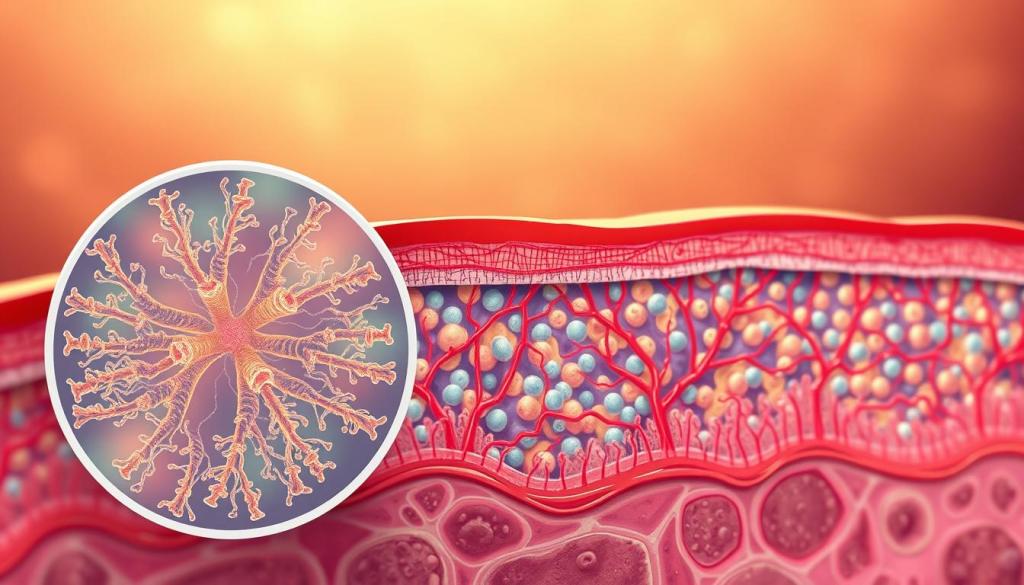
Wound healing goes through several stages. These stages transform damaged tissue into functional repair. The main phases are:
- Inflammation
- Proliferation
- Remodeling
Stages of Wound Healing
Fibroblasts change a lot during wound healing. They move to injury sites, grow fast, and make essential tissue components. This growth phase lasts about 2-3 weeks, starting 4 days after injury.
Contribution to Scar Formation
Scar formation is a natural part of wound healing. Fibroblasts turn into myofibroblasts. These cells help close wounds by making collagen.
Myofibroblasts are crucial agents in wound repair, generating traction forces through complex molecular mechanisms.
| Wound Healing Phase | Fibroblast Activity | Duration |
|---|---|---|
| Inflammation | Initial migration | 1-4 days |
| Proliferation | Rapid cell division | 4-21 days |
| Remodeling | Collagen restructuring | 21 days – 1 year |
Fibroblasts help repair wounds but can also cause too much scarring. Age, diseases, and genetics affect this process a lot.
Role of Fibroblasts in Inflammation
Fibroblasts are key players in the body’s fight against inflammation. They work closely with immune cells to manage inflammation and help wounds heal. Their response to growth factors is vital in these processes.
The connection between fibroblasts and immune cells is complex. It shows a detailed communication network that drives inflammation. Recent studies have shed light on how these cells act in inflammatory conditions.
Interaction with Immune Cells
Fibroblasts are very flexible in talking to immune cells. They do this through several ways:
- Secreting inflammatory cytokines
- Recruiting immune cells to infection sites
- Modulating immune system responses
- Producing critical growth factors
Fibroblast Activation in Inflammatory Responses
Fibroblasts get activated through complex processes. Researchers have found specific ways to trigger their response during inflammation.
“Fibroblasts are not passive bystanders but active participants in inflammatory processes”
Single-cell RNA sequencing has given us a closer look at fibroblast diversity in inflammation. It shows that tissues have different fibroblast types. Each type has its own role in inflammation.
| Fibroblast Type | Inflammatory Response | Key Function |
|---|---|---|
| Progenitor Fibroblasts | Initial Response | Trigger Immune Recruitment |
| Steady-State Fibroblasts | Moderate Response | Maintain Tissue Homeostasis |
| Inflammation-Associated Fibroblasts | Intense Response | Direct Immune Cell Activation |
Learning about fibroblasts’ role in inflammation could lead to new treatments for chronic conditions. Their ability to produce growth factors is crucial for healing wounds and repairing tissues.
Influence of Fibroblasts on Organ Function
Fibroblasts are key to keeping organs working well. They work closely with connective tissue to support organs. These cells are vital for the structure and repair of many organs.

The extracellular matrix is where fibroblasts show their skills. They make important proteins and signals. These help keep tissues in good shape and working right.
Contribution to Organ Structure
Fibroblasts help build the shape of organs:
- They make proteins like collagen and elastin.
- They control how tissues feel and work.
- They keep cells in the right place.
- They help special cells do their jobs.
Role in Organ Regeneration
Fibroblasts are key in fixing damaged organs. They help in many ways:
- They make growth factors.
- They help keep stem cells ready to work.
- They help cells turn into the right type.
- They help control inflammation.
“Fibroblasts are not just passive structural cells, but active participants in organ homeostasis and regeneration.”
Studies show how fibroblasts work differently in each organ. They change how they work based on the organ. This helps them support repair in each place.
| Organ System | Fibroblast Function | Key Markers |
|---|---|---|
| Intestinal | Stem Cell Niche Support | GLI-1, CD90, FSP-1 |
| Dermal | Wound Healing | α-SMA, Vimentin |
| Cardiac | Tissue Remodeling | PDGFR-α, Collagen I |
The dynamic nature of fibroblasts underscores their pivotal role in maintaining organ function and supporting regenerative processes.
Factors Affecting Fibroblast Activity
Fibroblast cells are key to keeping tissues healthy and strong. Many things can change how these cells work. This affects how we age and how we look.
Knowing what affects fibroblast cells helps us understand aging and healing.
Age-Related Changes in Fibroblast Behavior
As we get older, fibroblast cells change a lot. Important changes include:
- They grow slower
- They make less of the tissue’s framework
- They don’t make as much collagen
- They heal wounds more slowly
Lifestyle Factors Influencing Fibroblast Function
Our lifestyle choices really affect how fibroblast cells work. This impacts aging. Key factors are:
| Factor | Impact on Fibroblasts |
|---|---|
| Nutrition | Helps cells grow back and make more tissue |
| Physical Exercise | Makes cells work better and repair faster |
| Stress Management | Helps cells stay healthy by reducing inflammation |
| Environmental Exposure | Can speed up or slow down aging |
These lifestyle choices can help or hurt how fibroblast cells work. This opens up new ways to look younger and healthier.
The resilience of fibroblast cells reflects the body’s remarkable capacity for adaptation and regeneration.
Learning about these complex processes helps doctors and scientists find new ways to fight aging.
Research and Future Directions
Fibroblast research is growing fast, leading to new insights in cell biology and possible treatments. Recent findings have changed how we see these cells. This opens up new areas for medical and beauty uses.
Scientists have made big discoveries about fibroblasts using new tech like single-cell RNA sequencing. These tools have shown how different and complex fibroblasts are.
Advances in Fibroblast Study
Research has made big strides in understanding what fibroblasts can do:
- Found many types of fibroblasts with special traits
- Learned more about how cells talk to each other and grow
- Found better ways to see how cells change
Potential Therapeutic Applications
Scientists are looking into how fibroblasts can help in medicine and beauty. The growth factors they make could help fix and make tissues new again.
| Research Area | Potential Applications |
|---|---|
| Tissue Engineering | Wound healing, organ regeneration |
| Cosmetic Applications | Anti-aging treatments, skin reconstruction |
| Regenerative Medicine | Cellular therapies, targeted interventions |
As we learn more, fibroblast research is finding new ways to heal and change cells.
“The future of fibroblast research lies in understanding their incredible plasticity and therapeutic potential.” – Cellular Biology Research Consortium
With more studies and tech, fibroblasts are at the forefront of medical breakthroughs. They promise big changes in many health areas.
Conclusion: The Essential Role of Fibroblast Cells
Fibroblast cells are key to our body’s health. They help keep tissues strong and working right. These cells make important stuff like collagen and elastin, which are in our skin and connective tissues.
They are very important because they make up a big part of our skin. About 70% of our skin’s dry weight is collagen type I. This shows how vital fibroblasts are for our skin’s structure.
Fibroblast cells do more than just hold things together. They change and help in many ways. They help heal wounds and fight off infections. They also keep our tissues healthy by changing the stuff around them.
Summary of Functions
Fibroblast cells do a lot more than just keep tissues together. They help fix damaged tissues, control inflammation, and even help grow new organs. They come in different types, each with its own job. This shows how important they are for our health.
Final Thoughts on Fibroblast Importance
Research is showing us more about fibroblast cells. They could be very helpful in new medical treatments. They are at the center of new ways to fix damaged tissues and understand how our cells work.
FAQ
What are fibroblast cells and what is their primary function?
Fibroblast cells are special cells found in connective tissue. They help make and keep the tissue’s structure strong. They make collagen, elastin, and glycosaminoglycans, which are key for tissue health.
What are the main products produced by fibroblast cells?
Fibroblasts make collagen, elastin, and glycosaminoglycans. These help tissues stay strong and flexible. They are vital for the body’s connective tissues.
How do fibroblasts contribute to wound healing?
Fibroblasts turn into myofibroblasts to help heal wounds. They make collagen and other materials to repair tissue. They also help close the wound and form scars.
How do fibroblasts change with age?
As we get older, fibroblasts work less. They make fewer materials and grow slower. This leads to older skin and slower healing.
What role do fibroblasts play in inflammation?
Fibroblasts work with immune cells during inflammation. They make substances that help or hinder inflammation. They play a key role in healing and managing inflammation.
Can fibroblast activity be influenced by external factors?
Yes, many things can change how fibroblasts work. Diet, exercise, stress, and UV rays can all affect them. These changes can impact how well tissues heal and grow.
What are the potential future applications of fibroblast research?
Research on fibroblasts could lead to new treatments. They might help in regenerative medicine and treating fibrotic diseases. New technologies could unlock ways to improve wound healing and fight aging.
How do fibroblasts support organ function?
Fibroblasts help organs work by making the right materials. They keep the tissue’s environment right and support special cell functions. They help keep organs strong and can even help them grow back.




Leave a Comment
Your email address will not be published. Required fields are marked *