


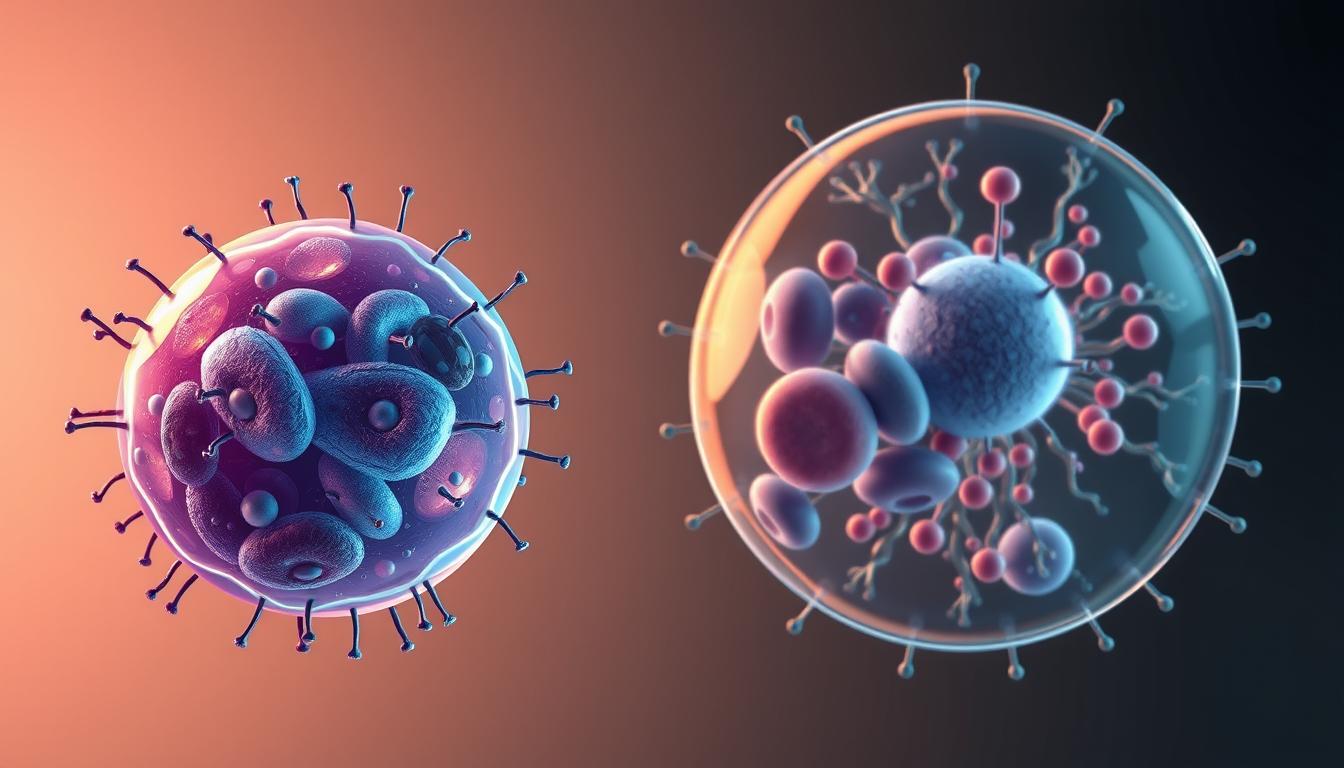
Have you ever thought about how tiny bacteria differ from the complex cells in our bodies? The world of cell structure is full of amazing diversity. It challenges our view of life.
Looking at the differences between prokaryotic and eukaryotic cells shows us how unique bacterial cells are. Scientists have found big differences in size, structure, and function. These differences define their own worlds.
In our bodies, there are more bacterial cells than human cells, by a lot. Yet, these tiny beings only make up a small part of our body’s mass. They are just 1 to 3 percent of our total body mass.
Understanding cell structure helps us see these big biological differences. Prokaryotic cells, like bacteria, are simpler than the complex eukaryotic cells in humans. This shows the incredible diversity of life at the cellular level.
Key Takeaways
- Bacterial cells are much smaller than human cells
- Prokaryotic organisms are the most common in our world
- Human cells have complex parts that bacterial cells lack
- Cell structure affects what cells can do
- Microorganisms are key to our biological systems
Overview of Cellular Structures
The world of cells is full of interesting differences between bacteria and human cells. Learning about these differences helps us understand how life works at its most basic level.
Cellular biology shows us how diverse cells can be. Bacteria and human cells organize themselves in very different ways.
Defining Bacterial Cells
Prokaryotic cells, like bacteria, have special features:
- Diameter ranges from 0.1–5.0 µm
- Lack a membrane-bound nucleus
- Contain a nucleoid region housing genetic material
- Possess four core components:
- Plasma membrane
- Cytoplasm
- DNA
- Ribosomes
Understanding Human Cells
Eukaryotic cells, like those in humans, are more complex:
- Diameter typically ranges from 10–100 µm
- Contain a membrane-bound nucleus
- Feature specialized organelles
- Enable advanced cellular compartmentalization
Significance of Cell Comparisons
Comparing cells gives us important insights. Cellular biology helps us understand evolution, diseases, and life’s basics.
“The complexity of cellular structures demonstrates nature’s incredible design capabilities.” – Anonymous Cellular Biologist
Scientists keep studying the differences between bacterial and human cells. They find new ways to understand life and discover medical breakthroughs.
Size and Shape Variations
The world of microbiology shows us how different bacterial and human cells can be. These differences help us understand how cells work and adapt.

Bacteria come in many shapes and sizes. They are much smaller than human cells, ranging from 0.5 to 10 micrometers.
Bacterial Cell Morphologies
Bacteria have unique shapes that help them survive and interact with their environment:
- Cocci: Spherical bacteria ranging from 0.5 to 1.0 micrometers in diameter
- Bacilli: Rod-shaped cells approximately 0.5 to 1.0 µm wide and 1 to 4 µm long
- Spirilla: Spiral-shaped bacteria extending 5 to 40 µm in length
Comparative Cell Dimensions
In cytology, the size difference between bacterial and human cells is huge. Bacterial cells are about 1 µm in diameter, while human cells are 10 to 100 micrometers.
“The microscopic world is a testament to the incredible diversity of cellular structures.” – Dr. Elizabeth Roberts, Cellular Biologist
The size of cells affects how they function. Smaller bacterial cells have a higher surface-to-volume ratio. This helps them process biochemicals more efficiently.
Significance of Morphological Diversity
Each bacterial shape has its own benefits in different environments. Spiral-shaped bacteria move better in thick liquids. Rod-shaped cells are better at getting nutrients.
Cell Membrane Composition
Exploring cell structure and physiology shows us how bacterial and human cells differ. The cell membrane is key, acting as a protective barrier and controlling what enters and leaves the cell.
Bacterial Cell Membrane Features
Bacterial membranes are a marvel of cellular design. They are made mostly of proteins and phospholipids, with a 3:1 protein-to-phospholipid ratio. Key characteristics include:
- Presence of peptidoglycan in cell wall structure
- Lipopolysaccharides in Gram-negative bacteria
- Dense protein composition supporting active transport
Human Cell Membrane Composition
Human cell membranes are more complex, with a phospholipid bilayer structure. They contain:
- Cholesterol for membrane stability
- Embedded proteins for signaling and transport
- More intricate lipid arrangements
Membrane Functionality and Significance
The membrane’s role varies between bacterial and human cells. Bacterial membranes focus on quick nutrient uptake and adapting to their environment. Human cell membranes handle more complex tasks like communication and specialized functions.
“Cellular membranes are not just boundaries, but dynamic interfaces of biological interaction.” – Cellular Biology Research Consortium
These differences greatly affect how cells work, their resistance to antibiotics, and their overall function.
Genetic Material Organization
Cellular biology shows us how prokaryotic and eukaryotic cells organize their genetic material differently. This knowledge helps us understand how bacterial cells and human cells work and evolve.
Bacterial DNA Structure
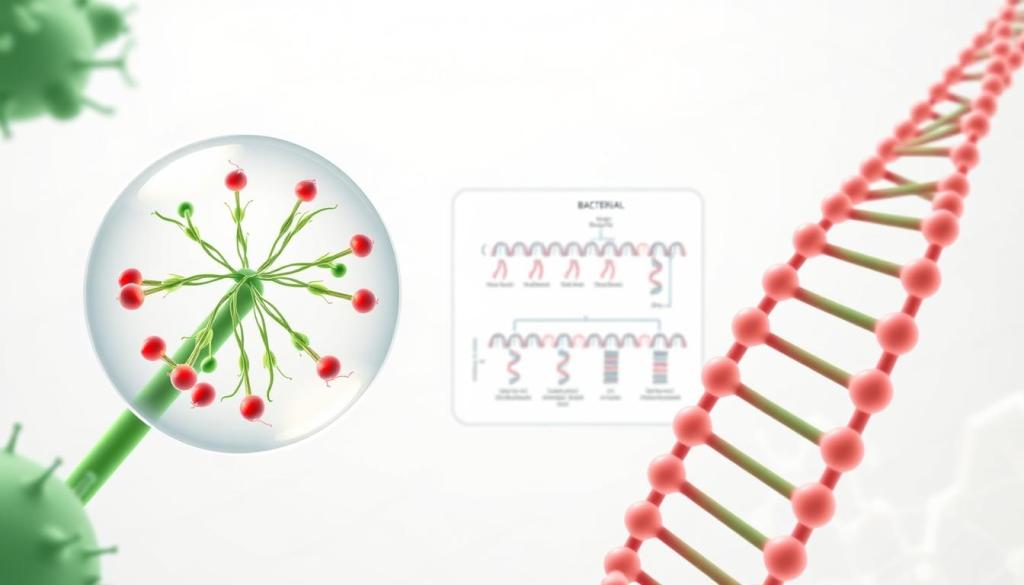
Bacterial DNA is unique compared to human DNA. Most bacteria have a single circular chromosome in the nucleoid region. This region is not surrounded by a membrane. Key features include:
- Chromosome size ranges from 580,000 to 13 million base pairs
- Irregular nucleoid structure within the cytoplasm
- Presence of multiple plasmids containing additional genetic information
Human DNA Organization
Human cells have linear chromosomes in a membrane-bound nucleus. Their genetic material is more complex and structured than bacterial DNA.
| Characteristic | Bacterial DNA | Human DNA |
|---|---|---|
| Chromosome Shape | Circular | Linear |
| Location | Nucleoid region | Membrane-bound nucleus |
| G+C Content | 25-75% | Approximately 50% |
Implications for Cellular Function
The way genetic material is organized affects important cell functions like replication and gene transfer. Bacterial plasmids, for example, help bacteria adapt quickly through gene sharing. This is not common in human cells.
The genetic diversity of bacterial cells allows for remarkable adaptability in challenging environments.
Metabolism and Energy Production
Cell physiology shows interesting differences in how bacterial and human cells make energy. Microbiology research points out special ways these cells produce energy.
Bacterial cells are very good at making energy. They can use many ways to make ATP, showing they are more energy-efficient than human cells.
Bacterial Metabolic Pathways
Bacteria can survive in harsh places because of their unique ways of making energy. They use:
- Fermentation processes
- Anaerobic respiration
- Multiple electron acceptor utilization
“Bacterial metabolism represents an extraordinary adaptation to environmental challenges” – Microbiology Research Journal
Human Cellular Respiration
Human cells mostly use aerobic respiration, which is more efficient. This process turns glucose into about 38 ATP molecules. It shows how advanced human cells are at making energy.
Energy Efficiency Differences
There are big differences in how cells make energy:
- Bacterial fermentation makes only 2 ATP molecules per glucose
- Human aerobic respiration can make up to 38 ATP molecules
- Bacterial cells can change how they make energy to fit different environments
Learning about these differences helps us understand cell biology, find new treatments, and see how life has evolved.
Reproduction Methods
Cell structure shows us how bacterial and human cells reproduce differently. This highlights the amazing variety in how cells divide. It also shows how bacterial cells are unique compared to human cells.
Bacterial Cell Division: Binary Fission
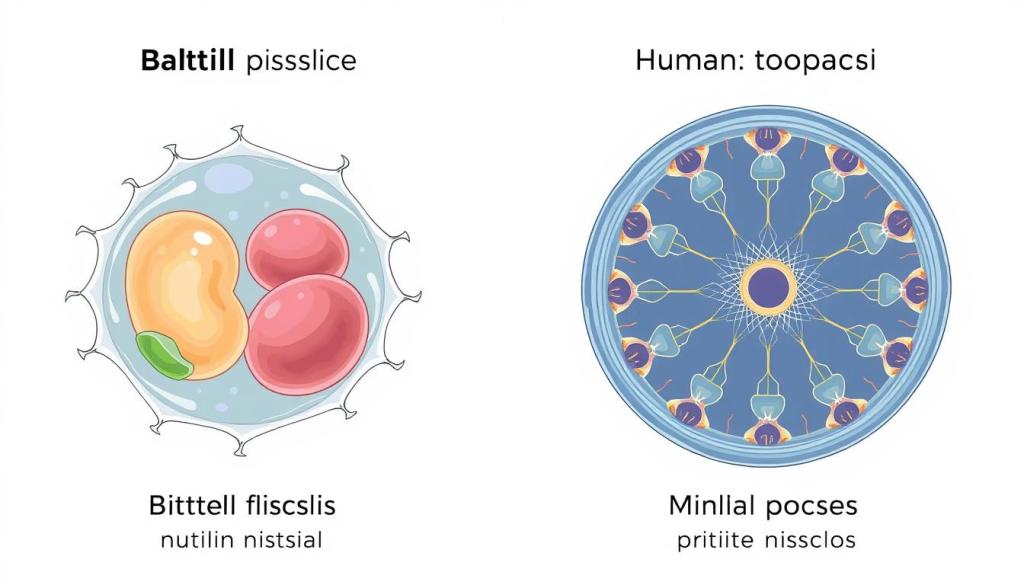
Bacteria reproduce quickly through binary fission. Bacterial cells can divide every 10-15 minutes when conditions are right. This fast rate lets bacterial numbers grow very quickly.
- Bacteria split into two identical daughter cells
- Entire process occurs within 20-30 minutes
- Plasmids can be exchanged during division
Human Cell Division: Complex Genetic Processes
Human cells divide in a more complex way: mitosis and meiosis. These methods ensure genetic diversity and precise cell reproduction. Mitosis makes identical cells, while meiosis creates reproductive cells with unique genetic mixes.
Population Dynamics and Evolutionary Implications
The different ways of reproducing greatly affect population dynamics. Bacterial binary fission allows for quick adaptation and genetic exchange. Human cell division supports the growth of complex multicellular organisms.
*Bacteria have existed for approximately 4 billion years, demonstrating the incredible success of their reproductive strategy.*
| Reproduction Characteristic | Bacterial Cells | Human Cells |
|---|---|---|
| Division Speed | 10-15 minutes | 24 hours |
| Genetic Variation | Limited | Significant |
| Daughter Cell Similarity | Identical | Genetically Diverse |
Cell Wall Presence
Bacteria and human cells have different cell walls. This shows how unique each type is. It helps us understand bacteria and human anatomy better.
Bacteria have a strong cell wall. This wall is key for their survival and keeping their cells together.
Characteristics of Bacterial Cell Walls
Bacterial cell walls are complex and varied. They mainly come in two types:
- Gram-positive bacteria: Thick peptidoglycan layers
- Gram-negative bacteria: Thin peptidoglycan walls with an additional outer membrane
Absence of Cell Walls in Human Cells
Human cells don’t have a rigid cell wall. Instead, they use a flexible cell membrane for protection. This big difference affects how cells work and handle challenges.
Functional Implications of Cell Walls
Bacteria’s cell walls give them big advantages:
- Protection against osmotic pressure
- Structural rigidity
- Defense mechanism against external threats
“The cell wall is not just a barrier, but a sophisticated biological structure that defines bacterial survival strategies.” – Cellular Biology Research Team
The differences in cell walls between bacteria and humans show how complex cells are. They also show the amazing ways cells have evolved over time.
Response to Antibiotics
In the world of microbiology, knowing how bacterial cells differ from human cells is key. This knowledge helps us understand how antibiotics work. Bacteria have unique targets that make antibiotics both strong and precise in treating diseases.
Antibiotics use the differences between bacterial and human cells to fight infections well. They target specific processes found only in bacteria. This makes them effective tools against harmful microbes.
Mechanisms of Antibiotic Action on Bacteria
Bacterial cells have many weak spots for antibiotics:
- Cell wall synthesis disruption
- Protein production interference
- DNA replication blockage
- Metabolic pathway interruption
“Antibiotics are molecular surgeons, cutting through bacterial defenses with remarkable precision.” – Microbiology Research Institute
Human Cell Resistance to Antibiotics
Human cells have special features that protect them from antibiotics. These differences help ensure that antibiotics mainly target bacteria. This way, human tissues are not harmed.
Significance for Medical Treatments
The way antibiotics work is very important for health care. Studies show that certain antibiotics can kill bacteria without harming human cells.
Every year, about 700,000 people die from infections that antibiotics can’t fight. This shows how crucial it is to understand how antibiotics work with cells.
Important findings show that antibiotics like penicillin stop bacteria from making a strong cell wall. This is something human cells don’t do. It shows how precise these medicines are.
Conclusion: Implications of Cellular Differences
The world of cellular biology is complex. It shows how bacterial and human cells interact. With 38 trillion bacteria and 30 trillion human cells in our bodies, they live in a delicate balance. This balance is key to understanding life.
Importance of Understanding Cell Biology
Research in cytology has shown us how different cells are. Bacteria and human cells are vastly different. Bacteria are smaller and have simpler genes compared to human cells.
Relevance to Health and Disease
The human microbiome is crucial for our health. Most bacteria are good for us, helping our bodies work right. Studying these interactions can lead to new treatments and therapies.
Future Directions in Research
Science is always exploring new things in cellular biology. We’ll learn more about how bacteria and human cells talk to each other. This could change how we treat diseases and understand our bodies.
FAQ
What are the fundamental differences between bacterial and human cells?
Bacterial cells are simpler, with no membrane-bound organelles. They have circular DNA and a basic structure. Human cells, on the other hand, are more complex. They have a true nucleus and many specialized organelles.
How do the sizes of bacterial and human cells differ?
Bacterial cells are tiny, ranging from 0.2 to 2 micrometers. Human cells are much larger, between 10 to 100 micrometers. This size difference shows how different their structures and functions are.
What makes bacterial cell membranes unique?
Bacterial membranes are made of peptidoglycan and have a special lipid mix. They help bacteria quickly absorb nutrients and adapt to their environment. This is key for their survival in various conditions.
How do bacterial and human cells reproduce differently?
Bacteria divide quickly through binary fission. Human cells, however, have more complex division processes. These include mitosis and meiosis, which involve chromosomal reorganization.
Why are bacterial cells more susceptible to antibiotics?
Bacterial cells have unique structures like cell walls. Their protein synthesis is different too. This makes them vulnerable to antibiotics. Human cells don’t have these structures, so antibiotics can target bacteria without harming human cells.
Do bacterial and human cells store genetic material differently?
Yes, they do. Bacterial cells have DNA in a circular chromosome and small plasmids. Human cells have linear chromosomes in a membrane-bound nucleus. This allows for more complex genetic regulation in humans.
How do metabolic processes differ between bacterial and human cells?
Bacterial cells have diverse metabolic pathways. They can use different electron acceptors and perform fermentation. Human cells mainly use aerobic respiration through mitochondria. This provides consistent energy but is less flexible.
What role does the cell wall play in bacterial cells?
The cell wall gives bacterial cells structure and protection. It helps maintain cell shape and withstands osmotic pressure. It’s a key feature that’s missing in human cells, making it a target for antibiotics.






Leave a Comment
Your email address will not be published. Required fields are marked *