



Ever thought about the role of chemistry flasks in science? These containers are more than just glass vessels. They are key tools for making new discoveries in many fields.
Chemistry glassware is essential in labs, with glass being the main material. It’s great for science because it doesn’t react with chemicals and stays stable under heat.
The variety of flasks in chemistry is vast, from simple beakers to complex research containers. Each type is made for a specific task, helping scientists mix, heat, and store chemicals with great care.
Knowing about different types of chemistry glassware is vital for safe and precise science experiments. These containers help in chemical reactions and keep scientists safe from dangers.
Key Takeaways
- Glass is the preferred material for laboratory flasks due to its chemical resistance
- Different flask types serve specific scientific research purposes
- Precision and safety are paramount in flask design
- Flask selection depends on the specific experimental requirements
- Chemical research relies heavily on specialized glassware
Introduction to Chemistry Flasks
Chemistry flasks are key in labs for precise experiments. They come in many shapes and sizes, each for a specific need.
Lab equipment, especially glassware, must handle tough conditions. Borosilicate glass is top for flasks because of its great properties.
Importance of Chemistry Flasks in Scientific Research
Chemistry flasks are vital in science:
- They help with chemical reactions
- Store chemical solutions
- Measure exact volumes
- Support complex experiments
“The right flask can make the difference between a successful experiment and a failed investigation.” – Laboratory Science Quarterly
Common Materials in Flask Production
Borosilicate glass is the main choice for flasks. It’s great because it resists heat and chemicals well.
Its benefits include:
- It can handle high temperatures
- It doesn’t react much with chemicals
- It’s durable in harsh conditions
- It’s clear for easy viewing
Scientists rely on these flasks for safe and precise tests in many fields.
Erlenmeyer Flasks
Erlenmeyer flasks, also known as conical flasks, are key in scientific labs. Their unique shape makes them stand out. They are useful for many experiments.
Key Features of Erlenmeyer Flasks
Erlenmeyer flasks have special features that make them very useful. These include:
- Distinctive cone-shaped design with a cylindrical neck
- Flat base providing excellent stability
- Narrow opening to minimize dust contamination
- Reduced liquid evaporation
Scientific Applications in Experiments
Researchers use Erlenmeyer flasks for many things. They are great for:
- Titration experiments
- Microbial culture studies
- Chemical mixing and heating
- Sample storage and preparation
Material Composition and Durability
Today’s Erlenmeyer flasks are made from different materials. Borosilicate glass is the top choice because it’s strong and lasts long. Plastic ones, like PETG or polycarbonate, are lighter and safer for some labs.
These flasks are a must-have for scientists in many fields. They show how important they are in research and experiments.
Volumetric Flasks
Chemistry labs need precise tools, and volumetric flasks are key. They help prepare and measure solutions with great accuracy.
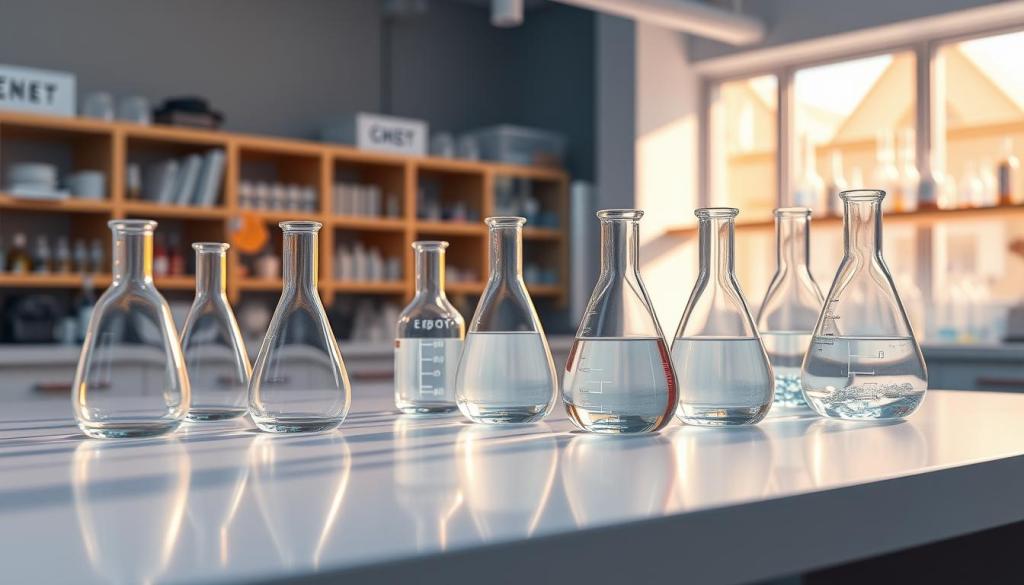
- A flat bottom for stability
- An elongated, narrow neck
- Precise volume graduation marks
- Exceptional measurement accuracy
Precision in Chemical Analysis
These flasks come in two main types for different levels of precision:
| Flask Class | Precision Level | Typical Application |
|---|---|---|
| Class A | Highest Accuracy | Advanced Research |
| Class B | Standard Accuracy | Routine Laboratory Work |
Critical Uses in Analytical Chemistry
Scientists use volumetric flasks for many important tasks. They are used for:
- Preparing standard chemical solutions
- Diluting concentrated samples
- Creating precise concentration mixtures
- Conducting quantitative chemical analyses
The design of volumetric flasks ensures consistent and reliable measurements. They are crucial for modern scientific research.
Beakers
Beakers are key pieces of chemistry glassware found in labs everywhere. They are shaped like cylinders and are vital for many scientific tasks. They are useful for both students and researchers because of their design and versatility.
Diverse Sizes and Practical Applications
Beakers come in many sizes, from 50 mL to 2000 mL. They have features that make them handy:
- Flat bottom for stable placement
- Wide opening for easy stirring
- Graduated markings for approximate volume measurements
- Convenient pouring spout
Comparing Beakers and Flasks
Beakers and flasks are both important in labs, but they are used for different things. Here’s what sets them apart:
| Characteristic | Beakers | Flasks |
|---|---|---|
| Shape | Cylindrical with straight sides | Curved or conical body |
| Volume Accuracy | ±5-10% | ±1-2% |
| Primary Use | Mixing, heating, stirring | Precise measurements |
Beakers are great for flexible manipulation of materials. They are essential in many scientific environments, from school labs to research centers.
Florence Flasks
Round bottom flasks, also known as Florence flasks, are key pieces in labs around the world. They are vital for many scientific tests and analyses.
Florence flasks stand out because of their unique design. They have a round bottom and a long neck. This design helps them perform well in scientific studies.
Design and Structural Characteristics
Florence flasks have special features for lab work:
- Round bottom for even heat
- Long neck for vapor collection
- Made from borosilicate glass for chemical safety
- Comes in different sizes
Application in Laboratory Settings
Scientists use Florence flasks for important tasks in chemistry:
- Distillation
- Mixing solutions
- Reflux reactions
- Collecting vapors
| Flask Characteristic | Specification |
|---|---|
| Typical Volume | 400 mL to 1 Liter |
| Material | Borosilicate Glass |
| Height | 16.5 cm (approximately 6.5 inches) |
| Neck Configuration | Single or Multi-neck Options |
Knowing about Florence flasks helps scientists pick the right glassware for their experiments.
Test Tubes and Their Role
Test tubes are key pieces of chemistry glassware. They are crucial in labs. These small, cylindrical vessels are versatile tools for scientists.

In scientific research, test tubes are very flexible. They can handle small reactions, collect samples, and do quick tests. They are used in many scientific fields.
Versatility in Laboratory Settings
Test tubes are special because of their unique features:
- They are small, ranging from 10 to 20 cm long
- Their diameters are usually 1 to 2 cm
- They are made from heat-resistant borosilicate glass
- They are clear, making it easy to watch reactions
Distinguishing Test Tubes from Flasks
Test tubes are different from flasks in several ways:
- Size: Much smaller than flasks
- Purpose: Great for quick tests and small reactions
- Design: They are cylindrical with one closed, rounded end
- Heating: Can be heated directly over a flame
Scientists use test tubes for many things. They store samples, do chemical reactions, and start experiments. Their light weight and easy use make them essential in chemistry labs.
Special Purpose Flasks
Chemistry labs use special flasks for precise experiments. These flasks are made for specific research needs. They help scientists tackle complex challenges.
Specialized flasks are key in science. They are made for specific tasks. These flasks offer solutions for complex chemical processes.
Defining Specialized Chemistry Flasks
Specialized flasks have unique designs. They support specific scientific needs. Key features include:
- Precise structural modifications
- Enhanced durability for specific chemical reactions
- Ability to withstand particular experimental conditions
Examples and Their Uses in the Lab
Many specialized flasks show the innovation in chemistry:
- Büchner Flasks: Made for vacuum filtration, they have thick walls. This helps manage pressure during solid-liquid separation.
- Kjeldahl Flasks: Created for nitrogen analysis, they help measure protein content accurately.
- Schlenk Flasks: Designed for air-sensitive reactions, they control gas exchange. This protects delicate chemical interactions.
The American Society for Testing and Materials (ASTM) sets standards for these flasks. This ensures quality and performance in labs.
Flask Maintenance and Care
Keeping chemistry glassware clean is key for accurate science. It also makes lab equipment last longer. Clean flasks give reliable results and stop experiments from mixing up.
Best Practices for Cleaning Chemistry Flasks
Cleaning lab gear needs special steps to keep it precise and clean. Scientists should do the following:
- Rinse flasks right after use with the right solvents
- Start with warm water and a mild soap for cleaning
- Do several rinses with deionized water
- Don’t dry with paper towels
Detailed Cleaning Process
Experts suggest a detailed cleaning method:
- First, rinse with solvents like acetone or ethanol to get rid of organic stuff
- Then, gently scrub with a soft brush and soapy warm water
- Next, rinse well with tap water
- Do 3-4 rinses with deionized water
- Check if water sheets smoothly
Tips for Storing Flasks Safely
Storing lab equipment right is important. Here are some tips for your chemistry glassware:
- Put flasks upright to avoid contamination
- Keep them in cool, dry places
- Don’t let them get direct sunlight
- Check for chips or cracks often
- Keep humidity low
By sticking to these care tips, scientists can keep their glassware in top shape. This helps with precise and reliable science work.
Conclusion: Choosing the Right Flask for Your Needs
Choosing the right flask for lab work is important. Scientists need to think about what their experiments need. This includes things like how much liquid it can hold, what chemicals it can handle, and how well it keeps heat.
There are many types of flasks in labs today. Each one is made for a specific use. For example, round-bottom flasks are great for heating things evenly. Volumetric flasks are perfect for measuring liquids accurately.
Key Selection Criteria
When picking lab equipment, there are key things to look at. The material of the flask, like borosilicate glass, affects how long it lasts and what it can handle. Also, how precise you need to be, how well it keeps heat, and what kind of reactions you’re doing are important.
Future Innovations in Flask Design
New ideas in flask design are exciting. New materials and ways of making things are leading to better flasks. Soon, we’ll have flasks that work even better, are more accurate, and can do more things in labs.
FAQ
What are the most common types of chemistry flasks?
Chemistry flasks come in several types. You have Erlenmeyer, volumetric, Florence (round bottom), and specialized ones like Büchner and Schlenk. Each is made for different lab tasks, with shapes and features that fit various needs.
Why is borosilicate glass preferred for laboratory flasks?
Borosilicate glass is top choice for labs. It’s great at handling heat, doesn’t break down easily, and changes size slowly with temperature. These traits make it perfect for lab work, keeping experiments safe and clean.
How do I choose the right flask for my experiment?
Choosing the right flask depends on your experiment. Think about the chemical reaction, volume needed, and if you’ll be heating or cooling. Look at Erlenmeyer, volumetric, or specialized flasks to see which fits your needs best.
What is the difference between an Erlenmeyer flask and a volumetric flask?
Erlenmeyer flasks are conical, great for mixing and heating. They don’t have exact volume marks. Volumetric flasks, on the other hand, are flat-bottomed, have a long neck, and exact volume marks. They’re best for making standard solutions and precise measurements.
How should I clean and maintain my laboratory flasks?
Clean flasks well with the right solvents. Avoid mixing different chemicals and handle them gently. Rinse them right after use, use special cleaners for different residues, and store them dry to avoid damage.
What are specialized flasks, and when are they used?
Specialized flasks are for specific lab tasks. You have Büchner for filtration, Kjeldahl for nitrogen analysis, and Schlenk for air-sensitive reactions. They’re designed for tasks that regular flasks can’t handle.
Can I use the same flask for different types of experiments?
While some flasks are versatile, it’s best to use specialized ones for certain experiments. This prevents contamination and ensures your results are accurate. Always clean flasks well between uses and check if they’re safe for your chemicals.
What safety precautions should I take when using chemistry flasks?
Safety first! Wear the right PPE, check flasks for damage, and use the right one for your chemicals. Make sure they can handle heat and handle glassware carefully to avoid breakage.






Leave a Comment
Your email address will not be published. Required fields are marked *