


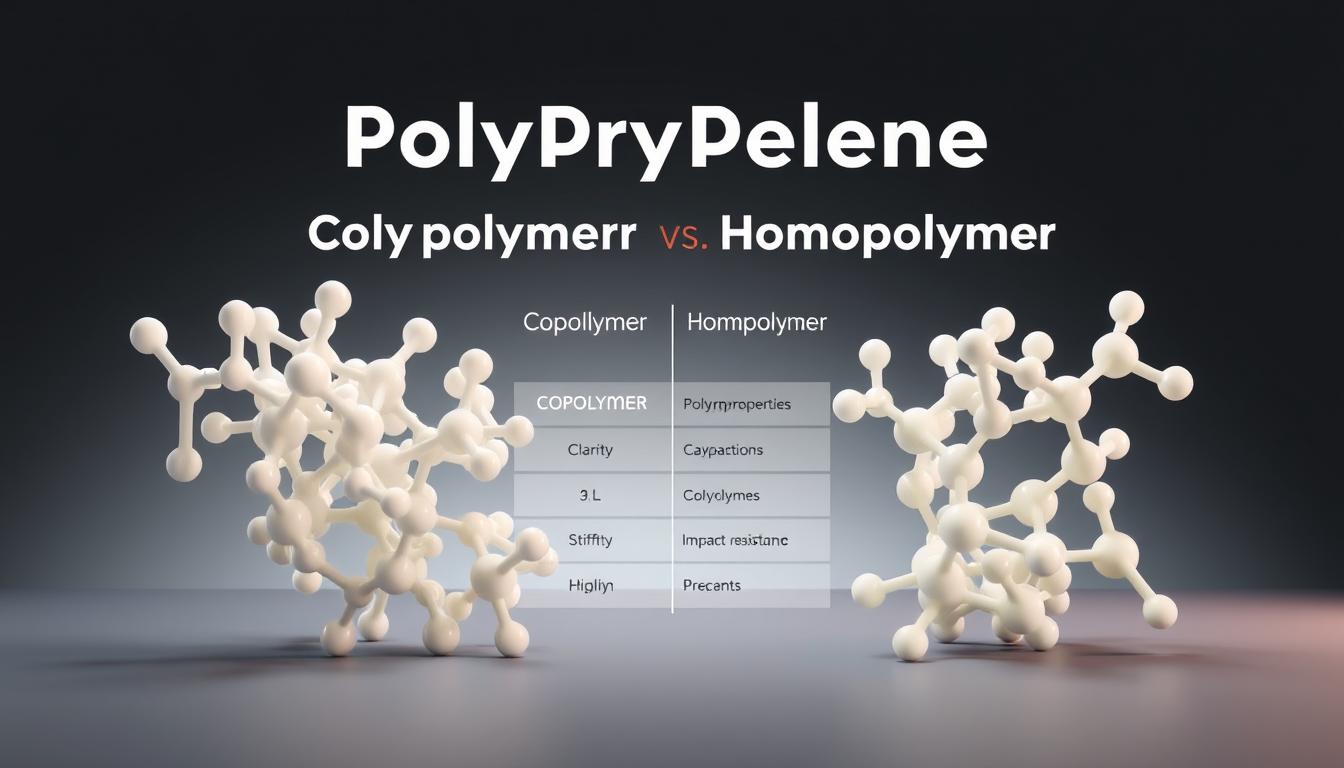
Can two different polymer structures change the game in industrial manufacturing and performance? The battle between copolymer and homopolymer polypropylene is a thrilling dive into molecular engineering. It affects many industries in big ways.
Polypropylene is a top player in the polymer world, with about 55.9 metric tons made every year. Its amazing properties have changed how we make things in many fields. It offers special traits that meet different tech needs.
It’s key for engineers, designers, and makers to know the difference between copolymer and homopolymer polypropylene. Each type has its own molecular makeup. This greatly affects their strength and how they react to chemicals.
Key Takeaways
- Polypropylene is a versatile polymer with many forms
- The molecular makeup affects how well it performs
- Homopolymers and copolymers have their own strengths for different uses
- What a polymer can do depends on its properties
- Keeping improving molecular engineering opens up new possibilities for polymers
Understanding Polypropylene Types
Polypropylene is a versatile polymer with unique molecular structures. These structures define its performance characteristics. The material’s complexity comes from different compositional arrangements. These arrangements significantly impact its industrial applications.
Polypropylene can be classified into two primary types based on its molecular structure: homopolymer and copolymer. Each type offers distinct properties. These properties are critical for various engineering and manufacturing processes.
Homopolymer Polypropylene: A Singular Molecular Approach
Homopolymer polypropylene is made from a single propylene monomer. Its molecular structure shows:
- High crystallinity
- Exceptional rigidity
- Superior mechanical strength
- Limited flexibility
Copolymer Polypropylene: Enhanced Molecular Complexity
Copolymer polypropylene introduces additional monomers, typically ethylene, into its molecular structure. This strategic composition creates two primary variations:
- Random Copolymer: Contains 1-4% ethylene, offering improved flexibility
- Block Copolymer: Contains 7-15% ethylene, providing enhanced impact resistance
The copolymer composition allows manufacturers to engineer materials with tailored properties. This expands polypropylene’s versatility across multiple applications.
Chemical Structure of Polypropylene
Polypropylene is a world of molecular engineering. The way it’s made shapes its unique traits. Homopolymers and copolymers have different structures, leading to various uses in industries.
To grasp polypropylene, we must look at its building blocks. The making process greatly affects its properties.
Molecular Composition of Homopolymers
Homopolymer polypropylene has a uniform structure. It’s made of just one type of monomer – propylene. Its key traits are:
- Uniform propylene monomer arrangement
- High crystallinity (30-60%)
- Consistent molecular weight
- Melting point range of 160-165°C
Molecular Composition of Copolymers
Copolymer polypropylene mixes in other monomers. This makes its molecular chains more complex. The mix includes:
- Random copolymers with ethene units (up to 6% by mass)
- Block copolymers with ethene content between 5-15%
- Impact copolymers containing 45-65% ethylene
| Polypropylene Type | Monomer Composition | Melting Point | Density (g/cm³) |
|---|---|---|---|
| Homopolymer | Pure Propylene | 160-165°C | 0.904-0.908 |
| Random Copolymer | Propylene + Ethene (≤6%) | 135-159°C | 0.904-0.908 |
| Impact Copolymer | Propylene + Ethene (45-65%) | 135-155°C | 0.898-0.900 |
The detailed molecular structure shapes the polymer’s performance. It affects its thermal resistance, flexibility, and strength.
Properties of Homopolymer Polypropylene
Polypropylene homopolymer (PPH) is a standout material. It has great mechanical strength and can handle high temperatures. Its special molecular structure makes it a reliable choice for tough tasks.
- Highest tensile strength ranging from 5000 to 5800 psi
- Superior hardness compared to copolymer variants
- Exceptional strength-to-weight ratio
- Excellent chemical resistance
Strength and Durability
Homopolymer polypropylene is very durable. Its rigid molecular structure gives it incredible strength. It has a flex modulus of 210 to 290 kpsi, showing it’s very strong.
Thermal Resistance
This material also stands up well to heat. It keeps its shape and strength even when it’s hot. This makes it perfect for jobs that need it to perform well at high temperatures.
Its notched Izod impact values are 0.4 to 0.9 ft-lb/in. This shows it’s tough in tough situations.
Polypropylene homopolymer offers engineers a versatile material with unparalleled mechanical and thermal characteristics.
Properties of Copolymer Polypropylene
Copolymer polypropylene is special because of its mechanical strength. It’s different from regular polypropylene because of its design. This makes it perform better in many ways.
This material has unique properties because of its complex makeup. It’s made with more than one type of monomer. This gives it better strength and flexibility.
Impact Resistance
Copolymer polypropylene is great at handling impacts. It’s perfect for tough jobs. It has:
- Higher shock absorption
- Less brittleness than others
- Longer life in tough places
Adding comonomers like ethylene makes it even more durable.
Flexibility and Toughness
This material is very flexible and strong. It can handle a lot of stress without breaking. This is because of its special design.
| Property | Copolymer PP Performance |
|---|---|
| Impact Strength | Significantly Higher |
| Flexibility Range | Broader Tolerance |
| Low-Temperature Performance | Superior Resilience |
Thanks to these properties, it’s used in many fields. From car parts to medical tools, it’s a game-changer.
Applications of Homopolymer Polypropylene
Homopolymer polypropylene is a versatile material used in many industries. Its special molecular structure makes it perform well in different areas. This makes it a top choice for those looking for reliable materials.
- Creating strong plastic containers
- Making durable car parts
- Producing strong textile fibers
- Developing advanced packaging
Industrial Performance Advantages
Homopolymer polypropylene is cost-effective because of its great mechanical properties. It has high tensile strength and rigidity. This makes it perfect for tough industrial settings where durability is key.
“Homopolymer polypropylene represents an engineering marvel, combining performance with economic efficiency.” – Materials Science Research Institute
Specialized Manufacturing Uses
Engineers and designers love homopolymer polypropylene for its versatility in complex manufacturing. Its ability to withstand repeated stress is great for making precise parts in cars, medicine, and consumer goods.
| Industry | Key Applications |
|---|---|
| Automotive | Interior components, bumpers |
| Medical | Laboratory equipment, packaging |
| Consumer Goods | Storage containers, household items |
The material’s amazing chemical resistance and thermal stability make it even more appealing. This solidifies its role as a key engineering polymer in various industries.
Applications of Copolymer Polypropylene
Copolymer polypropylene is a versatile material with great performance in many industries. Its unique composition allows for advanced uses beyond traditional polymers.
Manufacturers use copolymer polypropylene’s special properties for new solutions. Its flexibility and impact resistance are key in specific applications.
Utilization in Bioplastics
Bioplastics are a growing area for copolymer polypropylene. Its adaptable nature helps in making sustainable manufacturing better.
- Enhanced biodegradability compared to traditional plastics
- Reduced environmental impact
- Improved mechanical properties for complex applications
Benefits for Medical Devices
Medical device makers turn to copolymer polypropylene for its top-notch performance. Its unique traits offer big benefits in healthcare tech.
- Superior chemical resistance
- High-temperature stability
- Lightweight design capabilities
- Excellent biocompatibility
Studies show random copolymers boost clarity, flexibility, and impact resistance. They’re perfect for advanced medical gear and precise tools.
Copolymer polypropylene is changing manufacturing in many key industries with its outstanding material properties.
Processing Techniques for Polypropylene
Polypropylene processing techniques are key to turning raw materials into useful products. The way the polymer is made affects the best way to make different types of polypropylene.
Companies use special methods to make polypropylene production cheaper. These methods change a lot between homopolymer and copolymer types. Each needs its own way of being made.
Injection Molding for Homopolymers
Injection molding is a main way to make homopolymer polypropylene. Important things to think about for good molding are:
- Cylinder temperatures between 400-570°F
- Injection pressures ranging from 1,000 to 1,500 psi
- Mold temperatures from 60-150°F
Designing parts right is also key:
- Keep wall thickness even
- Use a draft angle of at least 1 degree per side
- Control mold shrinkage to 0.008 to 0.025 inches per inch
Extrusion and Film Blowing for Copolymers
Copolymer polypropylene works best in extrusion and film blowing. Random copolymer PP is flexible and clear, perfect for special making processes.
Extrusion lets makers create:
- Continuous profiles
- Sheets
- Pipes and tubes
- Thin films
Knowing the special traits of different polypropylene types helps makers choose the best making methods.
Performance Comparison
Polymer properties are key in how well polypropylene works in different uses. Homopolymer and copolymer polypropylene have different strengths and qualities. This makes each one perfect for certain jobs.
Polypropylene stands out in engineering thanks to its unique mechanical properties. Here’s a look at what makes them different:
- Homopolymer polypropylene has superior tensile strength, usually between 5000 to 5800 psi
- Copolymer polypropylene is better at impact resistance and flexibility
- The strength of polypropylene changes with its molecular makeup
Mechanical Properties Detailed Analysis
The strength of polypropylene depends on its molecular structure. Homopolymers are more rigid and strong because of their high crystallinity. Copolymers, with their mix of monomers, are more flexible and resistant to impact.
| Property | Homopolymer PP | Copolymer PP |
|---|---|---|
| Tensile Strength | 5000-5800 psi | 3000-4900 psi |
| Impact Resistance | 0.4-0.9 ft-lb/in | 1.2-10 ft-lb/in |
| Flex Modulus | 210-290 kpsi | 155-225 kpsi |
Chemical Resistance Insights
Polymer properties go beyond just strength. Both homopolymer and copolymer polypropylene resist chemicals well. Copolymers can be made to fight off certain chemicals better, making them great for tough jobs.
The choice of polypropylene depends on what the job needs.
Environmental Impact and Sustainability
Polypropylene is key in the fight for sustainable manufacturing. As the world worries more about the environment, recycling and saving money with polypropylene are big deals for businesses everywhere.
The future of polypropylene looks promising but also poses challenges. Here are some interesting facts:
- Post-consumer recycling rate worldwide is approximately 1%
- Potential greenhouse gas reduction from 30% polypropylene recovery: 311,000 metric tons
- Recycled polypropylene market value projected to reach £10.3 billion by 2029
Recycling Homopolymer Polypropylene
Recycling homopolymer polypropylene is a complex task. It involves separation, cleaning, melting, and granulating. These steps help cut down waste and save resources.
Sustainable Practices with Copolymers
Copolymer polypropylene is even more sustainable. Its flexibility makes recycling easier, especially in packaging and cars. The green polypropylene market is expected to grow by 5.6% CAGR from 2023 to 2031.
Using new recycling tech and circular economy ideas can greatly lower carbon emissions. Now, making polypropylene releases 1.95 to 3.5 kg of carbon dioxide per kilogram. This shows a lot of room for improvement with better recycling.
Future Trends in Polypropylene Development
The polypropylene industry is changing fast, thanks to new research and tech. The global market is now worth USD 125.25 billion and is expected to hit USD 168.92 billion by 2032. This means big changes in how we use polymers.
New research in copolymer composition is leading to better materials. Several trends are shaping the future of polypropylene:
- Advanced catalyst technologies improving polymer precision
- Enhanced material performance for specialized applications
- Sustainable manufacturing processes
- Increased focus on recycling and circular economy strategies
Innovations in Copolymer Research
Metallocene catalysts are changing how we make copolymers. These advanced catalysts let researchers control the molecular structure better. This results in materials with better strength and special properties.
Advances in Homopolymer Technology
Homopolymer polypropylene is seeing big tech leaps. The market is set to grow from USD 64.17 billion in 2023 to USD 101.28 billion by 2033. The focus is on making lighter materials for cars and packaging.
The future of polypropylene lies in its ability to adapt and meet increasingly complex industrial demands.
As the industry grows, researchers are working on making polypropylene more sustainable and versatile. They aim to improve its performance across various sectors.
Conclusion: Choosing Between Copolymer and Homopolymer Polypropylene
Choosing the right polypropylene type is all about understanding your needs. You must decide between copolymer and homopolymer polypropylene based on how they perform. This choice affects how well your product works.
When picking polypropylene, think about what it will be used for. Homopolymer is great for things that need to be strong and stiff. On the other hand, copolymer is better for items that need to be flexible and can handle impacts well. Knowing this helps industries like cars, medicine, and packaging choose the right material.
Key Factors Influencing Selection
The makeup of the polymer is key to its performance. Homopolymers, made from just propylene, are very rigid. This makes them perfect for parts that need to be strong.
Copolymers, which include ethylene, are tougher and more flexible. They work well in many different settings. This makes them versatile for various uses.
Final Thoughts on Polypropylene Types
Understanding material science is crucial for using polymers well. You need to consider things like how the material crystallizes, its thermal properties, and its strength. This knowledge helps engineers create better materials for tough challenges.
FAQ
What is the primary difference between homopolymer and copolymer polypropylene?
Homopolymer polypropylene is made from one type of monomer. Copolymer polypropylene, on the other hand, is made from two or more types of monomers. This difference greatly affects their properties.
How do the properties of homopolymer and copolymer polypropylene differ?
Homopolymer polypropylene is stiffer and stronger. It’s great for rigid items. Copolymer polypropylene is more flexible and tough. It’s better for items that need to be durable and flexible.
In what industries are these types of polypropylene most commonly used?
They’re used in many fields like medicine, packaging, and cars. Homopolymer is good for rigid items and lab tools. Copolymer is better for flexible packaging and medical devices.
What are the key advantages of copolymer polypropylene?
Copolymer polypropylene is very tough and flexible. It also resists chemicals well. Its structure makes it great for items that need to be strong and flexible.
How does the polymerization process differ between homopolymer and copolymer polypropylene?
Homopolymer is made from just one monomer. Copolymer is made by adding different monomers during the process. This changes its structure and properties.
Are there environmental considerations when choosing between these polypropylene types?
Both can be recycled, but copolymer recycling is more complex. Companies are working on making both types more eco-friendly.
What processing techniques are typically used for each type of polypropylene?
Homopolymer is often molded. Copolymer is usually extruded or blown into films. The choice depends on the item’s needs.
What future developments are expected in polypropylene technology?
Research aims to improve its strength, resistance, and eco-friendliness. New developments include bio-based polymers and more sustainable production methods.




Leave a Comment
Your email address will not be published. Required fields are marked *