


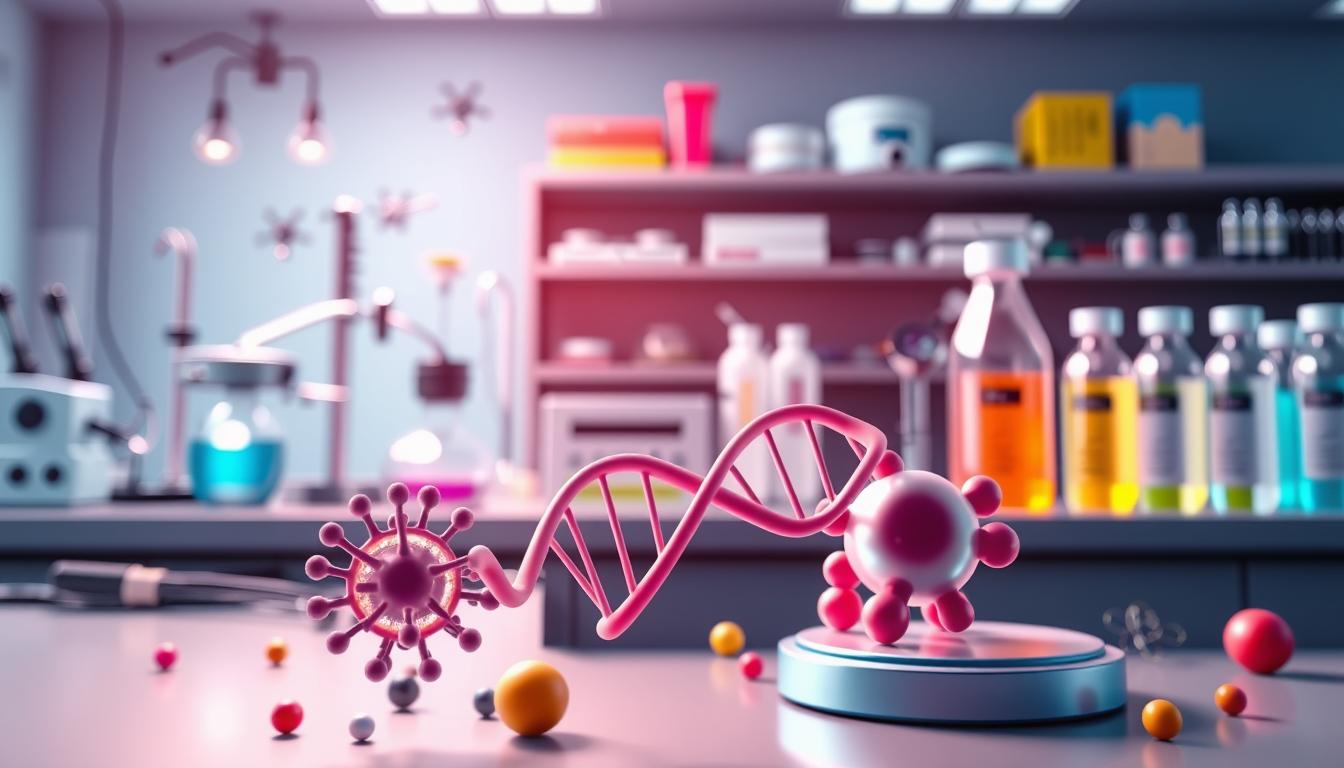
Ever wondered how scientists can make millions of DNA copies from just one in hours? The amazing Polymerase Chain Reaction (PCR) has changed molecular biology. It lets researchers dive into genetic mysteries with great detail.
PCR types are a flexible set of tools for genetic studies. Real-time PCR is a key method for measuring genetic amounts. These methods are crucial in medical tests and forensic science to understand complex genetics.
The world of PCR techniques is wide, from basic to advanced like multiplex PCR. Now, scientists can amplify many genetic targets at once. This saves time and money in labs.
Key Takeaways
- PCR enables rapid DNA amplification with high specificity
- Multiple PCR types exist for different research needs
- Real-time PCR provides quantitative genetic analysis
- PCR techniques span medical, forensic, and research applications
- Technological advances continue to expand PCR capabilities
Overview of Polymerase Chain Reaction (PCR)
Polymerase Chain Reaction (PCR) is a key technique in molecular biology. It has changed how scientists study genes. This method makes it easy to copy specific DNA parts quickly and accurately.
PCR is vital for research. It helps scientists make millions of DNA copies from just a little bit of genetic material. The process uses temperature changes to copy DNA very efficiently.
What is PCR?
PCR is a way to make lots of copies of specific DNA parts. It has three main steps:
- Denaturation: Separating DNA strands at 95°C
- Annealing: Primers binding to target DNA sequences
- Extension: DNA polymerase synthesizing new DNA strands
History of PCR Development
“PCR is a method that allows us to make millions of copies of a specific DNA sequence in just a few hours.” – Kary Mullis
In 1983, Kary Mullis came up with PCR. He won the Nobel Prize in Chemistry in 1993 for it. His idea changed molecular biology by making DNA copying fast.
Importance of PCR in Molecular Biology
Reverse transcription PCR is crucial in many fields. It lets researchers make lots of DNA copies quickly. They can make between 10^6 to 10^9 copies in a short time.
This method is very useful. Scientists can study DNA from many sources. This includes:
- Peripheral blood
- Skin samples
- Hair follicles
- Saliva
- Microbiological specimens
PCR can make millions of DNA copies in 30-40 cycles. This helps scientists do detailed genetic studies and make important discoveries.
Standard PCR Techniques
Polymerase Chain Reaction (PCR) is a key tool in molecular biology. It lets researchers make lots of DNA copies from just a little bit of DNA. This has changed how we study genes, making it easier to get lots of DNA from small samples.
Today, PCR has grown to meet new challenges in genetic research. It uses advanced methods to give us deep insights into genes and how they work.
Conventional PCR Explained
Conventional PCR is the basic way to make more DNA. It uses cycles to grow the DNA, making it easier to see. Key points include:
- It can make DNA up to 4 kilobases long.
- Results are seen with agarose gel electrophoresis.
- It follows a standard heating and cooling cycle.
- It’s good for basic genetic studies.
Real-Time PCR (qPCR)
Quantitative PCR (qPCR) is a big step up in molecular diagnostics. It uses special dyes to track DNA growth in real-time. This gives us instant info on genetic material.
| qPCR Feature | Characteristic |
|---|---|
| Fluorescence Detection | Measures DNA amplification in real-time |
| Quantification | Precise measurement of initial DNA template |
| Probe Specificity | Can identify multiple genetic targets simultaneously |
Multiplex PCR Applications
Multiplex PCR lets us work on many genes at once in one go. It needs careful setup to work well. This is key for studying complex genetics.
- It can find many genes at once.
- It uses less reaction mix.
- It’s great for detailed genetic tests.
- It’s essential for complex genetic studies.
These PCR methods show how versatile genetic research is. They give scientists powerful tools to study genes with great detail.
Advanced PCR Techniques
Molecular biology researchers keep pushing the limits of genetic analysis with new PCR techniques. These advanced methods make DNA amplification more precise, sensitive, and versatile. This lets scientists delve into complex genetic landscapes with great detail.
Specialized PCR methods help overcome old challenges. Two key techniques are reverse transcription PCR and nested PCR.
Reverse Transcription PCR (RT-PCR)
RT-PCR turns RNA into complementary DNA (cDNA) for amplification. It’s vital for studying gene expression and finding RNA-based pathogens. The process involves:
- Getting RNA from samples
- Converting RNA to cDNA with reverse transcriptase
- Then, PCR amplifies the cDNA
Touchdown PCR for Improved Specificity
Touchdown PCR boosts target sequence specificity with a temperature gradient. It starts with a high annealing temperature, then lowers it. This helps the primers bind better and reduces unwanted amplification.
Nested PCR for Enhanced Sensitivity
Nested PCR is a complex method for finding rare genetic targets. It uses two primer sets in two steps. This makes it more specific and sensitive.
“Nested PCR allows researchers to amplify minute genetic sequences with unprecedented precision.” – Genetic Research Institute
Nested PCR’s main benefits are:
- Less background noise
- Higher specificity
- Better detection of rare genetic sequences
| PCR Technique | Primary Advantage | Key Application |
|---|---|---|
| Reverse Transcription PCR | RNA to cDNA conversion | Gene expression analysis |
| Nested PCR | Enhanced specificity | Detecting rare genetic targets |
| Touchdown PCR | Improved primer binding | Reducing nonspecific amplification |
Digital PCR: Principles and Applications
Digital PCR is a big leap in molecular biology. It gives us super-accurate ways to count genetic material. This new method changes how we study genes, making it more precise and sensitive.
Digital PCR breaks down genetic samples into tiny parts. This lets us find and count tiny amounts of genetic material. It’s way more sensitive than old methods, spotting things as small as 0.001%.
Core Principles of Digital PCR
Digital PCR uses tiny droplets to split PCR samples. This way, scientists can:
- Find rare genetic changes
- Count genetic material exactly without needing standard curves
- Spot tiny amounts of DNA
- Get super-accurate results in genetic studies
Advantages Over Conventional Methods
Digital PCR beats old methods in many ways. It’s super accurate, with errors under 5%. This makes it great for precise genetic studies.
| Parameter | Digital PCR | Traditional PCR |
|---|---|---|
| Sensitivity | 0.001% – 0.1% | ~1% |
| Quantification | Absolute | Relative |
| Error Rate | <5% | Higher variability |
Research and Diagnostic Applications
Digital PCR is very useful in many fields. Some key uses are:
- Finding rare genetic changes
- Screening for genetic disorders
- Measuring viral loads
- Finding cancer biomarkers
- Quantifying next-generation sequencing libraries
Its unmatched precision and sensitivity are changing genetic research and diagnostics.
Specialized PCR Methods
The world of molecular biology is always changing. New PCR types are being developed. They help scientists and doctors do more precise DNA work.
New PCR methods are changing genetic research. They use new ways to copy DNA. Hot-start PCR is one example. It makes DNA copying more focused and quick.
Isothermal Amplification Techniques
Isothermal amplification is a big step forward. It works at the same temperature all the time. This makes it great for quick tests at places like doctor’s offices.
- Simplified temperature management
- Rapid DNA amplification
- Reduced equipment complexity
LAMP: A Revolutionary Amplification Method
Loop-Mediated Isothermal Amplification (LAMP) is very efficient. It can copy DNA well at just one temperature. This is super useful in places where resources are limited.
High-Resolution Melting (HRM) Analysis
HRM analysis is a new way to find genetic changes. It looks at how DNA melts to spot small changes. This method is very accurate.
These new PCR methods are taking genetic research to new heights. They give scientists and doctors better tools for understanding DNA and diagnosing diseases.
PCR in Genetic Research
Genetic research has been changed by polymerase chain reaction (PCR) technologies. These technologies let scientists study DNA with great detail. The different types of PCR are key in understanding how genes work and solving tough biological questions.
Researchers use many PCR methods to learn more about genomes. The use of touchdown pcr has made genetic analysis better. It increases specificity and cuts down on unwanted amplification.
Applications in Genomics
Genomic research uses advanced PCR techniques to study genetic material. Some main uses are:
- Whole genome amplification
- Gene expression analysis
- Targeted sequencing projects
- Genetic variation detection
Role in Genetic Engineering
Genetic engineering has seen big changes with new PCR methods. Scientists can now make precise genetic changes. They use techniques like:
- Site-directed mutagenesis
- Gene synthesis
- DNA cloning
- Genetic construct development
Population Genetics Studies
Population genetics researchers use PCR to study genetic diversity and how genes are passed down. Microsatellite markers and SNP genotyping give important insights into genetic relationships and evolution.
PCR makes it possible to amplify genetic material from very small samples. This has changed how we understand genetic inheritance and diversity.
PCR in Medical Diagnostics
Medical diagnostics have seen a big change thanks to advanced PCR techniques. These methods offer high precision in finding and tracking different health issues. Real-time PCR and multiplex PCR are key tools that change how doctors diagnose and follow diseases.
Today’s diagnostic methods use PCR to find medical problems quickly and accurately. These tools give important information in many health areas:
- Rapid pathogen detection
- Genetic disorder screening
- Cancer molecular monitoring
- Early infection identification
Detection of Pathogens
Real-time PCR lets doctors find infectious agents very precisely. PCR tests can spot pathogens even when there’s very little of them. This can find diseases before symptoms show up. It can make billions of DNA copies in about an hour, making it a key diagnostic tool.
Genetic Disorders Diagnosis
Multiplex PCR has changed how we diagnose genetic disorders. It lets us check many genetic markers at once. This gives doctors a full picture of a person’s genetics. It helps find problems early and tailor treatments.
Cancer Detection and Monitoring
PCR is very important in cancer research and treatment. Real-time PCR helps track cancer cells and see how well treatments work. It finds genetic changes with great accuracy. This helps doctors use more focused and effective treatments.
As PCR technology keeps getting better, we can expect even more advanced diagnostic tools. This could change how we get personalized medical care in the future.
Environmental and Agricultural Applications of PCR
PCR techniques have changed how we study the environment and farming. They help us understand ecosystems better and improve how we grow crops. Scientists use different PCR types to study complex biological systems with great detail.
Today’s farming uses advanced molecular methods, like quantitative pcr, to solve big problems in food production and keeping the environment healthy.
Soil Microbial Diversity Assessment
Researchers use special PCR methods to study soil microbes. These methods help scientists:
- Find rare microbes
- Learn about ecosystem interactions
- Track environmental changes
- Check soil health
Plant Pathogen Detection
PCR has changed how we find plant diseases. Quantitative PCR helps by:
- Finding diseases early
- Measuring disease levels
- Watching how diseases spread
Biotechnology in Crop Improvement
Agricultural scientists use advanced PCR to make crops better. They use it for genetic mapping, picking traits, and creating crops that resist diseases.
PCR is key in modern farming research. It opens up new ways to improve crops and manage the environment.
Future Trends in PCR Technologies
PCR technologies are changing fast, with digital PCR leading the way. It offers unmatched precision in genetic studies. New PCR types are also making molecular diagnostics better, allowing for very sensitive genetic material detection.
New trends are moving towards faster and automated PCR systems. Ultra-sensitive PCR technologies are tackling big challenges in medical tests. They aim to cut healthcare costs and boost accuracy in many research areas.
Next-generation sequencing platforms are changing genetic analysis. PCR is getting more advanced, with digital PCR splitting samples into millions of parts. This boosts precision and cuts down on errors, opening up new areas in genetics and personalized medicine.
The future of PCR looks bright, with a focus on speed, accuracy, and making it more accessible. Microfluidic platforms and new thermal cycling tech are set to change genetic material processing. This will make complex molecular diagnostics faster and more efficient for science and medicine.
FAQ
What is Polymerase Chain Reaction (PCR)?
PCR is a way to make lots of copies of a DNA segment. It uses heat and cooling to do this. This method is key for scientists to study DNA quickly and in large amounts.
Who invented PCR?
Kary B. Mullis created PCR in 1983 at Cetus Corporation. His work changed molecular biology a lot. He won the Nobel Prize in Chemistry in 1993 for it.
What are the basic steps of PCR?
PCR has three main steps. First, DNA strands are separated by heat. Then, primers bind to the DNA. Finally, DNA polymerase makes new strands. These steps are repeated many times to make more DNA.
What is the difference between conventional PCR and real-time PCR?
Conventional PCR checks for DNA after it’s done. Real-time PCR, or qPCR, watches DNA as it’s being made. Real-time PCR gives more accurate results.
What is multiplex PCR?
Multiplex PCR can make many DNA types at once. It uses different primers for each type. This makes it faster and uses less sample.
What is reverse transcription PCR (RT-PCR)?
RT-PCR is for studying RNA. It first turns RNA into DNA. This is important for looking at gene activity and finding viruses.
What is digital PCR?
Digital PCR breaks a sample into tiny parts. It counts each DNA molecule. This method is very precise because it looks at each molecule separately.
What are the main applications of PCR?
PCR is used in many fields. It helps in medical tests, genetic studies, forensic science, and more. It’s also used in agriculture and archaeology.
What is hot-start PCR?
Hot-start PCR stops unwanted DNA copying. It uses special enzymes or antibodies. This makes PCR more specific and effective.
How is PCR used in medical diagnostics?
PCR is key in medical tests. It finds viruses and bacteria, screens for genetic diseases, and tracks cancer. It’s fast and accurate, thanks to real-time and multiplex PCR.





Leave a Comment
Your email address will not be published. Required fields are marked *