


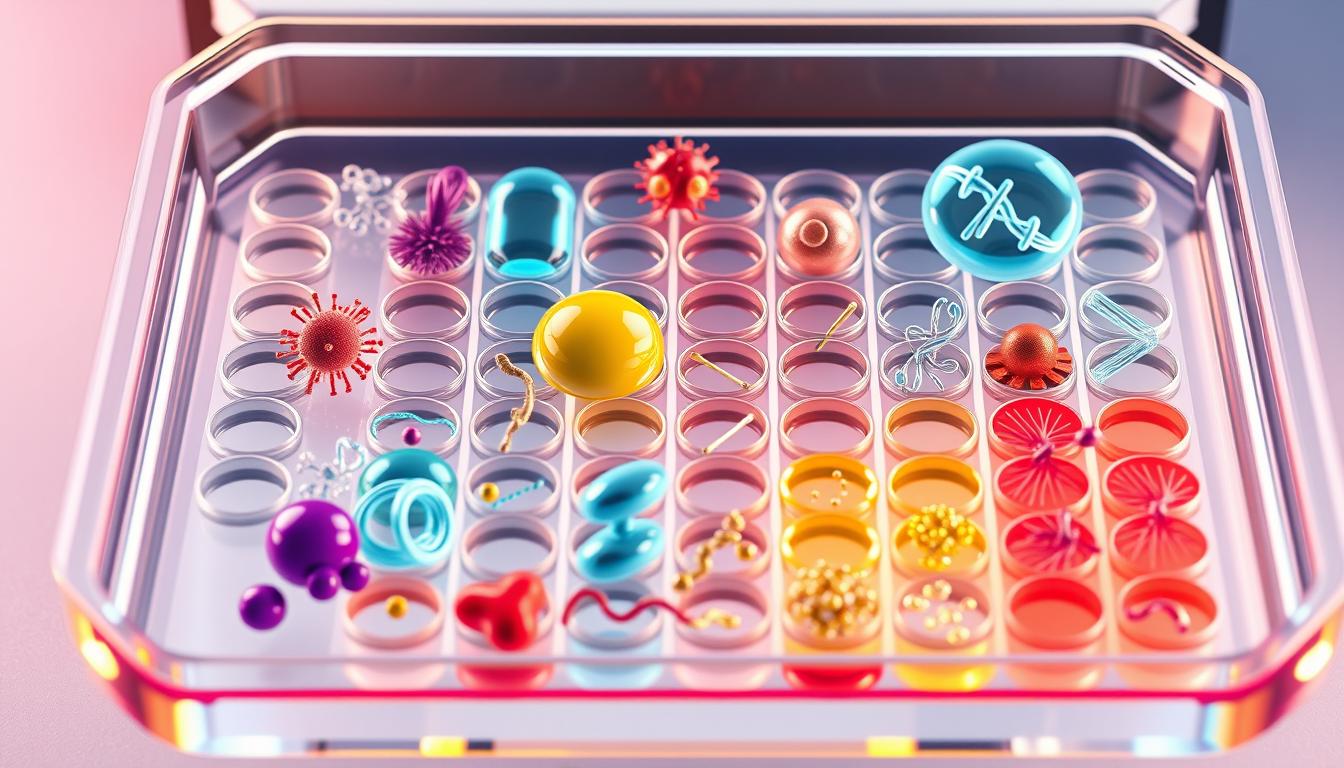
Ever thought about how scientists handle hundreds of biological samples at once? The micro plate is a key player in modern lab research. It helps scientists explore many fields with ease.
Microplates, or microtiter plates, are vital for researchers. They make complex experiments simpler. These small, rectangular platforms have many wells. This lets scientists run lots of tests in one place.
The design of micro plates makes research faster and more efficient. They allow scientists to test many samples at once. This saves time and cuts down on the need for lots of samples.
Key Takeaways
- Micro plates enable simultaneous sample processing
- Versatile tools used across biological research disciplines
- Reduce experimental time and resource consumption
- Support advanced high-throughput screening techniques
- Standardize scientific experimental protocols
Understanding Micro Plates: Definition and Purpose
Micro plates are a key innovation in science, making research more efficient. They are designed for precise tests, changing how we study biology. This tool allows for the analysis of many samples at once.
Micro plates are flat platforms with many wells to hold small amounts of liquid. Their design lets scientists test many samples quickly and accurately.
Defining Micro Plates
A micro plate has many wells in a set pattern. It has:
- Standardized dimensions (127.76 mm × 85.48 mm)
- Well configurations ranging from 6 to 3456 wells
- Liquid volume capacity between 10 and 1000 nanoliters
Common Applications in Biological Research
Scientists use micro plates in many important areas, such as:
- Drug discovery processes
- Enzyme-linked immunosorbent assays (ELISA)
- Protein interaction studies
- Cell culture experiments
| Micro Plate Type | Well Configuration | Volume Capacity |
|---|---|---|
| Standard 96-Well Plate | 8 × 12 matrix | 0.1-0.3 mL |
| 384-Well Plate | 16 × 24 matrix | 0.03-0.1 mL |
| 1536-Well Plate | 32 × 48 matrix | 0.005-0.015 mL |
Micro plate technology keeps improving, making it easier to test many samples at once. This helps scientists work more accurately and consistently.
Types of Micro Plates Used in Laboratories
Micro plates are key tools in today’s biology labs. They help scientists do precise cell culture and ELISA tests efficiently. The variety of micro plates shows the different needs of researchers in many fields.
Researchers use many types of micro plates for their work. Each type has special features for different research goals.
Standard Micro Plate Configurations
Standard micro plates have different well densities for various needs:
- 6-well plates for small experiments
- 12-well and 24-well plates for medium samples
- 96-well plates for common cell tests
- 384-well and 1536-well plates for lots of samples
Deep-Well Micro Plates
Deep-well micro plates, also called block plates, hold more liquid. They have:
- Standard height of 44 mm
- More space for liquids
- Better mixing for complex tests
Specialized Micro Plates for High-Throughput Screening
Advanced micro plates for high-throughput screening are very precise. They help with genomics and drug discovery. These plates are designed for fast and efficient testing.
| Plate Type | Well Density | Typical Application |
|---|---|---|
| Standard Micro Plate | 96 wells | Standard cell culture assays |
| High-Density Plate | 1536 wells | Advanced drug screening |
| Deep-Well Plate | 24-96 wells | Sample preparation |
Choosing the right micro plate depends on the research, sample size, and goals. It’s important for researchers to pick the best plate for their work.
Key Features of Effective Micro Plates
Micro plates are key tools in today’s biochemical analysis. They have special designs that greatly affect research results. Scientists use these precise tools for immunoassays and complex studies.
The success of micro plates depends on several important features. These features make them work well in many scientific tasks.
Material Composition
Materials greatly affect how well micro plates perform. Scientists choose from a few main materials:
- Polystyrene: Most common for immunoassays
- Polypropylene: Ideal for low-temperature storage
- Glass: Provides exceptional chemical resistance
Well Design and Volume Capacity
The design of wells is crucial for precise experiments. Modern micro plates have from 6 to 1536 wells. Each has a specific volume for research needs:
- 96-well plates: 50-200 μL working volume
- 1536-well plates: 1-10 μL working volume
Surface Treatment Options
Surface treatments can improve biochemical analysis. Researchers have options for special treatments:
- High-binding surfaces: Optimize protein attachment
- Low-binding surfaces: Prevent non-specific interactions
- Ultra-low attachment surfaces: Minimize sample loss
These advanced features help micro plates meet today’s scientific research needs. They support precise and reliable results in experiments.
Manufacturing Standards for Micro Plates
Precision and reliability are key in biomedical research, especially in microplate assays. Making micro plates requires strict standards for consistent results in science.
The American National Standards Institute (ANSI) and the Society for Laboratory Automation and Screening (SLAS) set rules for making micro plates. These rules cover important parts of plate design and quality checks.
Regulatory Compliance Requirements
There are several important parts to follow in making micro plates:
- Dimensional precision for well placement
- Material composition standards
- Surface treatment specifications
- Performance consistency verification
Quality Control Measures
Manufacturers use many quality control steps to make sure microplates work well. These steps include:
- Precision machining with computer-controlled equipment
- Rigorous dimensional tolerance checks
- Material purity validation
- Comprehensive performance testing
The ANSI SLAS 4-2004 standard gives rules for different micro plate sizes, like 96-well, 384-well, and 1536-well. Positional tolerances for well centers are meticulously defined, making results the same in different labs.
The goal of these standards is to create uniformity and reliability in biomedical research micro plate production.
By following these strict standards, researchers can do microplate assays more accurately. This means better and more consistent results in their work.
Selecting the Right Micro Plate for Your Experiment
Choosing the right micro plate is key for good scientific research. You need to think about many things to get the best results in high-throughput screening and cell culture assays.
When picking a micro plate, you must know what your experiment needs. Then, find a plate that fits those needs well.
Key Considerations for Experiment Type
Each experiment has its own special needs for a micro plate. For cell culture assays, look at these important points:
- Well density (96-, 384-, or 1536-well configurations)
- Material composition (polystyrene, polypropylene)
- Surface treatment options
- Bottom geometry
Compatibility with Assay Techniques
Choosing the right micro plate means knowing how it works with your analytical methods. For high-throughput screening, you want plates that don’t mess with your signals and help you detect them better.
The right micro plate can make your experiments more precise and reliable.
Think about these important things for different assay techniques:
- Fluorescence assays: Black plates cut down on background noise
- Luminescence measurements: White plates boost signal strength
- Absorbance tests: Clear plates let light pass through best
- Cell culture: Tissue culture-treated surfaces help cells stick better
Researchers must carefully look at plate features to get the best results in high-throughput screening and cell culture assays.
Best Practices for Handling Micro Plates
Laboratory researchers know that handling micro plates right is key. ELISA plates and immunoassays need careful handling for accurate results.
Good micro plate management is about more than just handling. It’s about keeping samples safe and research results reliable.
Storage and Maintenance Strategies
Storing micro plates correctly is vital. Here are some important steps:
- Store ELISA plates in controlled temperature environments
- Protect plates from direct sunlight and humidity
- Use protective packaging to prevent contamination
- Implement systematic inventory tracking
Sample Handling Techniques
When working with immunoassays and micro plates, precision is crucial. Here’s how to handle them carefully:
- Always use clean, sterile equipment
- Minimize plate surface contact
- Utilize specialized pipetting techniques
- Follow consistent sample loading procedures
Automation can greatly improve sample handling accuracy and lower human error in labs. New labeling technologies help track samples with high precision in many fields.
Innovations in Micro Plate Technology
The world of biochemical analysis and biomedical research is changing fast. New advancements in micro plate technology are leading the way. Researchers are creating better materials and using advanced tech to make labs work better.
Recently, micro plates have become more than just simple lab tools. Thanks to material science, they now have better designs and functions.
Advances in Material Science
New breakthroughs in material science have changed how micro plates work:
- Ultra-lightweight polymers have been developed.
- Surface treatments have been improved to reduce background noise.
- Thermal stability has been enhanced for sensitive tests.
- Chemical resistance has been increased for various research needs.
Integration of Technology for Enhanced Performance
Today, micro plates work with advanced tech to boost research efficiency:
- Automated data collection systems are available.
- High-throughput screening is now possible.
- Real-time monitoring technologies exist.
- Computational analysis interfaces have been improved.
These advancements mark a big step forward in lab research. Scientists can now do more precise and detailed experiments faster and more accurately.
Environmental Impact of Micro Plates
The world of biological research is moving towards greener lab practices. This includes using microwell and microtiter plates in a more eco-friendly way. With 58 million tonnes of plastic made every year, scientists are looking for ways to cut down on waste.
Labs use a lot of microwell plates, leading to a lot of plastic waste. It’s time to think about how these tools affect our planet.
Biodegradable Options
New biodegradable microwell plate tech is changing lab work. Scientists are exploring:
- Plant-based polymers
- Compostable synthetic materials
- Ways to make less waste
Recycling Initiatives in the Lab Industry
Science groups are starting recycling programs for microtiter plates. They want to tackle plastic waste with smart plans.
| Recycling Strategy | Implementation Rate | Environmental Impact |
|---|---|---|
| Material Segregation | 65% | Reduces contamination |
| Specialized Plastic Recycling | 40% | Prevents ocean microplastic pollution |
| Clean Plate Reprocessing | 35% | Minimizes virgin plastic production |
The future of lab sustainability relies on new ideas in microwell plate design and waste handling.
Conclusion: The Importance of Micro Plates in Research
The micro plate has changed biological research a lot. It’s now a key tool for scientists. The market for micro plates is worth USD 1.5 Billion, showing how important they are.
Over 70 years, micro plates have grown a lot. The last 30 years have seen the biggest changes. This shows how fast technology has improved.
Micro plates help scientists do their work better and faster. They make experiments more precise. New technologies like nano-plates and pico-plates are coming.
These new tools will make testing cheaper and more accurate. They promise to change lab work a lot.
Key Research Benefits
Micro plates have changed how scientists do their work. They help with complex methods like PCR and ELISA. These tools make research more efficient.
As technology gets better, micro plates will keep being important. They help scientists learn more about biology and medicine.
Future Research Potential
Micro plate technology is always getting better. Scientists look forward to even smaller plates and better data handling. This will help with new research methods.
High-throughput screening will keep getting better. Micro plates are at the heart of this progress. They drive new discoveries and ideas in science.
FAQ
What is a micro plate?
A micro plate is a flat plate with many small wells. It holds lots of small samples at once. Scientists use them in labs to do many tests at the same time. This makes their work more efficient and accurate.
What are the most common applications of micro plates?
Micro plates are used in many areas of biology. They help with things like studying cells, finding new medicines, and understanding genes. They let scientists test many samples at once, making their work easier.
What materials are micro plates typically made from?
Micro plates are made from materials like polystyrene, polypropylene, and glass. Each material has special properties. These can affect how well the plate works in different tests.
How do surface treatments impact micro plate performance?
Surface treatments can really help a micro plate work better. For example, some treatments help proteins stick better. This makes tests more accurate and reliable.
What types of micro plates are available?
There are many kinds of micro plates. You can find standard ones, deep-well plates for bigger samples, and special ones for drug discovery. Each type is designed for different needs.
How should micro plates be stored and maintained?
Storing micro plates right is important. Keep them clean, dry, and at the right temperature. Handle them carefully and follow the maker’s instructions to keep them in good shape.
What are recent innovations in micro plate technology?
New advancements in micro plates include better materials and surface treatments. These help make tests more sensitive and accurate. They also work better with lab machines.
Are there environmentally friendly micro plate options?
Yes, there are eco-friendly micro plates being made. Scientists are also working on recycling lab plastics. This helps reduce waste and keeps research high-quality.
How do I choose the right micro plate for my experiment?
Choosing the right micro plate depends on your experiment. Think about the type of test, how much sample you need, and what detection methods you’ll use. Pick a plate that fits your needs best.
What quality standards are applied to micro plate manufacturing?
Micro plate makers follow strict rules and quality checks. They test plates to make sure they’re reliable and accurate. This ensures that research results are trustworthy and valid.






Leave a Comment
Your email address will not be published. Required fields are marked *