


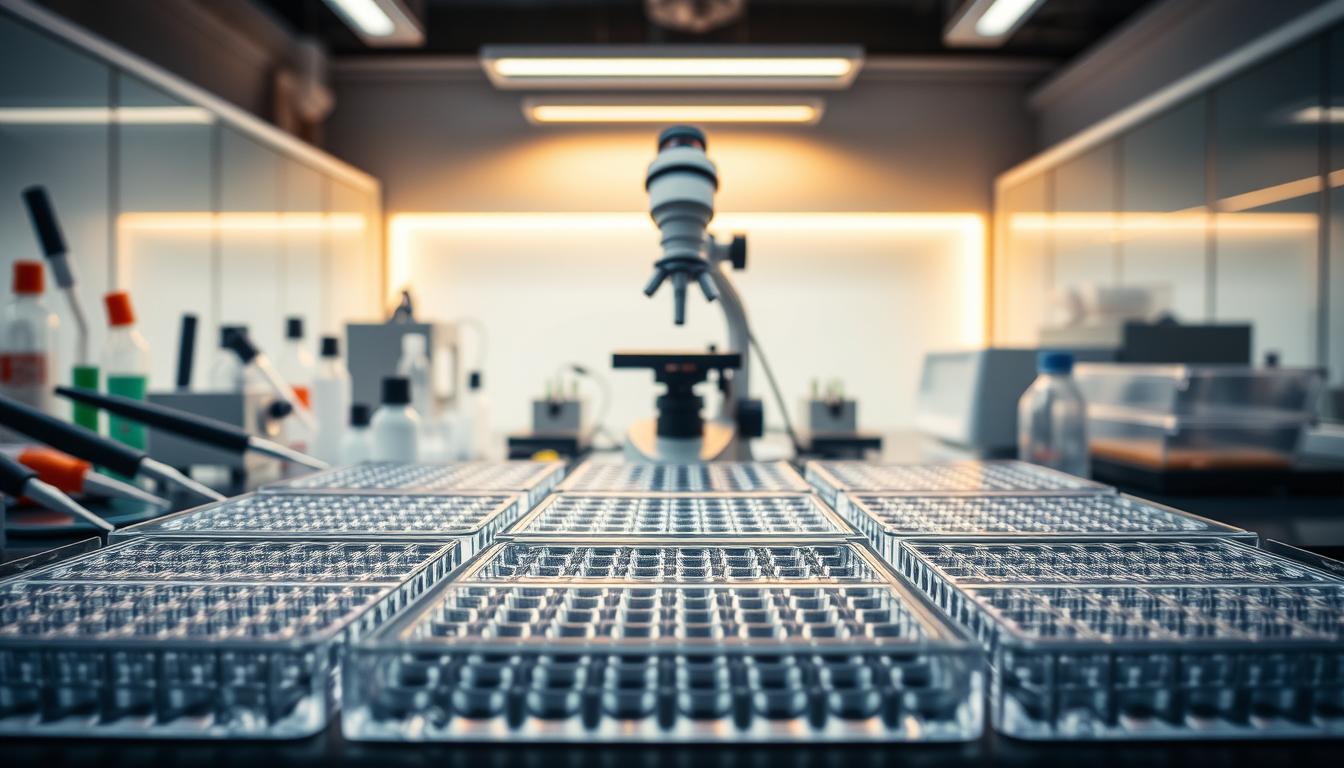
Ever thought about how scientists can check thousands of biological samples at once with great detail? The secret is in microwell technology, a game-changer in biomedical research.
Microwells are a top-notch tool in lab work. They let researchers handle and study tiny biological samples with unmatched speed. These small systems have changed how scientists do experiments, making them more precise and controlled.
The tech behind microwells has grown from old 24-well setups to advanced 1536-well designs. This means scientists can work with more samples using less material. It’s a big step forward for high-throughput screening and single-cell analysis, saving resources.
Key Takeaways
- Microwells enable precise control of small biological samples
- Advanced microwell technology supports high-throughput research
- Modern microplates can process thousands of samples simultaneously
- Microwell designs continue to improve scientific research capabilities
- These technologies reduce laboratory waste and increase experimental efficiency
Understanding Microwell Technology
Microwell technology is a new way scientists do research in labs. It changes how they do biological experiments. These cell culture plates are key tools for precise and efficient research.
Defining Microwells
Microwells are tiny holes in a surface for biological samples. They are 10 to 100 micrometers wide. This lets scientists study small amounts of cells very precisely.
- Dimensions typically 10-100 μm
- Enables single-cell analysis
- Supports high-throughput screening techniques
Laboratory Significance
Well plates are very important in science. Microwell technology helps with single-cell analysis. This gives scientists powerful tools for complex studies.
Microwells transform experimental approaches by creating controlled, miniature environments for cellular research.
| Feature | Benefit |
|---|---|
| Miniature Size | Reduces sample volume requirements |
| Isolated Environments | Enables precise cellular studies |
| High-Throughput Capability | Increases experimental efficiency |
Today’s labs use microwell technology for detailed cell studies. It’s great for high-throughput screening with little resources. This makes it essential for modern science.
Applications of Microwells in Research
Microwells have changed bioanalytical research a lot. They offer advanced platforms for detailed scientific studies. These small wells help researchers in cell culture, screening, and biological analysis.
Scientists use microwells to study cell interactions with great detail. Lab-on-a-chip systems use these tiny wells for complex bioassays in small spaces.
Cell Culture and Growth Techniques
Researchers use microwells for advanced cell culture. They get precise results in their studies. The benefits include:
- Controlled cellular environment
- Single-cell trapping capabilities
- High-resolution observation of cellular behavior
Microwell arrays open up new research paths. They have sizes from 30 μm to 100 μm. This lets scientists design experiments that fit their needs.
High-Throughput Screening Innovations
High-throughput screening is a big use of microwells. It lets researchers quickly check many cells. This speeds up drug discovery and genetic studies.
| Research Technique | Key Performance Metrics |
|---|---|
| Single-Cell Trapping | 88 ± 6% well occupancy in under 10 seconds |
| Particle Flow Experiments | Occupancy rate of 49 ± 9% at 50-100 μL/min |
| Well Depth Precision | Approximate 35 μm depth configuration |
Microwell technology is getting more versatile. It’s helping in many scientific fields, from genetics to stem cell research.
Advantages of Using Microwells
Microwell technology is a big step forward in lab research. It lets researchers do miniaturized assays like never before. These platforms make science more efficient and precise in many areas.
Microwell platforms offer big advantages over old research methods. They give scientists powerful tools for studying complex biology.
Efficient Resource Utilization
Researchers use microwell tech to manage resources better. They get many benefits, like:
- Less reagent needed
- Smaller sample volumes
- Lower costs
- More experiments done
Microplates can have 15,000 to 150,000 microwells. This lets researchers handle huge amounts of data with little material.
Improved Assay Sensitivity
Microwells create a controlled space that boosts experimental accuracy. They offer amazing abilities, such as:
| Performance Metric | Achievement |
|---|---|
| Cell Capture Efficiency | Exceeds 50% |
| Microwell Dimensions | 50 µm diameter, 58 µm height |
| Cell Profile Purity | Greater than 98.8% |
The precision of microwell arrays is unmatched. They allow for incredible molecular detection. For example, they can detect about 4,800 genes per cell. This is way beyond what was possible before.
Comparing Microwell Formats
Microtiter plate technologies have changed lab research a lot. They provide different platforms for screening many samples at once. Each well plate format has its own special features for scientists.
Researchers pick the right microwell format for their needs. The choice depends on the research goals, how much sample they have, and how complex the screening is.
96-Well Plates: Standard Research Platform
The 96-well plate is a key tool in biology. It has big benefits:
- Great for starting screenings
- Works well with most lab automation
- Cost-effective for everyday tests
384-Well Plates: Enhanced Throughput
384-well plates are a step up from 96-well plates. They are made for more experiments at once:
- Has four times as many wells as 96-well plates
- Uses less sample
- Is better for screening many samples
- Helps get more data faster
1536-Well Plates: Ultra-High-Density Screening
The 1536-well plate is the latest in microwell tech. It’s for very advanced research:
- Does the most experiments at once
- Needs very little sample
- Is perfect for detailed molecular screening
- Great for big genomic and pharmaceutical studies
Each microwell format has its own benefits. This lets researchers choose the best one for their research.
Microwell Design Considerations
Designing microwells is a detailed process. It involves choosing the right materials and surface features. These choices are key to making cell culture plates work well for bioanalytical research.
Critical Material Selection Strategies
Choosing the right material is essential for microwell performance. Researchers look for materials with certain qualities:
- High biocompatibility
- Chemical stability
- Precise dimensional control
- Optical transparency
SU-8 stands out as a top choice for microwell making. Its special properties allow for detailed microstructure creation with high accuracy.
Advanced Surface Coating Techniques
Coating microwells can turn them into advanced research tools. New techniques improve cell adhesion and protein interactions. This makes experiments more reliable.
“The right surface treatment can dramatically improve cellular response and experimental outcomes.” – Bioengineering Research Consortium
Coating methods include:
- Plasma treatment for better hydrophilicity
- Protein-based matrix applications
- Synthetic polymer modifications
- Biomimetic surface engineering
Recent studies show that precise microwell design is crucial. It can greatly affect single-cell analysis. Some research has seen over 90% cell trapping efficiency in special arrays.
Microwell Automation in Laboratories
Automation has changed lab work a lot, especially in high-throughput screening and miniaturized assays. New tech has made lab-on-a-chip systems better and more accurate.
Benefits of Automation in Microwell Technologies
Automated systems bring big benefits to labs:
- They do more experiments at once
- They cut down on mistakes
- They make results more reliable
- They process samples faster
- They give more accurate data
Examples of Automated Microwell Systems
Today’s labs use advanced automated systems for microwell research. These systems make many scientific tasks more efficient:
- Liquid Handling Robots: Move tiny sample amounts with precision
- Automated Plate Readers: Quickly check many microwell plates
- Integrated Screening Platforms: Make complex experiments easier
Automation changes lab work, letting scientists dive into important research instead of doing the same tasks over and over.
Using automated microwell systems can cut media exchange time from three minutes to 45 seconds. This speeds up research a lot. These systems help with things like 3D cell culture, making organs in a dish, and complex biological tests.
Quality Control in Microwell Production
Ensuring consistent performance and reliability in microwell technology is key. Manufacturers of microtiter plates and microplates must follow strict standards. These standards ensure precision and reproducibility in lab research.
The production of high-quality microwells involves several critical steps. These steps protect the integrity of research. Scientists depend on precise microwell manufacturing techniques for complex biological studies.
Regulatory Standards for Microwell Manufacturing
Quality control in microwell production includes several important elements:
- Compliance with international laboratory standards
- Comprehensive dimensional accuracy verification
- Surface property assessments
- Material consistency evaluation
Testing Protocols for Microplate Reliability
Manufacturers use extensive testing protocols to check microwell performance:
- Dimensional precision measurements
- Surface treatment verification
- Chemical compatibility assessments
- Biological sample interaction tests
Advanced technology ensures each microwell meets exacting specs. Specialized equipment and trained technicians perform multiple validation steps. This guarantees optimal performance in various research applications.
Innovations in Microwell Technology
The world of bioanalytical research is changing fast with new well plate technologies. Scientists are making cell culture plates better, finding new ways to do experiments.
Nanostructured Microwells: Precision at the Nanoscale
Nanostructured microwells are a big step forward in cell culture. These plates have tiny textures that:
- Help cells stick better
- Control how cells grow
- Offer special features for experiments
Now, scientists can control cell environments like never before. This lets them do more detailed bioanalytical tests.
Biodegradable Microwell Options
Biodegradable microwell options are becoming key in science. Gri3D® microwell plates are leading the way with:
- Supporting organoid and spheroid growth
- A 500-micrometer microwell array
- Less than 5% organoid loss in tests
- Reducing media change time to 45 seconds
These breakthroughs show how microwell tech keeps getting better. They give scientists better, greener tools for top-notch biological studies.
Future Trends in Microwell Applications
The world of biomedical research is changing fast, with microwell technology leading the way. Scientists are looking into new uses that could change how we understand and treat diseases.
Microwells are being combined with new technologies to open up new ways to test and study things. This is making it easier to do lots of tests at once and to study things more precisely. It’s all about using less and getting more out of it.
Microfluidic Integration Advances
Microwell arrays are getting more advanced, with amazing specs:
- Microwell diameters ranging from 50 µm to 500 µm
- Precise well spacing of 1 mm (x-direction) and 2 mm (y-direction)
- Internal volumes as small as 16 µl
- Capability to culture up to 1500 cell clones simultaneously
Personalized Medicine Potential
Bioassay techniques with microwell tech are changing personalized medicine. Now, scientists can study patient samples in detail. This lets them look at individual cell populations in a way that was never possible before.
Some big steps forward include:
- Enhanced cell aggregate monitoring
- Precise media flow rate control
- Detailed metabolic profiling
- Single-cell analysis capabilities
These changes mark a big shift in how we use microwells. They’re connecting advanced research with real medical breakthroughs.
Conclusion: The Future of Microwell Technology
Microwell technology is changing the game in biological research. It allows for super-precise miniaturized assays. The new microwell platforms are amazing for cell culture and research.
They show great results, like better vascularization in microtissues at 100×100 μm openings. This is a big deal.
Now, research places are at a key moment. They can start using microplate technologies to change how we study cells. This tech lets us make uniform cell groups, control cell numbers, and make millions of similar cell clusters per plate.
This shows how powerful microwell tech is for science. It could really help us understand more about the world.
Summary of Key Benefits
Microwell tech has many benefits. It makes experiments more reliable, uses resources better, and creates controlled 3D cell spaces. It lets researchers make cell groups accurately and keep microwell sizes the same, from 10-100 μm.
This makes experiments better in many areas of biology. It’s a big win for science.
Call to Action for Research Institutions
Researchers should check out and use the latest microwell tech in their labs. There’s a lot of potential for new discoveries in personalized medicine, stem cell research, and drug development.
By using these new microwell technologies, science can move forward faster and more accurately. It’s a chance to really understand complex biological systems better than ever before.
FAQ
What are microwells and why are they important in laboratory research?
Microwells are tiny wells used to study small biological samples. They help scientists work with tiny amounts of cells and substances. This makes it easier to do detailed research and experiments.
What are the primary applications of microwells in scientific research?
Microwells are mainly used for growing cells and screening many samples at once. They help scientists study how cells work and find new medicines. This is very useful in drug discovery and medical research.
How do different microwell plate formats differ from each other?
There are different types of microwell plates, like 96-well, 384-well, and 1536-well. Each type has its own size and how many samples it can hold. The right one depends on the research needs and the equipment available.
What materials are typically used in microwell fabrication?
Materials like polystyrene, glass, and SU-8 are used to make microwells. The choice depends on the research goal, the surface needed, and if it’s safe for cells.
How does automation impact microwell-based research?
Automation makes microwell research faster, more accurate, and consistent. It uses robots and special machines to handle samples and read results. This makes experiments more efficient.
What are the recent innovations in microwell technology?
New advancements include nanostructured microwells for better cell growth and biodegradable microwells for green research. These innovations open up new possibilities in studying cells and tissues.
How do microwells contribute to resource efficiency in laboratory research?
Microwells help save resources by using very little sample. This means less waste, lower costs, and more experiments with the same amount of sample.
What role do surface coatings play in microwell design?
Surface coatings are key in microwell design. They help cells stick better, proteins bind, and add special functions. The right coating makes the microwell work better for different studies.
How are microwells contributing to the advancement of personalized medicine?
Microwells help study individual patient samples in detail. This allows for custom treatments and tests. They’re important for making medicine more personal and effective.
What quality control measures are important in microwell production?
Making sure microwells are consistent and reliable is crucial. This includes following strict rules, testing them thoroughly, and checking they work with cells. This ensures accurate and trustworthy research results.





Leave a Comment
Your email address will not be published. Required fields are marked *