


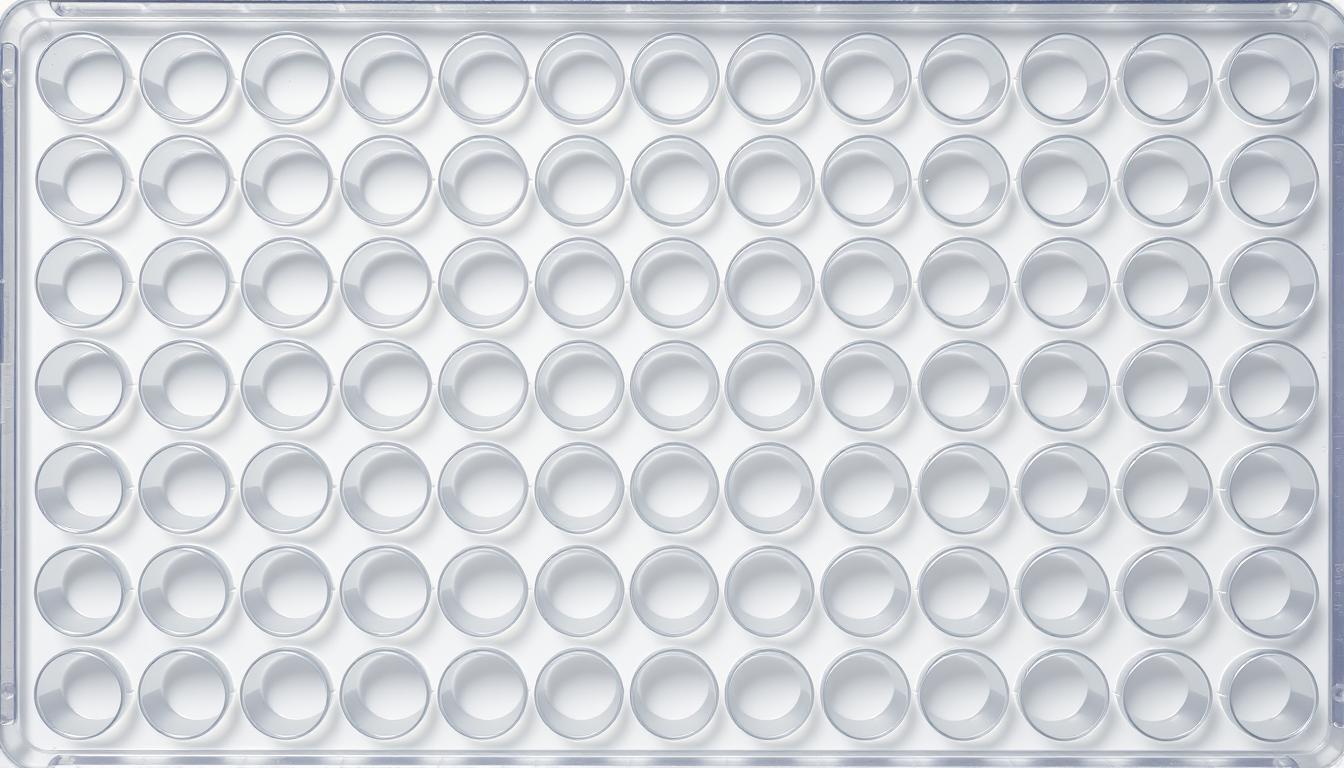
Accurate measurements of growth area directly impact cell behavior and experimental outcomes. Researchers rely on standardized labware to ensure consistency, but how do these dimensions affect cell culture performance?
Most high-throughput studies use rectangular wells with precise alphanumeric markings for tracking. These vessels often comply with ANSI/SBS 1-2004 standards, ensuring robotic compatibility. Stackable lids and sterile packaging further enhance workflow efficiency.
Understanding the relationship between cell confluence and available space helps optimize seeding densities. Variations like half-area designs offer flexibility for specialized applications. Proper evaporation control through lid designs maintains stable conditions.
Key Takeaways
- Growth space calculations influence cell adhesion and proliferation rates
- Standardized dimensions ensure compatibility with automated systems
- Lid designs minimize evaporation in sensitive cultures
- Surface treatments enhance cell attachment in specific applications
- Working volumes typically range between 15-175µl per well
Understanding 96 Well Plate Surface Area Per Well
Cell behavior varies significantly based on available growth space. Researchers must balance spatial constraints with biological needs to ensure reproducible results. Standardized labware dimensions help maintain consistency across experiments.
Why Surface Area Matters in Cell Culture
Larger spaces allow higher cell densities, affecting proliferation rates. Smaller areas may limit nutrient diffusion, altering metabolic activity. Proper cell adhesion relies on optimized surface-to-volume ratios.
Tissue culture treatments enhance attachment for sensitive lines. These coatings mimic natural extracellular matrices. Such modifications are critical for primary cells or 3D cultures.
Standard Dimensions and Growth Area
Most designs follow ANSI/SBS standards for automation compatibility. Round and rectangular wells offer distinct advantages:
| Well Shape | Advantages | Typical Use |
|---|---|---|
| Round | Uniform stress distribution | Suspension cultures |
| Rectangular | Maximized edge clarity | Imaging assays |
Lids with stacking rings minimize evaporation. Alphanumeric coding simplifies tracking across high-throughput workflows. Half-area options reduce reagent costs without sacrificing data quality.
How to Calculate Surface Area for 96 Well Plates
Precision in lab measurements starts with understanding spatial dimensions. Accurate calculations ensure consistent cell behavior and reliable data. This guide covers formulas, adjustments, and tools for precise results.
Key Variables Affecting Well Surface Area
Well shape and depth directly impact usable space. Round wells use the formula πr², while rectangular designs multiply length by width. For standard 6.4mm diameter wells, this equals 32.17mm² (0.32cm²).
Surface treatments like poly-L-lysine coatings alter effective space. These modifications enhance cell adhesion but may reduce measurable area. Meniscus formation also affects volume distribution, requiring adjustments.
“For half-area plates (15mm²), reduce seeding density by 50% to maintain optimal confluence.”
Using the Surface Area Calculator
Automated tools simplify conversions between mm² and cm². They account for edge effects in perimeter wells, where evaporation rates differ. Always verify tool outputs against manual calculations.
Quality control ensures consistent dimensions across batches. For specialized applications like 3D cultures, consult manufacturers for growth area specifications. Explore high-quality labware to ensure measurement accuracy.
- Round wells: π × (3.2mm)² = 32.17mm²
- Rectangular wells: Length × Width (varies by product)
- Adjustments: Subtract 5-7% for meniscus effects
Applications of 96 Well Plates in Research
Modern research labs rely on standardized culture plates for diverse experimental needs. These tools enable rapid screening and precise measurements across life sciences. Their compatibility with automated systems accelerates data collection.
Pharmaceutical studies use these plates for high-throughput drug screening. Luminescence assays identify compound interactions efficiently. Cytotoxicity tests reveal drug safety profiles early in development.
Key Research Applications
| Application | Purpose | Advantage |
|---|---|---|
| ELISA | Protein detection | Quantitative antibody analysis |
| Spheroid culture | Cancer research | 3D tissue modeling |
| ADME/Tox | Drug metabolism | Early-stage safety data |
Stem cell studies benefit from uniform growth conditions. Plates support cell adhesion for differentiation tracking. Automated liquid handlers streamline media changes.
PCR workflows use these plates for parallel DNA amplification. Thermal stability ensures consistent reaction conditions. Antimicrobial tests compare agent efficacy across bacterial strains.
“Viability assays in compact formats reduce reagent costs by 40% compared to traditional methods.”
Metabolic activity measurements track real-time cell responses. Oxygen-sensitive dyes integrate seamlessly with plate readers. Researchers optimize conditions for tissue engineering.
Conclusion
Choosing the right culture plate impacts cell behavior and data accuracy. Standardized designs with stacking rings and sterile packaging ensure reproducibility across labs. Advances in surface treatments enhance adhesion for sensitive cells.
Emerging organoid research demands precise plate selection. Always validate product specifications against ANSI standards. Proper lid designs maintain stable cell culture conditions.
Optimize growth by matching plate dimensions to experimental needs. Evolving industry benchmarks refine microplate manufacturing. These steps guarantee reliable results in high-throughput workflows.
FAQ
Why is surface area important for cell culture?
Adequate surface area ensures proper cell attachment and growth. Insufficient space can limit proliferation, while excess space may lead to uneven distribution.
What are the standard dimensions for a 96-well plate?
Most plates feature wells with a diameter of approximately 6.4 mm and a growth area of around 0.32 cm². Exact measurements vary slightly by manufacturer.
How do I calculate the surface area for each well?
Multiply π (3.14) by the radius squared. For example, a well with a 3.2 mm radius has an area of 3.14 × (3.2)² ≈ 32 mm².
Can I use a calculator to determine well surface area?
Yes, online tools simplify the process by automatically computing the area based on input dimensions like diameter or radius.
What applications benefit from 96-well plates?
These plates are ideal for high-throughput screening, drug discovery, and assays requiring uniform cell distribution and controlled experimental conditions.
Does well shape affect cell culture results?
Yes, flat-bottom wells promote even cell adhesion, while round or V-bottom designs are suited for suspension cultures or specific assay types.





Leave a Comment
Your email address will not be published. Required fields are marked *