


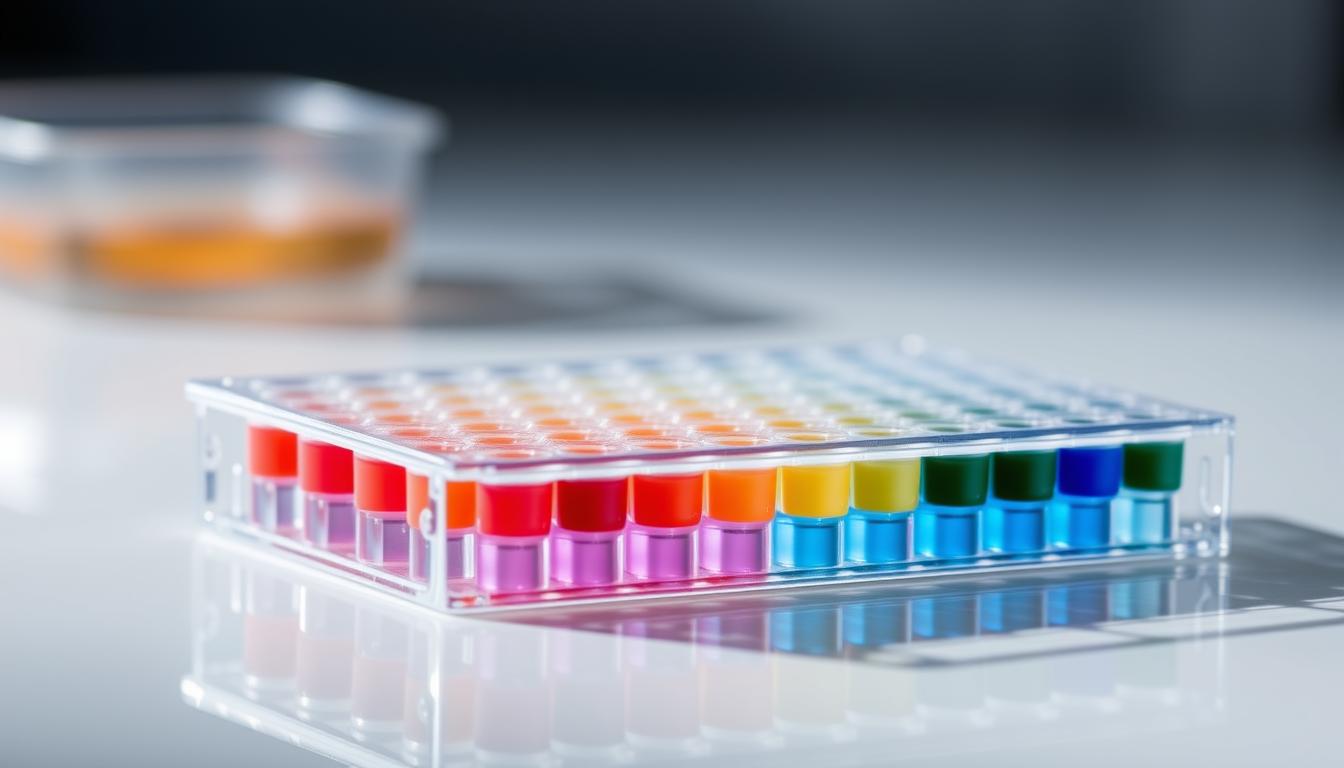
Ever wondered how scientists achieve precise, repeatable results in high-throughput experiments? The answer lies in a simple yet powerful tool—the 96-well microplate. Designed for efficiency, this lab essential streamlines workflows in diagnostics, biotechnology, and cell culture research.
Constructed from polystyrene, these plates meet USP Class VI standards, ensuring compatibility with diverse assays. Their flat or round bottom designs enhance stability and sample visibility, while their standardized format guarantees consistency across research teams.
Whether used for automated screening or manual assays, high-quality microplates minimize variability, delivering reliable data. This product isn’t just a lab accessory—it’s a cornerstone of modern scientific discovery.
Key Takeaways
- 96-well microplates optimize high-throughput lab workflows.
- Polystyrene construction ensures material safety and compatibility.
- Flat or round bottom designs improve stability and visibility.
- Standardized formats support consistent experimental results.
- Essential for cell culture, diagnostics, and biotech research.
Introduction to 96 Well-Plates
Modern labs rely on standardized tools like the 96-well plate to handle complex experiments. Its 12×8 grid design, with a size of 127.76 x 85.48 mm, balances compactness and capacity. Each well holds 200–400 µL, making it ideal for repetitive testing.
Originally developed in the 1950s, these plates evolved from manual pipetting to automated systems. Today, they integrate seamlessly with robotic liquid handlers, speeding up workflows.
“The shift to automation cut processing time by 70%,”
notes a lab technician.
Their flat or round-bottom surface enhances stability for assays like ELISA and PCR. Researchers also use them for cell culture, where consistent well geometry ensures even growth. This uniformity reduces variability in results.
In cell-based studies, such as proliferation assays, their design minimizes reagent waste. Labs save costs while maintaining precision. For example, optimizing cell-based assays becomes easier with standardized plates.
Key Features of High-Quality 96 Well-Plates
High-throughput research demands durable and consistent materials. The right lab tools ensure experiments run smoothly, with minimal errors. Two critical factors define quality: material composition and structural design.
Material Composition and Quality Standards
Top-tier plates use virgin polystyrene for optical clarity and low fluorescence. This material meets ISO and USP Class VI standards, ensuring safety for cell cultures and sensitive assays. Some variants offer high-binding surfaces for protein studies.
Deep well options accommodate larger volumes, ideal for sample storage. Polystyrene’s thermal stability (2.4 mm wall thickness) prevents warping during temperature shifts.
Design and Structural Integrity
Precision engineering enhances performance. Raised rims (0.5 mm) create airtight seals with films or caps. Stacking compatibility (±0.25 mm height tolerance) saves lab space.
Draft angles (3–5°) improve sample recovery, reducing waste. Molded alphanumeric grids simplify tracking, while flat bottom designs optimize absorbance readings.
| Design | Best For | Key Advantage |
|---|---|---|
| U-bottom | Cell suspension | Even mixing |
| V-bottom | Pelleting | Precise centrifugation |
Round bottom plates excel in ELISA washes, while flat bottom versions suit colorimetric assays. Choose based on your lab’s workflow needs.
Types of 96 Well-Plates
Not all lab plates are created equal—each type serves a distinct purpose. Researchers select designs based on assay needs, detection methods, and sample types. The right choice ensures accuracy and efficiency.
Flat Bottom vs. Round Bottom Plates
Flat-bottom plates are ideal for absorbance readings in colorimetric assays. Their even surface minimizes light scattering. Round-bottom versions excel in mixing suspensions, like ELISA washes.
For pelleting cells, V-bottom designs provide precise centrifugation. A comparative overview:
| Design | Primary Use | Key Benefit |
|---|---|---|
| Flat | Absorbance assays | Optimal light transmission |
| Round (U) | Cell suspension | Uniform mixing |
| Conical (V) | Pelleting | NBS-compatible recovery |
Clear, Black, and White Polystyrene Options
Clear plates suit general assays with visible light detection. Black variants reduce crosstalk in fluorescence studies. White plates enhance luminescence signals for sensitive readings.
Each color aligns with specific instruments. For example, black plates work best with high-binding surfaces in protein assays.
Specialized Plates for Unique Applications
Coated surfaces expand functionality. Poly-D-lysine plates promote neuron adhesion, while ECM coatings support 3D cell models. Hydrophilic treatments improve hemagglutination assays.
Other niche options include:
- Cyclic olefin plates for organic solvent resistance.
- Glass-bottom designs for high-resolution microscopy.
- Ultra-low attachment surfaces for spheroid cultures.
Applications of 96 Well-Plates in the Lab
From drug discovery to diagnostics, standardized lab tools drive consistent results. These plates excel in high-throughput workflows and specialized assays, thanks to their uniform design and cell culture treated surfaces.
High-Throughput Screening
Automated systems rely on these plates to test thousands of compounds rapidly. Their compatibility with robotic handlers cuts processing time by 70%, ideal for pharmaceutical research.
Key advantages include:
- Oxygen permeability (2.5 cm³/m²/day) supports aerobic cultures.
- CO₂ diffusion rates maintain pH stability for long-term studies.
Cell Culture and Protein Binding Assays
Cell culture treated surfaces achieve >90% confluency within 24 hours, ensuring reliable adhesion. The delta surface chemistry minimizes variability in protein assays.
| Assay Type | Surface Requirement | Performance Metric |
|---|---|---|
| ELISA | High-binding | >300 ng/cm² albumin retention |
| Spheroid Culture | Ultra-low attachment |
Endotoxin levels (protein binding or scaling cell-based studies, these plates deliver precision.
Advantages of Using 96 Well-Plates
Industrial-scale research thrives on tools that balance accuracy and automation. These plates streamline workflows, ensuring reliable data across high-volume testing. Their standardized design minimizes errors, making them indispensable for labs handling repetitive assays.
Precision and Efficiency in Sample Testing
Miniaturized wells reduce reagent waste while maintaining test integrity. Parallel processing allows 80+ samples to run simultaneously, cutting downtime. Key precision features include:
- 0.2 mm height tolerance for gripper arm compatibility.
- Machine-readable 2D barcodes to track samples.
- Centrifugation stability up to 4,000 x g.
Compatibility with Automated Systems
Seamless integration with robotic handlers boosts throughput. Adherence to SBS footprint standards ensures universal fit. Below, a comparison of automation-ready features:
| Feature | Benefit | Industrial Use Case |
|---|---|---|
| RFID tagging | Real-time sample tracking | Pharmaceutical batch testing |
| Nesting compatibility | Space-saving storage | High-capacity labs |
For large-scale programs, these plates offer scalability without sacrificing precision. Individually wrapped options (case or bag packaging) maintain sterility in automated environments.
Surface Treatments and Their Importance
The right surface chemistry can make or break experimental results. Coatings on lab plates dictate how samples interact, ensuring accuracy in assays ranging from cell culture to protein studies.
Non-Treated vs. Treated Surfaces
Standard polystyrene plates lack coatings, ideal for general storage. Treated surfaces, however, enhance functionality:
- Plasma-treated: Electronegative and hydrophilic, boosting cell adhesion.
- Poly-D-lysine: Promotes neuron growth with amine reactivity >300 pmol/cm².
- Hydrogel coatings: Enable 3D spheroid formation for advanced models.
Ultra-Low Attachment and High-Binding Options
Ultra-low attachment surfaces minimize cell adhesion (high-binding plates retain proteins like albumin at >300 ng/cm² for ELISA.
| Surface Type | Best For | Key Metric |
|---|---|---|
| Ultra-low attachment | 3D cell models | <5% cell adhesion |
| High-binding | Protein assays | Streptavidin capacity: 20 pmol/cm² |
Temperature-responsive polymers and carboxylated surfaces further expand options for DNA binding or reversible cell detachment.
Choosing the Right 96 Well-Plate for Your Needs
Selecting the optimal lab plate requires careful consideration of experimental goals and workflow demands. A structured approach ensures compatibility with instruments, accuracy in results, and cost efficiency.
- Assay type: ELISA needs high-binding surfaces, while cell cultures require treated wells.
- Detection method: Fluorescence assays demand black-walled plates, whereas luminescence works best with white surfaces.
- Sample volume: Deep-well designs accommodate larger volumes (up to 2 mL).
- Automation needs: Robotic handling requires SBS-compatible footprints and barcoding.
- Sterility: Individually wrapped options prevent contamination in sensitive studies.
For optical detection, material transparency matters. Clear polystyrene suits absorbance readings, while opaque plates minimize crosstalk in fluorescence. Centrifugation stability (tested up to 4,000 x g) is vital for pelleting applications.
| Detection Method | Plate Requirement |
|---|---|
| Absorbance | Transparent bottom, no lid |
| Fluorescence (Top) | Black walls/opaque bottom |
| Luminescence | White plates, dark storage |
Long-term storage considerations include chemical resistance charts. Polypropylene handles organic solvents better than standard polystyrene. Always verify manufacturer specifications against lab protocols.
This product selection framework balances performance with practicality, helping researchers avoid costly mismatches. Matching plate features to experimental needs streamlines workflows and enhances data reliability.
Sterility and Packaging Options
Maintaining sterile conditions is critical for reliable lab results, and packaging plays a key role. Proper sealing and handling prevent contamination, ensuring data integrity. Labs must weigh convenience against risk when choosing formats.
Individually Wrapped vs. Bulk Packaging
Individually wrapped plates minimize exposure, ideal for sensitive assays. Each unit undergoes gamma irradiation (25–40 kGy) and meets ISO Class 5 cleanroom standards. Foil seals pass integrity tests to block airborne particles.
Bulk packaging in case quantities cuts costs by 15–20% but requires careful storage. Resealable options balance savings and sterility for multi-use workflows. Double-bagged plates with desiccant protect moisture-sensitive applications.
- Gamma validation: Ensures microbial reduction without material degradation.
- Cleanroom certified: Guarantees ≤3,520 particles/m³ during manufacturing.
- Peelable seals: Enable quick access while maintaining barrier properties.
| Packaging Type | Contamination Risk | Best For |
|---|---|---|
| Individually wrapped | Low | Long-term storage, sensitive studies |
| Bulk (case) | Moderate | High-volume labs with controlled environments |
Optical Clarity and Detection Methods
Accurate data starts with optimal light transmission in lab tools. Plates engineered for optical clarity minimize signal distortion, ensuring precise readings in assays like UV/VIS spectroscopy.
- <1% variation in optical density readings across wells.
- Autofluorescence levels below 100 RFU at 485 nm, reducing background noise.
- UV transparency down to 240 nm for nucleic acid quantification.
Advanced designs combat light scattering with dual-side polishing. Pathlength correction algorithms adjust for 50–200 µL volumes, standardizing absorbance measurements.
| Plate Type | Optimal Detection Method |
|---|---|
| Clear polystyrene | Absorbance (300–700 nm) |
| Black-walled | Fluorescence (minimized crosstalk) |
For fluorescence assays, black plates cut halo effects by 90%. White variants amplify luminescence signals, ideal for low-abundance targets.
96 Well-Plates for Specific Assays
Precision in lab assays hinges on selecting plates tailored to detection methods. Each technique—whether colorimetric, luminescent, or fluorescent—requires unique plate properties to minimize noise and maximize signal clarity.
Colorimetric and Luminescence-Based Assays
For colorimetric readings, clear polystyrene plates ensure optimal light transmission. Anti-reflective coatings reduce scatter, while flat-bottom wells emulate cuvette geometry for consistent absorbance measurements.
Luminescence assays benefit from white plates, which amplify weak signals by reflecting 90% of light. Key features include:
- Quartz-bottom options for UV-range transparency (down to 240 nm).
- Polarization-compatible designs to reduce photobleaching.
- Chimney-style wells in LUMITRAC™ plates to prevent cross-contamination.
Fluorescence and UV/VIS Spectroscopy
Black-walled FLUOTRAC™ plates cut background fluorescence by 80%, ideal for sensitive detection. Their opaque material minimizes crosstalk between wells during high-throughput imaging.
For UV/VIS spectroscopy, specialized plates offer:
| Feature | Impact |
|---|---|
| UV-transparent bottoms | Accurate nucleic acid quantification |
| Optically flat surfaces | Reduced light distortion |
Well geometry is optimized to match spectrometer pathlengths, ensuring data reliability across volumes from 50–200 µL.
Innovations in 96 Well-Plate Design
Cutting-edge research now leverages next-gen lab tools with unprecedented precision. Recent advancements merge material science with smart technology, redefining high-throughput workflows.
3D-printed plates integrate microfluidics, enabling parallel assays with minimal manual intervention. Nanotextured surfaces guide cell growth directionally, ideal for neurobiology studies.
Emerging designs include:
- Smart plates with embedded pH/O₂ sensors for real-time monitoring.
- Thin-wall PCR-compatible variants that optimize thermal conductivity.
- Multi-layered platforms for sequential reactions, reducing cross-contamination.
“Engineered hydrogels mimic in-vivo conditions, improving migration studies by 40%,”
Sustainability gains traction with biodegradable polymers. Glass-bottom designs (180-µm thickness) enhance microscopy resolution, while hydrogel-coated surfaces support dynamic 3D cultures.
These products expand application scope—from drug discovery to regenerative medicine. Labs adopting such innovations gain a competitive edge in data accuracy and workflow efficiency.
Maintenance and Handling Best Practices
Proper lab practices extend the lifespan of essential tools while ensuring reliable results. Consistent handling and maintenance protocols minimize contamination risks and preserve equipment integrity.
Cleaning Protocols: For reuse, soak plates in 70% ethanol for 30 minutes or 0.1M NaOH for tougher residues. Rinse thoroughly with deionized water to avoid chemical interference.
- Centrifugation: Balance plates symmetrically to prevent warping. Use adapters for speeds exceeding 3,000 x g.
- Storage: Keep in controlled environments (15–25°C, <60% RH). Seal in dust-free bags to prevent moisture absorption.
Surface Regeneration: Plasma-treated surfaces can be reactivated with UV ozone cleaners for cell adhesion studies. Avoid abrasive scrubbing to maintain coating integrity.
Decontamination: In BSL-2+ labs, use 10% bleach followed by 70% ethanol wipes. Validate sterility with ATP swab tests before reuse.
“Sterile technique isn’t optional—it’s the backbone of reproducible science,”
Pair these practices with compatible lab products, like lint-free wipes and pH-neutral detergents, to maximize efficiency.
Comparing 96 Well-Plates to Other Formats
Higher-density plates offer advantages but require specialized equipment. Labs balancing throughput and cost must evaluate formats like 384-well and 1536-well designs. Each suits different workflows, from drug discovery to genomics.
- 384-well plates reduce reagent use by 65% versus 96-well, cutting expenses.
- 1536-well designs maximize throughput but demand advanced liquid handlers.
- Error rates rise 12% in ultra-high-density formats due to smaller *wells*.
Automation infrastructure costs vary. While 96-well plates work with basic 8-channel pipettes, 1536-well versions need robotic systems. Hybrid designs blend benefits—like high-quality 96-well plates with removable strips for flexibility.
| Format | Reagent Savings | Automation Needs |
|---|---|---|
| 96-well | Baseline | Low |
| 384-well | 65% | Moderate |
“Smaller *wells* save reagents but amplify pipetting errors,” notes a biotech engineer.
Edge effects—evaporation in outer *wells*—worsen in high-density formats. Proper sealing and humidity control mitigate this. For labs prioritizing compact size and scalability, 384-well plates often strike the best balance.
Conclusion
Selecting the right lab equipment impacts research accuracy and efficiency. A 96-well plate delivers versatility for high-throughput workflows, ensuring quality results in diagnostics and cell culture studies.
Key factors like material safety, optical clarity, and automation compatibility define performance. Future trends include smart sensors and eco-friendly materials, enhancing precision while reducing waste.
Partnering with trusted suppliers ensures consistent product standards. For first-time buyers, balancing cost with assay needs is critical. Investing in reliable tools pays off in long-term data integrity.
FAQ
What are the key differences between flat and round bottom plates?
Flat bottom plates provide uniform optical clarity for absorbance readings, while round bottom plates are ideal for mixing and suspension-based assays. The choice depends on the specific lab application.
How does surface treatment impact cell culture performance?
Treated surfaces, like Corning’s Nunclon Delta, enhance cell attachment and growth. Ultra-low attachment options minimize binding for specialized studies like spheroid formation.
Why is polystyrene commonly used for these plates?
Polystyrene offers excellent optical clarity, chemical resistance, and compatibility with high-throughput screening. It’s also lightweight and cost-effective for disposable labware.
What packaging options are available for sterility?
Plates come individually wrapped for single-use sterility or in bulk cases for high-volume labs. Both options maintain cleanliness and reduce contamination risks.
Can these plates be used with automated systems?
Yes, most 96-well plates are designed for compatibility with robotic handlers and liquid dispensers, ensuring seamless integration into automated workflows.
How do I choose between clear, black, and white plates?
Clear plates are ideal for absorbance assays, black plates reduce cross-talk in fluorescence, and white plates enhance luminescence signals. Select based on detection method.
What assays benefit most from high-binding surfaces?
Protein binding, ELISA, and other immunoassays require high-binding surfaces to maximize analyte retention and improve sensitivity.
Are there low-evaporation designs available?
Yes, brands like Nunc offer plates with optimized lids to minimize evaporation during long incubations, critical for cell-based assays.






Leave a Comment
Your email address will not be published. Required fields are marked *