



Ever thought about how scientists mix things up in lab experiments? The magnetic stirrer is a big deal. It changes how we mix in labs, helping in many scientific fields.
Magnetic stirrers are key in today’s labs. They mix solutions well and without mess. These small devices use magnets to mix things evenly in labs.
They make labs better by improving accuracy and cutting down on manual work. In fields like biotech and pharma, they’re crucial for getting the same results every time.
Key Takeaways
- Magnetic stirrers enhance mixing efficiency across scientific industries
- They minimize contamination risks during laboratory experiments
- These devices offer precise speed control and uniform mixing capabilities
- Suitable for various laboratory applications, including chemical and biological research
- Provide consistent performance with low maintenance requirements
Introduction to Magnetic Stirrers
Laboratory agitators are key in scientific research. Magnetic stirrers are a crucial tool for precise mixing and sample prep. They have changed how researchers do experiments in many fields.
Magnetic stirrers mix liquids without touching them. They use a magnetic field to make a stir bar spin. This creates smooth fluid movement.
Definition and Core Purpose
A magnetic stirrer mixes liquids through electromagnetic forces. It has a few main parts:
- A magnetic stir bar
- An electromagnetic base
- Speed and rotation control mechanisms
Importance in Laboratory Settings
Magnetic stirrers offer big benefits:
- Uniform mixing without touching the sample
- Control over stirring speed
- Less chance of sample damage
| Stirrer Characteristic | Typical Range |
|---|---|
| Stirring Speed | 100-1500 rpm |
| Maximum Volume | 0.25-150 liters |
| Temperature Range | -120°C to 250°C |
Since 1917, magnetic stirrers have been vital in science. They offer quiet, efficient, and precise mixing in many areas.
Types of Magnetic Stirrers
Magnetic stirring equipment is key in lab research. It helps mix and heat samples. Scientists use different stirrers for their needs.
There are many magnetic stirrers, each for a special purpose. They range from small units to complex systems. These tools offer a wide range of mixing options.
Standard Magnetic Stirrers
Standard magnetic stirrers are the basic tool in labs. They have:
- Stirring speeds up to 1000 rpm
- A small design for simple lab tasks
- They mix liquids well with little mess
Hot Plate Magnetic Stirrers
Stirring hotplates mix and heat at the same time. They are advanced tools for lab work. They have:
- Temperature ranges up to 380°C
- Exact electronic temperature control
- They heat and mix at the same time
Digital heating and stirring equipment provides the highest level of accuracy in temperature and stirring speed management.
Multi-Position Magnetic Stirrers
Multi-position magnetic stirrers are the top choice in labs. They let researchers:
- Mix many samples at once
- Keep stirring conditions the same
- Work with different flask sizes
Knowing about these stirrers helps researchers pick the right one for their work.
Key Features to Consider
Choosing the right magnetic agitation devices is crucial. Lab professionals need to know what makes top-notch magnetic stirrer accessories stand out. It’s not just about picking any equipment.

Stirring Speed Range
The speed range of magnetic stirrers is key. Today’s devices can stir between 1000-15000 RPM. This range is vital for mixing various samples effectively.
- Minimum speed for gentle samples
- Maximum speed for strong mixing
- Consistent mixing across different viscosities
Capacity and Size Considerations
Magnetic stirrers vary in size to fit different lab needs. Small models can handle up to 3 liters of solution. Specialized units can handle:
- Surfactant solutions (up to 1 liter)
- Emulsions (around 250 ml)
- Multi-position setups for multiple experiments
Advanced Control Mechanisms
Top magnetic stirrers have advanced controls. Digital models come with:
- LCD/LED panels for clear monitoring
- Electronic speed controllers
- Pre-programmable settings
- Remote control options
Precision in magnetic agitation devices directly affects research quality and results.
Researchers should look for magnetic stirrer accessories that offer reliable performance and control. This ensures the best results in experiments.
Benefits of Using Magnetic Stirrers
Magnetic stirrers have changed the game in lab mixing. They offer big advantages for scientists and researchers. These tools help make sample preparation precise and efficient in many fields.
Lab experts love magnetic stirrers for their top-notch mixing. They make sure mixtures are even and keep contamination risks low. The design of these tools makes experiments reliable and consistent.
Enhanced Mixing Efficiency
Magnetic stirrers are great at mixing thanks to their tech:
- They spin fast with rotating electromagnets
- They work with stir bars from a few millimeters to several centimeters
- They support different stir bar shapes like octagonal and circular
Reduction of Contamination Risks
Choosing the right lab stirrer accessories is key to avoiding contamination. Magnetic stirrers have a sealed design. This keeps the mixing parts away from the samples, keeping experiments clean.
| Mixing Characteristic | Magnetic Stirrer Performance |
|---|---|
| Viscosity Range | Low to Medium Viscosity Samples |
| Contamination Risk | Minimal Direct Contact |
| Mixing Precision | High Uniformity |
Scientific research needs to be precise, and magnetic stirrers deliver. They provide consistent mixing in different lab settings.
Common Applications in Biology
Magnetic stirrers are key in biology labs. They mix materials precisely and efficiently. This helps scientists get reliable results in complex experiments.
Sample Preparation Techniques
In biology labs, magnetic stirrers are vital. They help make solutions and suspensions uniform. Scientists use them to:
- Dissolve chemicals evenly
- Prepare cell culture media
- Mix substances safely
- Ensure solution concentrations are the same
Enzyme Reaction Optimization
Enzyme reactions need exact mixing. Magnetic stirrers offer the right solution. Controlled magnetic mixing ensures:
- Even substrate distribution
- Best reaction speeds
- Less heat
- Consistent results
Cell Culturing Advancements
Today’s cell culturing depends on magnetic stirrers. They keep cells and nutrients evenly distributed. Special stirrers are gentle, protecting cells during mixing.
Magnetic stirrers have changed biology by offering consistent, clean mixing for all kinds of experiments.
Choosing the Right Magnetic Stirrer
Choosing the right lab stirrers is key for your research. Laboratory agitators are vital in scientific experiments. They are a crucial choice for researchers and lab professionals.
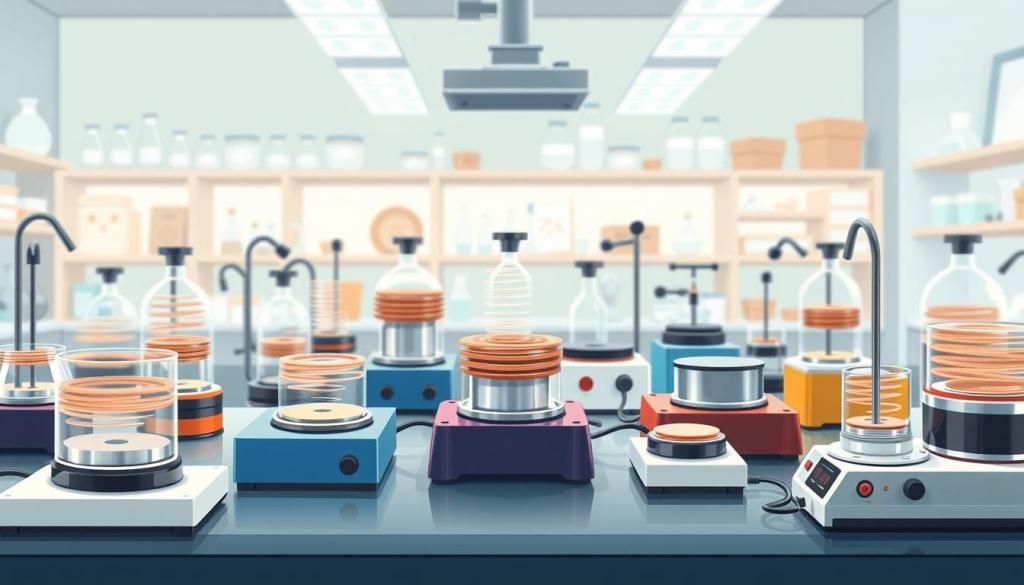
When picking magnetic stirrers, focus on several important aspects. This ensures they work well and meet your experimental needs.
Assessing Laboratory Requirements
Start by understanding your research environment. Look at these important factors:
- Types of experiments you do often
- Sample volumes you usually work with
- How often you use the stirrers
- What mixing you need to do
Evaluating Technical Specifications
It’s crucial to analyze the technical specs of lab stirrers. Check these key points:
- Speed range capability
- Maximum mixing volume
- Temperature control features
- Compatibility with different vessel types
Precision in selection determines the success of your scientific experiments.
Knowing your lab’s specific needs helps you pick the best magnetic stirrer. This ensures your research goes smoothly.
Safety Considerations
Laboratory safety is key when using magnetic stirring equipment and stirring hotplates. It’s important for researchers to know the risks. This helps prevent accidents and ensures experiments run smoothly.
When using magnetic stirring equipment, several critical safety considerations demand careful attention:
Electrical Safety Protocols
Electrical safety is a major concern with magnetic stirrers. About 70% of lab accidents are due to electrical issues. Important steps include:
- Regularly check electrical cords for damage
- Make sure equipment is properly grounded
- Keep electrical parts dry
- Use equipment on stable, level surfaces
Heat Management Strategies
Stirring hotplates can get very hot, up to 500°C. Important steps for managing heat include:
- Use heat-resistant borosilicate glassware
- Check glassware for cracks before use
- Ensure the hot plate is bigger than the heating vessel
- Use automatic shutdown features
“Safety in the laboratory is not an option, but a necessity.” – Laboratory Safety Experts
Wearing personal protective equipment is crucial. About 60% of lab injuries happen because of bad protective gear. Always wear gloves, lab coats, and safety glasses when using magnetic stirring equipment.
By following these safety tips, labs can reduce risks. This makes the research environment safer for everyone.
Maintenance and Care
Laboratory researchers know that keeping magnetic agitation devices in good shape is key. They focus on regular cleaning and solving problems to make their equipment last longer.
Keeping your magnetic stirring gear in top shape involves a few important steps:
- Check stir bars for damage or wear
- Clean surfaces after each use with the right solvents
- Make sure electrical connections and grounding are good
- Store magnetic stirrer accessories where there are no magnets
Cleaning Best Practices
Cleaning magnetic devices right is crucial. Alkanox is great for organic stuff, and Aqua Regia gets rid of metal. A special coating called FDA-grade Teflon® PTFE is also very good for chemicals.
Troubleshooting Common Issues
Researchers often face problems with magnetic stirrers. If it doesn’t work, check the fuse on the back. If it stirs poorly, the stir bar might be the issue.
| Stir Bar Material | Temperature Resistance | Recommended Use |
|---|---|---|
| Ceramic | Moderate | Cost-effective, general applications |
| Alnico | High | High-temperature environments |
| Neodymium | Low | High-efficiency viscous solutions |
Look out for signs that your stir bar needs to be replaced. These include damage, poor stirring, or it keeps coming loose. By taking care of your magnetic stirrer, you’ll get the best out of it.
Advanced Magnetic Stirrer Features
Modern lab tools keep getting better, helping scientists do their work more accurately. Magnetic stirrers are a big part of this, with new tech that makes them more precise and efficient.
Today, lab workers have magnetic stirrers with amazing features. These tools make research easier and more controlled. They also make it simpler to keep them in good shape and use smart accessories.
Programmable Settings
Modern magnetic stirrers have cool programmable options that change how we do science:
- Preset stirring protocols with precise speed settings
- Programmable timer from 1 second to 160 hours
- Speed stays stable within ±5 RPM for even mixing
- Digital interfaces for quick adjustments
Integrated Temperature Control
Now, advanced models come with top-notch temperature control:
- Works from 5°C to 40°C
- Can go up to 340°C
- Calibrates temperature for precise experiments
- Monitors and controls temperature in real-time
There are many magnetic stirrers to choose from, priced from $170 to $2,726. This range meets all budgets and needs. These new features greatly boost the quality and speed of biological research.
Future Trends in Magnetic Stirring Technology
The world of magnetic stirring technology is changing fast. New ideas and research are leading to big improvements. These changes are making magnetic mixing better for science.
New trends in magnetic stirrer technology are changing how we do research. Some key developments include:
- Integration of Internet of Things (IoT) capabilities for remote monitoring
- Advanced digital control systems enabling precise parameter adjustments
- Enhanced energy efficiency with reduced power consumption
- Implementation of artificial intelligence for optimized stirring parameters
Automation in Laboratory Processes
Automation is a big step forward in magnetic stirring technology. Today’s magnetic stirrers are getting smarter. They have features that make lab work easier.
Researchers can now control magnetic mixing better than ever. Intelligent systems adjust to what each experiment needs.
Improvements in Materials and Design
New materials are making magnetic stirrers better. High-grade ceramics and advanced plastics make them last longer and work better. This means they can handle tough research conditions.
The global magnetic stirrer market is growing fast. It’s expected to go from US$ 1.9 billion in 2022 to US$ 2.2 billion by 2028. This 3% compound annual growth rate shows more people want advanced magnetic mixing tools for science.
Conclusion
Lab stirrers are key in scientific research, especially in biological labs. They help make experiments more precise and efficient. It’s important for researchers to pick the right stirrers for their needs to get the best results.
Choosing the right stirrer means looking at speed, capacity, and special features. Modern magnetic stirrers can heat and mix, reducing contamination risks. They come with digital controls and precise temperature settings, making them essential for research.
To use magnetic stirrers well, match them with your experiment’s needs. Think about the liquid’s volume, how thick it is, and how much stirring it needs. Buying top-notch lab stirrers from trusted makers can greatly improve your research process and results.
Key Selection Strategies
When picking lab stirrers, look for ones that are flexible, durable, and have precise controls. Knowing what biological research needs helps make better choices. This leads to better science and more accurate results.
FAQ
What is a magnetic stirrer and how does it work in a laboratory setting?
A magnetic stirrer is a device used in labs. It uses a magnetic field to mix liquids. A stir bar in the liquid and a plate below create this field.
What are the primary advantages of using a magnetic stirrer in biological research?
Magnetic stirrers mix liquids well and safely. They keep samples clean and mix them evenly. This is key in biology where samples must be pure.
What types of magnetic stirrers are available for laboratory use?
There are many types of magnetic stirrers. You can find ones that heat liquids, stir multiple samples at once, or just mix solutions.
How do I select the right magnetic stirrer for my biological research?
Choose a stirrer based on its speed, volume, and temperature needs. Also, think about how many samples you need to stir at once.
What safety precautions should be taken when using magnetic stirrers?
Be careful with electrical safety and heat. Don’t overload the stirrer and keep it away from flammable things. Check it regularly for damage.
How do I maintain and care for a magnetic stirrer?
Clean it after each use and check the connections. Look for stir bar damage and ensure smooth rotation. Store it dry when not in use.
Can magnetic stirrers be used for different types of biological samples?
Yes, they work for many biological tasks. This includes mixing samples, enzyme reactions, and cell culture media. They’re good for all kinds of liquids.
What advanced features should I look for in modern magnetic stirrers?
Look for features like programmable settings and temperature control. Also, check for digital displays and compatibility with other lab tools.
Are there any limitations to using magnetic stirrers in biological research?
They might not work well with very thick liquids. They also have limits on volume and can affect temperature. Special stir bars are needed for some samples.
What emerging trends are expected in magnetic stirring technology?
Future stirrers will be more automated and easy to monitor remotely. They’ll be made of better materials and be easier to use. They’ll also work better with lab systems.





Leave a Comment
Your email address will not be published. Required fields are marked *