



Have you ever wondered how scientists precisely measure and transform mysterious chemical substances with seemingly simple glassware?
Chemical lab flasks are key in scientific research. They help scientists conduct detailed experiments with great precision. These glassware vessels are crucial for handling, mixing, and analyzing chemical compounds accurately.
Since 1861, when German chemist Emil Erlenmeyer introduced them, flasks have evolved a lot. Today, you can find many types of flasks made from different materials. They are designed to meet various needs in scientific research.
Key Takeaways
- Chemical lab flasks are essential for precise scientific measurements
- Flasks come in multiple designs for different experimental needs
- Laboratory equipment requires careful selection based on research requirements
- Materials like borosilicate glass enhance flask performance
- Proper flask selection impacts experimental outcomes
Introduction to Chemical Lab Flasks
Chemical lab flasks are key tools in science, used for precise measurements and mixing chemicals. They are vital in labs across many fields.
Borosilicate containers are top-notch in lab glassware, known for their strength and resistance to chemicals. Their special features are crucial for reliable scientific results.
Defining Chemical Lab Flasks
Volumetric flasks stand out due to their unique design. They have:
- A long, narrow neck with precise graduation markings
- A bulbous body for holding specific liquid volumes
- High-quality borosilicate glass construction
- Exceptional thermal and chemical resistance
Critical Importance in Scientific Research
Laboratory flasks are vital for many scientific tasks. They help researchers:
- Measure liquids with great accuracy
- Prepare standard chemical solutions
- Conduct complex chemical reactions
- Store sensitive chemical compounds
The precision of volumetric flasks is unmatched, allowing scientists to measure with up to 0.1% accuracy. This precision is key for reliable scientific experiments.
| Flask Type | Primary Function | Key Characteristic |
|---|---|---|
| Volumetric Flask | Solution Preparation | Precise Volume Marking |
| Erlenmeyer Flask | Mixing Chemicals | Narrow Neck Design |
| Round-Bottom Flask | Heating Reactions | Even Heat Distribution |
Scientific progress heavily depends on the precision and reliability of lab equipment. Chemical lab flasks are essential in this process.
Types of Chemical Lab Flasks
Chemical labs use special glassware for precise work. Different beakers and flasks have unique roles. They help scientists do experiments well and efficiently.
Each flask type meets specific needs, from mixing to measuring. Knowing about these helps scientists pick the best tools for their work.
Erlenmeyer Flasks
Erlenmeyer flasks are common in chemistry and biology labs. They have a triangular shape, a narrow neck, and a wide base. This makes them great for mixing and heating.
- Typically made from borosilicate glass
- Available in various sizes
- Graduated markings allow approximate volume readings
- Accuracy tolerance of plus or minus 5%
Volumetric Flasks
Volumetric flasks are precise tools for making standard solutions and chemical analysis. They have a special design and high accuracy.
| Flask Class | Precision | Primary Use |
|---|---|---|
| Class A | High Precision | Analytical Measurements |
| Class B | General Accuracy | Standard Laboratory Work |
Florence and Round-Bottom Flasks
Florence flasks have a long neck and round bottom, in 500 milliliters and 1-liter sizes. Round-bottom flasks are made of heat-resistant glass. They’re great for distillation and heating.
- Heat-resistant materials
- Suitable for complex chemical reactions
- Designed to withstand thermal stress
Choosing the right flask is key for accurate and safe research.
Materials Used in Manufacturing Flasks
Chemical lab flasks are key in scientific research. The materials used in them are very important. Scientists pick flask materials carefully to get the best results with chemical reagents and lab supplies.
Most flasks are made from glass or plastic. Each has its own benefits for different lab needs.
Glass vs. Plastic Flasks
Choosing between glass and plastic flasks depends on several factors:
- Glass flasks are better at resisting chemicals
- Plastic flasks are lighter and won’t break easily
- They handle temperature differently
- They cost differently too
Advantages of Borosilicate Glass
Borosilicate glass is top-notch for making lab flasks. It has special qualities that make it great for precise lab work:
- Thermal Shock Resistance: It can handle big temperature changes
- Chemical Inertness: It keeps reactions clean
- Durability: It lasts longer than regular glass
- Precision: It stays the same size during experiments
Scientists love borosilicate glass for its ability to keep experiments safe. Its special mix keeps lab supplies and research safe from contamination.
Key Features of Chemical Lab Flasks
Chemical lab flasks are key tools in science and experiments. They are made with great care to help with complex lab work.
Each flask has special features that make science more accurate. Scientists use these containers to get reliable results.
Measurement Accuracy
In labs, being precise is crucial. Volumetric flasks are the most accurate. They come in two types:
- Class A: For very precise science
- Class B: For standard research
Design Variations
Flasks come in many designs to meet different needs. These designs affect how well they work in science.
| Flask Type | Key Design Feature | Primary Use |
|---|---|---|
| Erlenmeyer Flask | Conical shape with wide base | Reduced spillage risk |
| Round Bottom Flask | Spherical bottom | Heating and distillation |
| Büchner Flask | Thick wall construction | High-pressure experiments |
The detailed design of these flasks lets scientists measure and mix chemicals with confidence.
Application of Flasks in Experiments
Chemical lab flasks are key in scientific research. They help scientists do complex tasks safely and accurately. These glassware pieces are vital for many experiments.
Scientists use different flasks for different tasks. Each type is made for specific needs in science:
- Mixing chemical solutions
- Conducting controlled reactions
- Facilitating heating and cooling processes
Mixing Solutions with Precision
Volumetric flasks help make standard solutions with great accuracy. They are designed to prevent evaporation and loss. This ensures solutions have precise concentrations.
Conducting Chemical Reactions
Round-bottom and Erlenmeyer flasks are great for managing reactions. Their shapes help heat evenly and reduce splashes. Scientists like them for their stability and efficiency in complex reactions.
Heating and Cooling Techniques
Flasks come in designs for different heat needs in experiments. Round-bottom flasks are best for even heat, which is important for delicate processes.
| Flask Type | Primary Experimental Function | Key Advantage |
|---|---|---|
| Volumetric Flask | Solution Preparation | High Measurement Accuracy |
| Erlenmeyer Flask | Mixing and Titration | Reduced Splash Risk |
| Round-Bottom Flask | Heating Reactions | Even Heat Distribution |
It’s important to handle and maintain flasks well. This ensures reliable results and keeps labs safe.
Selecting the Right Flask
Choosing the right flask is key for good scientific research. Researchers must think about many things when picking borosilicate containers and volumetric flasks. This is for their lab work.
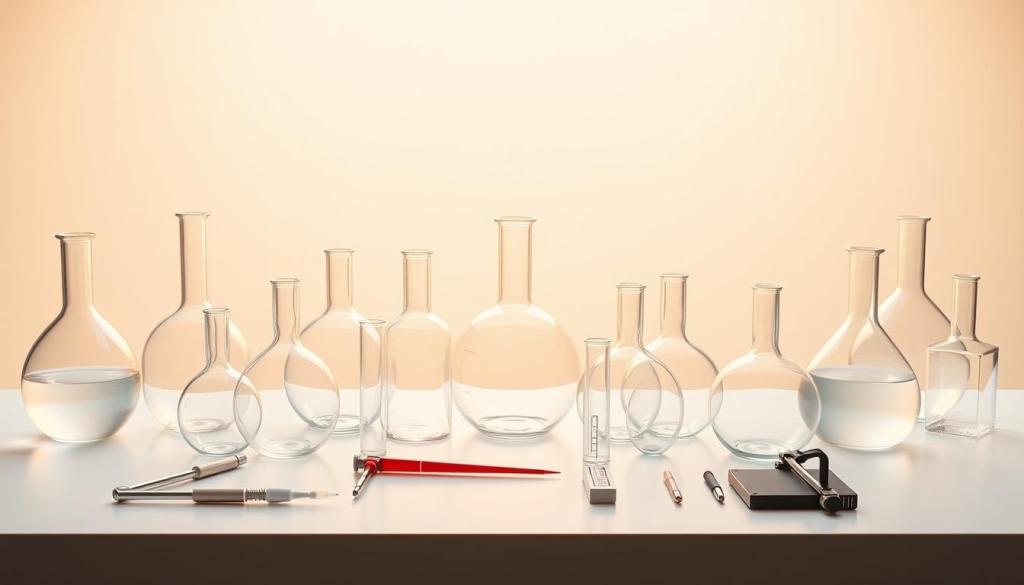
Lab experts need to look at several important points. They must find the best flask for their experiments:
- Nature of the chemical experiment
- Types of chemicals being used
- Required measurement precision
- Potential thermal and chemical stress
Key Considerations for Researchers
Researchers should focus on these important selection criteria:
- Volume Requirements: Different experiments need specific flask sizes
- 50 mL for small-scale reactions
- 250 mL for standard lab work
- 500 mL to 1 L for bigger experiments
- Material Compatibility: Borosilicate containers are great for chemical resistance
- Thermal Stability: Make sure the flask can handle the expected temperatures
Recommended Size and Volume Selection
Volumetric flasks come in many sizes for different needs. Choose a flask that fits your experiment well. This way, you avoid too much extra space. For exact measurements, Class A volumetric flasks are best. They are very accurate and durable.
Choosing the right flask is crucial for success in experiments. It helps avoid contamination and supports reliable research.
Maintenance and Care for Chemical Lab Flasks
Keeping scientific beakers and Erlenmeyer flasks in good shape is key for getting accurate results. It also helps your lab equipment last longer. It’s important to clean and store them properly to avoid contamination and keep them in top condition.
Essential Cleaning Protocols
Cleaning lab glassware needs careful attention. Here are the main steps:
- Rinse right away with warm tap water
- Use lab-grade detergents for a deep clean
- Do multiple rinses with deionized water
- Don’t dry with paper towels or blow air on it
Specialized Cleaning Techniques
Each chemical needs its own cleaning method:
- Water-soluble solutions: 3-4 rinses with deionized water
- Water-insoluble solutions: 2-3 rinses with ethanol or acetone
- Strong acids and bases: Lots of tap water rinses, then deionized water
Storage Recommendations
Storing Erlenmeyer flasks and scientific beakers right helps prevent damage. Here’s how:
- Take off stoppers and stopcocks when not using
- Let them air dry naturally on clean shelves
- Keep them in a dust-free, controlled temperature area
- Check for cleanliness before putting them away
Effective glassware maintenance is not just a routine—it’s a critical component of scientific accuracy.
Safety Practices for Using Flasks
Laboratory safety is key when working with chemicals. Researchers must take steps to avoid accidents and keep the workplace safe. Knowing the risks of handling flasks can help prevent dangerous situations.
Keeping people and equipment safe requires careful safety plans for chemical lab flasks. Here are some guidelines to help avoid hazards in the lab.
Proper Handling Techniques
- Always check glassware for visible cracks or scratches before use
- Wear the right personal protective equipment (PPE)
- Use the lowest vacuum pressure needed in experiments
- Handle flasks with special laboratory gloves
Risk Mitigation Strategies
To prevent flask breakage, it’s important to have safety plans in place. Researchers should take several steps to lower the risk of accidents.
- Apply criss-cross filament tape around flask exteriors
- Install plexiglass protective barriers
- Use smaller flasks when possible
- Disconnect vacuum hoses carefully
| Safety Practice | Recommended Action |
|---|---|
| Glassware Inspection | Check for structural integrity before use |
| Personal Protection | Wear safety goggles and protective clothing |
| Vacuum Management | Use minimal pressure settings |
Training is vital for lab safety. Schools should have strong safety programs. These programs teach researchers about the dangers of chemicals and lab supplies.
Safety is not an option—it is a fundamental requirement in scientific research.
Innovations in Flask Design
Scientific innovation is changing the world of lab equipment, especially in distillation and flask technologies. New advancements have made lab tools more functional and safe.

The evolution of chemical lab flasks is a big step forward for science. Now, researchers have better tools thanks to new designs that fix old problems.
Advancements in Materials
Modern flask design uses new materials for better durability and performance. Key improvements include:
- Enhanced glass that can handle high heat
- Materials that last longer against chemicals
- Light but strong materials
- Resistance to sudden temperature changes and chemical reactions
New Features for Enhanced Functionality
Today’s flask designs have smart features that make science easier. These include:
- Ergonomic shapes for easier handling and less strain
- Advanced seals to keep out contamination
- Safety features to reduce breakage
- Accurate measurement markings
Artificial intelligence and advanced manufacturing are making flasks even better. Now, scientists have more precise and safe tools for their work.
Scientific progress is fundamentally linked to the continuous improvement of our laboratory tools.
Regulatory Standards for Chemical Lab Flasks
Laboratory equipment needs strict rules to keep it safe and working well. Chemistry glassware must follow detailed standards. These protect researchers and keep science honest.
Scientific groups have set tough rules for quality and safety in chemistry glassware. These rules cover important parts of making and using lab equipment.
Safety Compliance Requirements
Rules from regulatory bodies set clear steps for making and using chemical lab flasks. Researchers must follow these rules closely. This ensures the best results and keeps risks low.
- OSHA safety regulations for laboratory equipment
- ASTM International manufacturing specifications
- ISO quality control guidelines
- NIST measurement accuracy standards
Industry Standard Frameworks
Professional groups create detailed plans for lab equipment design and use. These standards help keep quality the same everywhere.
Following rules is not optional – it’s key for honest science.
Equipment makers must show they follow rules through lots of tests and certifications. These steps prove the safety, lasting power, and accuracy of chemistry glassware in science.
Researchers should always check that their equipment meets current rules. This keeps science safe and protects people too.
Conclusion: The Role of Flasks in Science
Chemical lab flasks are key in scientific research. They help scientists make new discoveries by allowing them to do precise experiments. These flasks are crucial for measuring exact amounts and making groundbreaking findings.
The way flasks have evolved shows how science keeps getting better. Now, we have flasks that help scientists get exact solution concentrations. They also support complex research, helping scientists follow the same steps to get the same results.
As science gets more advanced, so will lab equipment. We might see flasks that can track measurements in real-time and last longer. This will help scientists tackle new challenges and make even more discoveries.
Science labs all over the world know how important precise tools are. By using top-notch chemistry glassware, labs can keep making new discoveries. This helps us learn more about the world and push the limits of what we know.
FAQ
What are chemical lab flasks?
Chemical lab flasks are special glassware for science labs. They help measure, mix, store, and conduct chemical reactions. They’re made from borosilicate glass, which is very resistant to chemicals and lasts long.
What are the main types of chemical lab flasks?
There are a few main types. Erlenmeyer flasks have a conical shape and flat bottom. Volumetric flasks are for precise measurements. Florence flasks have a round bottom and long neck. Round-bottom flasks are for heating and distillation.
Why is borosilicate glass preferred for lab flasks?
Borosilicate glass is great because it can handle high heat, is chemically inert, and doesn’t expand much with temperature changes. It’s also very durable, making it perfect for lab work.
How do I choose the right flask for my experiment?
Choosing the right flask depends on several things. Think about the chemical reaction, how precise you need it, the volume, temperature, and your experiment’s needs. Consider the flask’s material, shape, size, and use.
What safety precautions should be taken when using chemical lab flasks?
Safety first! Wear the right PPE, handle flasks carefully, and use safe heating and cooling. Always check for damage before use and follow lab safety rules.
How should chemical lab flasks be cleaned and maintained?
Clean them with lab detergents, rinse well with deionized water, dry carefully, and store in clean places. Different chemicals need special cleaning to avoid damage.
What recent innovations exist in chemical lab flask design?
New designs include stronger glass, easier-to-handle shapes, better seals, safety features, and materials that improve performance and reliability.
Are there specific standards for chemical lab flasks?
Yes, flasks must meet standards from groups like ASTM International and ISO. These ensure quality, safety, and reliability by setting rules for materials, size, and performance.
What are the key differences between glass and plastic flasks?
Glass flasks are better for science because they resist chemicals, heat, and are clear. Plastic flasks are lighter, cheaper, and less likely to break but may not be as good with chemicals or heat.
How do volumetric flasks ensure measurement accuracy?
Volumetric flasks have precise markings and are calibrated for accurate liquid volume measurements. They’re usually accurate to ±0.1% of the volume, making them key for precise experiments.




Leave a Comment
Your email address will not be published. Required fields are marked *