



Ever thought about how the height of a deep well plate affects science? The world of microtiter plates is more complex than many scientists think.
Deep well 96 well plates are key in today’s labs. Their size matters a lot for accuracy. These plates come in different heights, from 14.5mm to 44.3mm. This lets researchers store and process samples better for their experiments.
Knowing the details of deep well plates helps scientists pick the right one for their work. These plates hold from 0.36mL to 2.3mL. This makes them very flexible for designing experiments and managing samples.
Key Takeaways
- Deep well plates have multiple height variations critical for different research applications
- Volume capacities range from 0.36mL to 2.3mL across different plate models
- Plate height directly influences sample handling and experimental precision
- Researchers can choose from round or square well configurations
- Temperature resistance extends down to -80°C for most plate models
Understanding Deep Well Plates and Their Applications
Deep well plates are a big step forward in lab research. They give scientists tools for complex experiments. These plates do more than just hold samples.
Researchers use deep well assay plates for many important tasks. They are especially useful in high-throughput screening. The deeper wells make handling samples and running experiments much better.
Defining Deep Well Plates
Deep well plates have deeper wells than regular plates, usually 15 to 45 millimeters. They stand out because of several key features:
- They can hold more sample volume
- They mix samples better
- They work well with automated systems
- They are used in many research areas
Laboratory Applications
Scientists use deep well plates in many fields, including:
- Studying cells
- Genomics
- Pharmaceutical testing
- Growing microbes
| Plate Type | Mathematical Volume | Working Volume |
|---|---|---|
| 96 Well Polystyrene | 323 μl | 40-280 μl |
| 96 Well V-bottom | 382 μl | 25-340 μl |
| 384 Well Microplates | 199 μl | 15-75 μl |
The consistent ANSI/SLAS footprint standards ensure optimal compatibility with modern laboratory automation systems.
Deep well plates are key in today’s science. They help run complex experiments with great precision and speed.
Key Specifications of Deep Well 96 Well Plates
Laboratory researchers need precise measurements for their experiments. They look for deep well storage plates with specific dimensions and height. This is key for successful scientific work.
Precise Plate Dimensions
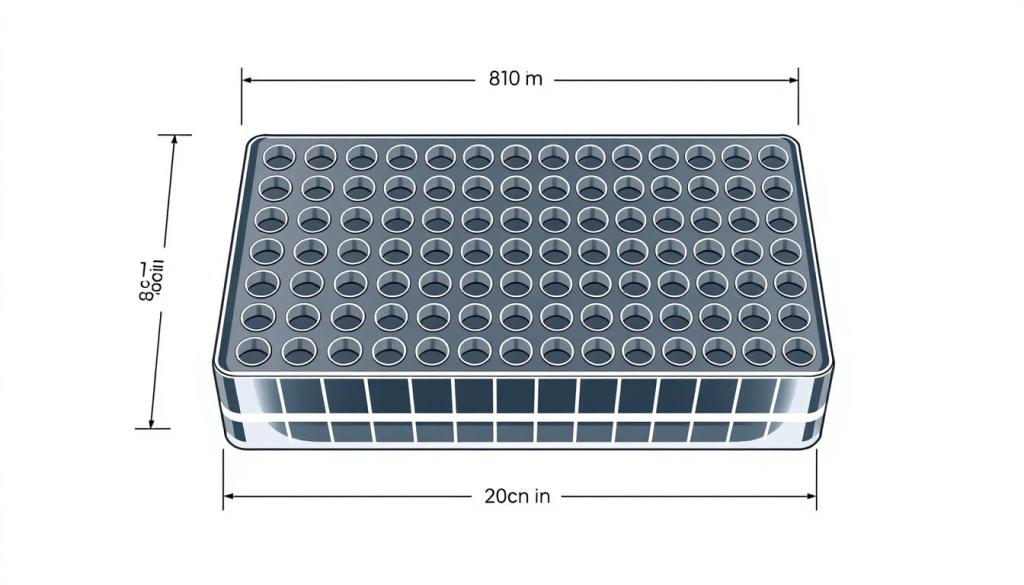
Standard 96-well microplates have important dimensions. These dimensions are crucial for lab work. The standard dimensions are:
- Length: 127.71 mm
- Width: 85.43 mm
- Height: 14.10 mm
Height Variation Considerations
Plate dimensions are vital for experimental design. They must fit with lab equipment. Different well depths are needed for various sample volumes:
| Plate Format | Maximum Well Volume | Well Bottom Geometry |
|---|---|---|
| 48-well | 6000 µL | Square |
| 96-well | 200-2200 µL | Round (U) or Conical (V) |
| 384-well | 55-254 µL | Square |
Researchers must think about the cell culture vessel depth when picking deep well plates. The dimensions affect how samples are handled and the precision of experiments.
Choosing the right plate dimensions is critical for maintaining sample integrity and achieving reproducible results.
Today’s deep well plates are made from USP Class VI virgin polystyrene. This ensures they work well in many scientific tasks.
Importance of Plate Height in Experiments
Deep well 96 well plates height is key in biotechnology labware. Scientists pick plate sizes to get the best results in their research.
Getting the right microplate volume means measuring carefully. Researchers look at many things when picking deep well plates for their experiments.
Impact on Sample Volume
The height of microplates affects how much sample you can handle and store. Different wells hold different amounts:
- U-Bottom wells: 10.85 mm height
- V-Bottom wells: 11.65 mm height
- F-Bottom wells: 10.65 mm height
- C-Bottom wells: 10.85 mm height
“Precision in plate height selection can dramatically improve experimental reproducibility and data quality.” – Laboratory Research Quarterly
Influence on Incubation and Mixing
Plate height changes how well you can incubate and mix samples. Different depths affect:
- Temperature distribution
- Liquid mixing dynamics
- Cellular growth environments
- Reagent interaction rates
| Well Type | Height (mm) | Recommended Application |
|---|---|---|
| Standard Deep Well | 10.85 | General cell culture |
| High-Volume Well | 11.65 | High-density sample storage |
| Low-Profile Well | 10.65 | Precise liquid handling |
Choosing the right deep well plate height is vital for keeping experiments reliable and getting the best results.
Industry Standards for Deep Well Plates
Laboratory precision is key, and it relies on strict standards. These standards make sure all scientific equipment works well together. Deep well assay plates follow these important rules, ensuring they meet high standards.

The rules for microplater plates are set by top organizations. The American National Standards Institute (ANSI) and the Society for Laboratory Automation and Screening (SLAS) lead the way. They make sure all plates are made to the same high quality.
Regulatory Framework for Plate Dimensions
There are key rules for deep well plates:
- ANSI/SLAS 4-2004 (R2012) standards for well positioning
- Precise specs for 96-well and 384-well plates
- Well center locations must be within 0.70 mm
Manufacturer Compliance Requirements
Manufacturers must follow strict rules to make sure plates work well together. The main specs include:
- Standard 96-well plate size: 8 rows × 12 columns
- Exact well center distances
- Clear marking of the top left well
“Standardization is the cornerstone of reproducible scientific research”
The Microplate Standards Development Committee works hard. It has over 100 organizations from 15 countries. They keep improving the rules for plate dimensions and specs. Their work helps keep science moving forward.
Comparison of Deep Well Plates Across Brands
Choosing the right deep well storage plates is key for biotechnology labware experts. Different makers offer special microtiter plate specs. These can greatly affect research results and how precise experiments are.
Research labs need top-notch deep well plates that fit their specific needs. Knowing the differences between brands helps scientists choose wisely.
Popular Brands and Their Distinctive Features
- Chrom Tech: Known for Mass Spec Quality Polypropylene plates
- Labcyte: Specializes in Echo-compatible plates
- Corning: Provides versatile assay plate solutions
Price Range and Performance Analysis
| Brand | Plate Type | Price per Plate | Recommended Volume |
|---|---|---|---|
| Corning | Standard 96 Well | $7 | 60-200 µL |
| Labcyte | 384 LDV COC | $10 | 15-60 µL |
| Chrom Tech | Deep Well Plate | $15 | 350µL-2mL |
When picking deep well storage plates, researchers should look at more than just cost. Performance, material compatibility, and specific experimental needs are also important.
Choosing the right plate is not just about cost, but about ensuring scientific accuracy and reproducibility.
Important factors include solvent compatibility, working volume range, and how well they work with lab equipment. Experts need to weigh each brand’s special features to improve their research.
Materials Used in Deep Well Plates
Biotechnology labware needs careful material selection for best performance. The right material choice is key to successful experiments and reliable research.
Fundamental Material Types
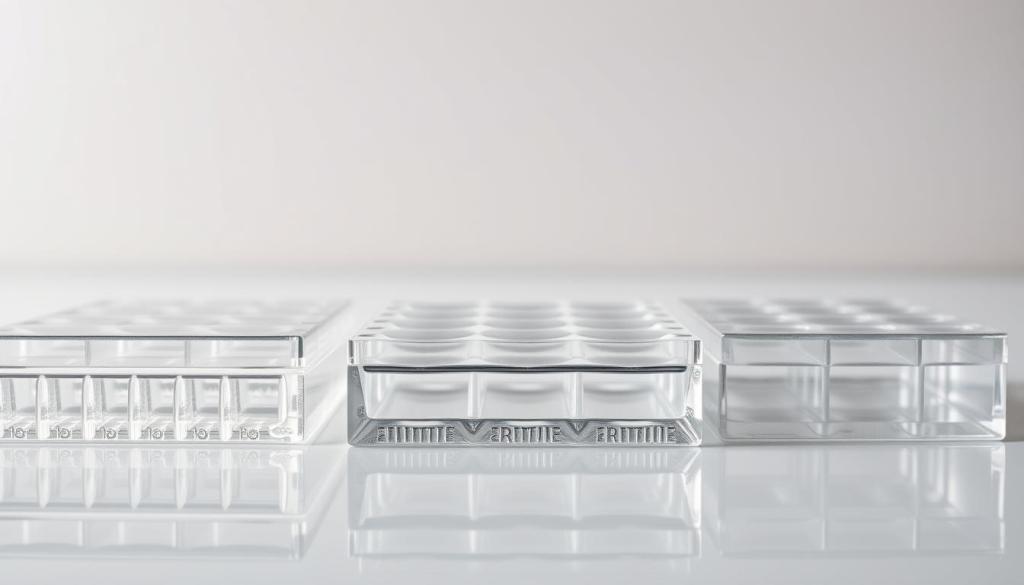
Researchers often find a few main materials in deep well plates:
- Polypropylene (PP)
- Polystyrene
- Cyclo-olefin copolymers (COC)
- High-density polyethylene (HDPE)
Material Characteristics and Advantages
Each material has special properties for lab use:
- Polypropylene: Great chemical resistance
- Polystyrene: Best for seeing through
- Cyclo-olefin copolymers: Tolerates high temperatures well
- High-density polyethylene: Very strong
“Material selection is paramount in ensuring reproducible scientific results.” – Laboratory Research Consortium
Performance Considerations
When picking labware, researchers look at:
- How well it handles temperature
- Chemical resistance
- How clear it is
- Leaching concerns
Knowing these details helps pick the right deep well plates for each experiment.
Maintenance and Care for Deep Well Plates
Keeping deep well storage plates in good shape is key for lab research. It helps keep experiments running smoothly in high-throughput screening. It’s important to take good care of these plates to protect your research.
First, you need to know how deep well plates work and what they’re made of. Each type needs its own cleaning method to avoid contamination and keep results reliable.
Proper Cleaning Techniques
Cleaning deep well plates needs to be done right. Here are some key steps:
- Rinse plates right after use with the right solvents
- Use special detergents made for the plate material
- Stay away from rough cleaning tools that can scratch the plates
- Follow strict decontamination steps for sensitive research
“Meticulous cleaning is the foundation of reproducible scientific results.” – Laboratory Research Standards
Storage Best Practices
Storing deep well plates right is also crucial. Think about:
- Keep plates in a controlled temperature area
- Shield them from direct sunlight and big temperature changes
- Use special containers to keep dust and contamination out
- Arrange plates in an organized way for easy access
Experts say to use tracking systems to keep tabs on plate use and condition. This helps them last longer and keeps research reliable.
Innovations in Deep Well Plate Design
The world of biotechnology labware is always changing. Deep well assay plates are now key in lab research. New innovations are making microtiter plates better for science.
- Enhanced chemical resistance materials
- Optimized well geometries for better sample handling
- Advanced sealing to stop contamination
- Works with automated lab systems
Next-Generation Plate Features
Today’s deep well assay plates have cool new features. They help scientists get better results. Now, plates come with:
- Precision-engineered well configurations
- Can handle temperatures from -80°C to 120°C
- Space-saving designs for less storage
Technology Integration in Laboratory Equipment
The latest labware works well with robots. These plates have special features for robots and magnetic bead separation. This makes research faster and more efficient.
“Innovation in deep well plate design is not just about technical improvements, but about empowering researchers to push the boundaries of scientific discovery.” – Laboratory Technology Research Institute
Deep well assay plates are getting smarter. Thanks to better materials, shapes, and tech, they’re key tools in today’s science.
Best Practices for Selecting Deep Well Plates
Choosing the right deep well 96 well plates is key for lab success. Researchers need to look at many factors for the best results.
Choosing the right deep well plates is a strategic process. It involves considering important aspects of your lab work.
Essential Factors to Consider
- Plate dimensions matching experimental requirements
- Material compatibility with specific research protocols
- Microplate volumes suitable for sample handling
- Automation and robotic system compatibility
Comprehensive Selection Criteria
| Consideration | Key Parameters | Recommended Approach |
|---|---|---|
| Material | Polystyrene/Polypropylene | Select based on optical clarity or chemical resistance |
| Well Height | Standard 14.4 mm | Adjust for specific microplate volumes |
| Surface Treatment | Tissue culture, low binding | Match to cellular or molecular application |
Customization Options
Today, manufacturers offer deep well plates with special features. Researchers can now customize plates for specific experimental needs, including:
- Specialized bottom configurations
- Varied well depths
- Custom surface treatments
- Enhanced optical properties
“The right plate can significantly improve experimental precision and reproducibility.” – Laboratory Research Standards Institute
When picking deep well 96 well plates, focus on your research needs. Look at plate size, material, and how well they fit your experiments for the best results.
Future Trends in Deep Well Plate Development
The world of biotechnology labware is changing fast, with deep well plates leading the way. New trends in high-throughput screening are pushing the limits of cell culture vessel depth and design. Scientists are now looking at advanced plate setups that allow for more complex experiments with better precision and scale.
Top manufacturers are adding smart materials and sensors to deep well plates. These features let researchers track cell density, metabolic activity, and environmental conditions in real-time. This is a big step forward, especially for cancer research and personalized medicine.
Now, making deep well plates is also about being green. Modern makers focus on eco-friendly production to cut down on plastic waste and carbon emissions. They use recyclable materials and new manufacturing methods to meet environmental goals without sacrificing quality.
The future of deep well plates is exciting, with AI and machine learning on the horizon. As research gets more complex, these advanced tools will keep changing how we do experiments. They promise to give scientists deeper insights into how cells work and what results mean.
FAQ
What are deep well 96 well plates?
Deep well 96 well plates are special lab vessels. They have deeper wells than regular microplates, usually 10-40mm deep. They hold more sample, mix better, and are used in many scientific tasks like screening and cell culture.
What is the standard height of a deep well 96 well plate?
Deep well 96 well plates come in different heights. They are usually between 14.4mm and 44mm tall. The height depends on the use, but they often fit with lab automation systems.
What materials are typically used to manufacture deep well plates?
Deep well plates are made from materials like polypropylene, polystyrene, and cyclo-olefin copolymers (COC). Each material has special properties for different research needs.
How much sample volume can a deep well plate typically hold?
The volume a plate can hold varies by depth and design. Most can hold 1-2 mL per well. Some can hold up to 4 mL, great for big samples.
What industries commonly use deep well 96 well plates?
Many industries use deep well plates. These include biotech, pharma, microbiology, genomics, proteomics, and cell culture labs. They’re key for screening, prep, and storage in molecular biology.
How do I choose the right deep well plate for my research?
Choose based on material, volume, temperature, use, and automation. Talk to makers and check specs to pick the best one.
What are the key advantages of using deep well plates?
Deep well plates have big volume, mix well, and reduce contamination. They’re efficient, work with automation, and are versatile in research.
How should deep well plates be stored and maintained?
Store plates in a clean, dry place, away from sun and extreme temps. Use protective packaging and follow cleaning and sterilization guidelines to keep them in good shape.




Leave a Comment
Your email address will not be published. Required fields are marked *