



Ever wonder what makes scientific discoveries happen? Behind the scenes, lab flasks play a key role. They turn complex chemical processes into precise scientific breakthroughs.
Lab flasks are essential tools in scientific exploration. They meet strict standards set by the American Society for Testing and Materials (ASTM). These containers are not just simple glass vessels. They are precision instruments for conducting experiments with great accuracy.
There are different types of flasks, like Erlenmeyer flasks, designed to prevent spills. Each type has a unique purpose in scientific investigation. Knowing about these tools gives us a glimpse into the world of chemical and research methodologies.
Key Takeaways
- Lab flasks are fundamental to scientific research and testing
- Different flask types serve specific experimental requirements
- ASTM certification ensures high-quality laboratory equipment
- Materials like borosilicate glass provide durability and chemical resistance
- Proper flask selection is crucial for experimental success
Introduction to Lab Flasks
Laboratory flasks are key tools in scientific research and experiments. They come in various shapes and sizes. Each is designed for specific scientific tasks with precision and reliability.
Scientists use different lab flasks for complex experiments in many fields. The right flask is vital for getting accurate results.
Importance of Lab Flasks in Scientific Research
Lab flasks play a crucial role in scientific studies. They help researchers:
- Measure liquids with high precision
- Conduct chemical reactions safely
- Heat and mix solutions
- Store and transport chemical compounds
Overview of Various Types of Lab Flasks
The world of lab flasks is vast, with each type made for specific research needs. Volumetric flasks, for example, are known for their accuracy in making standard solutions.
| Flask Type | Primary Function | Typical Volume Range |
|---|---|---|
| Erlenmeyer Flask | Mixing and heating | 50 mL – 2 L |
| Volumetric Flask | Precise measurements | 10 mL – 1 L |
| Round Bottom Flask | Distillation and heating | 100 mL – 1000 mL |
Each flask type offers unique abilities in lab work. They make complex scientific processes easier to manage.
Beakers: Versatile Tools for Mixing
Laboratory research needs precise and reliable tools. Beakers are key for scientific studies. They are used for many tasks in labs, helping researchers with their work.
Griffin beakers are a common type in labs. They have a flat bottom and wide opening. This makes it easy to handle chemical solutions.
Design and Features of Beakers
Beakers have important features:
- Cylindrical shape with straight sides
- Flat bottom for stable placement
- Wide mouth for convenient pouring
- Graduated markings for approximate volume measurements
Conical flasks are similar, but Griffin beakers have special benefits. Scientists like their flexibility and ease of use in different experiments.
Common Uses of Beakers in Laboratories
Researchers use beakers for many important tasks:
- Mixing chemical solutions
- Heating liquids
- Temporary chemical storage
- Preparing sample dilutions
*Accuracy is crucial in scientific measurements*
Beakers are about 10% accurate. A 250-milliliter beaker can be off by about 25 milliliters. They are not for exact measurements but are still vital in labs.
Advanced research needs reliable and adaptable tools. Beakers continue to fulfill these needs.
Erlenmeyer Flasks: Ideal for Swirling
Scientific labs use special glassware for exact experiments. Erlenmeyer flasks are key for research. Their unique design is vital in chemistry and biology labs.
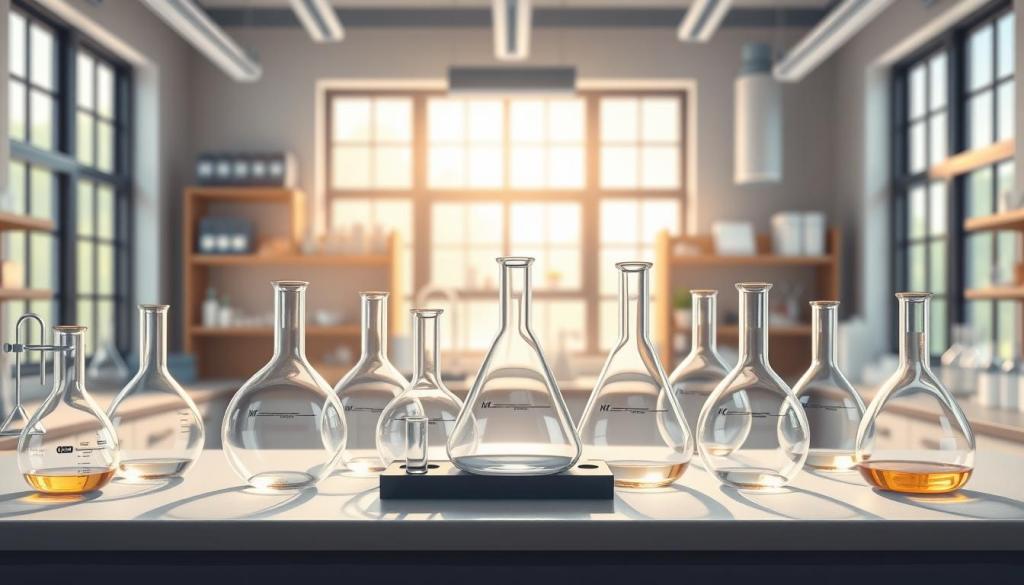
- Flat base for stable positioning
- Cone-shaped body for efficient mixing
- Narrow neck to prevent spills
- Graduated markings for volume
Characteristics of Laboratory Conical Flasks
The shape of Erlenmeyer flasks helps with many lab tasks. They can be made from different materials, like borosilicate glass and polypropylene. This makes them useful in many research settings.
Applications in Scientific Experiments
Research teams use Erlenmeyer flasks for many important tasks:
- Titration procedures
- Solution preparation
- Microorganism culturing
- Chemical reaction monitoring
Scientists like these flasks for swirling without spills. The graduated markings help estimate volumes with about 5% accuracy. This is very helpful in experiments.
The design of Erlenmeyer flasks makes them an essential tool for precise scientific investigation.
Volumetric Flasks: Precision in Measurement
Volumetric flasks are key in scientific research. They help achieve precise chemical measurements. These flasks have a pear-shaped body and a long neck. This design allows for accurate solution preparation.
Structure and Design of Volumetric Flasks
Volumetric flasks stand out due to their unique design. They have:
- Pear-shaped body with a flat bottom
- Long, narrow neck with a precise calibration line
- Available in sizes from 1 ml to 5,000 ml
- Made from USP Type 1 3.3 Low expansion Borosilicate Glass
When to Use Volumetric Flasks in Research
Scientists use volumetric flasks for tasks needing high precision. They are vital for:
- Creating standard chemical solutions
- Diluting strong compounds
- Preparing pharmaceutical samples
- Testing environmental contaminants
- Ensuring quality control
There are two accuracy levels: Class A for detailed work and Class B for less precise tasks. Each flask is set to hold a precise volume at certain temperatures. This ensures reliable results in experiments.
The precision of volumetric flasks makes them crucial in labs. Even small measurement errors can greatly affect research results.
Florence Flasks: Optimal for Heating Solutions
Scientific labs need special glassware for exact experiments. Florence flasks, also called boiling flasks, are key for heating and chemical work.
These vessels have a round body and long neck. They’re made for heating well and losing less solution. Their shape helps a lot in science.
Unique Structural Features
Florence flasks stand out because of their design:
- Spherical bottom for even heat
- Long neck to cut down evaporation
- Made from strong borosilicate glass
- Comes in different sizes
Laboratory Applications
Experts use round-bottom flasks for many important lab tasks:
- Heating chemical mixes
- Doing distillation
- Running reflux reactions
- Handling experiments that need careful temperature
Performance Characteristics
The design of boiling flasks helps scientists get exact results. Borosilicate glass keeps them strong under heat.
Scientists like Florence flasks for spreading heat well and avoiding solution bumps. They’re vital in advanced labs.
Round Bottom Flasks: Essential for Distillation
Scientific labs use special glassware for precise experiments. Round-bottom flasks are key for many chemical processes. Their unique spherical bottom makes them great for research.

Round-bottom flasks are vital in labs. Their design helps distribute heat evenly. This reduces the chance of damage during reactions.
Design and Structural Characteristics
These flasks come in various shapes for different needs:
- Single-neck for simple reactions
- Double-neck for complex procedures
- Triple-neck for advanced processes
Typical Applications of Round Bottom Flasks
Scientists use round-bottom flasks in many important lab tasks, like:
- Distillation setups
- Reflux reactions
- Rotary evaporation
These flasks are available in many sizes. They range from 25 mL to 2000 mL. This lets researchers pick the right size for their experiments.
| Flask Size | Typical Application |
|---|---|
| 25 mL | Small-scale reactions and sample prep |
| 250 mL | Medium-scale reactions |
| 1000 mL | Large-scale reactions and extensive sample processing |
When using round-bottom flasks, researchers need proper support. Heating mantles or sand baths are used for safety. The flasks’ shape helps with even heating, preventing damage during reactions.
Pesticide Flasks: Specialized for Chemical Research
Chemical research needs safe and precise containers for dangerous substances. Pesticide flasks are key for scientists working with complex chemicals. They are vital in agriculture and environmental studies.
These flasks are made for handling volatile and dangerous chemicals. They offer scientists better safety and reliability.
Construction and Material Specifications
Pesticide flasks have special features for maximum chemical resistance and durability:
- Thick glass walls for extra strength
- Chemical-resistant materials to prevent contamination
- Special vacuum flasks with strong seals
- Accurate manufacturing to avoid chemical reactions
Key Research Applications
Scientists use pesticide flasks in many important research areas:
- Studying agricultural chemicals
- Examining environmental contamination
- Conducting toxicology research
- Testing chemical compositions
It’s crucial to handle and store these flasks correctly. This keeps labs safe and experiments reliable. Researchers must follow strict rules when dealing with dangerous chemicals in these precise tools.
Test Tubes: Stepping Stones for Small-Scale Tests
Test tubes are key tools in science labs. They help with small chemical tests and early studies. These small glass containers are essential for precise work.
Labs use test tubes for many important tasks. They show how vital these tools are. They can handle tiny amounts of materials.
Design and Fundamental Features
Test tubes have a special shape. They have:
- Rounded bottom design
- Open top for easy access
- Compact size for minimal sample requirements
- Available in glass and plastic materials
Common Laboratory Applications
Researchers use test tubes in many fields. They are used for:
- Holding small liquid quantities
- Conducting chemical reactions
- Performing centrifugation processes
- Preliminary screening experiments
Microscale experiments work with tiny amounts. Automatic pipets help with this, delivering 0.10 to 1.0 mL. Filtering flasks help with more complex tasks.
Modern labs use these tools for efficient, cost-saving research.
Conclusion: Selecting the Right Flask for Your Needs
Laboratory research needs precision and the right tools. Lab flasks are key to getting good results. It’s important to know the differences in materials like PET, glass, and polypropylene.
Choosing the right vacuum flask is a big deal. You need to think about chemical resistance, temperature, and how clear it is. For example, PET flasks are great because they’re clear and strong. They’re perfect for watching cells grow.
New technology is making flasks better. Now, we have flasks that are stronger and can measure things more accurately. These changes help scientists do their work better.
Getting the right flask is crucial for good research. Knowing about different materials and designs helps scientists get better results. This is true for many kinds of science.
FAQ
What are the most common types of lab flasks used in scientific research?
Lab flasks include Erlenmeyer, volumetric, round bottom, Florence, and beakers. Each is made for different tasks like mixing, heating, and precise measurements.
How do I choose the right flask for my laboratory experiment?
Choose based on your experiment’s needs. Think about precision, chemical safety, and the flask’s design. For example, use a volumetric flask for exact measurements or an Erlenmeyer for mixing.
What makes Erlenmeyer flasks unique compared to other lab flasks?
Erlenmeyer flasks have a cone shape for easy mixing. They’re great for mixing, making solutions, and growing microorganisms.
Why are volumetric flasks important in scientific measurements?
Volumetric flasks are key for making precise solutions. They have a mark for measuring, ensuring accuracy. They come in different classes for varying levels of precision.
What safety considerations should I keep in mind when using lab flasks?
Always check if the flask is safe for the chemicals you’re using. Wear protective gear and choose flasks that match the chemical’s properties. Follow proper handling and disposal to stay safe.
What are the advantages of round bottom flasks?
Round bottom flasks heat evenly and are less likely to crack. They’re best for distillation and reactions. They need support like heating mantles.
How do test tubes differ from other types of lab glassware?
Test tubes are small and cylindrical, great for small tests. They’re used for heating liquids and simple reactions. They’re made of glass or plastic.
Can lab flasks be used for different types of chemicals?
Not all flasks are safe for all chemicals. You must check if the flask is compatible with the chemical. Special flasks are made for dangerous chemicals.





Leave a Comment
Your email address will not be published. Required fields are marked *