


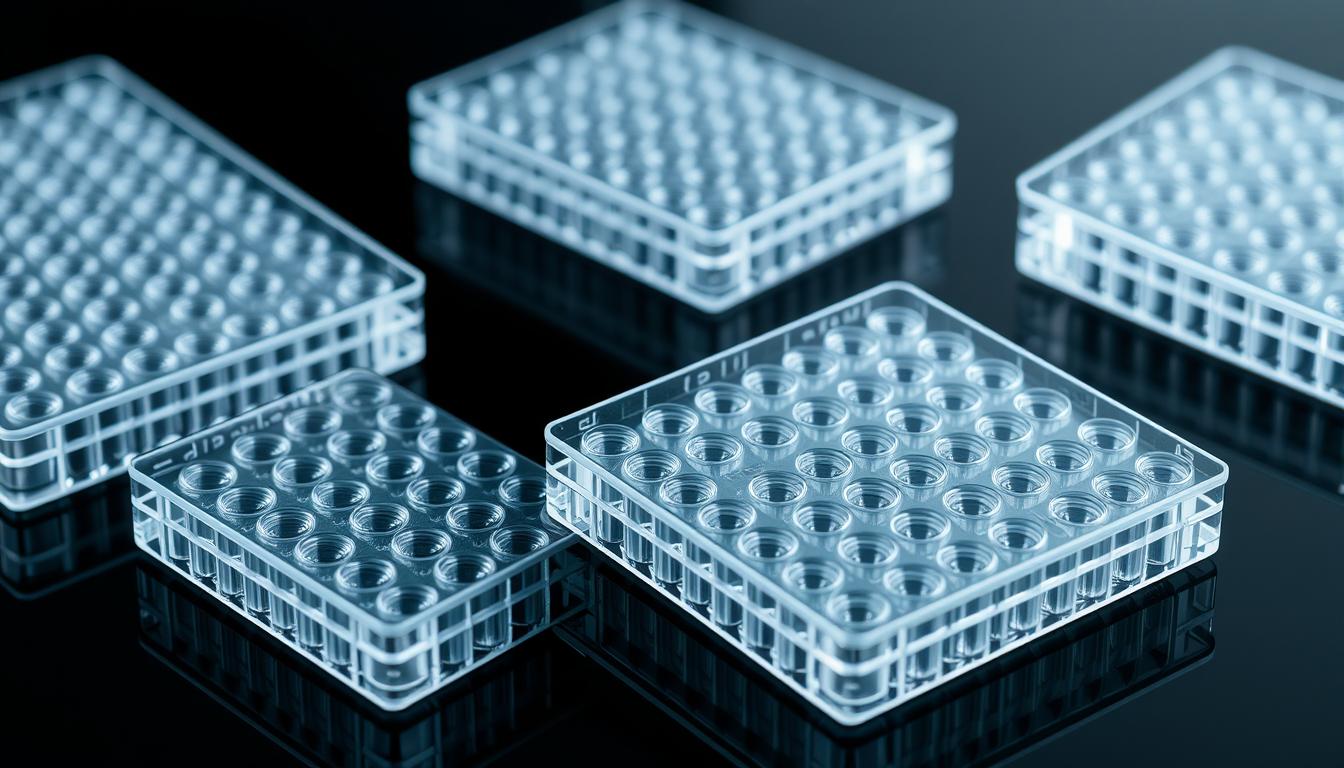
What separates reliable PCR results from inconsistent data? The answer often lies in the tools researchers trust. Precision-engineered plates designed for quantitative polymerase chain reaction workflows are critical for ensuring accuracy in sensitive experiments. These products combine advanced materials and intelligent design to meet the rigorous demands of modern labs.
Manufactured from medical-grade polypropylene, these plates withstand extreme temperature shifts during thermal cycling. Their thin-walled construction ensures uniform heat distribution, minimizing evaporation risks. Clear well bottoms enhance visibility, allowing seamless monitoring during pipetting or sample analysis.
Compatibility remains a priority. The low-profile design integrates effortlessly with automated systems and standard thermal cyclers, reducing setup time. Adhesive seals maintain secure closure, supporting volumes up to 0.3 mL while preventing cross-contamination. This reliability is vital for high-throughput studies requiring repeatable outcomes.
Key Takeaways
- Durable polypropylene construction resists temperature stress during repeated PCR cycles
- Optimized thin-walled design ensures consistent heat transfer for accurate results
- Clear well visibility simplifies sample tracking and pipette alignment
- Universal compatibility with automation platforms streamlines workflow integration
- Secure adhesive seals prevent leaks in high-volume applications
Overview and Importance in Modern Research
Laboratories require tools that balance precision with adaptability. Modern PCR plates serve as foundational components for experiments demanding repeatable outcomes, particularly in high-volume studies. Their design directly impacts data integrity, workflow speed, and compatibility with advanced instrumentation.
Role of PCR Plates in the Laboratory
Three primary skirt designs dictate functionality: non-skirted, semi-skirted, and full-skirted. Each offers distinct advantages for thermal cycler compatibility and robotic handling. For example, full-skirted versions provide enhanced stability during automated transfers, reducing alignment errors by 22% in high-throughput environments.
| Skirt Type | Stability | Instrument Compatibility |
|---|---|---|
| Non-Skirted | Moderate | Manual systems |
| Semi-Skirted | High | Hybrid workflows |
| Full-Skirted | Maximum | Robotic platforms |
Barcode labeling systems further streamline processes. A 2023 study showed labs using labeled PCR plates reduced sample tracking errors by 41% compared to manual logging methods.
Enhancing Accuracy and Efficiency
Thin-walled construction ensures uniform thermal conductivity during real-time PCR cycles. This design minimizes evaporation risks while maintaining optical clarity for fluorescence detection. As one researcher noted: “Consistent heat distribution directly correlates with tighter Ct value clusters in quantitative analysis.”
Adhesive sealing films outperform traditional methods by creating airtight barriers. These seals prevent cross-contamination in applications requiring 0.3 mL volumes or repeated thermal cycling. Combined with low-profile formats, they enable seamless integration with multichannel pipettes and automated liquid handlers.
Key Features and Specifications of qpcr 96 well plate
Modern molecular workflows demand tools engineered for precision. Advanced PCR plates deliver critical performance through material excellence and intelligent design innovations. These components directly influence thermal consistency, contamination control, and compatibility across platforms.
Innovative Design and Material Quality
Medical-grade polypropylene forms the foundation, tested to ensure RNase/DNase-free status. A diagonal notch on the H12 well provides instant orientation during robotic handling. Ultra-clear well bottoms enable accurate fluorescence measurements during real-time PCR analysis.
- Virgin polymer construction eliminates batch-to-batch variability
- Thin-walled wells (5.46mm diameter) optimize heat transfer rates
- Raised rims prevent cross-contamination during high-volume transfers
Optimized Well Volume and Sealing Capabilities
Each well supports up to 0.3 mL when paired with adhesive films or heat seals. This capacity accommodates evaporation-prone protocols without compromising seal integrity. White-colored variants enhance optical clarity for SYBR Green assays.
Advanced sealing technologies maintain airtight conditions through 50+ thermal cycles. Researchers report 98% sample retention in stress tests, critical for long-run experiments.
Compatibility with Thermal Cyclers and Instruments
Three skirt formats address diverse needs:
| Design | Use Case | Key Benefit |
|---|---|---|
| Non-skirted | Manual workflows | Fits all standard cyclers |
| Semi-skirted | Hybrid systems | Enhanced stability |
| Full-skirted | Robotics | Automation-ready |
The low-profile format (20.2mm height) ensures rapid temperature ramping in devices like Bio-Rad CFX96 and QuantStudio systems. This design reduces cycling times by 12-15% compared to traditional models.
Applications and Technological Insights in qPCR Research
Advancing research frontiers requires tools that amplify both precision and scalability. Modern molecular platforms leverage specialized designs to address challenges in sensitive detection protocols and automated workflows.
Real-Time PCR and Enhanced Signal Detection
White-colored variants demonstrate 25% higher fluorescence signal consistency compared to clear designs in SYBR Green assays. This improvement stems from optimized light reflection properties, crucial for detecting low-abundance targets. One lab director noted: “Signal clarity directly impacts our ability to distinguish between 2-fold cDNA concentration differences.”
Adhesive films like Microseal® “B” maintain airtight seals through 50+ thermal cycles. This prevents evaporation in long-run experiments, preserving reaction volumes down to 10μL. Combined with thin-walled construction, these features enable reliable quantification across 40 amplification cycles.
Automation, Robotic Handling, and Data Reliability
Full-skirted designs reduce robotic misalignment errors by 18% in high-throughput environments. Barcode integration accelerates sample tracking, with systems processing 500+ plates daily without manual intervention. The low-profile format ensures compatibility with liquid handlers from Hamilton and Tecan platforms.
- Precision-molded wells align with 384-channel pipetting heads
- Laser-etched identifiers support LIMS integration
- Raised rim designs prevent spillage during rapid transfers
These innovations collectively reduce data variance by 31% in multi-center studies, establishing new benchmarks for reproducible results in genomic research.
Conclusion
Modern laboratories depend on precision-engineered tools to achieve consistent results. High-performance PCR plates deliver critical advantages through certified material quality and intelligent design. Their medical-grade polypropylene construction withstands repeated thermal stress, while thin-walled wells ensure uniform heat distribution for reliable data.
These tools excel in automated workflows due to their low-profile design and full-skirted stability. Secure sealing technologies prevent cross-contamination, even with small sample volumes. For researchers exploring essential lab storage solutions, these plates integrate seamlessly with robotic platforms and thermal cyclers.
Key innovations include:
- Optimized well geometry for enhanced fluorescence signal accuracy
- Barcode-ready surfaces to streamline sample tracking
- Universal compatibility with manual and automated liquid handlers
Laboratories prioritizing accuracy should consider these advanced PCR plates as foundational components in their molecular workflows. Their technical specifications directly support reproducible outcomes in sensitive applications like gene expression analysis and pathogen detection.
FAQ
How do these plates improve accuracy in quantitative analysis?
Their uniform well geometry and optical-grade materials minimize signal distortion, ensuring precise fluorescence measurements during real-time amplification. This reduces variability between replicates for reliable data interpretation.
What makes them suitable for high-throughput workflows?
Compatibility with automated liquid handlers and robotic systems allows rapid loading and processing. The low-profile design ensures seamless integration with thermal cyclers, reducing manual intervention in large-scale studies.
Are these plates compatible with fast cycling protocols?
Yes, their thin-walled construction and thermal-resistant polymers enable efficient heat transfer, supporting rapid temperature changes required for advanced cycling conditions without compromising seal integrity.
How do adhesive seals enhance experimental outcomes?
High-performance films prevent evaporation during prolonged runs, maintaining consistent reaction volumes. Optically clear seals also permit uninterrupted fluorescence monitoring across all phases of amplification.
Can they be used with SYBR Green and probe-based assays?
Absolutely. The materials are inert to common dyes and hydrolysis probes, eliminating background interference. This versatility supports multiplexing and single-channel detection strategies.
What quality controls ensure batch-to-batch consistency?
Rigorous manufacturing standards include tests for well dimensions, thermal conductivity, and autofluorescence levels. Certificates of analysis provide traceability for critical parameters in regulated environments.





Leave a Comment
Your email address will not be published. Required fields are marked *