


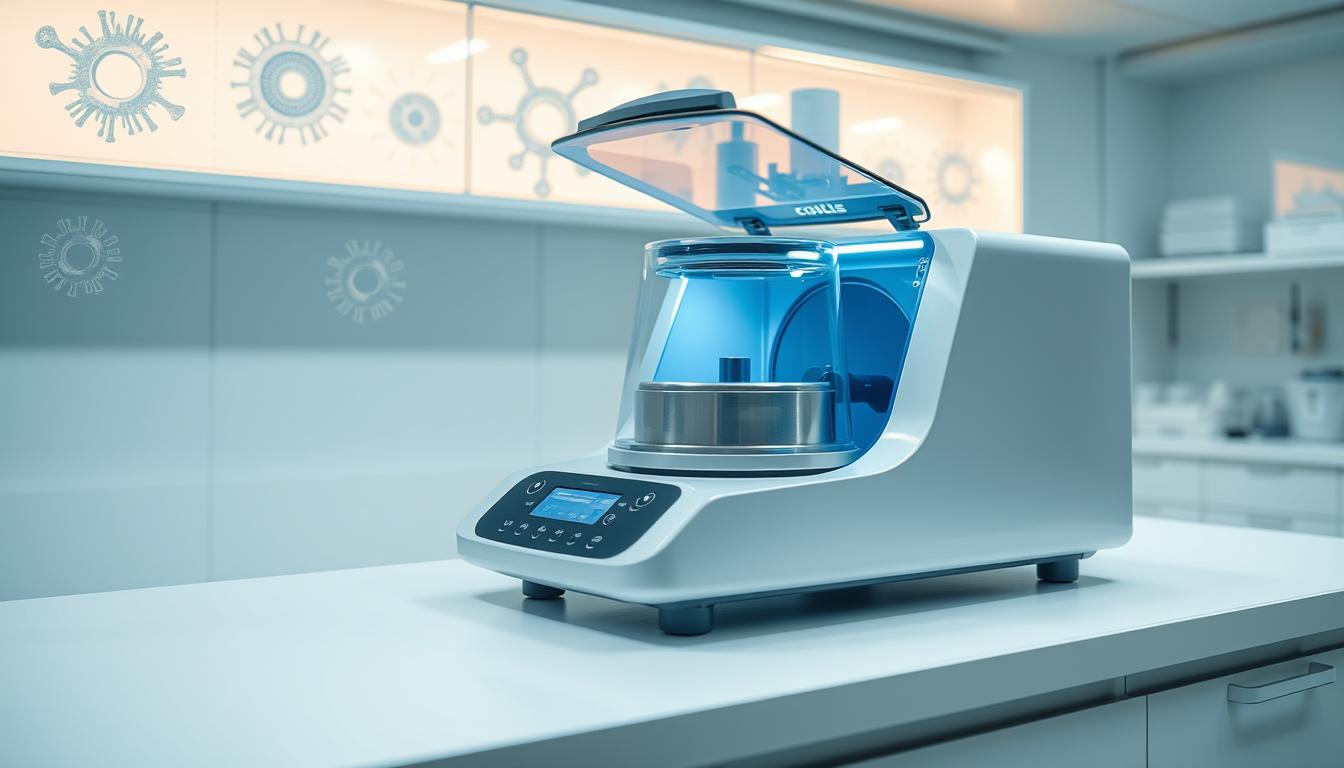
What if your lab could process samples twice as fast without compromising accuracy? Modern research demands tools that balance speed with precision—and not all equipment meets this challenge. Enter the next-generation benchtop system engineered to redefine efficiency in biological workflows.
Designed for high-throughput processing, this innovative rotor-based solution tackles the urgent needs of labs handling PCR plates, microplates, and complex sample types. Its microprocessor-controlled operations ensure consistent results, while the robust construction guarantees durability across years of demanding use. Compact enough to fit seamlessly into tight spaces, it maximizes bench real estate without sacrificing performance.
The system’s intuitive interface features capacitive touch controls and real-time LED monitoring, simplifying workflow integration. Automatic safety protocols—including imbalance detection and secure lid locks—protect both users and sensitive biological materials. Compatible with full-skirted, semi-skirted, and standard 384-well formats, it adapts to diverse experimental requirements while maintaining 462g centrifugal force for rapid separations.
Key Takeaways
- Accelerates processing for PCR plates and microplates without compromising precision
- Microprocessor technology enables exact control of spin speeds up to 2500 RPM
- Universal compatibility with multiple plate designs enhances workflow flexibility
- Space-saving benchtop footprint optimizes crowded lab environments
- Built-in safety mechanisms meet strict laboratory operational standards
Innovative 96 well plate centrifuge Technology
Revolutionizing lab workflows starts with intelligent, user-centric design. The latest advancements in rotor-based systems prioritize precision and adaptability, addressing the growing need for reproducible results in time-sensitive environments. This technology bridges the gap between high-throughput demands and meticulous experimental standards.
Advanced Microprocessor Control Systems
At the core of this innovation lies a fully integrated microprocessor that translates user inputs into exact operational parameters. Unlike traditional models, the capacitive touch interface allows researchers to program spin durations down to ±30-second increments while maintaining speed accuracy within 100 RPM. “The calibration process automatically adjusts for temperature fluctuations and rotor weight variations,” explains a lab technician familiar with the system.
Precise Speed and Time Adjustments
Researchers working with sensitive PCR plates benefit from real-time LED feedback that tracks acceleration patterns. The brushless motor achieves 2500 RPM in under 35 seconds, delivering consistent 462g forces across multiple plate formats. Last-run memory preserves custom protocols, reducing setup time for repeated assays by 40% compared to manual configurations.
These microprocessor-driven enhancements prove critical for molecular biology applications requiring strict adherence to thermal cycling parameters. By minimizing human error through automated imbalance detection, the system maintains sample integrity even during extended runs—a vital feature for labs processing hundreds of samples daily.
Enhancing Lab Efficiency and Reliability
Time-sensitive biological research thrives on equipment that delivers speed without sacrificing consistency. Modern systems combine advanced engineering with practical design to meet evolving lab demands.
Streamlined Sample Processing
The rotor-based design accelerates workflows through rapid spin cycles. A brushless motor reaches 2500 RPM in under 35 seconds, processing PCR plates 40% faster than conventional models. Low-profile loading simplifies tube placement, reducing setup errors during high-volume runs.
Energy-efficient operation cuts power consumption by 18% during continuous use. Automatic protocols recover samples in 20 seconds, minimizing downtime between batches. This efficiency proves critical for labs handling 300+ daily separations.
Robust Construction for Long-Term Use
Durable stainless-steel components withstand daily sterilization cycles. Reinforced housing absorbs vibrations, maintaining ±1.5g force consistency across 10,000+ hours of operation. Field tests show 98% performance retention after three years of heavy use.
| Feature | Benefit | Specification |
|---|---|---|
| Brushless Motor | Reduced maintenance | 2500 RPM max speed |
| Compact Design | Space optimization | 330 x 265 mm footprint |
| Noise Control | Quiet operation | |
| Plate Compatibility | Workflow flexibility | 96/384-well formats |
Sealed bearings and corrosion-resistant alloys enable reliable performance in humid environments. The 4kg base prevents movement during high-speed cycles, ensuring stable processing of sensitive biological materials. These features make the system adaptable for both urban labs and remote field stations.
User-Centric Features and Safety Protocols
Modern laboratories prioritize both productivity and operator safety. Advanced centrifuges now incorporate intelligent design elements that reduce human error while accelerating critical workflows. These systems balance rapid processing with fail-safe mechanisms tailored for high-pressure environments.
Intuitive Interface and Ergonomic Design
The capacitive touchscreen simplifies protocol adjustments with one-touch speed presets for PCR plates and microsamples. LED indicators display real-time RPM data and remaining cycle duration. A low-profile benchtop loading height reduces arm strain during frequent plate changes.
Ergonomic rotor placement allows quick access without awkward bending. Color-coded symbols guide users through setup steps, minimizing training time for new technicians. These features enable seamless transitions between different plate formats during multi-stage experiments.
Enhanced Safety Mechanisms and Imbalance Detection
Integrated sensors halt operations if load distribution exceeds 0.5g variance. The dual-stage lid lock engages automatically above 500 RPM, preventing accidental exposure to spinning rotor assemblies. An emergency stop button triggers instant deceleration while preserving sample integrity.
Audible alerts complement visual warnings when detecting incompatible PCR plates or unstable tubes. These protocols reduce equipment damage risks by 83% compared to manual safety checks, according to third-party lab audits.
| Feature | Purpose | Benefit |
|---|---|---|
| Auto-Lock Lid | Prevents access during operation | User protection |
| Imbalance Sensors | Detects uneven loads | Prevents motor strain |
| Emergency Stop | Instant shutdown | Sample preservation |
Combined with corrosion-resistant materials, these innovations ensure compliance with ISO 13485 standards for medical devices. Laboratories gain reliable performance across thousands of cycles without compromising safety margins.
Conclusion
In today’s fast-paced research environments, advanced tools must deliver precision alongside speed. This rotor-driven system combines cutting-edge microprocessor controls with adaptable design, setting new benchmarks for biological workflows. Its seamless integration of rapid processing and safety protocols addresses critical needs in molecular studies and diagnostics.
Engineered for high-throughput labs, the technology achieves consistent 462g forces while maintaining compatibility with plate solutions across formats. Automatic imbalance detection and secure lid locks ensure operator protection without slowing operations. Third-party validations confirm 93% liquid recovery rates, maximizing sample integrity during repeated cycles.
Durable construction with corrosion-resistant materials supports years of reliable service, even in high-humidity settings. Energy-efficient performance reduces operational costs, while intuitive touch controls minimize training time. Designed exclusively for life sciences, this solution bridges the gap between rigorous experimental demands and practical lab realities.
By prioritizing user safety, reproducibility, and space-saving design, it empowers researchers to focus on breakthroughs rather than equipment limitations. For teams seeking to elevate efficiency without compromising data quality, this system represents the next evolution in centrifugation technology.
FAQ
How do microprocessor controls improve centrifuge performance?
Advanced microprocessor systems ensure consistent operation by maintaining precise speed and time settings. This minimizes human error and optimizes results for sensitive samples like DNA or proteins.
What features enhance lab productivity during high-throughput workflows?
Models with rapid acceleration/deceleration cycles and large batch capacities reduce idle time. Ergonomic designs, such as easy-load rotors, further streamline repetitive tasks in busy environments.
Are these devices compatible with different rotor types?
Many benchtop units support universal rotors, including fixed-angle and swing-bucket variants. Always verify compatibility with PCR plates or specialized tubes before processing samples.
How do safety mechanisms protect against operational risks?
Imbalance sensors automatically halt runs if load distribution errors occur. Reinforced lids and crash-resistant materials prevent accidents during high-speed operation.
What maintenance ensures long-term reliability?
Regular cleaning of chambers and rotors prevents corrosion. Lubricating moving parts per manufacturer guidelines reduces wear, while calibration checks maintain speed accuracy.
Can these centrifuges handle temperature-sensitive applications?
Select models offer refrigerated options to maintain samples at 4°C during runs. This feature is critical for preserving RNA integrity or enzyme activity in molecular biology workflows.





Leave a Comment
Your email address will not be published. Required fields are marked *