


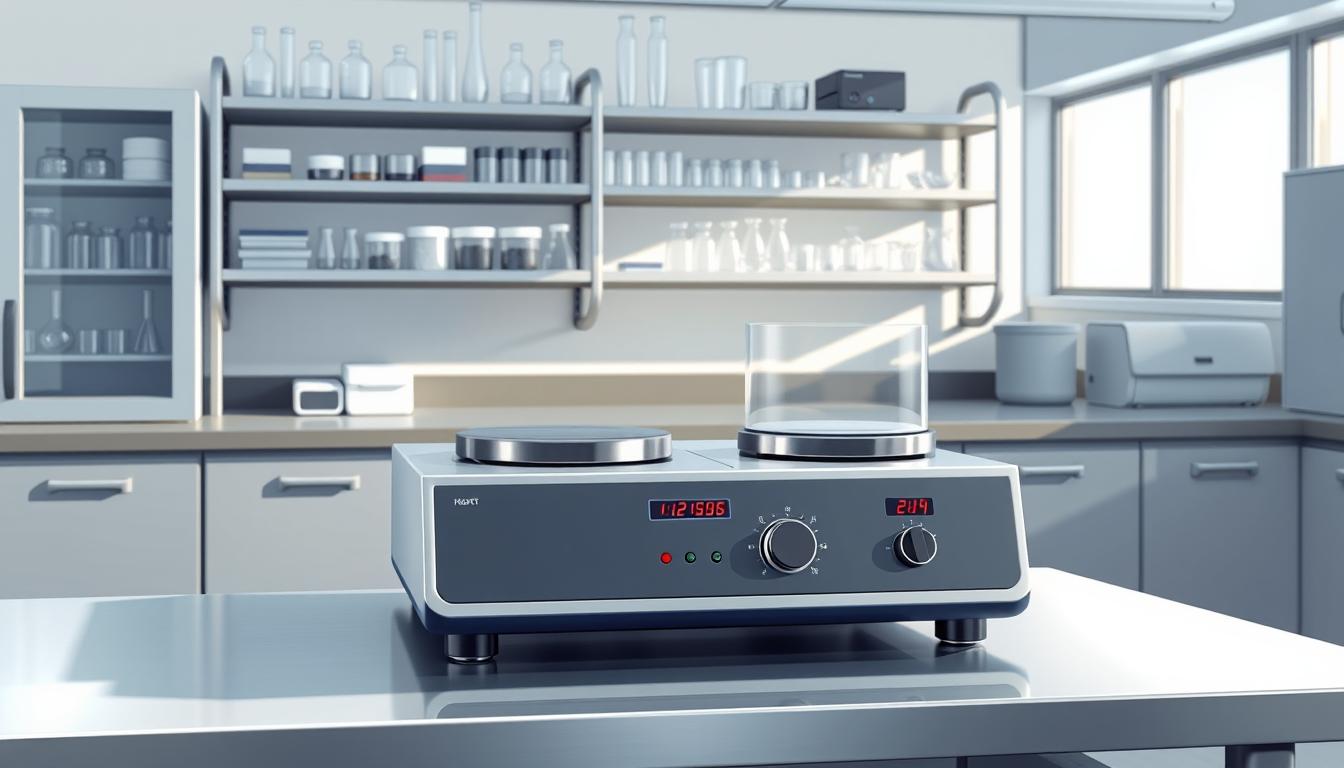
Is your lab’s efficiency missing something? A single piece of equipment could change everything. Hot plate and stirrer devices are key to modern science. They help researchers get precise results and control.
Laboratory equipment has changed a lot. Hot plate and stirrer technologies are now vital in science. They heat and stir, making complex experiments reliable and accurate.
Scientists use these tools for many things. They keep temperatures steady, mix samples, and do detailed research. Their design and features are perfect for labs around the world.
Key Takeaways
- Hot plate and stirrer devices enable precise temperature control
- Combines heating and mixing functions in one compact instrument
- Essential for biological and chemical research applications
- Supports consistent experimental conditions
- Enhances research efficiency and reproducibility
Introduction to Hot Plates and Stirrers
Laboratory equipment has changed science a lot. Heating mantles and magnetic stirrers are key in today’s biology labs. They make old ways of doing science better, giving scientists the tools they need for precise work.
Science labs need special tools for good results. Hot plates and stirrers are basic but crucial. They help scientists do detailed work with great accuracy.
Definition and Purpose
A heating mantle is a special tool for heating in science. It’s safer than old Bunsen burners because it doesn’t have an open flame. It has:
- Temperature ranges from 250°C to 350°C
- Multiple surface materials including ceramic and aluminum
- Integrated safety features like automatic shut-off mechanisms
Importance in Laboratory Settings
Magnetic stirrers are vital in biology labs. They mix things well using magnetic fields. They offer big benefits:
- Precise speed control (up to 2,500 rpm)
- Compatibility with various container types
- Reduction of manual intervention
“Technological advancements in laboratory equipment have transformed scientific research, making experiments more accurate and reproducible.” – Scientific Research Quarterly
| Equipment Type | Temperature Range | Speed Capabilities |
|---|---|---|
| Digital Hot Plate | 250°C – 540°C | Up to 2,500 rpm |
| Analog Hot Plate | 250°C – 350°C | Up to 1,200 rpm |
Scientists can pick the right hot plate and magnetic stirrer for their needs. This ensures their work is done well and reliably in biology labs.
Key Features of Hot Plates
Laboratory stirrers and lab hotplates have changed a lot. They now offer scientists advanced tools for precise work. These tools combine new technologies to improve accuracy and safety in experiments.
Today’s hot plates replace old heating methods. They give scientists safer and more controlled ways to work. They have key features that make them crucial in labs.
Temperature Control Mechanisms
Getting precise results is key in labs. Hot plates now have advanced systems for controlling temperature:
- External temperature controllers with submersible probes give accurate readings
- Digital displays show temperature in real-time
- Programmable settings let scientists follow complex plans
Surface Material Considerations
The choice of surface material is important for a stirrer’s performance and life:
- Ceramic plates: Stand up well against acids and solvents
- Aluminum heats up fast but can get damaged easily
- Coatings that resist corrosion help the equipment last longer
Safety Features
Today’s lab hotplates focus on keeping users safe with new safety features:
- Indicators show when the surface is hot
- Automatic shutdown stops overheating
- Alarms warn of any problems
These features turn laboratory stirrers into advanced, dependable tools for research.
Understanding Stirrers
Laboratory stirrers are key in scientific research, especially in biology and chemistry. A stirring hotplate is a versatile tool that controls temperature and mixes well. Scientists use it to get consistent results in their experiments.
Today’s labs use different stirrers for various needs. The main types are:
- Magnetic stirrers
- Overhead mechanical stirrers
- Digital precision stirrers
- Multi-position stirring platforms
Types of Stirring Mechanisms
Magnetic stirrers are the most common in labs. They use strong magnetic fields to move a stir bar in a container. These stirrers can go up to 1500 RPM, helping scientists mix substances accurately.
“The right stirring mechanism can significantly improve experimental consistency and efficiency.” – Laboratory Equipment Research Institute
Speed Control Options
Advanced stirring hotplates have better speed control. About 75% of users like devices with adjustable speeds. This lets them control the mixing intensity precisely. Digital interfaces allow for exact speed settings for specific experiments.
Compatibility with Containers
Choosing the right stirrer depends on the container. Size, material, and liquid volume are important. Some stirrers come with clamps and adaptors for different containers.
Stirrers keep getting better with technology. They now have features like temperature control, precise speed, and safety. These tools are crucial for today’s scientific research.
Applications in the Biological Field
Modern biological research uses lab stirrers and hot plate mixers a lot. These tools help get consistent and reliable results. They are key in many scientific processes, making complex procedures more accurate.
Scientists use hot plate mixers in many important biological areas. They change how research is done:
- Cell culture maintenance and media preparation
- Enzyme assay development
- Protein purification processes
- Biochemical reaction optimization
Cell Culture and Media Preparation
A lab stirrer is crucial for making cell culture media. It mixes at 200-2200 RPM, keeping temperatures steady. Precise temperature control is key in biological research.
Chemical Reactions and Mixtures
Biological studies often need complex chemical mixtures. Hot plate mixers help scientists create the same conditions for these mixtures. This supports complex biochemical changes.
Sample Heating and Mixing
Advanced magnetic stirrers with heating elements are great for sample prep. They have smart heating modes for different lab tasks.
“Precision in sample preparation determines the quality of scientific research.” – Laboratory Research Quarterly
| Application | Temperature Range | Stirring Speed |
|---|---|---|
| Cell Culture Media | 37°C – 45°C | 200-500 RPM |
| Protein Dialysis | 4°C – 25°C | 100-300 RPM |
| Enzyme Assays | 25°C – 65°C | 400-800 RPM |
Benefits of Using Hot Plate and Stirrer Combinations
Laboratory equipment keeps getting better. Hot plate and stirrer combinations are a big step forward in science. They help biological researchers work more efficiently and accurately.
Scientists can make their research better by using these advanced tools. These devices can heat and stir at the same time. This makes experiments easier and faster.
Efficiency in Laboratory Processes
Hot plate and stirrer combinations are very effective. They have special features that make work easier:
- They can heat and stir at the same time.
- They control temperature with 0.1-degree precision.
- They stir at speeds from 60 to 1600 rpm.
- They can mix up to 20 liters of liquid.
Improved Reproducibility
Researchers get big benefits in making experiments the same. Advanced digital hotplate stirrers offer:
- Exact temperature control.
- Stirring speeds that stay the same.
- Safe controls that work on their own.
- Features that turn off the device automatically.
“Precision is the essence of scientific research” – Anonymous Scientist
Space-Saving Solutions
Modern labs need less space with these compact systems. They:
- Take up less room.
- Need less space on the bench.
- Do more with one device.
- Work with different sizes and types of containers.
Using these hot plate and stirrer combinations, biological researchers can do their work better. They get more efficiency, accuracy, and convenience.
Safety Considerations
Laboratory safety is key when using heating mantles and magnetic stirrers. Studies show important safety risks and how to avoid them. It’s vital for researchers to stay safe and keep experiments reliable.
Knowing the dangers of lab equipment is essential. It helps prevent accidents and keeps research running smoothly.
Proper Usage Guidelines
- Keep at least 30 inches of space around hotplates for good air flow
- Wear the right protective gear (gloves, lab coat, safety glasses)
- Check equipment for damage before each use
- Only use equipment from approved makers
Critical Safety Precautions
Hot plates and magnetic stirrers can get very hot, posing burn risks. Over 40% of lab injuries come from mishandling equipment. By following strict safety rules, researchers can cut accident rates by half.
| Safety Aspect | Recommended Practice | Risk Reduction |
|---|---|---|
| Temperature Control | Use preset timers and automatic shut-offs | Up to 60% reduction in burn incidents |
| Flammable Materials | Use certified fume hoods | Prevents 25% of potential fire hazards |
| Equipment Inspection | Check electrical cords and connections | Eliminates 80% of mechanical failures |
Maintenance Best Practices
Keeping heating mantles and magnetic stirrers in good shape is crucial. Regular cleaning and checks help avoid contamination and equipment problems. This ensures reliable lab work.
- Clean equipment after each use
- Check temperature probes for accurate readings
- Verify stirring mechanism functionality
- Store equipment in clean, dry places
By following these safety tips, researchers can lower risks and keep their labs safe.
Comparison of Hot Plates and Stirrers
Laboratory research needs precision and efficiency. Choosing between standalone and combination units is key for success. The evolution of laboratory stirrers and lab hotplates has changed how we do experiments. Now, researchers have versatile tools for complex scientific tasks.
Researchers must make important choices when picking the right lab equipment. The debate between standalone and integrated systems shows big benefits in today’s science.
Standalone vs. Combination Units
Old lab equipment needed separate devices for heating and stirring. Standalone units had space and function limits:
- Limited multitasking capabilities
- Higher equipment costs
- Increased bench space requirements
Advantages of Integrated Systems
Modern integrated laboratory stirrers and lab hotplates offer complete solutions for research:
| Feature | Standalone Units | Integrated Systems |
|---|---|---|
| Temperature Control | Basic Range (250-350°C) | Extended Range (Up to 540°C) |
| Stirring Speed | Limited (Up to 1,200 RPM) | Advanced (Up to 2,500 RPM) |
| Space Efficiency | Multiple Devices Required | Compact Single Unit |
Integrated systems are a big step forward in lab tech. They give researchers more flexible and efficient tools for experiments.
“Integrated hot plate stirrers have revolutionized laboratory workflows, enabling simultaneous heating and mixing with unprecedented precision.”
Digital models now have advanced features like temperature probes, programmable settings, and safety features. These make them essential in today’s science.
Future Trends in Lab Equipment
The world of lab equipment is changing fast, with hot plate stirrers leading the way. New trends are changing how scientists do their work, especially in biology.
The global hot plate stirrer market is growing a lot. It’s expected to go from USD 17.86 billion in 2024 to USD 53.86 billion by 2037. This shows how important advanced lab tools are becoming.
Technological Innovations
New tech in stirring hotplates is changing lab work:
- Smart, programmable devices with better precision
- Advanced digital interfaces for remote use
- Integrated temperature control systems
- Smaller, more compact designs
Sustainability in Laboratory Practices
The future of hot plate stirrers is tied to being green. Makers are making energy-saving models. These models work well but are kinder to the planet.
| Market Segment | Projected Growth | Key Focus |
|---|---|---|
| Digital Hot Plate Stirrers | 70% market share by 2037 | Advanced automation |
| Geographical Expansion | Asia Pacific: 38% market share | Research & Development |
| Energy Efficiency | Primary Design Consideration | Reduced Power Consumption |
Scientists can look forward to more innovation in hotplate stirrer tech. There will be a focus on precision, efficiency, and being eco-friendly. The next lab tools will be smart and green.
Conclusion
Hot plate magnetic stirrers are changing the game in biological research. They give scientists the tools they need for precise and efficient experiments. With both heating and stirring in one, they keep temperatures steady and mix samples perfectly.
These devices make research in many fields better. They let scientists do delicate work with more control. This means less chance of contamination and a smoother lab workflow. They work with samples from 200 to 10,000 ml, with adjustable speeds and temperatures for all kinds of experiments.
Key Research Advantages
Today’s biological research needs top-notch equipment for accuracy and reliability. Hot plate magnetic stirrers deliver with precise temperature control, adjustable stirring, and safety features like over-temperature protection. They also reduce contamination risks by not having mechanical parts inside the vessels.
Future of Laboratory Innovation
As research keeps growing, lab stirrers and hot plate mixers will stay key for new discoveries. Investing in these technologies can make experiments more efficient. They offer unmatched control over complex biological studies.
FAQ
What is the primary function of a hot plate and stirrer in a biological laboratory?
Hot plates and stirrers are key tools in labs. They heat and mix biological samples at the same time. This is vital for cell culture, enzyme reactions, and mixing chemicals.
How do magnetic stirrers work in biological research?
Magnetic stirrers use a magnetic field to rotate a stir bar. This mixes solutions gently and consistently. It’s great for avoiding contamination and ensuring even mixing of samples.
What safety considerations are important when using hot plates and stirrers?
Safety is crucial. Keep temperatures right, use safe containers, and avoid spills. Make sure connections are secure, wear protective gear, and check the device often for damage.
Can hot plates and stirrers be used for different types of biological samples?
Yes, they are versatile. They work with many containers and sizes. This makes them useful for various tasks like making growth media and cell cultures.
What are the advantages of using a combined hot plate and stirrer?
Combined units save space and do both heating and mixing. They offer precise control, which improves experiments and makes work more efficient.
How do temperature control systems impact biological experiments?
Good temperature control is essential. It lets researchers keep exact temperatures for experiments. This is key for cell growth, enzyme activity, and chemical reactions.
What maintenance practices are recommended for laboratory hot plates and stirrers?
Keep them clean, check connections, and calibrate temperature controls. Inspect surfaces, lubricate parts, and store them properly. Follow the manufacturer’s maintenance advice.
Are there emerging technologies in hot plate and stirrer design?
Yes, there are new technologies. Look for smart devices, precise controls, energy-saving models, and integration with lab software. These advancements improve automation and reliability.
What factors should researchers consider when selecting a hot plate and stirrer?
Think about temperature range, stirring speed, material, and size. Also, consider safety, cleaning ease, durability, and control precision. Match these to your research needs.
How do hot plates and stirrers contribute to experimental reproducibility?
They ensure consistent heating and mixing. This is vital for reliable results. It helps in replicating experiments and validating findings.






Leave a Comment
Your email address will not be published. Required fields are marked *