


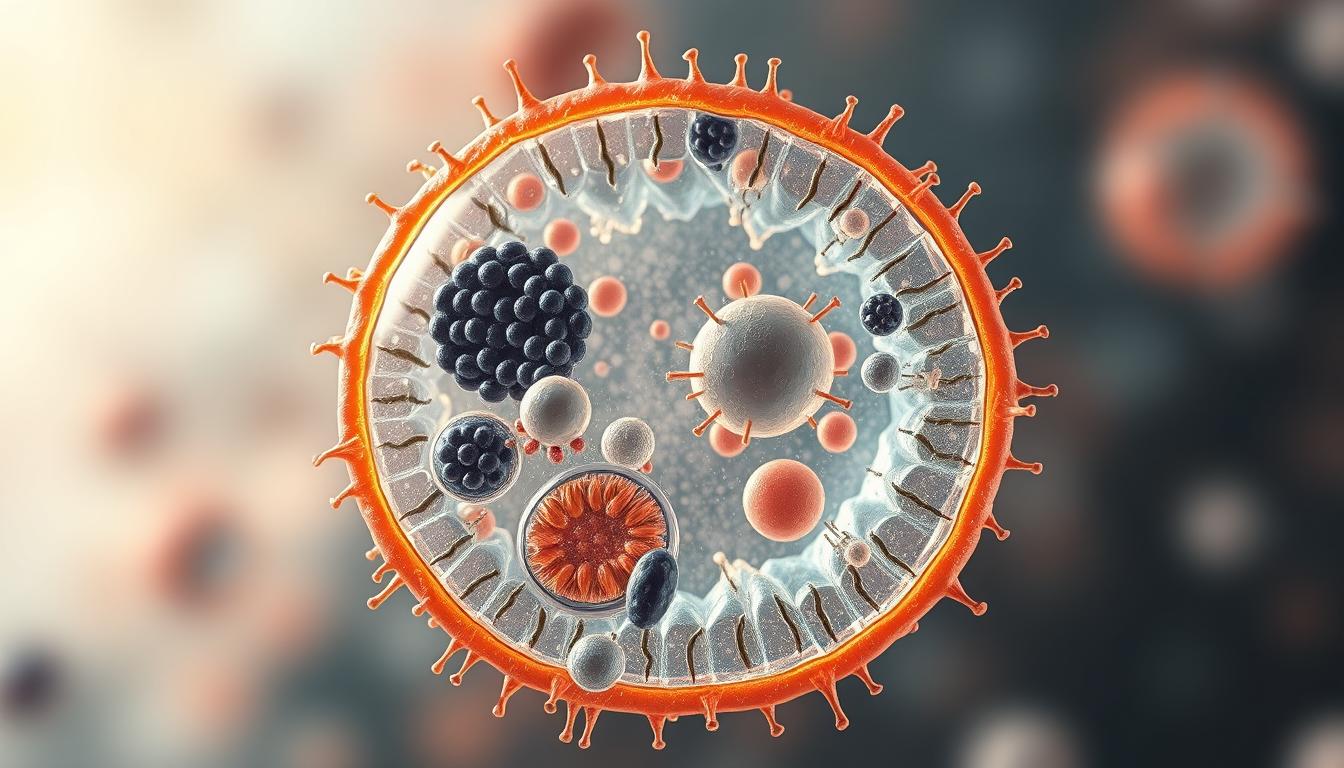
Ever thought about how tiny bacteria are? Imagine millions of them on a pinhead. It’s a world so small, we can’t see it with our eyes.
Bacteria are tiny living things that come in all sizes. They are usually between 1 to 10 micrometers long. This means we need special tools to see them.
These tiny creatures are all different sizes. Some are really small, while others are quite big. The smallest ones are just 323 nanometers long. But some, like Thiomargarita namibiensis, can be up to 750 micrometers wide.
Key Takeaways
- Bacteria range from 1 to 10 micrometers in typical length
- Microscopic measurements reveal incredible size diversity
- Most bacteria cannot be seen without advanced microscopes
- Size impacts bacterial function and survival
- One gram of soil can contain 40 million bacterial cells
Introduction to Bacteria Size
Microbiology opens a world of tiny life forms we can’t see. Bacteria, the smallest living things, are key to life on Earth. They’ve been around for about 3.5 billion years.
Definition of Bacteria
Bacteria are tiny, single-celled life forms. They vary in size, from 1 to 10 micrometers. This size lets them live in almost every place on Earth, from deep seas to hot springs.
- Smallest bacteria: 0.3 micrometers (Mycoplasma genus)
- Average bacterial size: 1-2 micrometers in diameter
- Largest known bacteria: Up to 0.5 millimeters (Thiomargarita namibiensis)
Importance of Size in Microbiology
Knowing how big bacteria are helps us understand their role in nature. Their size affects how they live and interact with other life forms.
“In the world of microorganisms, size is not just a physical attribute, but a fundamental characteristic that defines function and survival.” – Microbiology Research Consortium
| Bacterial Characteristic | Size Range | Significance |
|---|---|---|
| Cell Diameter | 0.5 – 5 µm | Determines nutrient absorption |
| Surface Area to Volume Ratio | High | Facilitates efficient metabolic exchange |
| Shape Variations | Spherical, Rod, Spiral | Influences mobility and environmental adaptation |
The study of bacterial size is captivating. It gives us a glimpse into the basics of life at its smallest.
The Average Size of Bacteria
Bacteria are tiny wonders of the microscopic world. They come in all shapes and sizes. By studying their dimensions, scientists can learn more about the tiny world around us.
Bacteria are incredibly small but vary a lot. They can be 1 to 10 microns long and 0.2 to 1 micron wide. This size lets them live almost everywhere on Earth.
Typical Bacterial Measurements
Researchers have found interesting differences in bacterial sizes:
- Bacillus subtilis: About 0.4-1.0 µm³
- Escherichia coli: Around 1-3 µm³
- Staphylococcus aureus: Roughly 0.6-1.5 µm³
Factors Influencing Bacterial Size
Several things affect how big bacteria can be:
- Environmental conditions: Things like food and temperature
- Genetic traits specific to each species
- How old the bacteria are and how active they are
“The diversity of bacterial size is a testament to the incredible adaptability of microbial life.” – Dr. Elena Rodriguez, Microbiology Research Institute
Some bacteria are really tiny, while others are quite big. For example, Candidatus Actinomarina minuta is just 0.013 µm³. On the other hand, Thiomargarita namibiensis is a huge 0.22 µL. This shows just how varied bacterial sizes can be.
Comparing Bacteria with Other Microorganisms
The microscopic world is full of different microorganisms. Each has its own size and features. Knowing about microorganism size helps scientists understand how these microbes interact.
Looking at bacteria size compared to other microbes shows interesting differences. These size variations are found in various microscopic life forms.
Bacteria vs. Viruses: A Size Perspective
Viruses are the smallest in the microbial world. They are about 1/10th the size of bacteria. Here’s a comparison:
- Typical bacteria are around 1 micrometer (µm) big.
- Viruses are about 100 nanometers (nm) on average.
- If a bacterium were as big as a cat, a virus would be like a mouse.
Bacteria vs. Archaea: Structural Comparisons
Archaea, another group of single-celled microbes, are similar in size to bacteria. Both are simple cells with small sizes.
| Microorganism Type | Average Size | Typical Shape |
|---|---|---|
| Bacteria | 0.5 – 1.0 µm | Spherical, Rod, Spiral |
| Viruses | 20 – 400 nm | Various geometric structures |
| Archaea | 0.5 – 1.5 µm | Similar to bacteria |
“In the realm of microbes, size isn’t everything, but it certainly tells a fascinating story of adaptation and survival.” – Microbiology Research Insights
The microbe scale shows us the detailed world of microbes. It highlights their diversity and complexity in the biological world.
Measurement Techniques for Bacteria
Scientists have come up with clever ways to study tiny life forms. They use special methods to measure bacteria. These techniques help us see the tiny world around us.
Many methods are used to measure bacteria. Each one gives us different information about their size and shape.
Advanced Microscopy Techniques
Microscopy is key in studying bacteria. There are different types of microscopy:
- Light microscopy for basic shape observations
- Electron microscopy for detailed images
- Fluorescence microscopy for seeing how cells move
Molecular Measurement Strategies
New molecular methods have changed how we study bacteria. Now, we can measure their size more accurately than ever.
| Technique | Key Characteristics | Measurement Sensitivity |
|---|---|---|
| Fluorescence Polarization | Detects cellular growth markers | High sensitivity |
| Optical Density (OD600) | Measures light scattering | Standard population measurement |
| Nephelometry | Measures light transmission | Enhanced sensitivity for low populations |
“The complexity of bacterial measurement lies not just in the tools, but in understanding the dynamic nature of microbial life.” – Dr. Elizabeth Roberts, Microbiologist
These advanced methods let scientists measure bacteria with great precision. They help us learn more about tiny life forms and their sizes.
Diversity in Bacterial Size
The world of bacteria is full of surprises. They come in all sizes, from tiny to huge. This shows how diverse bacteria can be in terms of size.
Exploring Microscopic Extremes
Bacteria sizes vary a lot. Some are so small they need powerful microscopes to see. Others are big enough to spot with our eyes.
- Smallest Bacteria: Mycoplasma measuring only 0.3 micrometres
- Largest Bacteria: Thiomargarita magnifica reaching up to 2 cm in length
Remarkable Size Variations
Bacteria sizes are truly amazing. They show how adaptable these tiny creatures can be:
- Tiny Mycoplasma pneumoniae: 0.1-0.25 μm wide
- Medium-sized Escherichia coli: 2 μm in length
- Giant Epulopiscium fishelsoni: Up to 600 μm long
“The diversity of bacterial size is a testament to nature’s incredible design capabilities.” – Microbiology Research Team
Extraordinary Size Champions
Some bacteria are truly record-breakers. The marine bacteria Thiomargarita namibiensis is a giant, with a diameter of 750 μm. It shows that bacteria can be much bigger than we thought.
Studying these size differences helps scientists learn more about bacteria. They can understand how bacteria adapt, their roles in nature, and their uses in science and medicine.
The Role of Size in Functionality
Bacterial size is key to their metabolic efficiency and survival. Knowing how big a bacteria is shows how cell size affects performance.
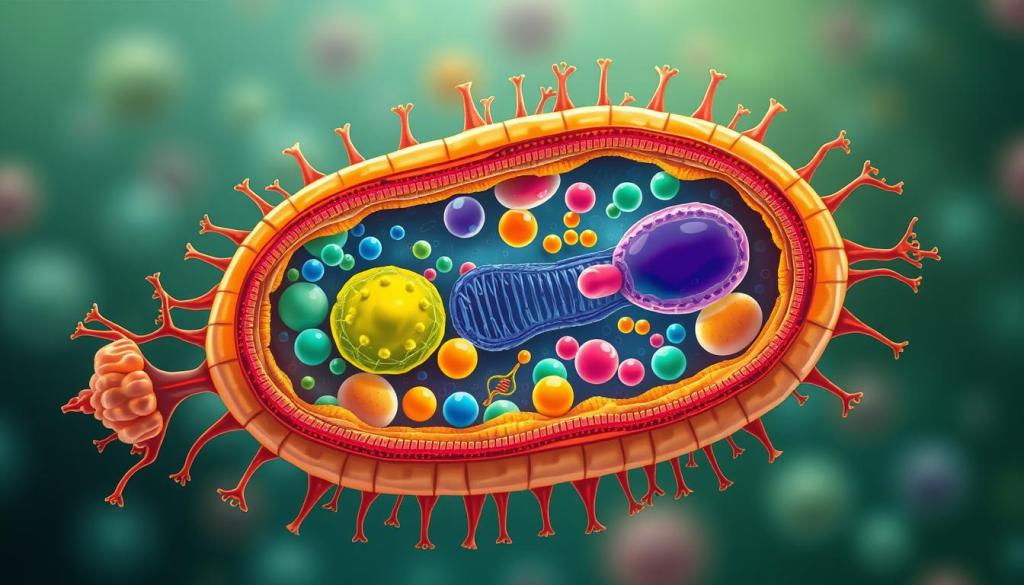
The size of bacteria greatly affects how they deal with environmental challenges. Their dimensions are not random. They are optimized through evolution.
Metabolic Activity and Cell Size
Bacterial metabolism shows interesting links to cell size. Smaller bacteria tend to:
- absorb nutrients faster
- use energy more efficiently
- reproduce quicker
Survival Strategies Linked to Size
Bacterial size affects their survival tactics. Escherichia coli, for example, shows amazing adaptability due to its size:
- Length ranges from 1.0-2.0 micrometers
- Radius around 0.5 micrometers
- Contains 10,000 to 60,000 ribosomes per cell
“The structure and function of bacterial cells are fundamentally bounded by the limits of molecular diffusion.” – Microbiology Research Insights
Smaller bacteria can get into tight spaces. Larger ones might have more complex survival strategies. This size-functionality link is a big interest for microbiologists.
Bacterial Size in Health and Disease
Bacteria play a big role in our health. Their size affects how we interact with them. This shows how complex the relationship between bacteria and our bodies is.
Bacteria size matters a lot for our health. It affects how well they can harm us and how our immune system fights back. Their tiny size lets them sneak into our cells and get past our defenses.
Impact on Human Health
Our bodies are full of tiny creatures, with bacteria outnumbering our cells 10 to 1. Even though they make up only 1-3% of our body weight, they’re crucial for many functions.
- Good bacteria keep bad ones out
- They help with digestion
- They do important enzyme work
Size and Antibiotic Efficacy
The size of bacteria affects how well antibiotics work. Bacteria that are smaller might be harder to kill than bigger ones. This is because antibiotics have a harder time getting inside and stopping them.
“The complexity of bacterial size reveals intricate mechanisms of survival and interaction within human biological systems.”
Scientists have found over 10,000 types of bacteria living in us. This shows just how complex our interactions with them are. Knowing about bacterial size helps doctors find better ways to treat us.
| Bacterial Characteristic | Health Impact |
|---|---|
| Small Bacteria | Easier cellular penetration |
| Large Bacteria | More visible to immune system |
The connection between bacteria size and our health is really interesting. It’s helping doctors find new ways to prevent and treat diseases.
The Evolution of Bacterial Size
Bacteria have changed a lot over Earth’s history. Their size has been a key part of their evolution. Scientists have found out how bacteria adapt and evolve over time.
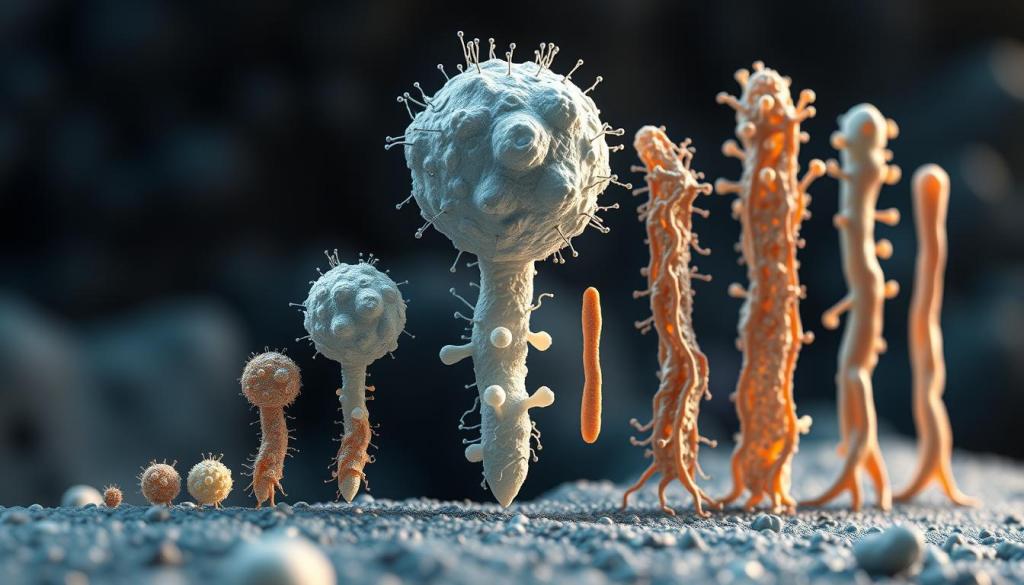
The size of bacteria is linked to their environment and survival. Scientists have found some amazing facts about bacterial evolution:
- Prokaryotes have existed for about 75% of Earth’s history
- Bacteria show incredible diversity in how they metabolize
- Long-term evolution experiments show big changes in bacterial traits
Historical Perspectives on Bacterial Growth
Research on Escherichia coli has given us new insights into bacterial size. Long-term studies followed bacterial changes over 60,000 generations. They found interesting patterns of growth and adaptation.
“Evolution is not just about survival, but about remarkable adaptability at the microscopic level.”
Research Directions and Emerging Trends
Now, scientists are looking into how cell size affects metabolic efficiency. They’ve found interesting links between cell volume and metabolic rates.
| Research Focus | Key Findings |
|---|---|
| Cell Volume Changes | Increased size linked to higher growth rates |
| Metabolic Efficiency | Larger cells show improved CO2 production |
| Evolutionary Adaptation | Cells become larger but fewer in number |
The future of studying bacterial size is full of promise. Scientists are eager to learn more about how size affects bacterial evolution and adaptation.
Implications of Bacterial Size in Biotechnology
Bacterial size is key in biotechnology. It helps researchers create new, exciting things. They learn about bacterial size to make big advances in science.
Biotechnology uses bacteria’s special traits to tackle big problems. Knowing bacteria’s size is crucial for making new solutions. This is true in genetic engineering and environmental science.
Genetic Engineering Strategies
In genetic engineering, how big bacteria are matters a lot. Scientists use bacteria’s size to:
- Make gene transfer better
- Design precise molecular changes
- Get more accurate genetic changes
Environmental Science Applications
Understanding bacteria helps a lot in environmental science. For example, certain sizes of bacteria are great for cleaning up pollution. They help in:
- Cleaning water
- Breaking down pollutants
- Fixing damaged ecosystems
“The minute dimensions of bacteria hold massive potential for solving global environmental challenges.” – Scientific Research Consortium
| Bacterial Size Range | Biotechnological Application |
|---|---|
| 0.2-2 μm | Precision genetic engineering |
| 1-10 μm | Bioremediation processes |
| Specialized sizes | Targeted environmental interventions |
By studying bacterial size, scientists can make big changes. These changes help solve big global problems.
Conclusion: Significance of Understanding Bacterial Size
Exploring bacterial size opens a world of tiny complexity. Studies in microfluidics and single-cell analysis have shown how bacteria keep their size. They control their volume with amazing precision, adding the same amount each time they grow.
Different sizes of bacteria show how they adapt to their environments. Even small changes in size can greatly affect their survival and success. For example, a 0.01% increase in growth rate can give them a big advantage.
Key Research Insights
Recent studies have shed light on how bacteria control their size. Changes in genes related to division can affect cell length. Each type of bacteria has its own way of keeping its size consistent.
This balance between cell division, resource use, and shape changes shows how microbes evolve. It’s a complex area that keeps scientists learning about tiny life forms.
Future Research Opportunities
New research areas are opening up to study bacterial size. Scientists will look into how size affects survival, getting nutrients, and interacting with the environment. Using advanced imaging, genetics, and computer models will help us understand more about bacterial size control in the future.
FAQ
What is the typical size of a bacteria?
Bacteria are usually between 0.2 to 2 micrometers long and 0.5 to 1 micrometer wide. They are too small to see with the naked eye. We need a microscope to study them closely.
How do researchers measure bacterial size?
Scientists use special tools like electron microscopy and light microscopy to measure bacteria. These tools help them get precise measurements of length, width, and volume.
Are all bacteria the same size?
No, bacteria come in all sizes. Some are as small as 0.1 micrometers, while others, like Thiomargarita namibiensis, can be up to 750 micrometers long. This shows how diverse bacteria can be.
Why is bacterial size important in microbiology?
Bacterial size affects how well they can survive and interact with their environment. It also impacts their ability to cause disease. Knowing their size helps scientists understand their behavior and effects on health and ecosystems.
How do bacterial sizes compare to other microorganisms?
Bacteria are bigger than viruses but smaller than many eukaryotic cells. Viruses are 20-400 nanometers, while bacteria are 0.2-2 micrometers. This makes bacteria unique in the microscopic world.
Can bacterial size change?
Yes, bacterial size can change based on their environment and what they need to grow. Things like temperature, pH, and nutrients can affect their size.
What are the smallest and largest known bacteria?
The smallest bacteria are around 0.1 micrometers, while the largest, Thiomargarita namibiensis, can be up to 750 micrometers long. These extremes show how varied bacterial sizes can be.
How does bacterial size affect human health?
Bacterial size can affect how well they can cause disease and how our immune system reacts. Smaller bacteria can get into cells more easily, while larger ones might trigger different immune responses.
Are there technological applications related to bacterial size?
Yes, knowing about bacterial size is key in biotechnology and medicine. It helps in genetic engineering, environmental cleanup, and creating targeted treatments. Scientists use this knowledge for many practical uses.
How have measurement techniques for bacterial size evolved?
Measuring bacterial size has come a long way. From early light microscopy to advanced tools like electron microscopy and molecular imaging, our understanding of bacteria has grown a lot.





Leave a Comment
Your email address will not be published. Required fields are marked *