


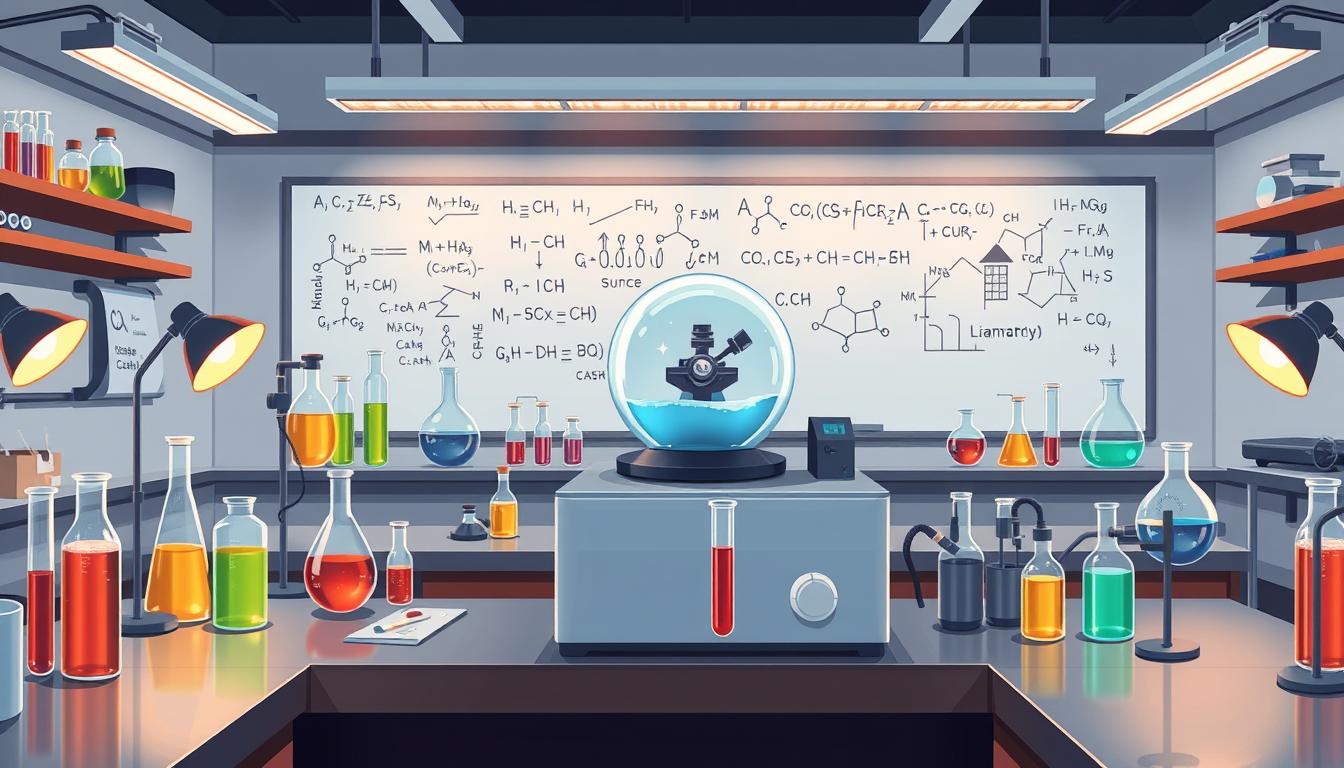
Concentration shows how much solute is in a certain amount of solution. Scientists use many ways to measure it, from simple percentages to complex spectroscopy.
They use units like molarity (M) to show the number of moles of solute in one liter of solution. These measurements are vital for precise chemical analysis, drug making, and checking the environment.
To learn about measuring concentration, you need to know the basics of solution chemistry. By getting good at these methods, scientists can do exact experiments and find new solutions in many areas.
Key Takeaways
- Concentration measures the amount of solute in a solution
- Multiple measurement units exist, including molarity and percentage
- Accurate concentration measurement is critical in scientific research
- Different techniques suit various types of solutions
- Precision depends on proper measurement methods
Understanding Concentration in Scientific Terms
Concentration is a key idea in science, linking cognitive tests and exact measurement methods. Scientists measure how much substance is in a certain volume. They study how solutes and solvents interact.
To grasp concentration, we must look at different ways to measure it. Researchers use advanced methods to track how easily we get distracted and mind wander. These help us understand complex scientific issues.
Defining Concentration Fundamentally
Simply put, concentration is about how much solute is in a solution. Scientists use several ways to show this:
- Molarity (M): moles of solute per liter of solution
- Molality (m): moles of solute per kilogram of solvent
- Percent by volume (% v/v): volume of solute per hundred volume of solution
- Parts per million (PPM): precise measurement of trace substances
Importance of Precise Measurement
Getting concentration right is crucial in science. Chemical reactions, environmental monitoring, and pharmaceutical development all need to know the exact amount of solute. This is because small changes can have big effects.
Scientific Applications of Concentration
Concentration is used in many ways in science. Chemists study reaction rates, biologists look at cells, and environmental scientists track pollutants. Each area needs careful concentration calculations.
Methods for Measuring Concentration
Scientists use many advanced methods to check concentration in different fields. These include chemical tests and ways to measure how well something works. They give us detailed information about what’s in a substance and how well it performs.
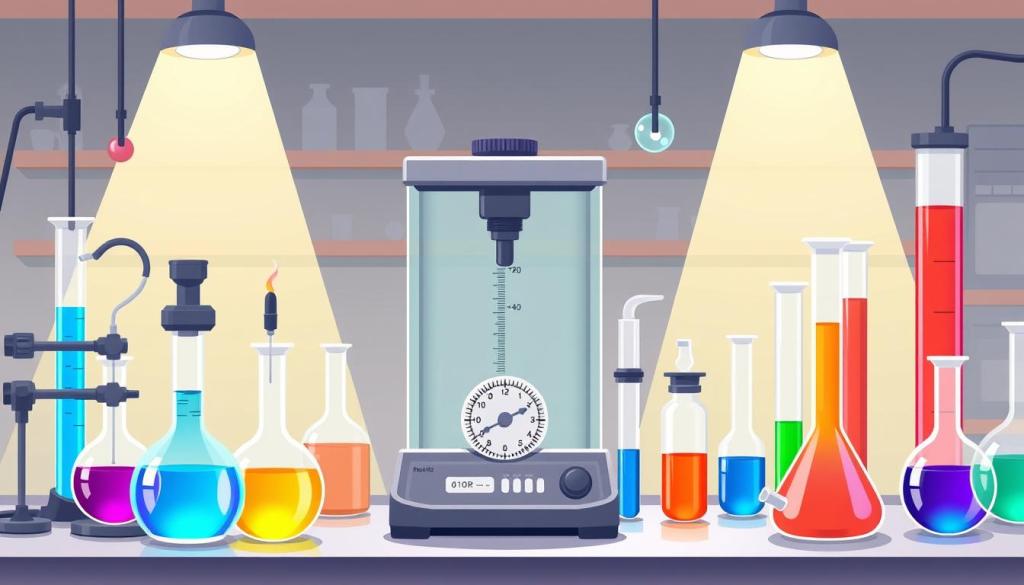
Looking into how we measure concentration, we find key methods. These help experts accurately check out complex mixtures and solutions.
Titration Techniques
Titration is a key way to find out concentration by using chemical reactions. It involves slowly adding a known solution to an unknown one until a certain point is reached.
- Precise volume measurements
- Chemical indicator usage
- Endpoint detection
Spectrophotometric Analysis
Spectrophotometry uses light to check how substances absorb it. It tells us how much light a sample absorbs at certain wavelengths. This gives us data on what’s in the solution.
| Method | Detection Limit | Application |
|---|---|---|
| UV-Visible Spectroscopy | 0.001 mg/L | Chemical Analysis |
| Infrared Spectroscopy | 0.01 mg/L | Molecular Composition |
Chromatographic Methods
Chromatography is a top-notch test for breaking down and measuring mixtures. It lets researchers study complex solutions by finding out what’s in them based on their unique traits.
- Gas chromatography
- Liquid chromatography
- High-performance liquid chromatography
Each method has its own strengths in measuring concentration. They are used in science, industry, and research. They give us accurate and reliable results.
Equipment Used for Concentration Measurement
Laboratories use advanced tools to measure concentration levels. These tools help get precise and reliable results. Scientists use them to study chemical compositions and track how well we resist distractions in different fields.
- Spectrophotometers for optical density analysis
- Chromatographs for substance separation
- Volumetric flasks for precise volume measurements
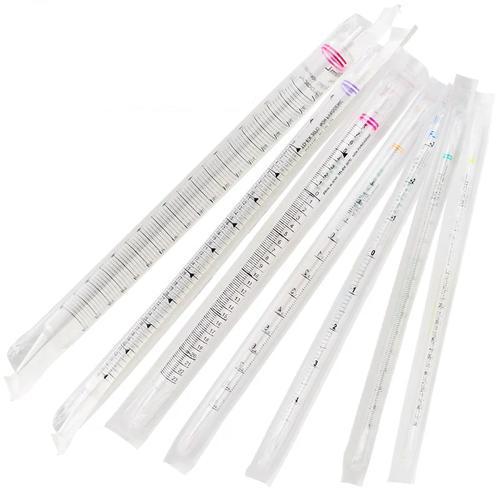
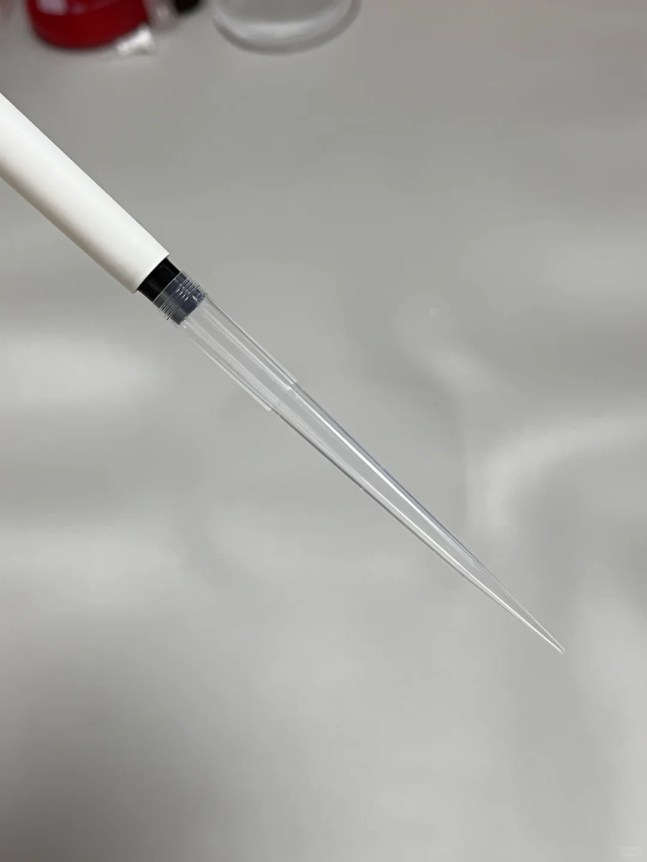
- Pipettes for precise liquid handling
- Burettes for controlled liquid dispensing
Precision Through Calibration
Calibration is vital for accurate measurements. Precise calibration ensures that instruments provide consistent and reliable data. Researchers must check their equipment often using standard materials and protocols.
Safety Considerations
Keeping the lab safe is crucial when measuring concentration. Scientists must wear the right gear and follow strict rules. This helps avoid risks from handling chemicals and using instruments.
Advanced Measurement Techniques
Today, we use new technologies like ultrasonic sensors and microwave systems. These methods are very accurate, with ranges from 0.05% to 0.1%. They work well, no matter the liquid’s color, transparency, or conductivity.
Units of Measurement for Concentration
Knowing how to measure concentration is key in science and analysis. Researchers use various units to show how much solute is in a solution. Each unit gives different insights into chemical makeup and how we focus and pay attention.
Scientists use several important units to measure concentration. These units help professionals do precise tests and study how we focus and pay attention in different situations.
Molarity and Molality Explained
Molarity (M) shows the number of moles of solute per liter of solution. The formula for molarity is:
- \(M = \frac{moles\;of\;solute}{liters\;of\;solution}\)
- Typically used in lab settings
- Helps understand solution strength
Molality (m) measures moles of solute per kilogram of solvent. It’s calculated by:
- \(m = \frac{moles\;of\;solute}{kilograms\;of\;solvent}\)
- Best for experiments sensitive to temperature
- Doesn’t change with temperature
Percentage Concentration Methods
Percentage concentration can be shown in several ways:
| Type | Formula | Application |
|---|---|---|
| Mass Percent | \(Mass\;Percent = \frac{Mass\;of\;Solute}{Mass\;of\;Solution} \times 100\%\) | Solid solutions |
| Volume Percent | \(Volume\;Percent = \frac{Volume\;of\;Solute}{Volume\;of\;Solution} \times 100\%\) | Liquid mixtures |
Parts per Million (PPM)
Parts per million is very precise for measuring trace amounts. The formula is:
- \(PPM = \frac{mg\;Solute}{Liter\;Solution}\)
- Very important for environmental and medical tests
- Helps measure tiny amounts of substances
These units are vital for accurate cognitive assessments and studying complex chemical interactions.
Factors Affecting Concentration Measurements
Getting accurate concentration measurements is key in science. Many factors can affect these measurements. Researchers must think about these factors to get precise results in their studies.
Several key elements influence the accuracy of concentration measurements:
- Temperature variations
- Solvent interactions
- Sample purity considerations
Temperature’s Critical Role
Temperature plays a huge role in how solutions work. Molecular interactions change with temperature, affecting solubility and volume. Scientists need to control temperature carefully to keep their measurements accurate.
Solvent Impact on Measurements
Different solvents behave differently with dissolved substances. The solvent’s chemical properties can greatly affect how solutes behave. This can lead to variations in measurements, affecting accuracy.
Sample Purity Considerations
Contaminants are a big challenge in measuring concentration. Even small impurities can change results. It’s crucial to prepare samples carefully to avoid errors.
By understanding and dealing with these factors, scientists can make their concentration measurement techniques more reliable. This is important across many scientific fields.
Practical Applications of Concentration Measurement
Concentration measurements are key in many fields. They give us important insights into complex issues. Experts use them to figure out how much mental effort is needed and find ways to improve focus.

These measurements are a strong tool for tackling real-world problems. Scientists and engineers use them to ensure quality, safety, and accuracy in their work.
Industrial Use Cases
In manufacturing, knowing the concentration is vital for keeping products consistent and high-quality. Some important uses include:
- Quality control in chemical production
- Material composition verification
- Process optimization
- Product safety assessment
Environmental Monitoring
Environmental scientists need precise concentration measurements to track pollutants and check the health of our planet. They use these tools to find out about:
- Air quality analysis
- Water contamination detection
- Soil composition studies
- Greenhouse gas concentration tracking
Medical Diagnostics
Doctors and medical teams use concentration measurements to diagnose and keep an eye on patients’ health. These measurements help them understand:
- Blood chemistry evaluations
- Drug level monitoring
- Metabolic disorder detection
- Nutritional status assessment
By studying concentration changes, researchers can create better ways to handle mental challenges. This helps improve how well we perform in different areas.
Challenges in Accurate Concentration Measurement
Measuring concentration accurately is a big challenge for scientists and industry experts. It’s important to understand how to measure concentration. This requires paying close attention to several key factors that can affect how precise the measurement is.
- Improper sample preparation techniques
- Instrument calibration inconsistencies
- Human calculation mistakes
- Variations in environmental conditions
Overcoming Measurement Obstacles
To improve measurement accuracy, researchers use certain strategies. Standardized procedures and strict quality control help reduce errors. It’s also important to train lab staff well in precise measurement techniques.
Automation’s Critical Role
Automation plays a big role in reducing human mistakes in concentration measurements. Advanced systems can greatly improve precision and consistency. For example, some automated systems have:
- 50% reduction in operational costs
- Elimination of manual calculation errors
- Faster data processing and analysis
- Enhanced measurement consistency
New technologies like Variable Pathlength Spectroscopy allow for very accurate protein concentration measurements. They can be accurate to within 1%, covering a wide range of concentrations. These advancements change how scientists conduct focus tests and attention span measurements.
Best Practices for Measuring Concentration
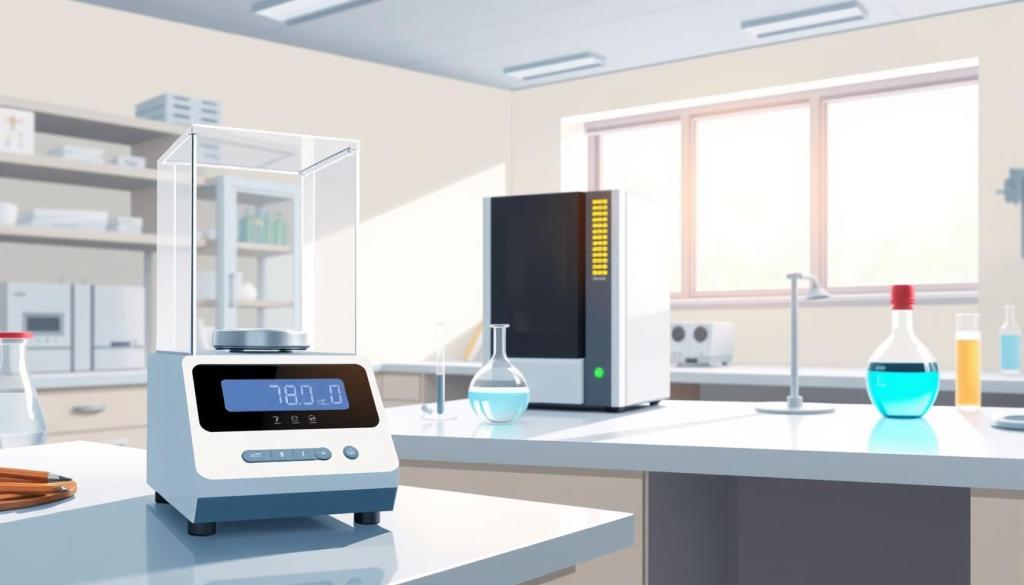
Measuring concentration needs to be precise and systematic. Researchers and experts must use strong methods for accurate tests and reliable data. This process includes several key steps to get consistent and useful results.
To measure concentration well, it’s important to use a detailed plan. This plan should tackle major scientific hurdles. It should include important parts to reduce mistakes and increase trustworthiness.
Standard Operating Procedures
Creating clear rules is key to keeping measurements right. These rules help make sure tests are done the same way every time. Important parts include:
- Detailed step-by-step experimental protocols
- Clear guidelines for equipment calibration
- Precise measurement techniques
- Standardized documentation methods
Training and Expertise
Being skilled is crucial for accurate concentration tests. Researchers need to keep learning to get better at complex tests. Important training areas include:
- Comprehensive theoretical knowledge
- Hands-on practical experience
- Understanding advanced measurement technologies
- Regular skill assessment and improvement
Documentation and Reporting
Keeping detailed records is essential for scientific trustworthiness. Researchers should document every part of the concentration test process. This includes method details, possible variations, and what was observed.
Future Trends in Concentration Measurement
The world of measuring concentration is changing fast with new tech. Scientists are working on better ways to test how well we focus and understand how hard our brains are working. These new tools will change how we study focus in many fields.
Small sensors and tiny devices are making measurements more accurate. New ways to look at things with high sensitivity are helping find tiny changes in focus problems. These tools help us understand complex systems better, from health to industry.
Researchers are also working on making these tests stronger and more flexible. They’re using smart tech to make data analysis faster and more precise. This tech is making it easier to study focus in different areas.
The future of measuring concentration is exciting, with new ideas from different fields. Scientists are creating advanced tools that give us quick, detailed insights into focus. As tech keeps getting better, we’ll have even more ways to study focus in complex systems.
References and further readings:
Liu, F., & Wang, J. (2020). Assessing Mental Fatigue and Concentration: A Meta-Analysis of Self-Report and Performance-Based Methods. Psychology of Sport and Exercise, 51, 101743.
https://www.sciencedirect.com/science/article/abs/pii/S1469029219307356?via%3Dihub
FAQ
What is concentration in scientific terms?
Concentration is how much solute is in a certain amount of solvent. It’s measured in units like molarity, molality, or parts per million (PPM). It’s key in chemistry, biology, and environmental science to know how much of a substance is in a solution.
Why are accurate concentration measurements important?
Getting concentration right is vital for many reasons. It helps ensure quality in making products, does precise research, checks environmental health, does medical tests, and keeps industries safe. It’s crucial for understanding how chemicals work together.
What are the most common methods for measuring concentration?
Main methods include titration, spectrophotometry, and chromatography. Each has its own strengths for different samples and studies. Spectrophotometry is great for liquids, while chromatography is best for complex mixes.
How do temperature variations affect concentration measurements?
Temperature changes can mess with concentration readings. It can change how much solute dissolves, the solution’s size, and how molecules interact. If not handled right, it can lead to wrong readings.
What units are typically used to express concentration?
Common units are molarity, molality, percentage, and parts per million (PPM). The right unit depends on the study and the solution being tested.
What equipment is essential for measuring concentration?
You need precision balances, flasks, pipettes, spectrophotometers, titration tools, and chromatography systems. Keeping these tools calibrated and in good shape is key for accurate results.
What are the common challenges in concentration measurement?
Issues include contamination, calibration errors, human mistakes, temperature changes, and prep differences. Using standard methods, training, and quality checks can help fix these problems.
How are concentration measurements used in different industries?
They’re crucial in many fields like making medicines, checking the environment, food, water, chemicals, and medical tests. They help ensure products are safe and meet standards.
What emerging technologies are improving concentration measurement?
New tech includes tiny sensors, microfluidics, advanced spectroscopy, and automated systems. These advancements offer better sensitivity, quicker results, and more accuracy in many areas.
How can researchers improve the accuracy of concentration measurements?
To get better results, follow strict procedures, invest in top-notch tools, train well, use several methods, and document everything carefully.
Leo Bios
Hello, I’m Leo Bios. As an assistant lecturer, I teach cellular and
molecular biology to undergraduates at a regional US Midwest university. I started as a research tech in
a biotech startup over a decade ago, working on molecular diagnostic tools. This practical experience
fuels my teaching and writing, keeping me engaged in biology’s evolution.




Leave a Comment
Your email address will not be published. Required fields are marked *