


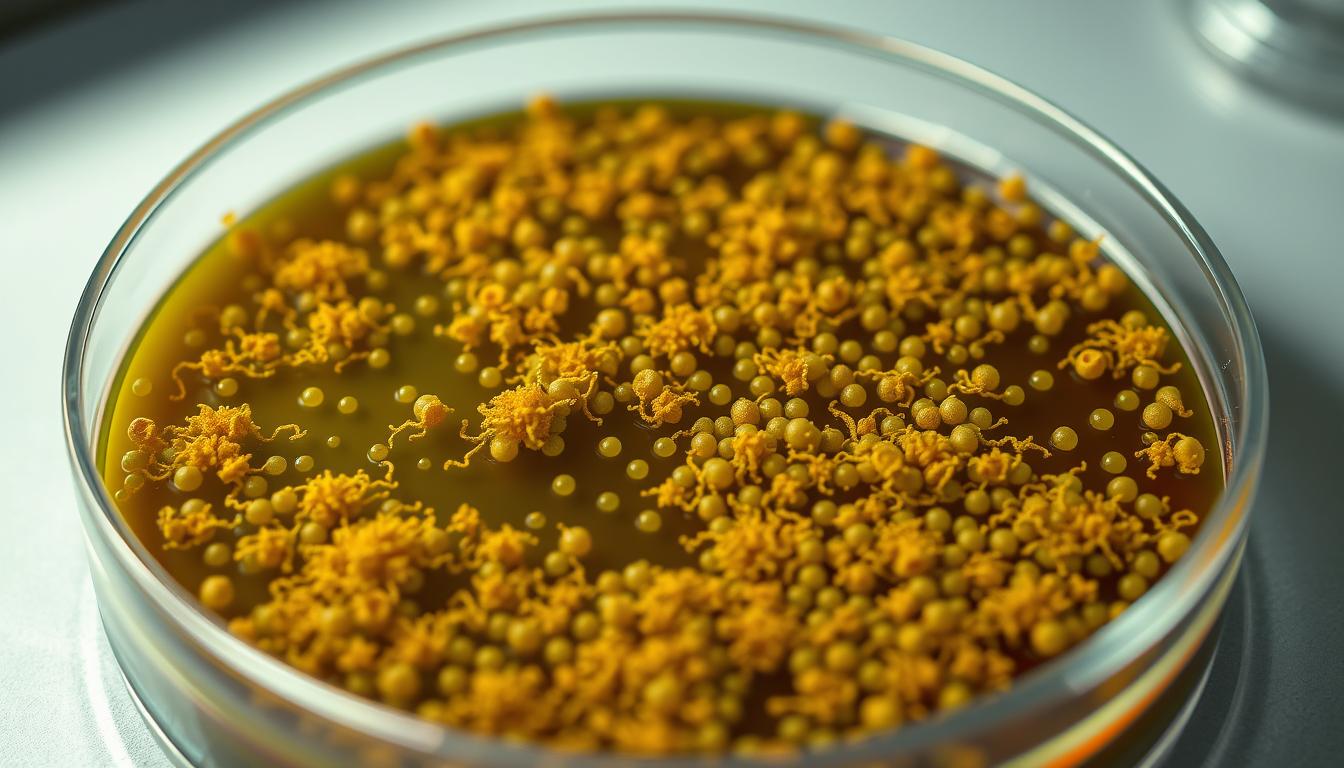
Ever thought about how tiny bacteria turn into big, thriving groups that change whole ecosystems? Learning about bacterial growth is like going on a journey into the tiny world of colony formation.
Bacterial colonies form when single cells grow and join together. This process depends on things like food, temperature, and the environment. It starts with one cell that quickly splits, making a network of connected bacteria.
Studies show that bacterial colonies grow faster in tight spaces than in liquid. This shows how bacteria adapt and survive in different places.
Key Takeaways
- Bacterial colonies start from a single cell and expand through rapid multiplication
- Nutrient availability significantly impacts colony development
- Bacterial growth rates can vary based on environmental conditions
- Colonies demonstrate remarkable adaptability and survival mechanisms
- Understanding colony formation is crucial for medical and scientific research
Understanding Bacterial Biology
Bacteria are tiny, single-celled organisms that are vital in many biological processes. They have unique traits that set them apart from other living things. Studying them helps us understand how they multiply and reproduce.
Bacterial cells are amazing at surviving and growing. They have complex structures that help them divide and adapt to different environments.
Key Characteristics of Bacteria
Bacteria have some key features that make them special:
- Unicellular structure
- Rapid reproduction rates
- Genetic flexibility
- Adaptability to extreme conditions
Bacterial Cell Structure
The structure of a bacterial cell is crucial for its survival and growth:
| Cell Component | Function |
|---|---|
| Cell Wall | Provides structural protection |
| Cytoplasm | Houses genetic material and metabolic processes |
| Cell Membrane | Regulates nutrient exchange |
Reproduction Methods
Microorganisms mainly reproduce through binary fission. This is when one bacterial cell splits into two identical cells. It allows them to grow quickly when conditions are right.
Studies show that bacterial colonies can grow very dense. They keep growing at the same rate for a long time. This shows how complex their biology is.
Initial Conditions for Bacterial Growth
For bacteria to grow, they need certain conditions. These conditions help them survive and form colonies. Knowing these factors is key for controlling bacteria in different places.
Nutrient Requirements for Bacterial Survival
Bacteria need nutrients to grow and multiply. They need:
- Carbon sources for energy
- Nitrogen for protein synthesis
- Minerals like phosphorus and sulfur
- Trace elements for metabolic processes
Temperature and pH Influences
Temperature and pH greatly affect bacterial growth. Each type of bacteria grows best in certain temperatures:
| Bacterial Type | Optimal Temperature Range | Growth Characteristics |
|---|---|---|
| Psychrophiles | Below 20°C | Cold-adapted organisms |
| Mesophiles | 20-45°C | Most common bacterial type |
| Thermophiles | 45-80°C | Heat-resistant bacteria |
pH levels also matter a lot. Most bacteria like a pH between 6.5 and 7.0.
Oxygen Availability
Oxygen levels affect how bacteria grow. Bacteria can be divided by how they handle oxygen:
- Obligate aerobes: Need oxygen to live
- Obligate anaerobes: Grow only without oxygen
- Facultative aerobes: Can grow with or without oxygen

Knowing these initial growth conditions is crucial for controlling bacterial populations in medical, industrial, and environmental contexts.
The Process of Bacterial Cell Division
Bacterial reproduction is a fascinating process that drives the growth of bacterial populations. At its core is bacterial cell division, a key mechanism for bacteria to multiply and spread. This happens in various environments.
Bacteria mainly divide through binary fission, a fast reproductive strategy. It allows single cells to grow into colonies quickly. During this process, a cell makes a copy of its genetic material and splits into two identical cells.
Stages of Binary Fission
- DNA replication begins at the origin of chromosome
- Chromosomes separate to opposite cell poles
- Cell membrane begins to constrict
- Cytoplasm divides, creating two genetically identical cells
Factors Influencing Division Rates
Many environmental conditions affect how fast bacteria divide. Important factors include:
| Factor | Impact on Division |
|---|---|
| Temperature | Optimal range accelerates division |
| Nutrient Availability | Rich nutrients increase division speed |
| pH Levels | Moderate pH supports faster reproduction |
Under the right conditions, bacterial reproduction can happen very fast. For example, Escherichia coli can divide every 20 minutes. This means it can grow into billions of cells in just a few hours.
Stages of Bacterial Colony Development
Bacterial growth is a fascinating process with distinct phases. These stages offer insights into how microbes reproduce and grow. A bacterial colony goes through four main stages, showing the complexity of microbial life.
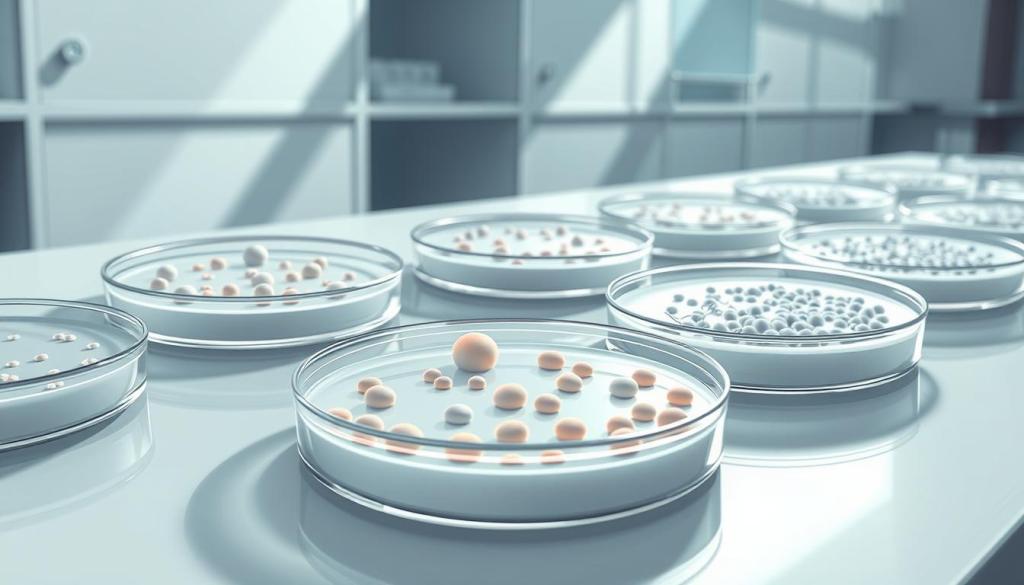
Bacterial colonies develop in a predictable way, showing their adaptability and survival skills. Researchers have found four main stages in their growth and change.
Lag Phase: The Initial Adaptation
In the lag phase, bacteria get ready for fast growth. Key traits include:
- Minimal population increase
- Active metabolic preparation
- Enzyme synthesis and cellular adaptation
Log Phase: Rapid Exponential Growth
The log phase is the most active time for bacterial colony growth. Interesting growth patterns have been found:
| Colony Characteristic | Percentage/Measurement |
|---|---|
| Initial Y-shaped colonies | 55% |
| Linear colony shape | 10% |
| Multibranched colony forms | 10% |
| Average Y-arm length (non-irradiated) | 136 μm |
Stationary Phase: Balancing Act
In the stationary phase, growth slows down. Nutrients and waste play key roles in keeping the colony stable.
Death Phase: Population Decline
The final stage is when the population starts to decrease. Microbial reproduction slows down as resources run low and conditions worsen.
Knowing these stages helps scientists understand bacterial behavior. It also aids in controlling bacterial growth and studying complex microbial ecosystems.
Importance of Biofilms in Bacterial Colonies
Bacterial biofilms are complex strategies that turn simple bacteria into strong communities. These structures are key for bacteria to grow and survive in many places.
Biofilms are networks of microorganisms that stick to surfaces and each other. They form a protective layer. Their unique features are important in many scientific fields.
Definition of Biofilms
A biofilm is a group of bacterial cells in a protective matrix. These complex structures help bacteria survive in tough conditions, showing great adaptability.
Formation Mechanisms
Biofilm development goes through several stages:
- Initial surface attachment
- Microcolony formation
- Extracellular polymeric substance (EPS) production
- Mature biofilm establishment
- Potential dispersal and colonization
Benefits to Bacterial Communities
Bacterial biofilms offer big advantages to microbial groups:
- Enhanced protection against environmental stressors
- Increased antibiotic resistance
- Efficient nutrient sharing
- Improved survival mechanisms
Studies show that biofilms cause 70% of infections by microorganisms. This shows their big impact on health and the environment.
Environmental Influences on Colony Formation
Bacterial colony formation is a complex process. It is deeply influenced by environmental conditions. Understanding how microorganism proliferation occurs requires examining the intricate interactions between bacteria and their surrounding ecosystem.
The environment plays a critical role in how a bacterial colony is formed. Several key factors determine bacterial growth and survival.
Role of Surrounding Flora
Microbial communities interact in sophisticated ways. These interactions impact colony development. They can be characterized by:
- Competitive resource utilization
- Chemical signaling between different bacterial species
- Symbiotic or antagonistic relationships
Impact of Temperature Fluctuations
Temperature significantly influences bacterial colony formation. Different bacterial species exhibit unique growth responses to temperature variations.
| Temperature Range | Bacterial Growth Response |
|---|---|
| 0-20°C | Slow growth, minimal proliferation |
| 20-37°C | Optimal growth conditions |
| 37-55°C | Reduced growth, potential stress response |
Effect of Chemical Signals
Chemical signals play a crucial role in coordinating bacterial behavior. Quorum sensing enables bacteria to communicate. This influences colony formation and microorganism proliferation.
Research shows that bacterial colonies adapt dynamically to environmental challenges. They demonstrate remarkable resilience and complexity in their growth mechanisms.
Interactions Within Bacterial Colonies
Bacterial colonies are complex communities with intricate interactions. They have developed ways to share resources, communicate, and compete. This shows their ability to work together and survive in their environment.
Microbial colonization shows amazing dynamics of communication between species. Bacteria use various strategies to interact and adapt to their surroundings.
Interspecies Communication Mechanisms
Bacterial growth involves complex signaling processes. These processes allow different species to share important information. Key methods include:
- Chemical signal transmission
- Quorum sensing techniques
- Genetic material exchange
- Molecular messaging systems
Resource Sharing Dynamics
In bacterial colonies, sharing resources is a strategic process. Different species show cooperation and competition in getting nutrients.
| Interaction Type | Characteristics |
|---|---|
| Cooperative Sharing | Mutual nutrient exchange |
| Competitive Dynamics | Territorial resource acquisition |
Competition for Resources
Bacterial colonies compete to get essential nutrients. Survival strategies include direct inhibition, metabolic competition, and spatial occupation techniques. The initial density ratios between species affect these competitions.
Research shows interesting patterns of interaction. For example, Acinetobacter baylyi and Escherichia coli negotiate space and resources. These interactions highlight the complex social behaviors of bacterial communities.
Impact of External Factors on Colony Growth
Bacterial colonies face many challenges from outside factors. These factors greatly affect how they grow and multiply. By understanding these interactions, scientists can find better ways to control bacterial growth in different places.
External elements can change how bacteria survive and grow. Researchers have found important insights into how different environments affect microbes.
Antimicrobial Resistance Mechanisms
Bacteria have clever ways to fight off threats. Their survival tactics include:
- Genetic mutations that block antibiotics
- Enhanced efflux pump systems
- Enzymatic changes to antimicrobial compounds
- Biofilm formation as protective barriers
Antibiotics’ Impact on Bacterial Colonies
Antibiotics cause complex responses in bacteria. Studies show detailed interactions between microbes and medicines.
| Antibiotic Type | Colony Growth Rate | Resistance Potential |
|---|---|---|
| Rifampicin | 36.5 µm/h | High |
| Control Culture | 60.3 µm/h | Low |
Environmental Cleaners’ Influence
Chemical cleaners can greatly disrupt bacterial growth. Viscoelastic properties of cleaners play a big role in controlling bacteria.
The complex relationship between bacteria and outside factors is a big challenge. It keeps offering chances for new research and ways to fight bacterial growth.
Applications of Understanding Bacterial Colonies
Studying how bacteria grow and form colonies has led to big discoveries in science. It has opened new ways to tackle tough problems in medicine, biotechnology, and environmental science. The secrets of how bacteria talk and grow help us find new solutions.
Doctors use this knowledge to create better treatments. They learn how bacteria talk to each other and how they grow. This helps them find ways to stop infections and fight antibiotic resistance.
Medical Implications
Biotechnology is also getting a boost from studying bacterial colonies. Scientists can now make bacteria do specific jobs, like making medicines or biofuels. This lets them control bacteria in a way that’s good for the environment and technology.
Environmental Monitoring and Bioremediation
Environmental scientists use this research to clean up polluted areas. Bacteria are great at fixing damaged ecosystems because they can change and adapt. By understanding how bacteria grow and talk, scientists can make better plans to fix the environment.
FAQ
What exactly is a bacterial colony?
A bacterial colony is a group of microorganisms that start from one cell. They grow and multiply on a solid surface or culture medium. These colonies are made of bacteria that look the same and can be seen with the naked eye.
How do bacteria reproduce to form a colony?
Bacteria reproduce by dividing into two cells. This process is called binary fission. It lets bacteria grow fast and form a colony. Each new cell can keep dividing, growing the population quickly.
What are the essential conditions for bacterial colony formation?
For a colony to form, bacteria need the right nutrients, temperature, pH, and oxygen. They require a source of carbon, nitrogen, minerals, and water. The exact needs vary by bacterial species.
What are the main stages of bacterial colony development?
Colony development has four stages: lag, log, stationary, and death phases. Each stage shows different growth and metabolic states. The lag phase is when bacteria adapt, the log phase is rapid growth, the stationary phase is balance, and the death phase is decline.
How do environmental factors impact bacterial colony formation?
Environmental factors like temperature, pH, nutrients, and chemical signals affect colony formation. Bacteria adapt to these conditions through communication. This helps them survive and grow in different places.
What are biofilms, and how do they relate to bacterial colonies?
Biofilms are groups of bacteria that stick together and to surfaces. They form a protective layer. This layer helps them survive, get nutrients, and communicate with each other.
Why are bacterial colonies important in scientific research?
Bacterial colonies are key in medicine, biotechnology, and environmental science. They help researchers understand bacteria, find treatments, explore new technologies, and study the environment.
How do bacteria communicate within a colony?
Bacteria talk to each other through quorum sensing. They send chemical signals to coordinate actions. This helps them share resources, detect numbers, and respond to changes as a group.
Can bacterial colony formation be controlled?
Yes, colony formation can be controlled. Methods include managing conditions, using antimicrobials, controlling nutrients, and adjusting temperature and pH. Knowing what bacteria need helps manage their growth.
What role do bacterial colonies play in medical and environmental applications?
Bacterial colonies are used in medicine, biotechnology, and environmental monitoring. They help in treatments, making medicines, cleaning pollutants, and finding new solutions in various fields.






Pingback: How to Efficiently Count Bacterial Colonies After Bacterial Culture in 96 - Well Plate Templates?