


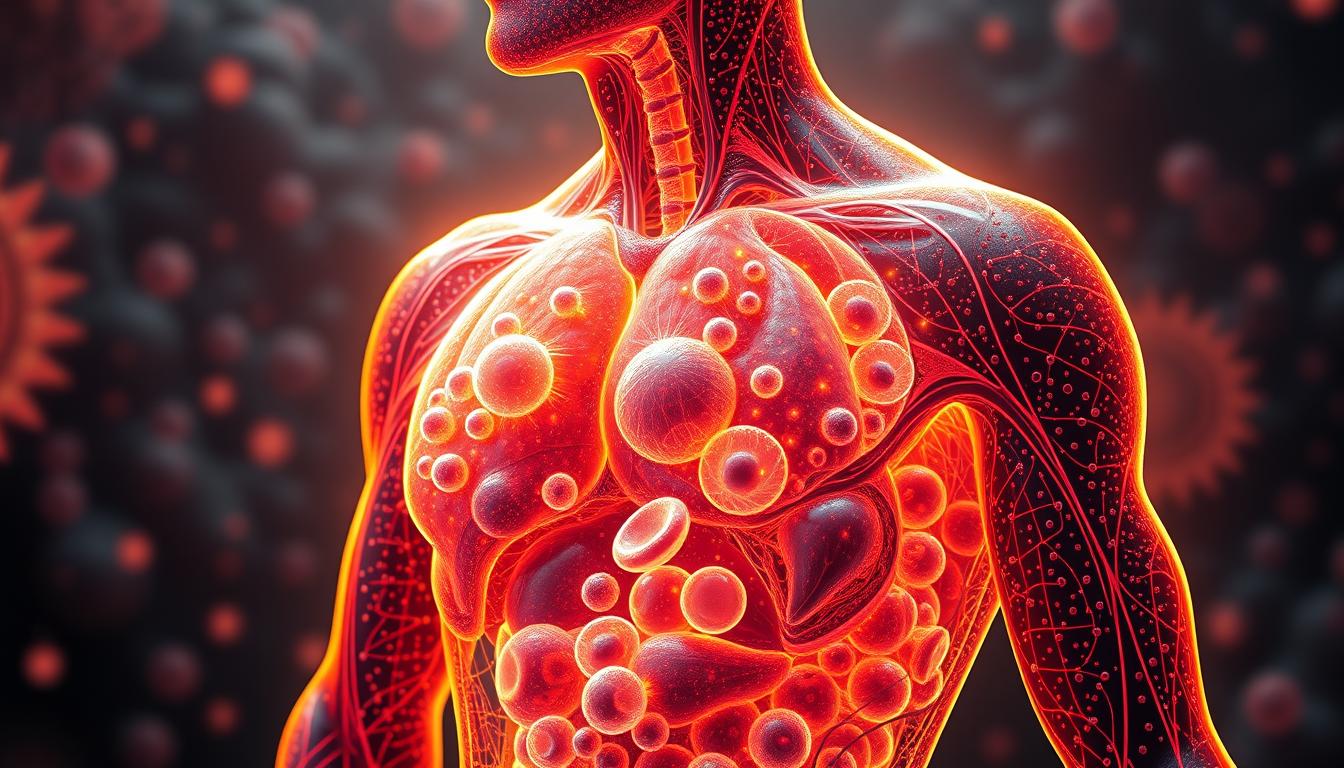
Ever thought about how many cells are in your body? The number might amaze you. Scientists say there are about 30 trillion cells in a human body. This creates a tiny world that is the basic part of our body.
Learning about the number of cells in our body shows how complex we are. Each cell is small but very important. They help keep our body working, fight off sickness, and control our body’s functions.
For years, scientists have been trying to figure out how many cells are in us. Thanks to new science tools, we now know more about our cells. This has changed how we see our body’s tiny world.
Key Takeaways
- Human bodies contain approximately 30 trillion cells
- Cells vary dramatically in size and function
- Scientific methods continue to refine cell count estimates
- Every cell plays a crucial role in bodily functions
- Cell count can change with age and health conditions
Understanding the Basics of Cellular Biology
Cellular biology shows us the detailed world of life’s basic parts. Our bodies are made up of trillions of cells, each vital for our health. These tiny units are key to our body’s makeup and what makes us human.
Cells are life’s smallest working parts. They join together to form tissues, organs, and systems. The human body has about 200 cell types, each with its own job.
What Defines a Cell?
A cell is a dynamic structure with many organelles working together. Each human cell has 10 to 100 organelles, each with a specific role for survival and function.
Key Components of Cellular Structure
- Nucleus: Houses genetic information
- Mitochondria: Generates cellular energy
- Ribosomes: Synthesizes proteins
- Plasma membrane: Regulates cellular interactions
Types of Human Cells
| Cell Type | Primary Function | Unique Characteristics |
|---|---|---|
| Muscle Cells | Movement and Contraction | Can contain up to 2,000 mitochondria |
| Nerve Cells | Communication | Axons can extend up to 1 meter |
| Blood Cells | Oxygen Transport & Immune Defense | Different specialized types |
Learning about cellular biology gives us deep insights into human health. It shows how these tiny parts work together to keep life going.
Estimating the Total Number of Cells
Finding out how many cells are in the human body is a big challenge. Scientists have come up with smart ways to guess the number. These guesses help us understand what makes us who we are.
Current Scientific Consensus
Experts agree that there are about 37.2 trillion cells in the average human. This number comes from a lot of research on what affects cell count.
- Average adult male: 36 trillion cells
- Average adult female: 28 trillion cells
- Average child: 17 trillion cells
Factors Influencing Cell Count
Many things can change how many cells are in someone’s body. Important factors include:
- Body weight
- Age
- Overall health status
- Genetic variations
Different Methods of Estimation
Scientists use different ways to figure out cell count. They look at volume and weight. These methods give us a better idea of how cells work together.
| Estimation Method | Approximate Cell Count |
|---|---|
| Volume-based Estimation | 15 trillion cells |
| Weight-based Estimation | 70 trillion cells |
| Current Scientific Consensus | 37.2 trillion cells |
Also, our bodies have a special group of cells called the microbiota. It has 10-100 trillion microbial cells. This shows how complex our body’s cells really are.
Major Cell Types and Their Functions
The human body is made up of many cells, each with its own role. These cells work together to keep us healthy. They show how complex and organized our bodies are.

There are almost 200 different types of cells in the human body. They vary in size, shape, and function. This shows how detailed and complex our cells are.
Epithelial Cells: Protective Barriers
Epithelial cells protect us by forming layers. They cover our surfaces and act as barriers. They are key to our health.
- Keratinocytes make up 95% of the skin’s outer layer
- Endothelial cells line blood vessels, just 1-2 µm thick
- They help protect us and help with secretion
Muscle Cells: Movement and Support
Muscle cells help us move and support our body. There are three main types:
- Skeletal muscle cells can be up to 30 cm long
- Cardiac muscle cells are about 0.1 mm long
- Smooth muscle cells are 10-600 µm long
Nerve Cells: Signal Transmission
The human brain has about 100 billion neurons. These cells send signals through the nervous system. The main types are:
- Neurons
- Oligodendrocytes
- Astrocytes
- Microglia
Blood Cells: Circulatory System Guardians
Blood cells are vital for our body’s functions. They help keep us healthy. The main types are:
| Cell Type | Diameter | Percentage |
|---|---|---|
| Red Blood Cells | 6-8 µm | 40-45% |
| Neutrophils | 12-14 µm | 65% of white blood cells |
| Lymphocytes | 6-14 µm | 20-25% |
| Monocytes | Up to 20 µm | 2-8% |
Each cell type is a vital part of our body’s complex system. They work together to keep us alive and healthy.
The Role of Stem Cells
Stem cells are a key area in cellular biology. They give us new insights into how our bodies work. These cells can do things that other cells can’t.
Stem cells are at the heart of how our bodies grow and repair. They can keep dividing and renewing themselves. This makes them very important for medical research and new treatments.
Definition of Stem Cells
Stem cells are special because they can turn into many different types of cells. There are two main types:
- Embryonic stem cells: Can become any cell type in a developing fetus
- Adult stem cells: Found in certain tissues, with a more limited range of development
Importance of Stem Cells in Development
In our bodies, stem cells are vital for keeping tissues healthy and fixing them when needed. For example, hematopoietic stem cells in bone marrow can make all the blood cells we need. This shows how important they are for our health.
Stem Cells in Medical Research
Scientists are working hard to use stem cells to treat many diseases. They’re looking into ways to help with:
- Neurological disorders like Parkinson’s disease
- Cardiovascular diseases
- Diabetes
- Orthopedic challenges such as osteoarthritis
New technologies like induced pluripotent stem cells (iPSCs) are also being explored. They can turn adult cells into stem cells, which is very exciting for research.
Variation in Cell Count by Age and Health
The number of cells in our bodies changes a lot over our lives. This change tells a story of growth, adaptation, and change in our biology.
How many cells we have changes a lot at different ages. This is because of many factors like growth, health, and how we interact with the world.
Changes During Developmental Stages
Cells grow the fastest when we’re young and developing. Studies show amazing changes in cell numbers:
- Newborns have about 17 trillion cells
- Adult men have around 36 trillion cells
- Adult women usually have about 28 trillion cells
Health Conditions and Cell Count Dynamics
Many health issues can really affect how many cells we have. Different diseases and health states make cells react in their own ways:
| Condition | Typical Cell Count Impact |
|---|---|
| Infections | More white blood cells are made |
| Cancer | Cells grow too much |
| Chronic Inflammation | Cells are stressed for a long time |
“Cells are the basic units of life, always changing and adapting to challenges.” – Dr. Rebecca Martinez, Cellular Biology Research Institute
The balance of cell numbers shows how healthy we are. Watching these changes helps us understand our bodies better and find ways to help them.
Cell Count Estimates for Different Body Systems
The human body is a complex ecosystem of cells. Each body system has its own cell types and structures. Knowing about these cells helps us understand the human body’s diversity.

Scientists have found ways to count cells in different body systems. This shows us the amazing world inside our bodies.
Circulatory System Cellular Breakdown
The circulatory system is very complex:
- There are about 25 trillion red blood cells in our body.
- White blood cells make up about 1% of all blood cells.
- Red blood cells are over 80% of all cells.
Nervous System Cellular Composition
The nervous system is full of amazing cells:
- There are about 86 billion neurons in the brain.
- Glial cells are much more common than neurons.
- The number of neurons varies in different brain areas.
Skeletal and Digestive Systems
These systems have special cells:
- Bones have about 2 billion special bone cells.
- The digestive tract has many cells for metabolism.
- The liver has around 240 billion cells in healthy people.
“Every system in the human body tells a unique cellular story of adaptation and functionality.”
These cell counts show how complex and dynamic our bodies are. They highlight the amazing details in our biological systems.
Advances in Technology for Cell Counting
Modern cellular biology has seen big changes in how we count cells. Now, we have advanced tools that help us study cells more accurately than ever before.
New methods in cell counting have changed science and medicine. These modern tools let scientists study cells quickly and with great detail.
Microscopy Techniques
Microscopy is still key in studying cells. It helps us see and count cells. The main methods are:
- Light microscopy for basic cell viewing
- Electron microscopy for detailed cell structure
- Fluorescence microscopy for spotting certain cell types
Flow Cytometry
Flow cytometry is a big leap in cell counting tech. It lets researchers:
- Look at thousands of cells every second
- Tell different cell types apart
- Check cell details with high accuracy
Imaging Technologies
New imaging tech is changing how we study cells. Digital imaging systems give us clear, live views of cell actions. This lets researchers count cells with high precision.
These new technologies are helping us learn more about cells. They open up new ways for medical research and diagnosis.
Why Cell Count Matters
Knowing how many cells are in the body is key for medical progress and understanding human anatomy. Cellular biology gives us deep insights into health and disease.
Cell count is more than just numbers. It’s a vital base for medical tests, research, and understanding diseases.
Implications for Health and Medicine
Cell count data is crucial for doctors. They use it to:
- Spot diseases early
- Check if treatments work
- See how health varies
- Make treatments fit each person
Research Applications
Scientists use cell count data for:
- Creating new treatments
- Studying disease paths
- Designing specific treatments
Understanding Disease Processes
Studying cells gives us key insights into diseases. By looking at cell types and how they work together, researchers can:
- Find genetic changes
- Watch how cells change
- See health risks coming
The human body has about 100 trillion cells. There are over 200 types of cells working together. This shows how important it is to keep studying cells and human anatomy.
Conclusion and Future Directions
The world of cells in our bodies is incredibly complex. About 3.72 × 10^13 cells work together in amazing harmony. This shows how much we still have to learn about cells and their roles in life.
New discoveries in bioprinting and stem cell research are changing the game. Scientists can now build detailed models of tissues. This helps us understand how cells work together, which could lead to new medical treatments.
Looking ahead, we’re getting better at mapping out cells in our bodies. Projects like the Human Cell Atlas and single-cell sequencing are making big strides. These advances will help us understand how cells interact and how diseases start.
Our quest to understand human cells is far from over. We’ve made big progress, but there’s still so much to discover. As we keep exploring, we’ll likely find new ways to improve health and medicine.
FAQ
How many cells are in the human body?
The human body has about 30-37 trillion cells. This number changes with age, size, and health. A 2013 study by Ron Milo and Ron Sender gave the most detailed estimate yet. It shows how complex our cells are.
What are the different types of cells in the human body?
Our bodies have many cell types. There are epithelial cells, muscle cells, nerve cells, and blood cells. We also have stem cells and specialized cells for different systems.
Do cell counts change throughout a person’s life?
Yes, cell counts change a lot as we grow. In early life, cells multiply fast. But as we age, they multiply less. Health and diseases can also affect cell counts.
What are stem cells, and why are they important?
Stem cells can turn into many cell types. They are key in growth, repair, and research. Scientists hope they can help treat diseases by replacing damaged cells.
How do researchers count cells in the human body?
Scientists use advanced tools like light and electron microscopy. They also use flow cytometry and new imaging tech. These help them see, count, and study cells more accurately.
Why is understanding cell count important in medicine?
Knowing cell counts helps doctors diagnose and treat diseases. It helps them understand how diseases work and find new treatments. This is especially true for diseases like cancer and blood disorders.
Do different body systems have different cell counts?
Yes, each system has its own cells. For example, the blood system has billions of cells. The nervous system has complex cells for signals. The digestive system has cells for digestion and protection.
Can cell counts be affected by health conditions?
Yes, health issues can change cell counts. Cancer can cause too many cells. Autoimmune diseases can reduce certain cells. Age, diet, stress, and health can also affect cells.






Leave a Comment
Your email address will not be published. Required fields are marked *