


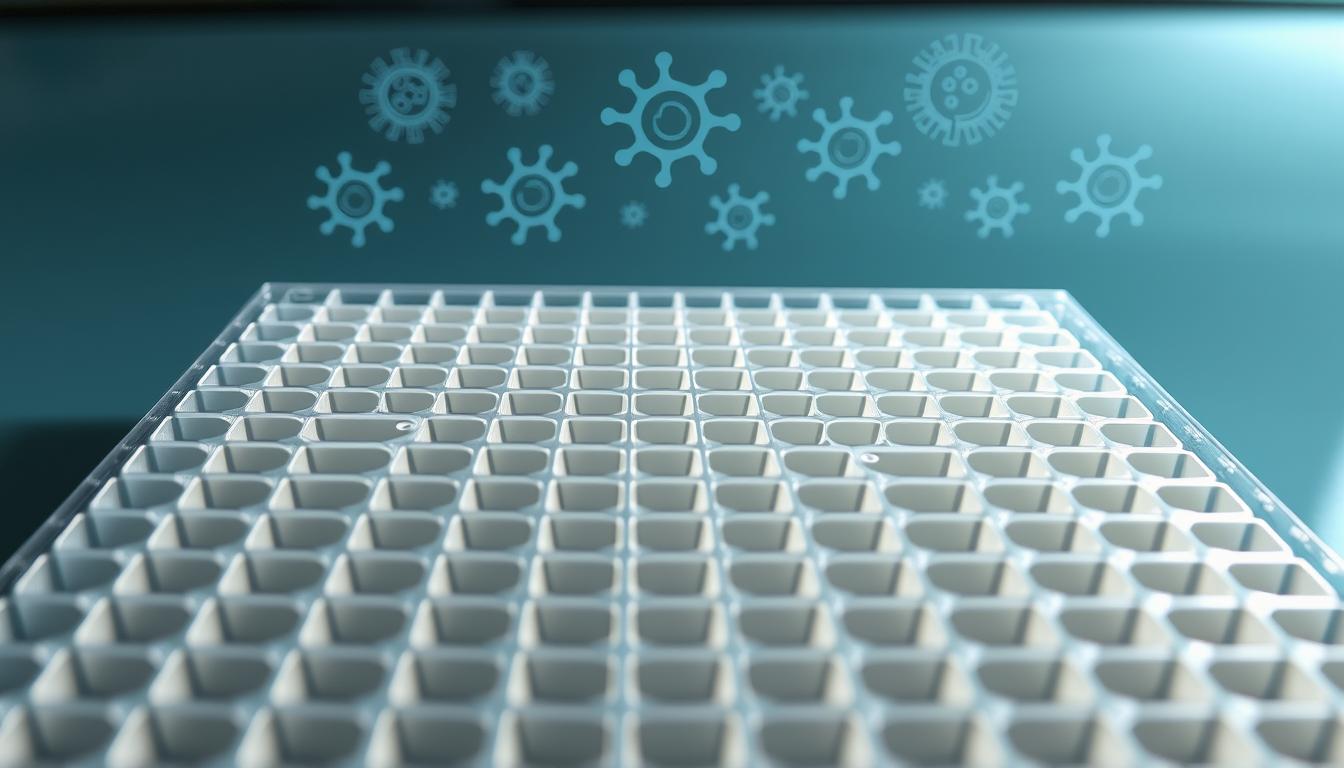
How do modern laboratories handle hundreds of samples with precision and speed? The answer lies in advanced tools designed for high-throughput workflows. Among these, the 96-well filter plate stands out as a critical component for biological research.
This specialized equipment enables simultaneous processing of multiple samples, saving time while ensuring accuracy. Its design supports automation compatibility, making it ideal for labs focused on DNA, RNA, and protein studies. Researchers rely on its consistent performance for reproducible results.
Built with durable materials, these plates resist chemicals and prevent contamination. Their versatility allows use in various biological applications, from sample prep to high-throughput screening. The optimized structure ensures efficient filtration without compromising sample integrity.
Key Takeaways
- Enables high-throughput processing for biological research.
- Compatible with automation systems for streamlined workflows.
- Designed for contamination-free DNA, RNA, and protein studies.
- Durable construction supports diverse lab applications.
- Ensures precise and reproducible results.
Introduction to the 96 Well Filter Plate
Parallel processing accelerates biological analysis in scientific settings. The standardized 96-well format enables simultaneous handling of multiple samples, reducing processing time while maintaining precision. This design is critical for labs focusing on high-throughput workflows.
Compatibility with common protocols enhances versatility. The 96-well filter integrates seamlessly with LCMS preparation and Dilute & Shoot methods. Its optimized flow rates efficiently process challenging solutions like antibiotics or alcohols.
| Protocol | Compatibility |
|---|---|
| LCMS Preparation | Full |
| Dilute & Shoot | Partial (varies by solvent) |
| Tissue Culture Media | Full |
Efficient sample preparation ensures accurate results. The device removes contaminants during DNA purification or protein binding. Its polypropylene construction achieves >99% protein removal, vital for sensitive assays.
Applications extend to cell culture and protein solutions. Centrifugation at 2,500 x g for 5 minutes optimizes recovery. Storage at 2-8°C preserves membrane integrity for repeated use.
Key Features of the 96 Well Filter Plate
Advanced membranes define efficiency in high-throughput workflows. Each material offers unique benefits, from chemical resistance to high protein recovery. Researchers can select options like Hydrophilic PP, PVDF, or glass fiber based on application needs.
High-Quality Membrane Options
PVDF excels in protein studies due to low non-specific binding. Glass fiber, with its 0.2µm pores, ensures precise particulate removal. For a balance of cost and performance, Hydrophilic PP is ideal for routine filters.
Hydrophilic PVDF stands out for sensitive assays. Its low-binding properties minimize sample loss, critical for PCR clean-up or lysate clarification. This membrane type retains >99% of proteins, as noted in versatile 96-well filter plate studies.
Rigid Side Walls for Stability
Polypropylene construction prevents deformation during automation. Shared walls reduce height while maintaining well width. “Mechanical strength is non-negotiable for robotic systems,” emphasizes a lab technician at UCallm Labs.
Nozzle Design to Prevent Cross-Contamination
Anti-wicking nozzles isolate samples, eliminating spillover risks. Long drip directors ensure clean drainage into collection plates. This design is compatible with vacuum manifolds and high-speed centrifuges.
Applications in Biological Research
Modern research demands tools that simplify complex biological workflows. The 96-well format excels in high-throughput settings, enabling precise handling of dna, protein, and cell culture samples. Its versatility supports critical protocols across molecular biology and biochemistry.
DNA Purification and PCR Clean-Up
This tool streamlines nucleic acid workflows, including plasmid isolation and PCR product purification. Compared to commercial kits, it offers cost-effective binding and elution steps. TurboFilter 96 Plates clear bacterial lysates rapidly, ensuring pure DNA for sequencing or transformation.
Protein Binding and Lysate Clarification
For protein studies, the device removes debris during lysate clarification. Hydrophilic PVDF membranes minimize non-specific binding, preserving sample integrity. Researchers achieve >99% protein recovery, vital for kinase assays or receptor studies.
Tissue Culture Media Filtration
Sensitive cell culture requires sterile media. The 0.2µm pores eliminate contaminants without altering nutrient composition. Compatible with automation, it integrates seamlessly into workflows for consistent, contamination-free results. For related lab storage needs, explore essential lab storage solutions.
Technical Specifications and Compatibility
Standardized designs ensure seamless integration with automated systems. The device adheres to ANSI/SBS footprint standards, guaranteeing interoperability with robotic handlers and liquid dispensers. A barcode-ready wide skirt simplifies tracking in high-throughput environments.
ANSI/SBS Footprint Standards
Precision-engineered dimensions (127.76 mm x 85.48 mm) fit universal lab equipment. Shared walls maintain well spacing while reducing overall size. This compliance minimizes recalibration needs for automated workflows.
Filter Types: PVDF vs. Glass Fiber
Two dominant filter types cater to distinct applications. PVDF membranes (0.25mm thick) excel in protein retention with low binding. Glass fiber (0.66mm) offers superior particulate removal for viscous samples.
Key technical highlights:
- Volume capacity: 2 mL per well for lysates, 1.2 mL for organic solvents
- Chemical resistance: Stable with DMSO, acetonitrile, and acidic buffers
- Thermal stability: Withstands -80°C to 121°C for autoclaving
Membrane choice impacts flow rates. Glass fiber processes 500 µL in 30 seconds, while PVDF requires 45 seconds for the same volume. Both options integrate with vacuum manifolds or centrifuges up to 3,000 x g.
Automation and Compatibility
High-throughput screening relies on equipment designed for robotic compatibility. Rigid polypropylene walls ensure stability during high-speed centrifugation or vacuum filtration. These features minimize errors in large-scale studies.
Seamless integration with liquid handlers and plate readers streamlines workflows. The standardized footprint fits robotic arms from major manufacturers like Hamilton and Tecan. This reduces setup time and improves reproducibility.
Key advantages for automated systems:
- Barcode-ready skirts for sample tracking and data logging
- Anti-wicking nozzles prevent cross-contamination in HTS workflows
- Centrifugation stable up to 3,000 x g without deformation
| System Type | Compatibility |
|---|---|
| Liquid Handlers | Full (ANSI/SBS compliant) |
| Plate Readers | UV-transparent options available |
| Storage Robots | Stackable design |
These products reduce manual intervention by 70% in DNA purification workflows. Laboratories report faster turnaround times when using automated information tracking systems. The design supports end-to-end process integration.
Quality Assurance and Certifications
Certified manufacturing processes guarantee reliable performance in critical applications. Each unit undergoes 100% well integrity verification, with encapsulated filter disks preventing leakage. Third-party audits validate ISO 13485 compliance for consistent quality certificate standards.
Production begins with ultrasonic welding to secure membranes. This eliminates adhesive contaminants while maintaining precise pore structures. Every batch undergoes:
- Bubble point testing for membrane integrity
- Flow rate validation using calibrated solutions
- Visual inspection under 10x magnification
Documentation packages include material safety data sheets (MSDS) and certificates of analysis. Full traceability tracks raw materials from supplier to final products. This meets FDA 21 CFR Part 820 requirements for medical device components.
“Batch-to-batch consistency reduces validation workloads by 40% in regulated environments.”
Sterilization options address diverse needs:
- Gamma irradiation (25 kGy) for ready-to-use units
- Autoclavable designs (121°C/15 psi) for research reuse
- Ethylene oxide compatibility for heat-sensitive cases
These protocols ensure compliance with USP Class VI and EP 3.1.9 standards. Laboratories receive full documentation with each shipment, including the quality certificate and material origin reports. Such rigor prevents failures in sensitive applications like cell therapy or diagnostic assays.
Conclusion
Life science labs require reliable tools for consistent results. The 96-well filter plate delivers high-throughput efficiency, reducing errors in DNA and protein studies. Its automation-friendly design cuts processing time by 70%, as noted in clinical proteomics workflows.
Precision filtration ensures reproducibility, with studies showing R ≥ 0.97 correlations. Reusable designs offer long-term savings, ideal for budget-conscious labs. Technical guides help optimize protocols for sensitive assays.
For modern research, this tool is indispensable. It balances speed, accuracy, and cost-effectiveness. Explore resources to maximize its potential in your lab’s workflow.
FAQ
What membrane options are available for the 96-well filter plate?
The plate offers high-quality membranes, including hydrophilic PVDF and glass fiber, optimized for protein binding, DNA purification, and sample filtration.
How does the design prevent cross-contamination?
The nozzle design and rigid side walls ensure stability and minimize sample mixing, making it ideal for sensitive applications like PCR clean-up.
Is this product compatible with automation systems?
Yes, it adheres to ANSI/SBS footprint standards, ensuring seamless integration with robotic handlers and high-throughput workflows.
What applications is this filter plate best suited for?
It excels in DNA purification, lysate clarification, and tissue culture media filtration, providing reliable results for biological research.
Are there different filter types for specific needs?
Users can choose between PVDF for protein binding or glass fiber for particulate removal, depending on their experimental requirements.
What certifications ensure product quality?
Each plate undergoes rigorous testing to meet industry standards, guaranteeing consistent performance and reliability in lab settings.




Leave a Comment
Your email address will not be published. Required fields are marked *