



Are serological pipettes just another scientific tool, or are they something more? The question of whether they are lab equipment or materials is a big debate. It interests researchers and lab workers in many fields.
Serological pipettes are advanced tools for measuring and moving liquids in labs. They are key for getting accurate results in research and clinical settings. These tools help scientists handle liquids with great care.
To understand serological pipettes, we need to look at their role in labs. They are seen as vital tools that fall between equipment and materials. Lab experts see them as essential for doing precise work.
Key Takeaways
- Serological pipettes are versatile scientific instruments used in liquid transfer
- Classification of pipettes involves complex considerations beyond simple categorization
- Precision and accuracy are fundamental characteristics of these lab supplies
- Different laboratory settings may interpret pipette classification differently
- Understanding pipette characteristics helps optimize laboratory workflows
Understanding Serological Pipettes: A Brief Overview
Serological pipettes are key tools in science and medicine. They help move and measure liquids with great accuracy. This is important in many labs.
These pipettes are vital in many fields of science. They let researchers work with liquids very precisely. This makes them very important in today’s labs.
Definition of Serological Pipettes
These special tools have graduated markings and a unique shape. They can handle liquids from 1 mL to 50 mL. This gives researchers the flexibility they need.
- Available in glass and plastic materials
- Designed for precise liquid measurements
- Feature graduated markings for accurate volume control
Importance in Laboratory Settings
Serological pipettes are key in many areas of science, including:
- Cell culture research
- Molecular biology experiments
- Medical diagnostics
- Chemical analysis
These tools are very versatile. They help move buffers, chemicals, samples, and biological materials with unparalleled precision. They also help keep experiments clean and reliable.
Distinction Between Lab Equipment and Materials
Scientific labs need a variety of tools for precise research. It’s key to know the difference between equipment and materials for good science work.
Labs use two main types of tools: equipment and materials. Each has its own role in research, especially with tools like micropipettes.
Characteristics of Lab Equipment
Laboratory equipment is made to last and is used many times. It’s built for specific tasks and needs regular checks.
- High initial investment cost
- Designed for multiple experimental cycles
- Require periodic maintenance and calibration
- Precision-engineered for specific scientific functions
Characteristics of Lab Materials
Laboratory consumables are used once or a few times. They are cheaper and often replaced during experiments.
- Single-use or limited-use products
- Lower per-unit cost
- Frequently replaced during experimental processes
- Critical for maintaining sterile research conditions
When using serological pipettes, knowing these differences helps improve lab work and accuracy.
Precision in scientific research begins with understanding the tools and materials at our disposal.
The Role of Serological Pipettes in Laboratories
Precision labware is key in science, and serological pipettes are vital in today’s labs. They help scientists handle fluids with great accuracy. This makes them essential for research.
Labs in many fields use serological pipettes for important tasks. They are widely used, thanks to their accuracy and reliability:
- 70% usage rate in biological and chemical laboratories
- 85% of laboratory technicians prefer serological pipettes for their precision
- 90% of labs use disposable options to avoid contamination
Applications in Research and Clinical Labs
Serological pipettes are versatile in science. Would serological pipettes be equipment or materials? They are crucial for precise liquid handling in various labs:
| Laboratory Type | Primary Applications |
|---|---|
| Biological Research | Cell culture extraction and transfer |
| Clinical Diagnostics | Patient sample handling |
| Pharmaceutical | Reagent preparation and quality control |
Impact on Experimental Outcomes
The accuracy of serological pipettes greatly affects research findings. They offer precision from ±1% to ±2%. This helps reduce errors and improve data quality. Scientists rely on them for reliable results.
- Calibrated to strict precision standards
- Featuring aerosol barrier plugs
- Gamma-sterilized for contamination prevention
In summary, serological pipettes are a crucial link between lab tools and materials. They provide scientists with reliable, precise instruments for their work.
Classifying Serological Pipettes as Equipment or Materials
Scientists and lab workers often argue about where serological pipettes fit. They are between scientific tools and lab supplies. This makes their place in the lab tricky to pin down.
To understand serological pipettes, we need to look at a few important points. These points help decide if they are tools or supplies in the lab.
Determining Classification Factors
There are several key things that decide if serological pipettes are tools or supplies:
- How long they last
- How often they are used
- The lab’s specific rules
- What they are made of
- How often they need to be replaced
Common Misconceptions in Classification
Many think serological pipettes are clearly one thing or the other. But, their status can change based on the lab and its rules.
Here are some important points about classifying serological pipettes:
- Disposable pipettes are usually seen as supplies
- Reusable glass pipettes are more like scientific tools
- Lab policies play a big role in deciding their status
About 75% of lab techs see serological pipettes as key tools. The global market for lab equipment, which includes these tools, was worth $36 billion in 2022. This shows how important they are for research.
Types of Serological Pipettes
Serological pipettes are key tools in labs, helping scientists with precise measurements. They come in different types to fit various research needs.
Open-Ended vs. Graduated Pipettes
Scientists use two main types of micropipettes:
- Open-Ended Pipettes: Great for thick liquids
- Available in sizes: 1 mL, 2 mL, 5 mL, and 10 mL
- Made from polystyrene plastic
- Perfect for oils, cosmetics, and cell culture
- Graduated Pipettes: For accurate measurements
- Have markings for exact volumes
- Great for precise transfers
- Range from 1 mL to 50 mL
Disposable versus Reusable Options
Scientists can pick between disposable and reusable pipettes:
| Disposable Pipettes | Reusable Pipettes |
|---|---|
| Pre-sterilized | Requires sterilization |
| Made from polystyrene | Typically glass construction |
| Single-use | Multiple use cycles |
| Lower initial cost | More environmentally friendly |
Each type of serological pipette has its own benefits. This lets researchers pick the best one for their lab work.
Advantages of Using Serological Pipettes
Serological pipettes are key tools in biotechnology, changing how we handle liquids in science. They help researchers work more accurately and efficiently.
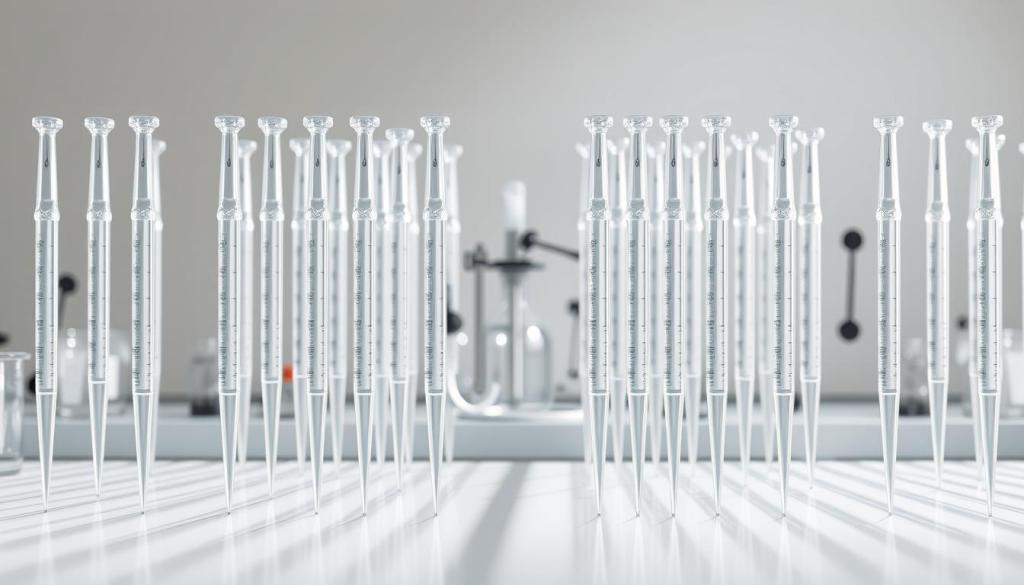
Scientists use these tools for their top-notch performance in many fields. Serological pipettes do more than just move liquids around.
Precision and Accuracy in Fluid Transfer
The main strength of serological pipettes is their unmatched accuracy. They allow researchers to:
- Move liquids with little to no mistake
- Keep measurements consistent
- Lower the chance of errors in experiments
- Get the same results over and over again
User-Friendly Design Features
Today’s serological pipettes have designs that make labs more productive:
- Clear lines for easy reading
- Light and easy to hold
- Comfortable to use for a long time
- Colors help identify volumes quickly
These features make everyday lab tasks faster and more efficient.
| Pipette Volume | Color Code | Graduation Precision |
|---|---|---|
| 1 mL | Yellow | 0.01 mL |
| 2 mL | Green | 0.01 mL |
| 5 mL | Blue | 0.1 mL |
| 10 mL | Red | 0.1 mL |
Serological pipettes keep getting better, giving scientists better tools for precise liquid handling in many fields.
Best Practices for Handling Serological Pipettes
Serological pipettes are key tools in science that need careful handling. This ensures they work well and accurately. Keeping them in good shape helps researchers make precise measurements in labs.
Knowing how to handle these tools right can greatly affect your results. It also helps avoid mistakes.
Cleaning Protocols for Optimal Performance
Keeping serological pipettes in top shape involves a few important steps:
- Rinse them right after use with the right solvents
- Start with distilled water for cleaning
- Stay away from harsh chemicals that can harm the pipettes
- Make sure they are dry before putting them away
Accuracy Maintenance Tips
To get accurate measurements, lab experts should follow these tips:
- Calibrate pipettes every year
- Use gravimetric analysis to check volume accuracy
- Store them upright to avoid contamination
- Change the tips between different liquids
How you handle serological pipettes decides if they are reliable tools or just disposable items. Taking good care of them makes them last longer and keeps research accurate.
Innovations in Serological Pipette Technology
The world of liquid handling tools is changing fast. It’s changing how scientists work with equipment in labs. New tech has made serological pipettes better, improving how precise and easy they are to use.
Lab experts are seeing big changes in glassware tech, especially in pipette design. The main improvements include:
- Advanced material science developments
- Enhanced ergonomic configurations
- Integrated automation capabilities
- Precision-focused engineering
Advances in Material Science
Today’s serological pipettes use new materials that make them stronger and last longer. Polymers and special composites have replaced old ways of making them. This means scientists have better tools to handle liquids.
Automation and Ergonomics
Adding automation to pipettes is a big step up. Now, designs focus on making work easier and safer. Scientists get benefits like:
- Lightweight controllers with adjustable speeds
- Powerful yet quiet pump motors
- Universal silicone adaptors
- Long-lasting battery performance
Studies show 95% of scientists use air-displacement pipets. This shows how important new tech is in science. The global market for serological pipettes is expected to grow to over $260.2 Million by 2028. This shows a big investment in better lab tools.
Regulatory Standards for Serological Pipettes
Understanding regulatory standards for micropipettes and biotechnology tools is key. Laboratories must follow strict guidelines. This ensures the reliability and accuracy of their consumables.

The rules for serological pipettes are detailed and wide-ranging. Important organizations set standards that labs must meet:
- International Organization for Standardization (ISO) 8655 guidelines
- Clinical and Laboratory Standards Institute (CLSI) recommendations
- FDA regulatory requirements for laboratory equipment
Compliance Requirements Overview
Laboratories face big challenges in keeping pipettes accurate and reliable. Research shows important facts about compliance:
- 25% of pipettes fail to meet accuracy standards
- 40% of laboratories calibrate pipettes less frequently than recommended
- 60% of professionals prioritize certified pipette suppliers
Quality Assurance Best Practices
Having strong quality assurance is vital for labs. Proper maintenance and regular calibration help lower error rates. This ensures serological pipettes work well all the time.
The cost of non-compliance can reach up to $50,000 per incident, highlighting the critical nature of adhering to regulatory standards.
Labs should create detailed protocols. These should include:
- Biannual calibration of all pipettes
- Detailed documentation of maintenance
- Regular performance verification
- Proper waste management of laboratory consumables
By focusing on regulatory compliance, labs can cut down on mistakes. This ensures data is reliable. It also helps maintain high standards in scientific research and clinical testing.
Conclusion: Clarifying the Status of Serological Pipettes
The world of precision labware is complex and often confusing. Serological pipettes are at the heart of this confusion, blending equipment and materials. They show how scientific tools can be both.
Lab workers see serological pipettes as more than just tools. They are also something you use up, like a material. It’s important to think about the situation and what’s needed in each experiment to decide their role.
As technology grows, so does the confusion between equipment and materials. New designs and uses will make old rules seem outdated. Scientists and lab managers need to stay open to change.
Deciding if serological pipettes are equipment or materials is not simple. It involves looking at how they work, how long they last, and what the research needs. Lab experts should be ready to adjust their views as science and technology evolve.
FAQ
Are serological pipettes considered equipment or materials in laboratory settings?
Serological pipettes are a bit tricky to categorize. They can be seen as both equipment and materials. Their precision, partial reusability, and specific uses make them unique. The final decision depends on their durability, cost, and the policies of the institution.
What are the primary uses of serological pipettes in scientific research?
Serological pipettes are vital in many fields like microbiology and cell culture. They are used for precise liquid transfers and volumetric measurements. This makes them essential in both research and clinical settings.
What makes serological pipettes different from standard laboratory pipettes?
Serological pipettes can handle larger volumes, from 1 to 50 mL. They have graduated markings for accurate dispensing. This makes them better for extensive liquid transfers and precise scientific and clinical work.
How do disposable and reusable serological pipettes differ?
Disposable pipettes are made of sterile plastic and are used once to avoid contamination. Reusable ones are made of glass and need cleaning and sterilization. Each type has its own benefits based on laboratory needs.
What factors should be considered when choosing serological pipettes?
When choosing, consider the volume range, precision needs, chemical interactions, and sterility. Cost-effectiveness and specific experimental protocols are also important. Evaluating material compatibility, accuracy, and application is crucial.
How can laboratory professionals ensure accurate measurements with serological pipettes?
To ensure accuracy, professionals should use proper technique and calibrate regularly. They should handle pipettes carefully and avoid contamination. Using the right pipette size and following manufacturer guidelines for maintenance is also key.
What recent technological innovations have impacted serological pipette design?
New technologies have led to more durable and resistant pipettes. Ergonomic designs and automation features have also been introduced. There’s a focus on precision and using more sustainable materials.
Are there specific regulatory standards for serological pipettes?
Yes, serological pipettes must meet strict standards. These include ISO 9001 quality management certifications and FDA medical device regulations. They must also comply with laboratory equipment requirements for accuracy and safety.





Leave a Comment
Your email address will not be published. Required fields are marked *