



Ever wondered how scientists handle dozens of test tubes at once without a mess? The test tube rack is key to keeping labs organized. It helps scientists work more efficiently and safely.
But what does a test tube holder do beyond just holding tubes? It’s a crucial tool for scientists, offering stability and safety. These racks keep test tubes upright, preventing spills and keeping samples safe.
Today’s labs use these racks to handle lots of test tubes at once. They have special wells to stop tubes from tilting. This makes them essential for all kinds of scientific tests.
Key Takeaways
- Test tube racks prevent accidental spills and sample loss
- They support multiple tubes simultaneously in laboratory environments
- Racks are available in various materials like wire, plastic, and foam
- They enhance laboratory safety and organizational efficiency
- Different rack designs accommodate specific experimental needs
Understanding the Purpose of a Test Tube Rack
Scientific glassware is key in lab research, and the test tube rack is vital for keeping things organized. It helps researchers work better and more precisely.
What is a Test Tube Rack?
A test tube rack holds many test tubes upright. It’s important for storing test tubes safely and keeping things in order.
How Does it Improve Organization?
Good lab organization comes from managing equipment well. Test tube racks offer many benefits:
- Prevents test tube breakage
- Allows easy access to multiple samples
- Reduces risk of contamination
- Facilitates efficient workflow
Common Materials Used for Test Tube Racks
Test tube racks are made from different materials for various lab needs:
| Material | Properties | Best Used For |
|---|---|---|
| Wire | Lightweight, affordable | General laboratory work |
| Plastic | Chemical resistant | Medical and research labs |
| Polystyrene | Disposable, sterile | Single-use applications |
| Fiberglass | Heat resistant | High-temperature experiments |
“A well-organized laboratory is the foundation of successful scientific research.” – Laboratory Safety Expert
Choosing the right test tube rack is crucial for managing scientific glassware. It makes labs safer and more efficient.
Benefits of Using a Test Tube Rack
Laboratory professionals know how important good chemistry supplies are. A test tube stand is key for keeping the lab organized. It makes scientific research and experiments run smoother.
Test tube racks help keep scientists safe and work better. These tools do more than just hold tubes. They make a big difference in the lab.
Enhanced Safety in the Laboratory
Safety is the top priority in any lab. Test tube racks help a lot by:
- Stopping tubes from breaking by accident
- Lowering the chance of spills
- Keeping glassware steady
- Keeping hands away from dangerous chemicals
“A well-organized lab is a safe lab” – Scientific Research Principle
Improved Efficiency and Workflow
Test tube stands make labs work better by organizing things well. Scientists can find what they need faster. This saves a lot of time.
Modern test tube racks are designed to:
- Help identify samples quickly
- Organize materials in a clear way
- Keep track of many samples easily
- Make experiments run smoother
Good lab organization makes complex research easier to handle.
Types of Test Tube Racks
Scientific labs use different test tube rack designs to manage their equipment and glassware well. Each rack has its own purpose. It helps researchers keep their work areas organized and safe.
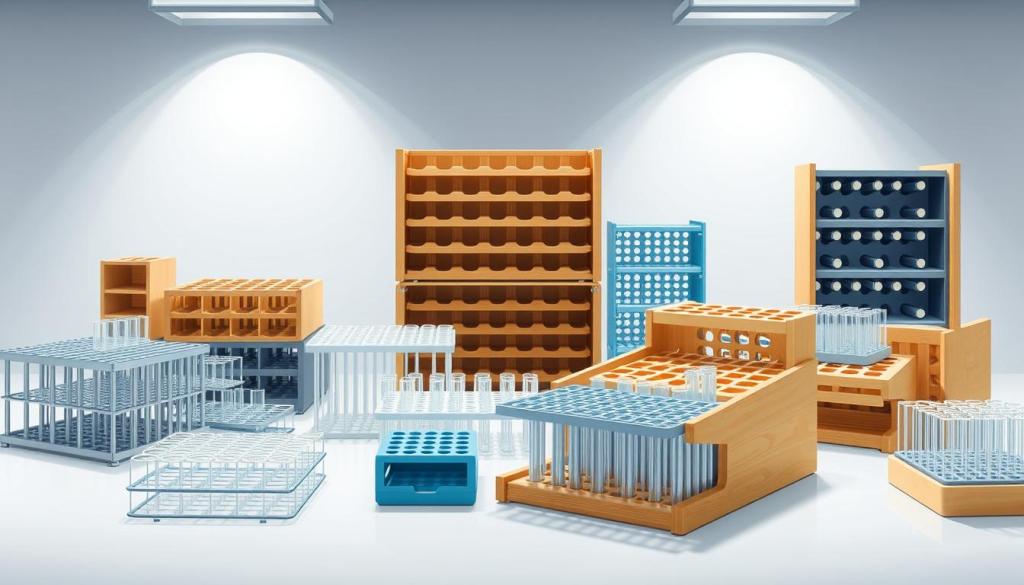
Test tube racks do more than just hold tubes. They are key for many scientific tasks. Researchers can pick from various rack types to fit their lab needs.
Standard Test Tube Racks
Classic test tube racks are the basic kind. They have:
- Space for 8-12 test tubes
- Made from strong materials
- Good for everyday lab work
Adjustable Test Tube Racks
Adjustable test tube racks are flexible. They fit different tube sizes and needs.
- Can be set up in many ways
- Wells can be changed
- Works with many research methods
Specialty Test Tube Racks
Special racks meet special lab needs. They help labs do more:
- Slant racks for exact angles
- Drying racks to prevent contamination
- Vial racks for small containers
The right test tube rack makes labs more efficient and better at managing samples.
Today’s labs need flexible rack systems. These systems support complex studies. They also keep samples safe and protect researchers.
How to Choose the Right Test Tube Rack
Finding the perfect test tube holder is key for keeping your lab organized and safe. The right rack can make your work flow better and your lab more efficient.
Lab experts need to think about several important things when picking a test tube rack. They must know their research needs and the size of their workspace.
Laboratory Size Considerations
Different labs need different test tube racks. Here are some things to keep in mind:
- Total number of test tubes used in experiments
- Available workspace dimensions
- Frequency of experiments conducted
- Storage and accessibility requirements
Matching Rack Materials with Chemicals
It’s important to choose a test tube rack that can handle the chemicals you work with. Different materials can handle chemicals in different ways.
| Material | Chemical Resistance | Best Used For |
|---|---|---|
| Polypropylene | High | Acid-based solutions |
| Stainless Steel | Moderate | General laboratory use |
| Epoxy-coated Wire | Low | Aqueous solutions |
Pro tip: Always check if the material can handle the chemicals you work with before you buy.
“The right test tube rack is not just a holder, but a critical tool in scientific precision.” – Laboratory Equipment Experts
Knowing what to look for will help you choose the best test tube rack. This will make your lab better organized and your chemistry supplies safer.
Proper Usage of a Test Tube Rack
Scientific glassware needs careful handling. A test tube rack is key for lab organization. Knowing how to load and unload test tubes keeps samples safe and prevents contamination.
Loading Techniques for Maximum Efficiency
Researchers must follow certain steps when loading a test tube rack. This ensures the lab stays in top shape. A test tube rack does more than just hold samples. It keeps them stable and organized.
- Always handle test tubes from the top rim
- Ensure tubes are placed vertically and securely
- Check that each tube fits snugly without excessive force
- Verify rack stability before adding tubes
Preventing Sample Contamination
Contamination can ruin research results. So, careful handling is crucial. Modern test tube racks have features to reduce contamination risks.
| Contamination Prevention Strategy | Implementation Method |
|---|---|
| Spacing Between Tubes | Use racks with narrow tolerance wells |
| Material Selection | Choose chemically resistant rack materials |
| Cleaning Protocol | Regularly sanitize rack surfaces |
“Precision in lab equipment handling is the hallmark of quality scientific research.” – Laboratory Safety Expert
By using these methods, researchers can make test tube racks more effective. This helps keep samples pure and experiments accurate.
Maintenance and Cleaning of Test Tube Racks
Keeping lab equipment in top shape is key for safe and accurate science. Cleaning test tube racks well is important to avoid contamination and make them last longer.
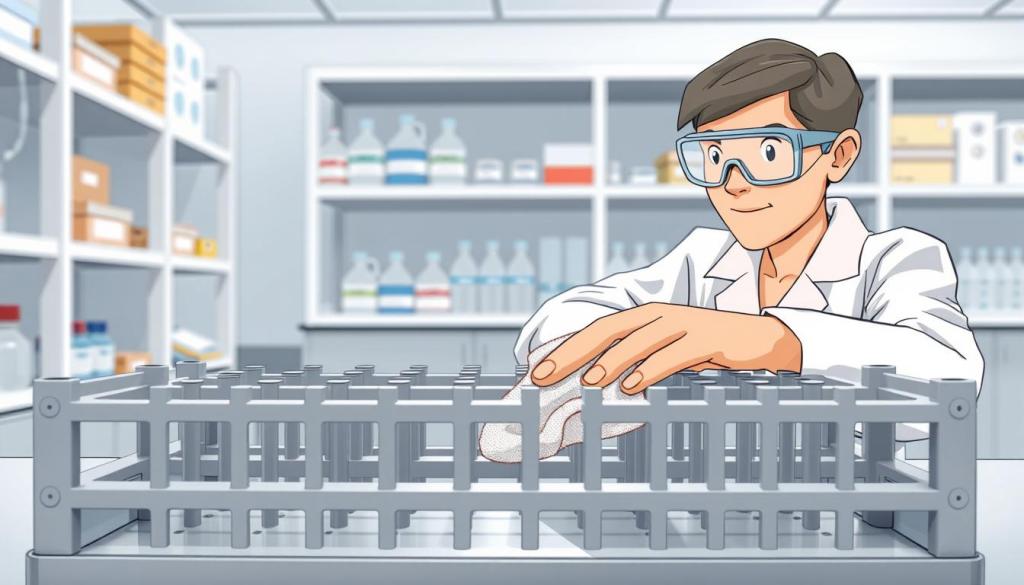
Lab teams need to follow strict cleaning rules to keep their test tube racks in good condition. More than 80% of scientists say that keeping things clean boosts the accuracy of their work.
Recommended Cleaning Supplies
- Mild laboratory-grade detergent
- Soft-bristled brushes
- Distilled water
- Disposable gloves
- Autoclave for sterilization
Cleaning Frequency Guidelines
| Lab Environment | Cleaning Frequency | Sterilization Method |
|---|---|---|
| High-use biochemistry lab | After each experiment | Autoclave |
| Clinical research facility | Daily | Chemical sterilization |
| Educational laboratory | Weekly | Soap and water |
Sterilization tip: Over 75% of labs rely on autoclaving to kill off germs in their equipment.
Safety begins with cleanliness: Always check test tube racks for any damage before using them.
It’s important for scientists to wear protective gear when cleaning. They should also plan to spend about 10% more time on cleaning. By doing this, they can keep their lab equipment clean and their experiments precise.
Alternative Uses for Test Tube Racks
Test tube racks are not just for labs. They help organize many things in creative ways. This makes them useful in places beyond the lab.
People in science and teaching find new uses for these racks. They make learning and experimenting fun and organized.
Classroom Demonstrations
Test tube racks make science lessons better. Teachers use them to:
- Keep chemistry experiment stuff tidy
- Show off science samples
- Show how to organize a lab
Home Science Experiments
At home, test tube racks help with fun science projects. They’re great for:
- Growing herbs
- Doing simple chemistry tests
- Making science displays
| Application | Purpose | Benefits |
|---|---|---|
| Kitchen Spice Storage | Organize kitchen stuff | Looks good, keeps things fresh |
| Herb Cultivation | Grow small plants | Easy to care for, looks neat |
| Educational Demonstrations | Science project displays | Looks professional, easy to set up |
Test tube racks are more than lab tools. They open up new ways to learn, experiment, and organize in many places.
“Creativity in science often begins with seeing familiar tools in unexpected ways.” – Anonymous Scientist
The Historical Development of Test Tube Racks
The history of test tube racks shows how science has grown. These tools have changed a lot over time. They’ve adapted to what scientists need and how labs work.
Scientists created test tube racks to help manage many test tubes at once. The first ones were simple, made from wood with basic pegs.
Evolution of Design and Materials
Test tube rack design has improved a lot. Early ones were just for basic needs. Now, they have advanced features:
- Wooden pegs became metal wire
- Racks used to be single-purpose, now they do many things
- They’re made from wood, stainless steel, plastic, and special polymers
Impact on Scientific Practices
Test tube racks changed how labs work. They helped with:
- Keeping samples organized
- Making labs safer
- Doing research more efficiently
*The test tube rack is more than a storage tool – it shows how smart science can be.*
Today, test tube holders fit different tube sizes. They have 8 to 12 holes. You can stack and connect them, giving scientists more ways to organize their labs.
Technological Milestones
| Era | Design Characteristics | Primary Function |
|---|---|---|
| Early 1900s | Wooden pegs | Basic tube support |
| Mid-1900s | Metal wire racks | Improved durability |
| Modern Era | Modular, autoclavable designs | Versatile laboratory management |
Test tube racks keep getting better, showing science’s dedication to precision and efficiency. From simple wood to advanced designs, these tools are key in labs around the world.
Common Mistakes with Test Tube Racks
Laboratory organization depends on careful handling of chemistry supplies. Test tube storage needs attention to avoid errors that could ruin experiments.
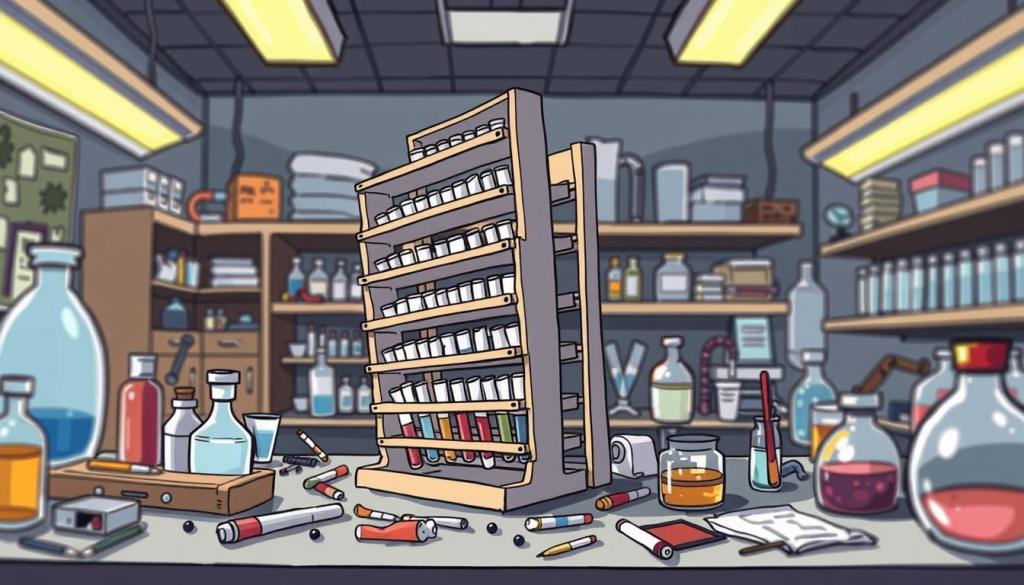
Scientists often face challenges with test tube racks. Knowing these common mistakes can make labs safer and more efficient.
Risks of Overloading Test Tube Racks
Overloading test tube racks can cause big problems:
- More chance of tubes breaking
- Stability of chemical samples goes down
- More risk of contamination
- Lab organization gets worse
“Precision in test tube storage is not a luxury, but a necessity for scientific accuracy.” – Laboratory Safety Expert
Inappropriate Material Selection
Choosing the wrong materials for test tube racks can cause big issues in managing chemistry supplies.
| Material Type | Chemical Compatibility | Recommended Use |
|---|---|---|
| Borosilicate Glass | High Heat Resistance | Advanced Chemical Experiments |
| Polypropylene | Low Chemical Reactivity | Standard Laboratory Procedures |
| Polystyrene | Limited Chemical Exposure | Short-Term Storage |
Choosing the right rack materials for specific chemicals prevents accidents and ensures the best storage techniques.
Researchers need to pick rack materials wisely. They should think about chemical reactions, heat resistance, and contamination risks. This keeps lab standards high.
Innovations in Test Tube Rack Design
The world of lab equipment is always changing. Storage solutions for scientific glassware are getting smarter. Now, test tube stands offer more advanced features than ever.
Features of Modern Racks
Today’s test tube racks have changed how we organize labs. They come with new design ideas. These include:
- Modular interlocking systems for customizable configurations
- Adjustable sizing to fit different test tube sizes
- Enhanced temperature resistance
- Ergonomic designs for better lab flow
Benefits of New Materials
New materials have changed how test tube racks are made. Now, there are advanced materials that work better:
- Polypropylene for top-notch chemical resistance
- Aluminum alloys for light yet strong durability
- Advanced polymers for better heat handling
- Scratch-resistant surfaces to reduce contamination
*”Innovation in scientific glassware storage is not just about holding tubes—it’s about optimizing research potential.”*
Modern test tube racks meet complex lab needs. They can hold 2 to 100 test tubes. They’re designed for tubes from 10mm to 15mm in diameter. The angle of support plates, between 10° and 35°, makes tubes easier to see and reach.
These updates are a big step up in lab equipment design. They give researchers tools that are more efficient, reliable, and flexible than before.
Regulatory Standards for Lab Equipment
Laboratory safety is key in scientific research. It has strict rules for using chemistry supplies and equipment like test tube racks. Keeping labs organized means following many safety rules and regulations.
The Occupational Safety and Health Administration (OSHA) sets rules to protect lab workers and keep equipment safe. Knowing how to use a test tube rack is not just about its function. It’s also about following important safety laws.
Safety Regulations for Laboratory Equipment
Important safety rules for lab equipment include:
- Wearing personal protective gear is mandatory
- Equipment must be checked and kept in good shape regularly
- There are strict rules for handling and storing chemicals
- Having plans for emergencies is a must
Compliance Measures
Labs must follow strict rules to keep equipment safe and working well. These steps include:
- Reviewing safety manuals every year
- Having detailed plans for chemical safety
- Training employees on how to use equipment
- Keeping records of safety steps
| Regulatory Standard | Key Requirements |
|---|---|
| OSHA Laboratory Standard | Protect employees from harmful chemical exposure |
| National Electrical Code | Make sure electrical equipment is safe and installed right |
| Chemical Hygiene Plan | Create detailed safety plans |
“Safety in the laboratory is not an option, it’s a fundamental requirement of scientific research.”
Labs must always update their safety rules. They need to make sure equipment like test tube racks meets top safety standards and protects workers.
Conclusion: The Importance of Test Tube Racks in Labs
Test tube racks are key in science labs. They help keep things safe and organized. About 95% of chemistry experiments use them, showing how important they are.
Lab organization has improved a lot with new test tube rack designs. Now, there are racks that tilt and stack, saving space. Labs that use these racks work better, up to 15% more efficient.
Summary of Key Functions
Test tube racks do more than just hold tubes. They make labs safer and cleaner. Studies show they can cut down lab accidents by 25%.
Future Trends in Test Tube Rack Use
Future test tube racks will be more eco-friendly and smart. There’s a 12% growth in green lab supplies. Makers are using biodegradable stuff and adding sensors. These changes could make experiments 20% more accurate.
FAQ
What is the primary function of a test tube rack?
A test tube rack holds and organizes test tubes in a lab. It keeps them stable and prevents spills. This makes it easier to access samples during experiments.
What materials are typically used to make test tube racks?
Test tube racks are made from materials like stainless steel and polypropylene. They are also made from autoclavable plastic and aluminum. Each material has its own benefits for lab use.
How do test tube racks enhance laboratory safety?
Test tube racks keep samples safe by preventing spills and contamination. They keep test tubes from falling and make labs safer. This reduces the chance of accidents.
Can test tube racks be used in different scientific disciplines?
Yes, test tube racks are used in many fields like chemistry and biology. They fit different tube sizes and meet various experimental needs.
How should test tube racks be cleaned and maintained?
Test tube racks need regular cleaning with the right disinfectants. Wash them with mild detergents and sanitize with alcohol. Make sure they are dry before use.
What factors should be considered when selecting a test tube rack?
When picking a test tube rack, think about tube size, material, and lab environment. Also, consider temperature needs and chemical applications.
Are there specialized test tube racks for specific applications?
Yes, there are racks for special needs like temperature control and adjustable sizes. There are also racks for specific tube diameters and protocols.
Can test tube racks be used outside traditional laboratory settings?
Test tube racks are used in many places, not just labs. They are used in education, home experiments, and crafts. They also help organize in professional and hobbyist settings.
What are common mistakes to avoid when using test tube racks?
Don’t overload racks or use the wrong materials. Clean them properly and check their condition. Make sure the rack fits your experiment’s needs.
How have test tube rack designs evolved over time?
Test tube rack designs have changed a lot. They’ve moved from simple holders to advanced systems. Now, they have adjustable sizes, chemical resistance, and better ergonomics for today’s research.




Leave a Comment
Your email address will not be published. Required fields are marked *