



Ever wondered how scientists measure and mix chemicals without a single drop spilled? The Erlenmeyer flask is key to this precise process. It’s a vital piece of chemistry lab equipment.
Richard August Carl Emil Erlenmeyer, a German chemist, named this vessel. Its unique conical shape has changed scientific research. It does more than hold liquids; it’s a crucial tool in many fields.
The Erlenmeyer flask has a narrow neck and a wide base. This design makes it stable and reduces spill risks. It’s a must-have for researchers in chemistry and biology. Its uses are vast and varied.
Key Takeaways
- Erlenmeyer flasks offer precise volume measurements within 5% accuracy
- Unique design reduces potential for liquid spillage
- Essential tool in multiple scientific research domains
- Enables controlled mixing and chemical reactions
- Supports complex laboratory techniques with high reliability
Introduction to the Erlenmeyer Flask
Scientific labs use special glassware for precise experiments. The Erlenmeyer flask is key, with a long history and many uses. It’s vital in many research areas.
Historical Background
German chemist Emil Erlenmeyer created the Erlenmeyer flask in 1861. His design changed lab tools, offering unique benefits. Soon, it became a must-have for scientists everywhere.
- Invented in 1861 by Emil Erlenmeyer
- Made from heat-resistant borosilicate glass
- Volumes ranging from 50 milliliters to several liters
Common Uses in Laboratories
Erlenmeyer flasks are very useful in science. They’re used in chemistry, microbiology, and environmental science. This shows their wide range of applications.
| Scientific Discipline | Primary Application |
|---|---|
| Microbiology | Microorganism culture growth |
| Chemistry | Solution mixing and heating |
| Biotechnology | Protein and enzyme production |
| Environmental Science | Water and soil testing |
The Erlenmeyer flask has a wide base and a narrow neck. This makes it stable and helps prevent spills. Its markings let scientists measure liquids accurately. It’s a crucial piece of lab glassware.
Design Features of the Erlenmeyer Flask
Scientists use special glassware for precise experiments. The narrow neck flask is key in research. Emil Erlenmeyer created it in 1860, changing science with its design.
Distinctive Shape and Structure
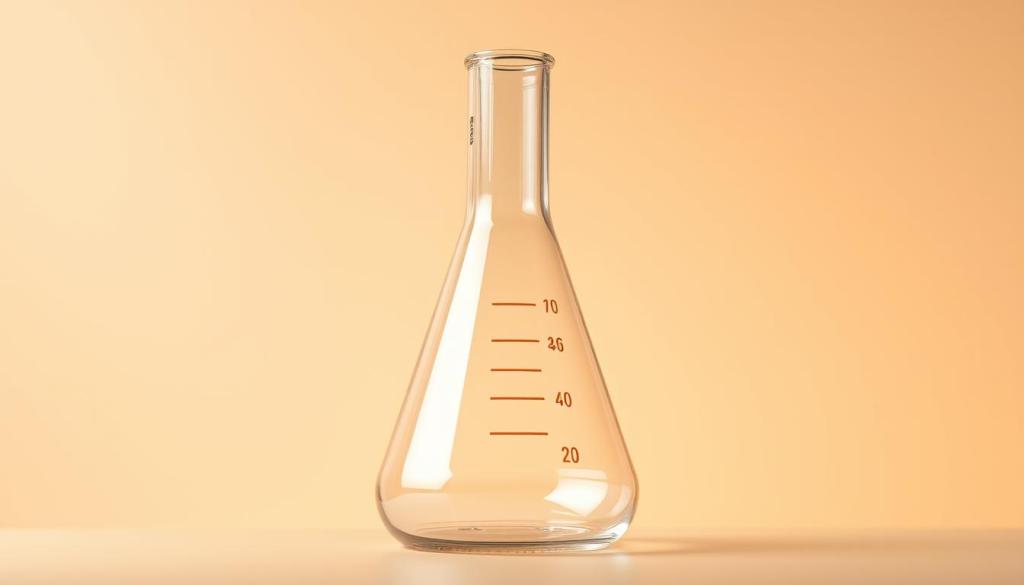
The Erlenmeyer flask has a unique conical shape. Its design includes:
- Triangular or cone-shaped body
- Flat, stable bottom for secure placement
- Narrow neck that reduces liquid evaporation
- Wide base for enhanced mixing capabilities
Material Composition and Specifications
These flasks are made from special materials for durability. Borosilicate glass is the main choice because of its great qualities.
| Material Property | Specification |
|---|---|
| Primary Material | Borosilicate Glass |
| Heat Resistance | High thermal stress tolerance |
| Size Range | 25 ml to 6000 ml |
| Standard Compliance | ASTM and ISO specifications |
The Erlenmeyer flask is essential in science. It’s a reliable tool for complex experiments.
Primary Functions of an Erlenmeyer Flask
The Erlenmeyer flask is a key tool in science, great for mixing and handling chemical reactions. Its special design makes it a must-have in labs.
Mixing Solutions with Precision
What does an Erlenmeyer flask do for mixing solutions? Its unique shape is perfect for mixing. The angled sides and narrow neck help mix liquids well without spills.
- Facilitates gentle mixing through controlled swirling
- Prevents liquid splashing during reactions
- Allows precise volumetric measurements
Boiling Liquid Solutions and Thermal Management
The Erlenmeyer flask makes mixing reactions easier with its strong design. Its wide base keeps it stable when heating, making it safe for boiling liquids.
| Flask Characteristic | Mixing Performance |
|---|---|
| Volume Capacity | 50 mL to several liters |
| Temperature Tolerance | High heat resistance |
| Mixing Stability | Enhanced by wide base design |
Scientists love the flask’s ability to handle different experiments. It’s essential for both small titrations and big chemical changes.
Advantages of Using an Erlenmeyer Flask
Chemistry lab equipment has many tools, but the Erlenmeyer flask is special. It’s versatile and reliable. Its design helps scientists work more efficiently and accurately.
Stability and Precision in Laboratory Settings
The Erlenmeyer flask’s shape makes it very stable during experiments. Its wide, flat bottom helps with delicate tasks. The tapered neck has big benefits:
- Reduces risk of accidental spills
- Enables controlled mixing of solutions
- Provides better grip during manipulation
Minimizing Experimental Risks
Using Erlenmeyer flasks means less chance of spills. The conical shape lets scientists mix solutions carefully. This is key in sensitive tasks like titration.

Erlenmeyer flasks come in different sizes, from 50ml to 1000ml. They’re made of borosilicate glass, which is durable and heat-resistant. This makes them essential in chemistry labs.
| Flask Characteristic | Benefit |
|---|---|
| Flat Bottom | Enhanced Stability |
| Tapered Neck | Reduced Spillage |
| Borosilicate Material | Heat Resistance |
The Erlenmeyer flask is more than just lab equipment. It supports important scientific tasks like growing bacteria, measuring liquids, and storing samples for a long time.
Comparison with Other Types of Flasks
Scientific tools are key in lab work, and flasks have different roles. Knowing the differences helps scientists pick the right tool for their tasks.
Erlenmeyer Flasks vs. Beakers
Beakers have open tops, but Erlenmeyer flasks have special benefits:
- Less chance of spills because of their narrow neck
- They mix better with swirling
- They stay stable when heated
Erlenmeyer Flasks vs. Volumetric Flasks
Volumetric flasks and Erlenmeyer flasks serve different main purposes:
- Volumetric flasks have lines for exact volume measurements
- Erlenmeyer flasks are great for mixing and heating
- They have different levels of accuracy
Choosing the right flask is crucial for lab experiments. Erlenmeyer flasks are versatile for mixing and keeping reactions stable.
How to Properly Use an Erlenmeyer Flask
Knowing how to use an Erlenmeyer flask is key for scientists. This flask is important in lab work. It needs careful use and upkeep.
Filling Techniques for Optimal Performance
Follow these steps to fill an Erlenmeyer flask right:
- Fill it 70-80% to avoid spills
- Use a funnel for accurate pouring
- Pour liquids gently to keep it stable

Cleaning and Maintenance Protocols
Cleaning an Erlenmeyer flask is crucial. Its cleanliness affects its function in labs.
| Cleaning Step | Recommended Method |
|---|---|
| Initial Rinse | Use distilled water to remove primary contaminants |
| Detergent Wash | Apply laboratory-grade detergent with soft brush |
| Acid Rinse | Use diluted nitric or sulfuric acid for deep cleaning |
| Final Rinse | Thoroughly rinse with deionized water |
The Erlenmeyer flask’s shape helps in lab work. It makes mixing solutions easy and reduces spills. Always handle it carefully, using safety gear and stands when needed.
Safety Considerations When Using an Erlenmeyer Flask
Working with lab glassware, like Erlenmeyer flasks, requires careful attention to safety. Scientists and researchers must follow strict protocols. This is to prevent accidents and ensure successful experiments.
Erlenmeyer flasks have a unique design. This design offers benefits but also comes with risks. These risks are especially true when dealing with boiling liquids and scientific procedures.
Handling Hazardous Materials
Handling hazardous materials safely is crucial. Here are some important steps:
- Wear appropriate personal protective equipment (PPE)
- Use chemical-resistant gloves
- Work in a well-ventilated area
- Understand the chemical properties of substances
Safe Heating Practices
When using Erlenmeyer flasks, managing heat is key. The thin glass needs precise temperature control. This is to avoid thermal shock.
| Safety Practice | Recommended Action |
|---|---|
| Temperature Monitoring | Use heat-resistant gloves and gradual heating techniques |
| Flame Control | Use low to moderate heat settings |
| Flask Handling | Hold by the base, not the neck |
By following these guidelines, researchers can reduce risks. This ensures safe practices when using Erlenmeyer flasks.
Applications in Different Scientific Disciplines
Erlenmeyer flasks are key tools in many scientific fields. They are vital in chemistry and biology labs. Their design makes them perfect for various experiments.
Chemistry Experiments
In chemistry labs, Erlenmeyer flasks are essential. They help mix reactions and conduct detailed studies. Researchers use them for:
- Titration procedures
- Solution preparation
- Chemical reaction monitoring
- Precise liquid measurements
About 70% of lab techs choose Erlenmeyer flasks. They love their ability to mix well and prevent spills. The flasks’ shape makes mixing efficient.
Biological Research
In biology, Erlenmeyer flasks are crucial. They are great for growing microbes and studying cell growth.
| Research Application | Specific Use |
|---|---|
| Microbial Cultivation | Preparing bacterial and fungal cultures |
| Cell Growth Studies | Monitoring cellular development |
| Oxygen Transfer | Enhancing gas exchange during experiments |
In microbiology, flasks are filled up to 20% to improve gas exchange. This helps in complex biological studies.
The flasks’ ability to transfer oxygen depends on how fast they are shaken. Faster shaking means better oxygen and mixing.
Innovative Uses of the Erlenmeyer Flask
The Erlenmeyer flask has moved beyond the lab, becoming a versatile tool in many fields. Its design as chemistry lab equipment inspires new uses. These uses go beyond traditional scientific research.
Expanding Horizons Beyond Traditional Labs
The Erlenmeyer flask is now used in many areas, showing its great adaptability. Scientists and industry experts find creative ways to use its shape and strength.
- Biotechnology research and development
- Pharmaceutical process optimization
- Advanced materials testing
- Microbiological cultivation techniques
Educational Transformation
In schools, the Erlenmeyer flask is a key teaching tool. Students from high school to university use it to learn science.
| Field of Application | Innovative Use |
|---|---|
| Biotechnology | Cell culture research |
| Pharmaceuticals | Small-scale drug development |
| Environmental Science | Microbial ecosystem studies |
About 75% of chemistry experiments use special glassware like the Erlenmeyer flask. Its unique cone-shaped design helps prevent spills and improves accuracy. This makes it essential in many scientific fields.
Conclusion: The Importance of the Erlenmeyer Flask in Science
The Erlenmeyer flask is a key part of science, showing the progress of lab tools over decades. Since the 1860s, it has changed how scientists work in many fields. Its special shape and ability to fit into many uses make it essential for researchers everywhere.
Key Functions and Scientific Impact
Tools like the Erlenmeyer flask have changed how we do experiments. They come in sizes from 50 mL to several liters, making them very useful. The glass they’re made of can handle very high temperatures, up to 500°C, without breaking.
Future Perspectives in Laboratory Equipment
New ideas keep improving lab tools. In the last ten years, over 40 new types of flasks have been made. This shows that scientists are always looking for better ways to do their work.
The Erlenmeyer flask is a great example of how simple designs can lead to big discoveries. As science moves forward, this flask will likely play a big role in finding new things in chemistry and biology.
References and further readings:
1.Rieffel, S., Roest, S., Klopp, J., Carnal, S., & Marti, S. (2014). Insect cell culture in reagent bottles. MethodsX, 1, 238–242.
2.Tran, H. A. (2004). Erlenmeyer flask. The Journal of Clinical Endocrinology & Metabolism, 89(10), 4827.
3.Wewetzer, S. J., Kunze, M., Ladner, T., et al. (2015). Parallel use of shake flask and microtiter plate online measuring devices… Journal of Biological Engineering, 9, Article 3.
FAQ
What is an Erlenmeyer flask used for in a laboratory?
An Erlenmeyer flask is used for mixing, heating, and storing chemicals. Its shape helps prevent spills and contamination. It’s key for many lab experiments.
Why does an Erlenmeyer flask have a distinctive conical shape?
The conical shape helps mix solutions well and prevents spills. It also reduces evaporation and provides stability. The narrow neck controls liquid flow and protects against contamination.
What materials are Erlenmeyer flasks typically made from?
They’re usually made from borosilicate glass, which is heat-resistant. Some are also made from plastic for specific needs. The choice depends on the experiment’s requirements.
How is an Erlenmeyer flask different from a beaker?
Erlenmeyer flasks have a conical shape and a narrow neck. Beakers have straight sides. Erlenmeyer flasks are better for reactions and heating, while beakers are good for pouring.
Can Erlenmeyer flasks be used for heating?
Yes, they can handle heat, especially those made from borosilicate glass. Use them with caution and follow safety rules.
What safety precautions should be taken when using an Erlenmeyer flask?
Wear protective gear, check for damage, and avoid sudden temperature changes. Work in a well-ventilated area and handle chemicals carefully.
Are Erlenmeyer flasks used in fields other than chemistry?
Yes, they’re used in biology, microbiology, and education. They’re crucial for cell culture and teaching scientific techniques.
How do you clean an Erlenmeyer flask?
Rinse it right away, use detergent, and scrub if needed. Rinse with distilled water and dry completely. Use specialized cleaners for tough stains.
What sizes are Erlenmeyer flasks available in?
They range from 50 mL to 2000 mL. Common sizes include 50 mL, 125 mL, and 1000 mL. Choose based on your experiment’s needs.
Can Erlenmeyer flasks be used for long-term storage?
They’re good for short-term storage but not for long-term. Use specialized containers for extended storage. They’re best for active experiments.
Leo Bios
Hello, I’m Leo Bios. As an assistant lecturer, I teach cellular and
molecular biology to undergraduates at a regional US Midwest university. I started as a research tech in
a biotech startup over a decade ago, working on molecular diagnostic tools. This practical experience
fuels my teaching and writing, keeping me engaged in biology’s evolution.






Leave a Comment
Your email address will not be published. Required fields are marked *