


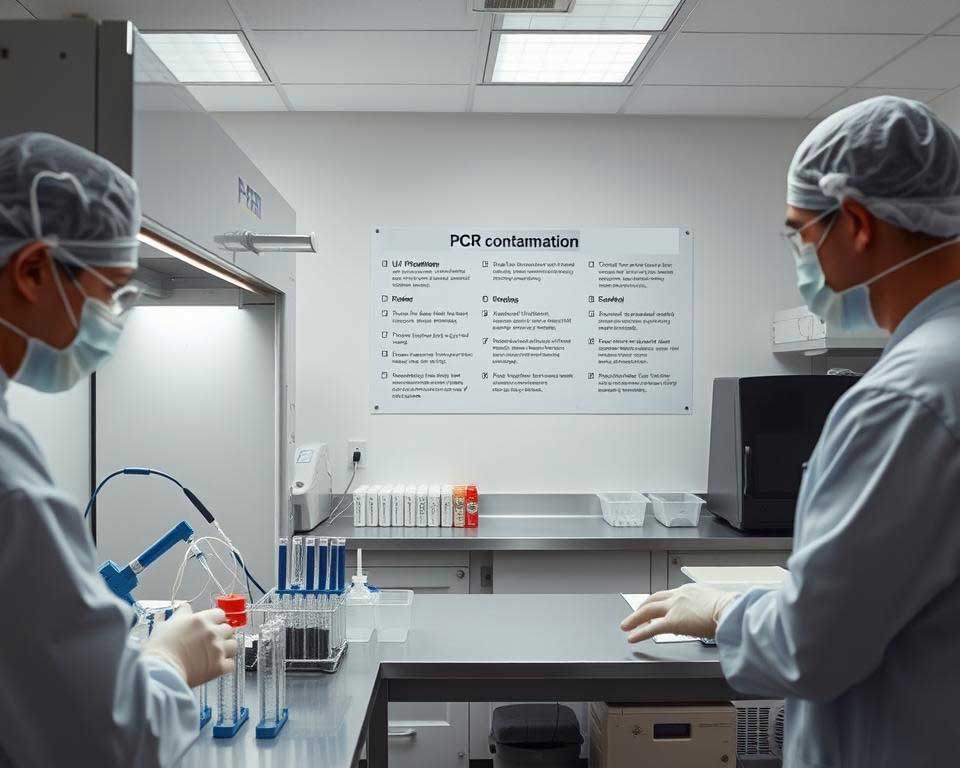
prevent contamination. This includes using dedicated equipment, keeping a clean workspace, and wearing protective
gear.Aliquoting reagents correctly, setting up negative controls, and using the UNG enzyme system are also important.
These steps help reduce contamination and make PCR results reliable and reproducible.
Key Takeaways
- Minimizing PCR contamination is essential for accurate results.
- Dedicated equipment reduces the risk of polymerase chain reaction contamination.
- A clean workspace is crucial for effective PCR contamination prevention strategies.
- Wearing PPE can significantly lower contamination risks.
- Effective aliquoting of reagents aids in the prevention of cross-contamination.
- Negative controls are necessary for validation of PCR results.
- The UNG enzyme anti-contamination system is an effective tool to enhance reliability.
Use dedicated equipment and consumables
In PCR contamination control, using dedicated gear and supplies is key. It’s vital to have separate areas for
different PCR steps, like before and after amplification. This keeps contaminants away from your results.
For example, don’t reuse pipettes or supplies without cleaning them well after a PCR run. This helps prevent
contamination.
Storing PCR reagents in their own spots helps too. This keeps them away from other lab stuff, stopping
cross-contamination. Using special tubes and disposables for PCR makes things easier.
High-quality PCR tubes and plates are also important. They help keep your experiments safe and reliable.
Using separate lab tools also boosts your results. Set up different pipettes, centrifuges, and vortexers for each
area. Clean and sterilize them regularly to keep things safe.
For more tips, check out this guide on good lab practices.
Organize your supplies with clear labels and keep them separate. Choose supplies that are DNA-free, RNase-free, and
endotoxin-free. This helps a lot with PCR contamination control.
For more on reliable supplies, visit this resource for PCR lab supplies.
Keep the work area clean
Keeping your work area clean is key to avoiding PCR contamination. Use 70% ethanol or a disinfectant to wipe
down surfaces. This helps remove skin cells and aerosols that can cause contamination.
Make sure to clean all lab equipment, like pipettes and racks. Clean them before each use to prevent contamination.
A clean area helps avoid unwanted DNA and enzymes. These can mess up your results. Clean up spills thoroughly to
reduce contamination risks.
For more tips on avoiding contamination, check out this page.
Here’s a table showing how different cleaning methods compare:
| Cleaning Method | Effectiveness | Frequency of Use |
|---|---|---|
| 70% Ethanol | High | Daily |
| Bleach Solution | Very High | Weekly |
| UV Light Treatment | Medium | Monthly |
| Disinfectant Wipes | High | As Needed |
Using these cleaning methods helps prevent PCR contamination. This makes your experiments more reliable.
Wear personal protective equipment
Wearing personal protective equipment (PPE) is key for strict PCR contamination control. It stops foreign DNA
from getting in and keeps PCR results accurate. It’s important to change gloves often because touching contaminated
surfaces can ruin PCR tests.
A clean lab coat acts as a shield against harmful particles. It’s smart to keep your hair tied back and avoid
jewelry, as it can catch contaminants. Using the right PPE protects your samples and makes your results more
trustworthy.
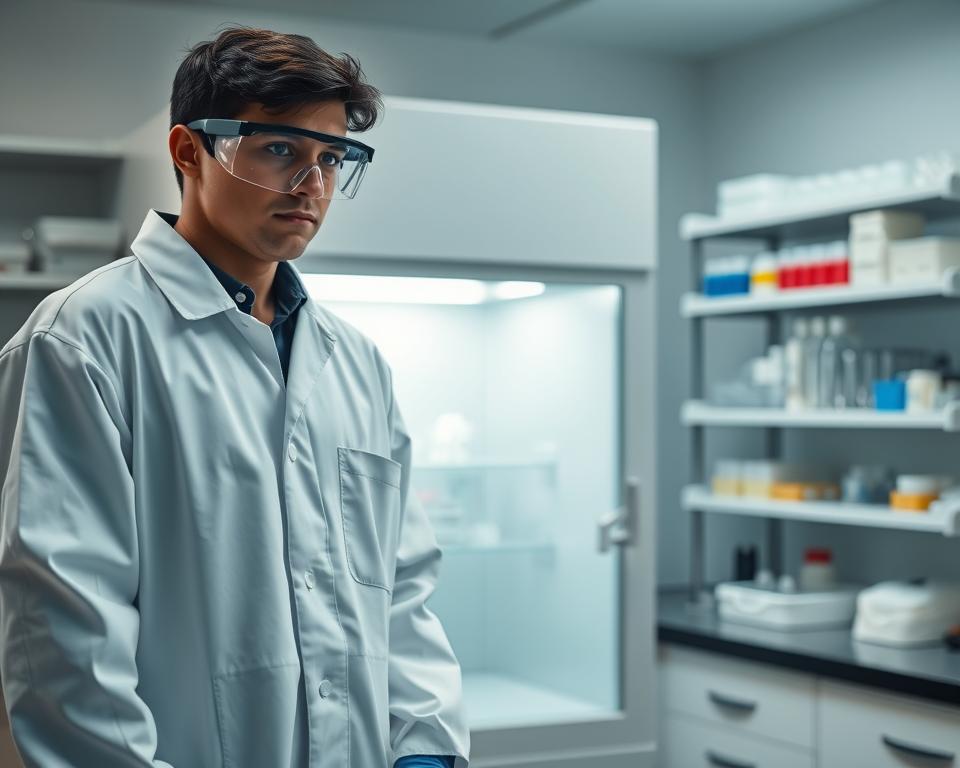
- Change gloves frequently to minimize contamination risks.
- Wear a clean lab coat to protect against external agents.
- Tie back loose hair to prevent shedding.
- Avoid jewelry that may harbor contaminants.
Using these PPE steps is crucial for keeping samples safe. By following these rules, you ensure PCR contamination
control and boost lab safety. Sticking to high standards in PPE is key to getting good PCR results.
Aliquot reagents
Aliquoting reagents is a key step in PCR contamination solutions. It involves dividing primers, buffers,
and nucleotides into single-use amounts. This cuts down on contamination risks.
Aliquoting keeps reagents fresh and makes setup easier. It’s important to store these in labeled containers for
quick access.
Storing them at –20°C also helps prevent contamination. For more tips on avoiding contamination, check out this useful guide.
By using aliquoting, you can protect your experiments from unwanted factors. It’s a crucial part of PCR
contamination troubleshooting.
Set up negative controls
Setting up negative controls is key for spotting PCR contamination. By adding No Template Controls (NTCs) to each
test, you have a baseline. This baseline helps you see if there’s unwanted DNA amplification.
NTCs do more than just show contamination. They help figure out where it comes from. It could be from the reagents
or the environment. The results from NTCs are vital for fixing contamination issues.
To get the most out of negative controls, remember these tips:
- Regularly check NTC results to keep PCR quality high.
- Make using NTCs a standard part of PCR work.
- Quickly look at results to spot problems and fix them.
| Observation | Interpretation |
|---|---|
| Amplicon in NTC | Indicates contamination |
| No amplicon in NTC | Suggested containment of the workflow |
| Amplicon in sample, none in NTC | PCR successful; minimal contamination risk |
| Amplicon in both sample and NTC | Possible contamination present; requires troubleshooting |
For more on negative controls, check out this detailed guide. Using these controls well can make your PCR results
much more reliable.
Employ UNG enzyme anti-contamination system
The uracil-N-glycosylase (UNG) enzyme system is key in our fight against PCR contamination. It targets and
inactivates any leftover products from previous reactions. This makes sure our results are accurate and reliable.
Using a special dNTP mix with uracil instead of thymine boosts the UNG system’s power. This mix stops unwanted
carryover from past reactions. New reactions stay clean, improving PCR results. It’s a smart way to prevent
contamination, trusted by researchers worldwide.
Optimize the experimental operation process
Improving the experimental workflow is key to preventing PCR contamination. It’s important to have clear pre- and
post-amplification areas. This helps keep materials separate and lowers the chance of contamination.
Having a one-way flow of materials in the lab also helps. It makes it less likely for contamination to happen.
Regular training and checks on lab practices are vital. They help everyone follow the right procedures. This keeps
the lab clean and ensures experiments are successful.
Creating a culture that watches out for contamination sources is also important. It makes the lab run better. When
everyone follows the rules, experiments are safer and better.
Theoretical Foundations of PCR Contamination Prevention
Mechanisms of PCR Contamination
Exogenous Contamination Sources
Endogenous Contamination Risks
Formation and Spread of Nucleic Acid Aerosols
Aerosol Generation Mechanisms
Aerosol Persistence and Transport
Molecular Biology Pathways of Cross-Contamination
Direct Physical Transfer
Enzymatic Carryover
Template Swapping During Amplification
FAQ
What are the main sources of PCR contamination?
PCR contamination can come from many places. This includes environmental factors and degraded or
mishandled reagents. Aerosols from pipetting and cross-contamination between samples or equipment
are also sources.
How can I effectively prevent PCR contamination?
To stop PCR contamination, use separate tools for pre- and post-amplification tasks. Keep your work
area clean and wear protective gear. Also, divide reagents into single-use portions and set up
negative controls.
Use the UNG enzyme system and work efficiently to prevent contamination.
What is the purpose of negative controls in PCR?
Negative controls, like No Template Controls (NTCs), are crucial. They show if contamination has
occurred. If they show a signal, it means you need to check your reagents or methods.
Why is it important to aliquot reagents?
Aliquoting reagents into single-use amounts reduces contamination risks. It prevents contamination
from repeated freezing and thawing. This keeps the reagents pure and improves your experiment’s
reliability.
What role does personal protective equipment (PPE) play in PCR?
Wearing PPE, like gloves and lab coats, helps prevent contamination. It keeps your PCR results
accurate by avoiding contaminants from your skin or personal items.
How can I optimize my experimental workflow to minimize contamination?
To improve your workflow, set up separate areas for pre- and post-amplification. Make sure materials
move in one direction only. Also, train your team regularly on how to prevent contamination.
References and further readings:
1.Wang, Y., Wang, J., Wei, M., Liu, L., & Wang, J. (2025). Development and application of a
quadruple RT-qPCR assay for the simultaneous detection of NoV GI, NoV GII, and HAV in bivalve shellfish.
Applied and Environmental Microbiology.
https://doi.org/10.1128/aem.01839-24
2.Singh, S. P., Verma, N., Kumar, D., & Gupta, S. (2024). Computational Challenges in Metagenomic
Data Analysis. In Genomic Intelligence (Chap. 4). Taylor & Francis.
https://www.taylorfrancis.com/chapters/edit/10.1201/9781003570233-4
3.Laezza, M., Pisapia, L., Toro, B., Mercadante, V., & Moretti, M. (2024). PBMC analysis and
contamination control in autoimmune diagnostics. Journal of Translational Autoimmunity.
https://www.iris.unina.it/retrieve/023ecd31-51eb-410b-b722-9c5b51710a31/Laezza2024.pdf
What is the UNG enzyme system, and how does it help prevent contamination?
The UNG enzyme system uses uracil in dNTP mix to inactivate old products. This stops them from being
amplified again. It helps separate new products from contaminated ones effectively.
How often should the work area be cleaned to prevent contamination?
Clean the work area often, before and after PCR experiments. Use strong disinfectants to remove
contaminants like skin cells and aerosols.
What troubleshooting steps should be taken if contamination is suspected?
If you think contamination has happened, check your negative controls first. Then, look at your
reagents and equipment for signs of contamination. Finally, increase cleaning efforts to find the
source.
Leo Bios
Hello, I’m Leo Bios. As an assistant lecturer, I teach cellular and
molecular biology to undergraduates at a regional US Midwest university. I started as a research tech in
a biotech startup over a decade ago, working on molecular diagnostic tools. This practical experience
fuels my teaching and writing, keeping me engaged in biology’s evolution.





Leave a Comment
Your email address will not be published. Required fields are marked *