


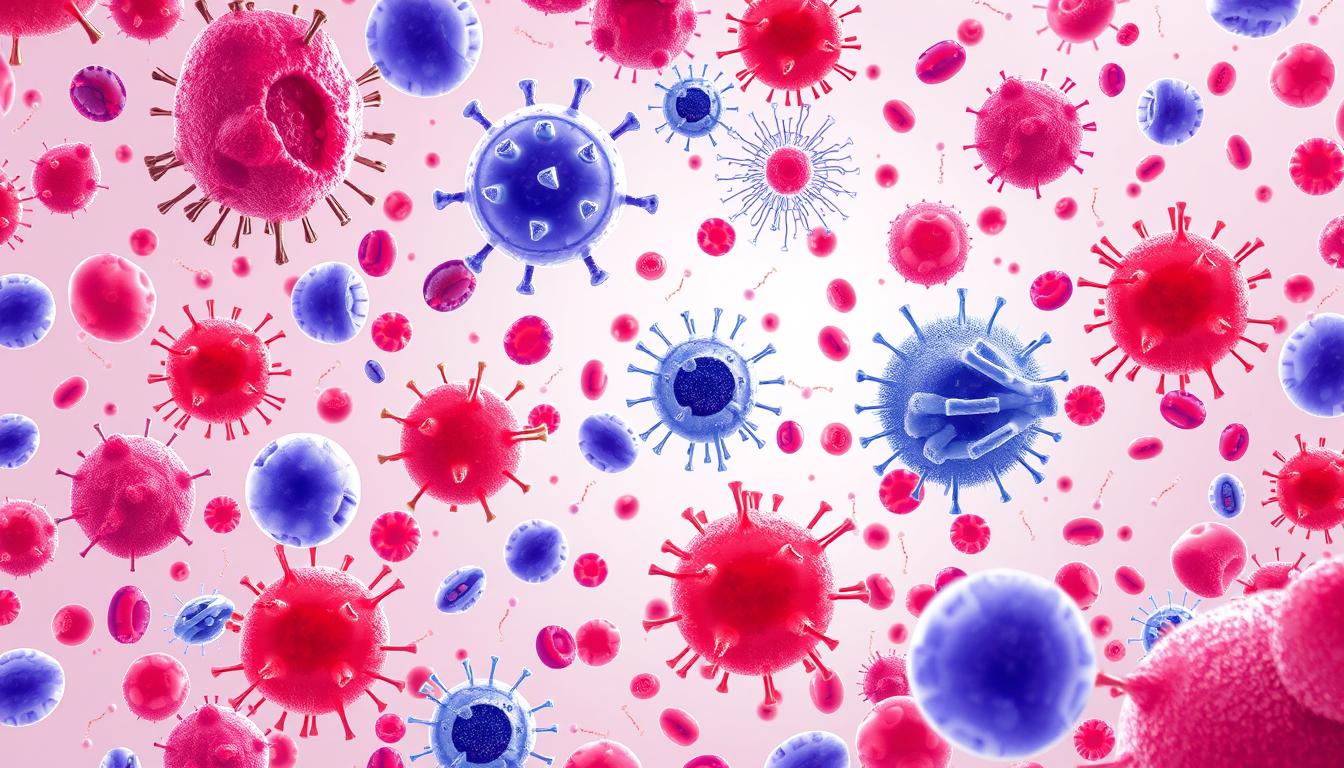
Have you ever wondered how your body fights off invisible threats? Peripheral blood mononuclear cells (PBMCs) are the heroes of our immune system. They work hard to keep us safe from harm.
These amazing immune cells make up about 30% of white blood cells. They play a key role in fighting infections and diseases. PBMC cells are not just simple defenders. They are complex warriors with special functions that keep our immune system strong and ready to act.
From T cells to B cells, these peripheral blood mononuclear cells form a complex network of defenders. Each type of PBMC has its own special abilities. Together, they create a dynamic and intricate defense system that adapts to different health challenges.
Key Takeaways
- PBMCs constitute 30% of white blood cells in human body
- Lymphocytes are the primary component of PBMC populations
- Different PBMC types work together to protect against infections
- PBMCs play crucial roles in immune surveillance
- Research continues to unlock the potential of these remarkable cells
Introduction to PBMC Cells
Peripheral blood mononuclear cells (PBMCs) are key to our immune system. They help fight infections and keep us healthy. These cells come from the bone marrow and are vital for understanding how our immune system works.
PBMCs are made up of different types of cells. These cells work together to protect us:
- Lymphocytes (T cells, B cells, NK cells)
- Monocytes
- Dendritic cells
Definition and Importance of PBMCs
PBMCs are white blood cells with round nuclei. They are important for our immune system. Lymphocytes make up most of the PBMCs. They are our main defense against infections.
Their ability to fight off threats is crucial. This makes them very important in medical research and treatment.
Overview of Blood Composition
In our blood, PBMCs are a small but important part of white blood cells. Monocytes are the second most common, and dendritic cells are less common.
Role of PBMCs in Immune Response
PBMCs play a big role in our immune response. They can find, fight, and neutralize threats. Their ability to adapt to different pathogens is key to our health.
Types of PBMCs
Peripheral blood mononuclear cells (PBMCs) are key to our immune system. They include lymphocytes and monocytes, vital for fighting off infections and keeping cells healthy.
Lymphocytes make up most of PBMCs, about 70-90%. They come in different types, each with its own role in our immune system.
T Cells: The Immune System’s Defenders
T cells are the main fighters in our immune system. They are split into several types:
- CD4+ helper T cells (25-60% of activated cells)
- CD8+ killer T cells (5-30% of activated cells)
- Naive T cells with significant developmental potential
B Cells: Antibody Production Specialists
B cells are about 5-15% of lymphocytes. They make antibodies to fight off infections and help our immune memory.
Monocytes and Macrophages: Phagocytic Cellular Warriors
Monocytes are 10-30% of PBMCs and turn into macrophages. These cells clean up debris and fight off invaders.
| Cell Type | Percentage in PBMCs | Primary Function |
|---|---|---|
| T Cells | 45-70% | Immune Defense |
| B Cells | 5-15% | Antibody Production |
| Monocytes | 10-30% | Phagocytosis |
| Natural Killer Cells | 5-10% | Viral Resistance |
Learning about these cells helps us understand how our immune system works. It also shows us ways to improve our health.
Functions of PBMCs
Peripheral blood mononuclear cells (PBMCs) are key to our immune system. They act as our body’s guardians, always ready to defend us against threats.
- Immune surveillance
- Inflammatory response management
- Long-term immunity preservation
Role in Immune Surveillance
Immune cells in PBMCs are like advanced security systems. They scan the blood for any abnormal or foreign cells that could harm us.
PBMCs and Inflammation
When we face pathogens, PBMCs start important inflammatory responses. Monocytes and macrophages quickly move to fight off threats and start healing.
Memory Cells and Long-Term Immunity
PBMCs also create memory cells. These cells remember past infections. This means they can fight off familiar pathogens faster and more effectively.
About 70-90% of PBMCs are lymphocytes. These cells are a crucial part of our defense against health challenges.
Isolation and Characterization of PBMCs
Peripheral blood mononuclear cells (PBMCs) are key in science and medicine. They need special methods for isolation to get top-quality cells for research.
Density gradient centrifugation is the best way to isolate PBMCs. It sorts blood components by weight, making it easy to get PBMCs.
Techniques for PBMC Isolation
Ficoll separation is a top choice for getting PBMCs from blood. The steps include:
- Carefully layering blood over Ficoll solution
- Centrifuging the sample at specific speeds
- Extracting the mononuclear cell layer
- Washing and preparing cells for further analysis
Flow Cytometry for PBMC Analysis
Flow cytometry is great for studying PBMCs. It lets researchers:
- Identify specific cell populations
- Measure cell characteristics
- Assess cellular function
Importance of Cell Viability Assessment
Keeping cells alive is crucial in PBMC studies. Research shows that processing blood samples within 8-12 hours keeps cells best. Key points include:
- Blood storage beyond 24 hours reduces PBMC recovery by 30%
- Viability decreases from 96% to 92% with extended storage
- Viral peptide-reactive T cells diminish by 36-56% after 24 hours
Researchers must handle samples carefully to get the best PBMCs for study.
PBMCs in Research and Medicine
Peripheral blood mononuclear cells (PBMCs) are key in medical research and understanding health. These immune cells are a powerful tool for scientists. They help explore many medical challenges.

Cell culture techniques with immune cells have changed research in many fields. Scientists use PBMCs to study complex medical issues. They work on new treatments.
Vaccine Development Breakthroughs
PBMCs are vital in vaccine research. They give scientists insights into how our immune system works. They use these cells to:
- Test vaccine safety and effectiveness
- Study how our immune system reacts
- Find new ways to fight diseases
Cancer Research Applications
In cancer studies, PBMCs open new doors. Researchers look at these cells to:
- Find new treatments that boost our immune system
- Learn how blood cancers grow
- Make treatments that fit each person’s needs
Infectious Disease Investigations
PBMCs are key in studying how we fight infections. They help scientists:
- See how our immune system fights off diseases
- Work on treatments that target specific diseases
- Find ways to prevent diseases better
PBMCs are essential in medical research. They bring hope for new treatments and a deeper understanding of health.
PBMCs in Transfusion Medicine
Peripheral blood mononuclear cells (PBMCs) are key in modern transfusion medicine. They connect complex medical procedures with advanced cell research. These cells are vital for understanding and managing blood-related medical interventions.
Blood cell isolation techniques have changed how we understand cell interactions in medical treatments. Medical professionals use PBMCs to tackle complex transplantation and transfusion challenges.
Hematopoietic Stem Cell Transplants
During stem cell transplants, PBMCs have important roles:
- They help with cellular regeneration.
- They support rebuilding the immune system.
- They make it possible to track cells precisely.
Graft-Versus-Host Disease Management
Researchers have found key roles for PBMCs in managing graft-versus-host disease:
| PBMC Characteristic | Impact on Transplantation |
|---|---|
| Regulatory T Cells | They help control the immune response. |
| Inflammatory Markers | They help predict possible complications. |
| Cellular Interaction | They determine if the transplant will be successful. |
Compatibility Testing in Transfusions
Blood transfusion safety relies a lot on PBMC analysis. Precise cellular characterization helps doctors reduce risks in blood transfusions.
Advanced blood cell isolation techniques let researchers study these important cells. They provide insights into how the body might react during medical procedures.
PBMCs and their Interaction with Pathogens
Peripheral blood mononuclear cells (PBMCs) are key in fighting off pathogens. They form a strong defense against viruses, bacteria, and other harmful invaders.
PBMC cells interact with pathogens in complex ways. This knowledge is vital for finding new ways to fight infections and improve immune health.
Response to Viral Infections
When viruses attack, PBMC cells spring into action. They use several strategies to fight back, including:
- Natural killer cells targeting virus-infected cells
- T cells producing antiviral cytokines
- Rapid recognition of viral particles
Role in Bacterial Defense
PBMCs play a crucial role in fighting bacteria. They use specific cells to detect and destroy bacterial threats.
| PBMC Component | Bacterial Defense Mechanism | Efficiency |
|---|---|---|
| Monocytes | Phagocytosis | 90% cell viability |
| T Cells | Cytokine Production | High IFN-γ Response |
| Natural Killer Cells | Direct Bacterial Elimination | Up to 30% CD69+ Activation |
PBMCs and Autoimmune Diseases
In autoimmune diseases, PBMC cells mistakenly attack healthy tissues. Researchers are working to understand these complex immune responses.
The complex interactions of PBMC cells show their importance in keeping us healthy. They help defend us against many diseases.
PBMCs in Therapeutic Applications
Peripheral blood mononuclear cells (PBMCs) are at the edge of new medical treatments. These cells are key to creating new ways to treat diseases. They have the power to change how we treat many health issues.
Scientists have found new uses for PBMCs through cell culture and blood cell isolation. These methods turn PBMCs into powerful tools for medicine. They can help in many important areas of health care.
Immunotherapy Innovations
Immunotherapy is a new way to fight diseases using PBMCs. It includes:
- Targeting specific disease mechanisms
- Developing personalized treatment protocols
- Enhancing immune system responses
Gene Editing Breakthroughs
Now, we can make precise changes to PBMCs with gene editing. This lets researchers:
- Modify cellular genetic structures
- Create targeted therapeutic interventions
- Develop potential treatments for genetic disorders
Personalized Medicine Approaches
PBMCs are vital for making treatments just for you. Doctors can use your cells to create tailored therapeutic strategies.
| PBMC Application | Medical Potential | Current Research Status |
|---|---|---|
| Immunotherapy | Cancer Treatment | Advanced Clinical Trials |
| Gene Editing | Genetic Disorder Management | Experimental Stage |
| Personalized Medicine | Targeted Treatment Design | Emerging Methodology |
As medical science grows, PBMCs lead the way in new treatments. They bring hope for better, more personal care in the future.
Challenges in Studying PBMCs
Studying peripheral blood mononuclear cells (PBMCs) is complex. It requires careful attention and advanced methods. The immune cells’ intricate nature makes it a challenge.
Scientists face many hurdles when studying these important cells. The variability in PBMC responses can greatly affect research results.
Variability in PBMC Responses
Immune cells show significant individual differences. This makes research more complicated. Key challenges include:
- Decreased white blood cell counts over time
- Changes in cell population within 24 hours
- Variations in genetic expression between individuals
Limitations of Research Methodologies
Current cell culture techniques have big limitations. Researchers must deal with:
- Processing time sensitivity
- Temperature-related viability challenges
- Potential contamination risks
Ethical Considerations
Ethical practices are crucial when working with human immune cells. Protecting donor rights and ensuring informed consent are key. They are essential for responsible research.
Researchers must respect privacy and the use of biological materials. Guidelines help address ethical concerns in PBMC research.
Future Directions in PBMC Research
The field of PBMC cell research is changing fast. New discoveries are opening up new ways to understand medicine. Scientists are working on better ways to separate PBMC cells, which will help us learn more about how our immune system works.
New technologies are changing how we study PBMC cells. Tools like advanced computers and single-cell genomics are showing us how cells talk to each other. These tools could lead to new ways to treat diseases by understanding our immune system better.
Using omics technologies is a big step forward in PBMC research. Genomics, proteomics, and metabolomics give us new views on how cells work. Researchers are creating detailed models to study immune cells and their responses in depth.
Studying PBMC cells is also leading to new treatments for diseases. Precision medicine is using detailed PBMC analysis to create targeted treatments. The future of studying the immune system looks bright, with new treatments on the way.
FAQ
What are Peripheral Blood Mononuclear Cells (PBMCs)?
PBMCs are key parts of our immune system. They include lymphocytes, monocytes, and natural killer cells. These cells help protect us from infections and threats by offering both adaptive and innate immunity.
How are PBMCs isolated from blood samples?
PBMCs are isolated using density gradient centrifugation, often the Ficoll method. This method separates blood components by density. It helps get a clean population of mononuclear cells from blood, keeping them alive and working well.
What are the main types of cells found in PBMCs?
PBMCs contain T lymphocytes, B lymphocytes, monocytes, and natural killer cells. Each type has its own role in defending the body against threats.
Why are PBMCs important in medical research?
PBMCs are vital in medical research. They help us understand the immune system, diseases, and treatments. They’re used in vaccine development, cancer studies, and personalized medicine.
How do PBMCs contribute to immune response?
PBMCs help in several ways. They monitor the body for threats, respond to inflammation, and create memory cells. These memory cells help fight off pathogens we’ve seen before.
Can PBMCs be used in therapeutic applications?
Yes, PBMCs have great potential in therapy. They’re being explored for treating cancer, autoimmune diseases, and creating targeted treatments.
What challenges exist in PBMC research?
Challenges include the variability in immune responses and the limits of current methods. There are also ethical issues with using human biological materials. Researchers must overcome these to conduct reliable and ethical studies.
How are PBMCs analyzed in research?
Flow cytometry is mainly used to analyze PBMCs. It helps identify and study different cell types. This method gives insights into the immune cells’ composition and behavior.
References and further readings:
1.Hartung, T., Bajramovic, J. J., Gibbs, S., et al. (2024). New approach methods in immunology. Frontiers in Immunology.
https://www.frontiersin.org/articles/10.3389/fimmu.2024.1488534/full
2.Zhu, G., Xie, Y., Li, L., Li, R., Sun, Y., Zhou, T., & Cun, Y. (2025). Single-cell RNA sequencing reveals important role of monocytes and macrophages during mucopolysaccharidosis treatment. Scientific Reports.
https://www.nature.com/articles/s41598-025-97330-7
3.Liu, Y., Yan, C., Li, Y., Zhou, R., Lin, X., et al. (2025). Single‐cell RNA sequencing of peripheral blood mononuclear cells from bronchopulmonary dysplasia. Clinical and Translational Medicine.
https://onlinelibrary.wiley.com/doi/full/10.1002/ctm2.70276
What role do PBMCs play in understanding autoimmune diseases?
PBMCs are key in studying autoimmune diseases. They help researchers understand how the immune system attacks the body’s own tissues. By studying PBMC interactions, scientists can learn more about autoimmune conditions.
What are the future directions for PBMC research?
Future research will focus on new technologies for isolating and analyzing PBMCs. It will also explore new treatments and combine PBMC studies with genomics, proteomics, and metabolomics. This will help us understand the immune system better.
Leo Bios
Hello, I’m Leo Bios. As an assistant lecturer, I teach cellular and
molecular biology to undergraduates at a regional US Midwest university. I started as a research tech in
a biotech startup over a decade ago, working on molecular diagnostic tools. This practical experience
fuels my teaching and writing, keeping me engaged in biology’s evolution.






Leave a Comment
Your email address will not be published. Required fields are marked *