



Ever wondered how scientists measure tiny amounts of RNA in labs? The NanoDrop spectrophotometer opens a world of molecular measurement. Just 2 µL of sample can reveal important scientific insights.
Measuring RNA is key in molecular biology research. The nanodrop spectrophotometer offers a new way to measure nucleic acid concentrations with great accuracy. Knowing the “40 factor” in RNA NanoDrop readings is vital for precise scientific studies.
Scientists use this technology to check RNA purity, concentration, and contamination. Even small samples can provide big data points for new research in many fields.
Key Takeaways
- NanoDrop spectrophotometers need only 2 µL of sample.
- Measuring RNA concentration relies on precise optical density readings.
- The “40 factor” is crucial for understanding RNA quantification results.
- Accurate RNA measurements are essential in molecular biology research.
- Advanced spectrophotometric techniques allow for precise nucleic acid analysis.
What is a NanoDrop Spectrophotometer?
The NanoDrop spectrophotometer is a game-changer in molecular biology. It makes measuring nucleic acids super precise and fast. It can handle tiny sample sizes with great accuracy.
Today’s science needs top-notch tools, and the NanoDrop is at the top. It uses UV-Vis spectroscopy for quick and accurate nucleic acid tests.
Definition and Purpose
A NanoDrop spectrophotometer helps scientists in many ways. It lets them:
- Measure nucleic acid amounts with just a little sample
- Check sample purity with spectral analysis
- Quickly measure DNA, RNA, and proteins
How It Works
The NanoDrop works by measuring light absorbance at certain wavelengths. It’s key for:
- Using very small sample volumes, down to 1-2 µL
- Measuring concentrations from 2 ng/µL to 60,000 ng/µL
- Looking at light at 260 nm for nucleic acids
Common Uses in Laboratories
NanoDrop spectrophotometers are vital in many labs. They help with:
- Genomics studies
- Protein studies
- Pharmaceutical development
- Biotechnology research
“The NanoDrop revolutionizes sample analysis by providing unprecedented accuracy in minimal sample volumes.” – Scientific Research Journal
Scientists love the NanoDrop for its fast, precise results. It uses very little sample, making it a must-have in today’s labs.
Importance of RNA Quantification
RNA is key to understanding how cells work and how genes function. Measuring RNA accurately is crucial for molecular biology. It helps researchers uncover important biological secrets.

Scientists need exact RNA measurements to study many biological events. They use different methods to find out how much RNA is there and how good it is. This is vital for detailed molecular studies.
The Role of RNA in Biological Processes
RNA has many important roles in cells:
- It helps control gene expression
- It’s involved in making proteins
- It helps cells talk to each other
- It carries genetic information
Why Accurate Measurement Matters
Getting RNA measurements right is very important in science. Researchers need high-quality RNA samples for their experiments to work well.
“Accuracy in RNA quantification determines the success of molecular biology experiments.”
Important things to think about when measuring RNA include:
| Measurement Parameter | Optimal Range | Significance |
|---|---|---|
| Concentration | 20-100 ng/μL | Ensures reliable downstream applications |
| A260/A280 Ratio | 1.8-2.1 | Indicates RNA purity |
| Sample Volume | 0.5-2.0 μL | Minimal sample requirement |
Measuring RNA concentration needs advanced molecular biology techniques. These methods give precise and reliable results. Researchers must pick the right methods to get accurate measurements in different experiments.
The 260/280 Ratio: What Does It Indicate?
Knowing the a260/a280 ratio is key for checking RNA purity. This number tells us about the quality and how clean the RNA sample is. It’s vital in molecular biology research.
The 260/280 ratio shows how much a sample absorbs at two specific wavelengths. Scientists look at this to see if RNA is pure and if there’s protein contamination.
Significance of Protein Contamination
Proteins in RNA samples can mess up the quality. They can also ruin the results of future tests. So, it’s very important to measure them accurately.
- Pure RNA usually has a 260/280 ratio of about 2.1
- Ratios between 1.8 and 2.0 are usually okay
- If the ratio is below 1.8, it means there’s protein contamination
Calculating the Ratio
To find the a260/a280 ratio, you divide the absorbance at 260 nm by the absorbance at 280 nm. This simple step gives us important info about the sample’s purity.
| Solution Type | 260/280 Ratio |
|---|---|
| DEPC-treated water | 1.60 |
| Nuclease-free water | 1.85 |
| TE Buffer (pH 8.0) | 2.14 |
Ideal Values for RNA Purity
The ideal RNA purity range is between 2.0 and 2.1. This means the RNA is mostly free of proteins and is ready for detailed research.
A clean RNA sample is the foundation of reliable molecular biology experiments.
By checking the 260/280 ratio, researchers can make sure their work is accurate and trustworthy.
Introducing the 40 in RNA NanoDrop Readings
Measuring RNA concentration is key in molecular biology. The “40 factor” in RNA NanoDrop readings is vital for precise RNA sample quantification.
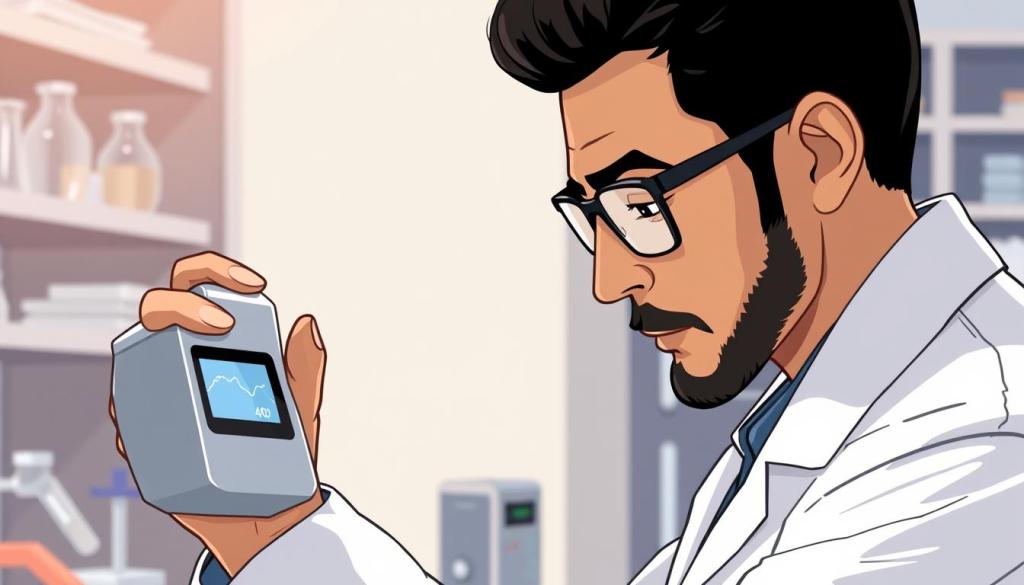
Understanding the 40 in RNA NanoDrop means knowing a special conversion factor for RNA. This number helps scientists figure out the exact RNA concentration in their samples.
Defining the 40 Value in RNA Measurement
The 40 factor is a specific conversion constant for RNA concentration. If a sample has an absorbance of 1 at 260 nm, it means a concentration of 40 ng/µl. This standard makes it easy for researchers to calculate RNA quantities during their work.
Typical Concentration Ranges for RNA Samples
- Low concentration: Less than 20 ng/µl
- Moderate concentration: 20-100 ng/µl
- High concentration: Above 100 ng/µl
Implications of Concentration Values
The RNA concentration measurement greatly affects research results. Low values might show poor sample quality or not enough extraction. On the other hand, very high concentrations could mean contamination or degradation.
| Concentration Range | Research Implications |
|---|---|
| Below 20 ng/µl | Potential insufficient sample for downstream applications |
| 20-100 ng/µl | Optimal range for most molecular biology techniques |
| Above 100 ng/µl | May require dilution before further analysis |
“Accurate RNA concentration measurement is the foundation of reliable molecular research.” – Genomics Research Consortium
Researchers must carefully understand the 40 value in RNA NanoDrop readings. This ensures the highest quality in scientific investigation.
How to Interpret the 40 Value in a NanoDrop Reading
Understanding NanoDrop is key for RNA analysis. Scientists use special techniques to check the quality and amount of RNA. This is done with great accuracy.
Looking at NanoDrop readings means checking important details. These details help know if the sample is pure and good quality.
Contextualizing RNA Purity Measurements
When looking at RNA samples, scientists look at certain numbers. These numbers show how good the sample is:
- Concentration accuracy
- Purity ratios
- Potential contaminant detection
Key Interpretation Strategies
The 40 value is very important for RNA quality. Scientists use special ways to check this value:
- Look at the A260/A280 ratio
- Check the A260/A230 ratio
- See the absolute concentration
| Metric | Ideal Range | Interpretation |
|---|---|---|
| A260/A280 Ratio | 1.8 – 2.1 | Shows RNA purity |
| A260/A230 Ratio | 2.1 – 2.3 | Means little contaminants |
| Concentration | 20-100 ng/μl | Best measurement range |
“Precise RNA quantification is the foundation of reliable molecular biology research.”
NanoDrop tests quickly and accurately check RNA samples. This helps scientists make smart choices for their research.
The Role of NanoDrop in RNA Research
Molecular biology techniques have changed science a lot. NanoDrop spectrophotometers are key for precise RNA analysis. They help scientists get quick and accurate results, leading to big discoveries in genomics and transcriptomics.
Applications in Genomics and Transcriptomics
NanoDrop spectrophotometers are very important in many research areas. Scientists use them for important tasks like:
- Gene expression studies
- RNA sequencing library preparation
- Microarray experiment validation
- Quality control of RNA samples
Enhancing Reproducibility in Experiments
Getting accurate RNA analysis is key for reliable experiments. NanoDrop technology has special benefits:
- Measures nucleic acid concentrations with high precision
- Needs only a little sample (1-2 μL)
- Gives fast results in under 1 minute
- Works with concentrations from 2 ng/μL to 15,000 ng/μL
“Precision in RNA quantification is the cornerstone of reliable scientific research.” – Genomics Research Institute
NanoDrop spectrophotometers help scientists check RNA purity and amount fast. They are essential in today’s molecular biology labs. They drive new discoveries and innovation.
Troubleshooting Common Issues with RNA Measurements
Getting precise RNA measurements is all about paying attention to many details. Scientists using nanodrop methods need to know about common problems. These issues can affect how well samples are prepared and how accurate the results are.
Common Sources of Error in RNA Extraction Protocols
Researchers often face several big challenges when they measure RNA:
- Sample contamination
- Improper sample handling
- Degradation of nucleic acids
- Inconsistent blanking procedures
Tips for Accurate RNA Testing
There are smart ways to make RNA measurements more reliable:
- Use ultra-pure water for dilutions
- Clean spectrophotometer surfaces between measurements
- Store RNA samples at appropriate temperatures
- Validate sample integrity before analysis
“Precision in RNA extraction protocols begins with meticulous sample preparation and careful measurement techniques.”
Maintenance of NanoDrop Equipment
Keeping your equipment in top shape is crucial for consistent results. Here’s what to do:
- Monthly calibration checks
- Regular cleaning of measurement surfaces
- Updating software and firmware
- Protecting equipment from environmental contaminants
By knowing about common problems in nanodrop methods, researchers can improve their RNA measurement techniques. This helps keep scientific quality high.
Best Practices for Sample Preparation
Getting good RNA samples starts with careful preparation. The quality of RNA extraction is key to getting accurate results. This affects the whole experiment.
Good sample prep means following a few important steps. These steps help get high-quality RNA and reliable results.
Importance of Clean Samples
Clean RNA samples are crucial for accurate NanoDrop measurements. Any contamination can mess up your research. It can also ruin the trustworthiness of your findings.
- Minimize potential RNA degradation
- Reduce interference from proteins and other cellular components
- Ensure precise concentration measurements
Recommended Protocols for RNA Extraction
Good RNA extraction needs careful attention to several details:
- Use RNase-free materials and workspace
- Select the right extraction method for your sample
- Keep your sample handling consistent
“The purity of your RNA sample determines the reliability of your research outcomes.”
| Parameter | Recommended Value |
|---|---|
| Sample Volume | 1-2 μL |
| Storage Temperature | -80°C |
| Freeze/Thaw Cycles | Minimize to prevent degradation |
| Resuspension Medium | RNase-free water or 1X TE |
Using strict RNA analysis methods makes research more reliable. It also makes results more consistent.
Advances in NanoDrop Technology
Spectrophotometry is getting better, making big steps in molecular biology. The nanodrop spectrophotometer is key for precise nucleic acid measurements.
New tech is changing how scientists measure RNA. These advancements are making measurements more accurate and opening up new research areas.
Innovations in Measurement Techniques
Today’s nanodrop spectrophotometers have amazing features:
- They can measure eight samples at once
- Need only 1-2 µL of sample
- Can get results in under 20 seconds
- Have advanced ways to spot contamination
Future Trends in Spectrophotometry
New trends in spectrophotometry are changing molecular biology:
| Technology | Key Advancement |
|---|---|
| Acclaro Technology | Precise nucleic acid contamination correction |
| Spectrum Range | Extended wavelength detection (220-750 nm) |
| Software Integration | Enhanced diagnostic and archival capabilities |
The future of nanodrop spectrophotometry is about more precision, quicker results, and better contamination detection.
“Technological innovations are transforming our understanding of molecular biology research techniques.” – Scientific Research Quarterly
Now, researchers get more reliable results faster. The ongoing updates in nanodrop spectrophotometer tech keep expanding scientific horizons.
Real-World Applications of RNA NanoDrop Readings
RNA NanoDrop readings are key in many scientific fields. They help researchers get precise RNA concentration. This is vital for molecular biology and genetic studies.
Scientists use the 40 in RNA NanoDrop to check sample quality. It tells them about nucleic acid purity and how much is there.
Breakthrough Case Studies in Research
Many important research projects show how crucial RNA quantification is:
- Cancer genomics investigations
- Genetic disease diagnostics
- Personalized medicine development
- Evolutionary biology studies
Impact on Research Outcomes
Accurate RNA concentration helps researchers a lot:
- It makes sure experiments can be repeated
- It reduces sample differences
- It improves molecular analysis
Accurate RNA quantification is the foundation of reliable scientific discovery.
Concentration Performance Analysis
| RNA Concentration Range | Measurement Reliability | Research Application |
|---|---|---|
| 1-20 ng/µl | Low Reliability | Limited Experimental Use |
| 20-50 ng/µl | Moderate Reliability | Preliminary Studies |
| 50-150 ng/µl | High Reliability | Advanced Research |
Understanding the 40 in RNA NanoDrop readings helps researchers make better choices about sample quality and experimental design.
Conclusion: The Importance of Understanding the 40 Value
Measuring RNA concentration is key in molecular biology. It’s a detailed process that needs careful attention. Accurate RNA measurements are the base for new scientific findings.
The 40 value helps scientists understand their sample’s quality. It’s vital for reliable results in molecular biology. This knowledge helps avoid mistakes and makes research more consistent.
Key Takeaways in RNA Analysis
Getting RNA measurements right takes a lot of focus and knowledge of spectrophotometry. It’s important to check RNA samples well to get good data. The 40 value shows if a sample is pure and ready for experiments.
Advancing Research Practices
Using the best methods for RNA measurement makes research more trustworthy. Keeping up with new techniques leads to more discoveries. It helps us understand complex life systems better.
FAQ
What is the 40 factor in RNA NanoDrop measurements?
The 40 factor is a special number used in RNA concentration calculations on NanoDrop spectrophotometers. It helps researchers figure out how much RNA is in a sample. This is done by changing the absorbance readings at 260 nm into exact RNA amounts.
How does a NanoDrop spectrophotometer work?
A NanoDrop spectrophotometer uses UV-Vis spectroscopy to measure RNA concentrations. It only needs 1-2 µL of sample. It uses a special method to keep the sample in place, so you don’t need cuvettes. This makes it quick and accurate for measuring nucleic acids.
What does the 260/280 ratio indicate about RNA purity?
The 260/280 ratio shows how pure RNA is. A pure RNA sample usually has a ratio of about 2.0. If the ratio is lower, it might mean there’s protein contamination. If it’s higher, it could mean there are other contaminants.
What are typical concentration ranges for RNA samples?
RNA samples usually have concentrations between 20-500 ng/µL. If your sample is outside this range, you might need to dilute or concentrate it. This ensures you get accurate measurements for your experiments.
How can I ensure accurate RNA measurements with NanoDrop?
To get accurate RNA measurements, follow these steps: use RNase-free water for blanking, check your sample’s purity, avoid bubbles or fingerprints, clean the measurement pedestal, and validate your results. Also, use multiple measurements and other methods for confirmation.
What are common sources of error in RNA NanoDrop measurements?
Errors can come from contamination, bad sample preparation, salts from extraction, protein interference, degraded RNA, and wrong blanking. To avoid these, handle your samples carefully, use good extraction methods, and stick to strict protocols.
When should alternative quantification methods be considered?
Use other methods like fluorometric assays (e.g., Qubit) for low-concentration samples, samples with contaminants, or when you need very high precision. This is especially true for important applications like next-generation sequencing.
How do I interpret variations in NanoDrop RNA readings?
To understand NanoDrop RNA readings, look at the 260/280 and 260/230 ratios, check the concentration, and assess the sample’s purity. Big differences from expected values might mean contamination, degradation, or the need for more purification before your experiments.






Leave a Comment
Your email address will not be published. Required fields are marked *