



Ever wondered how scientists separate tiny particles with such precision? The answer lies in the centrifuge. These machines use centrifugal force to change how we do research and tests.
Centrifuges spin samples at incredible speeds, up to 150,000 times a minute. This lets researchers sort out substances by their density. They create strong forces that can separate things that wouldn’t mix otherwise.
Labs in many fields use these machines to get, clean, and study complex samples. They’re key in medical tests and new research. Centrifuges are vital for finding new things in science.
Key Takeaways
- Centrifuges use centrifugal force to separate substances
- Top spinning speeds can reach 150,000 revolutions per minute
- Essential equipment in medical and scientific research
- Enables precise separation of microscopic particles
- Applicable across multiple scientific disciplines
What is a Centrifuge?
A centrifuge is a key scientific tool used for separating different parts of a mixture. It works by spinning the mixture fast. This creates forces that help sort out particles based on their size and weight.
In science labs, centrifuges are crucial for studying and preparing samples. They use strong forces to pull apart tiny particles from liquids. This makes it easier for scientists to focus on what they need to study.
Fundamental Definition
A centrifuge spins samples at high speeds. This creates a force that’s much stronger than gravity. It helps separate heavier particles from lighter ones, which is very useful in research.
- Generates forces up to several thousand times Earth’s gravity
- Allows precise separation of microscopic particles
- Used in biological, medical, and industrial research
Historical Evolution
The history of centrifuges started in the 1800s. In 1864, Antonin Prandtl made the first commercial centrifuge for milk. By 1869, Friedrich Miescher used it to study cell parts in labs.
“The centrifuge revolutionized scientific research by providing unprecedented ability to separate complex mixtures.” – Scientific Innovations Journal
| Decade | Technological Milestone |
|---|---|
| 1860s | First dairy industry applications |
| 1900s | Initial laboratory research implementations |
| 1950s | Advanced scientific separation techniques developed |
Today, centrifuges are much more advanced. They can separate particles with great precision in many fields of science.
How Does a Centrifuge Work?
Centrifuges are amazing tools that use strong physical forces to separate materials by density. They make complex scientific tasks simple by using advanced engineering.

The Science Behind Centrifugation
Centrifugation works on the idea of centrifugal force. When a centrifuge spins fast, it creates a strong force that separates materials. The speed at which it spins is key to how well it separates things.
- Particle density
- Sample viscosity
- Distance of particle displacement
- Rotational speed
Key Components of a Centrifuge
A centrifuge has important parts that work together for precise separation:
- Motor: Gives the spinning motion
- Rotor: Holds sample tubes while spinning
- Sample tubes: Where materials to be separated go
“Centrifugation transforms complex mixtures into precisely separated components through controlled rotational force.”
The speed at which a centrifuge spins is very important. Lab centrifuges spin between 1,000 and 30,000 RPM. This allows scientists to separate materials very accurately.
Types of Centrifuges
Centrifuges are key in labs for different research needs. Knowing the types helps scientists pick the right one for their work.
Many centrifuge designs help scientists separate samples well. Each type is good for different scientific tasks.
Fixed-Angle Centrifuges
Fixed-angle centrifuges keep tubes at a 45-degree angle while spinning. They are great for:
- Blood plasma separation
- Isolating cells
- Getting proteins out of solutions
Fixed-angle rotors are good at collecting particles without messing up the sample too much.
Swinging-Bucket Centrifuges
Swinging-bucket centrifuges have tubes at a 90-degree angle during spin. They are known for:
- Handling big sample volumes
- Less sample squishing
- Better separation
Microcentrifuges
Microcentrifuges are small and made for tiny samples. They spin really fast:
- Speed range: 12,000-13,000 RPM
- Perfect for molecular biology
- Accurate sample handling
Scientists choose the right centrifuge for their research. This ensures the best sample preparation and analysis in many fields.
Applications of Centrifuges in Laboratories
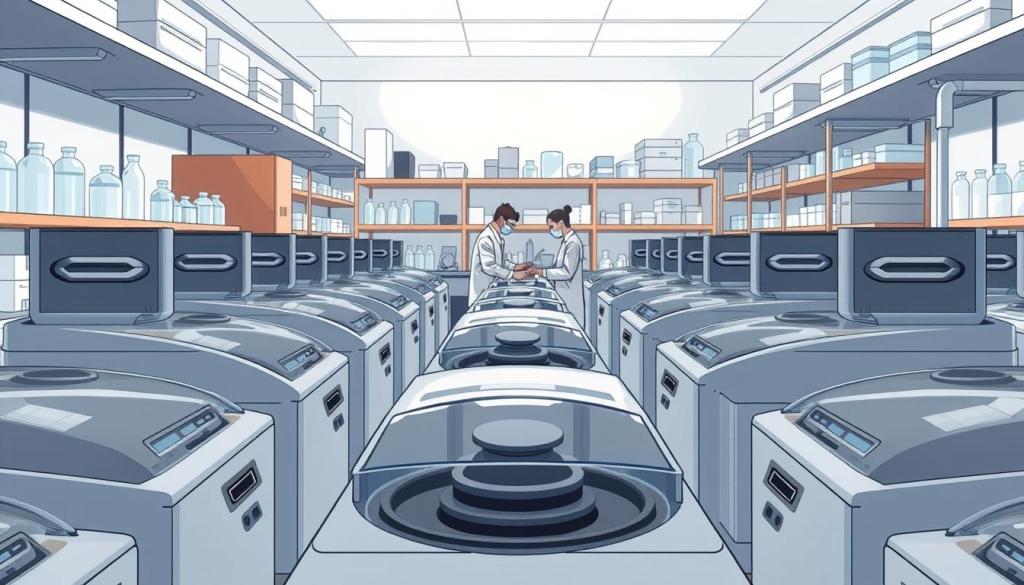
Centrifuges are key in science, medicine, and industry. They help separate and analyze complex mixtures with great accuracy.
Biological Research Insights
In biology, centrifuges are vital for studying cells and molecules. Scientists use them for:
- Cell collection and isolation
- Organelle purification
- Virus particle extraction
- Protein separation
- Nucleic acid purification
Clinical Applications in Diagnostics
Medical labs use centrifuges for precise tests. They help doctors:
- Separate blood components
- Analyze biological samples
- Do detailed medical research
Industrial and Biotechnology Uses
Centrifuges are also used in industries:
| Industry | Centrifugation Application |
|---|---|
| Pharmaceutical | Drug development and purification |
| Food Processing | Fat separation and milk processing |
| Biotechnology | Protein and enzyme extraction |
“Centrifugation represents a fundamental technique that bridges scientific discovery with practical applications across multiple disciplines.” – Scientific Research Journal
Today’s centrifuges can spin at incredible speeds. Some can reach forces up to 1,000,000g. This allows for deep analysis of molecules and cells.
The Importance of Centrifuge Speed
Understanding rotational speed is key in lab centrifugation. The right centrifugal force is needed for good sample separation in science.
Centrifuge speed is vital in science. It affects how good and reliable your results are. Choosing the right speed is crucial for the best sample separation.
Understanding RPM and RCF
Two important metrics show how well a centrifuge works:
- RPM (Revolutions Per Minute): How many times the rotor spins in a minute
- RCF (Relative Centrifugal Force): Measured in gravity units (×g)
“The relationship between RPM and RCF is fundamental to precise scientific separation techniques.”
Impact on Sample Separation
Different samples need different centrifugal forces for good separation:
- Bacterial cells: 2,000-10,000 × g
- Mammalian cells: 500-2,000 × g
- Ultracentrifuge applications: Up to 1,000,000 × g
The force needed depends on the sample’s mass and how fast it spins. For accurate results, these must be carefully set.
| Centrifuge Type | Maximum G-Force | Typical Application |
|---|---|---|
| Microcentrifuge | 14,000-30,000 × g | Small volume sample processing |
| Floor-standing Centrifuge | Less than 10,000 × g | General laboratory separations |
| Ultracentrifuge | 300,000-1,000,000 × g | Advanced research applications |
Choosing the right speed is essential for keeping samples intact and getting reliable results.
Safety Considerations for Centrifuge Use
Centrifuges need careful handling to avoid accidents and work well. The Occupational Safety and Health Administration (OSHA) says most accidents come from user mistakes. So, safety rules are key in science.
Following safety rules is crucial for good centrifuge use. Scientists must take steps to keep people safe and research quality high.
Essential Safety Protocols
- Wear the right Personal Protective Equipment (PPE)
- Check the lab equipment before using it
- Make sure tubes fit and are in good shape
- Ensure samples are balanced
Critical Maintenance Practices
Keeping centrifuges in good shape is important. Researchers should keep a detailed maintenance log. It should track:
| Maintenance Parameter | Recommended Action |
|---|---|
| Rotor Inspection | Look for corrosion or damage |
| Rotor Lifespan | Change it when the maker says to |
| Operation Logs | Write down run dates, speeds, and total spins |
“Safety is not an accident. It’s a deliberate and continuous process in scientific research.” – Laboratory Safety Expert
Emergency Procedures
If you hear strange noises or feel vibrations, stop the centrifuge right away. For spills of hazardous materials, keep the centrifuge lid closed for at least 30 minutes. This helps prevent aerosol risks.
Remember: Proper training and careful use are the basics of safe lab equipment.
Common Centrifuge Protocols
Centrifugation is key in lab work. It uses density gradients to separate biological parts. Scientists follow precise steps to get the right materials.
Lab experts use special centrifugation methods for various goals. These methods need careful planning and a grasp of how things separate.
Blood Serum Separation Protocol
The blood serum separation process has important steps:
- Collect fresh blood in the right tube
- Let blood clot for 30 minutes at room temperature
- Centrifuge at 1,000-3,000 RPM for 10 minutes
- Extract the clear serum layer carefully
DNA Extraction Protocol
DNA extraction needs careful centrifugation:
- Make cell lysate with a special buffer
- Spin at 10,000 RPM to separate debris
- Move the clear part to a new tube
- Use alcohol to precipitate DNA
- Final spin to get the clean DNA
Protein Purification Protocol
Protein purification uses advanced methods:
| Step | Centrifugation Parameters | Purpose |
|---|---|---|
| Cell Disruption | 3,000 RPM, 15 minutes | Remove big cell pieces |
| Differential Centrifugation | 10,000-50,000 RPM | Separate protein parts |
| Final Purification | High-speed spin, 60,000 RPM | Get pure protein |
“Precision in centrifugation determines the quality of scientific outcomes.” – Laboratory Research Handbook
Knowing these protocols helps researchers use separation techniques well. This is crucial for their scientific work.
Troubleshooting Centrifuge Issues
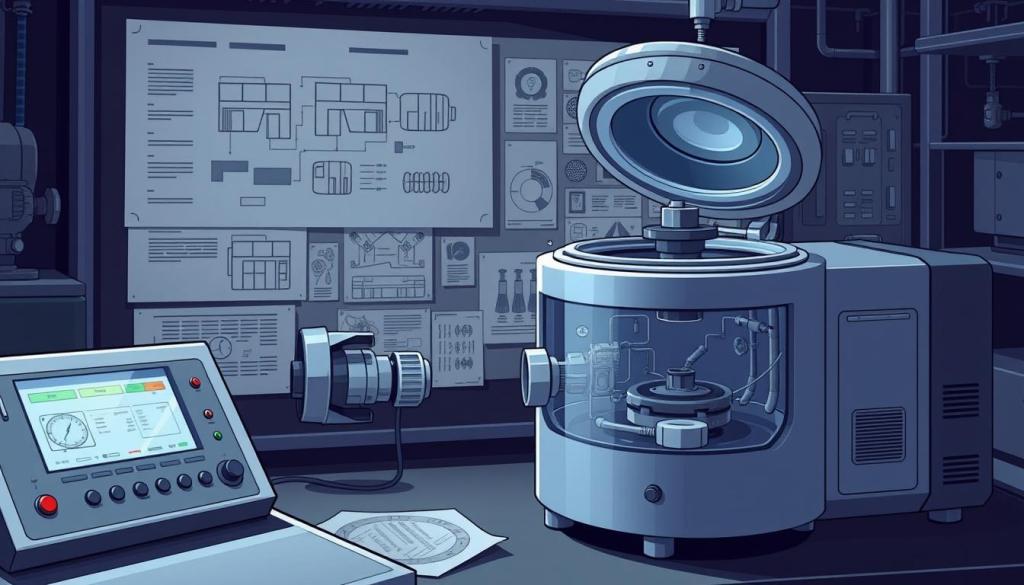
Laboratory equipment, like centrifuges, can face many problems. These issues can affect how well they work and how reliable they are. Knowing about these problems helps researchers keep their centrifuges running smoothly and avoid breakdowns.
Identifying Common Problems
Centrifuges can show signs of trouble that need quick action. It’s important for researchers to watch for these signs to keep their work running smoothly.
- Power supply interruptions causing blank displays
- Excessive vibration during rotation
- Unusual grinding or squeaking noises
- Failure to reach designated speed
- Unexpected overheating
Solutions and Best Practices
Using regular maintenance can help avoid many centrifuge problems. Regular checks and careful use are key to keeping equipment in good shape.
Prevention is always more cost-effective than reactive repairs in laboratory equipment management.
| Issue | Potential Cause | Recommended Action |
|---|---|---|
| Power Failure | Electrical connection problems | Check power cord and circuit breaker |
| Excessive Vibration | Unbalanced load | Redistribute samples evenly |
| Unusual Noises | Worn bearings | Professional equipment inspection |
Managing centrifuges well needs careful attention every day. Experts say to do a full check-up every six to twelve months. This keeps them working well and safely.
Innovations in Centrifuge Technology
The world of lab equipment is always changing, with big steps in centrifuge tech. Today, scientists need fast, precise, and reliable tools for their work.
New designs in centrifuges are opening up new ways to explore science. These advancements make it easier to process samples and do detailed analyses.
Breakthrough Design Innovations
- Enhanced temperature control systems with accuracy of ±1℃
- Advanced rotor designs achieving speeds up to 17,500 rpm
- Precision amplitude measurements as low as 0.003 mm
- Automatic rotor recognition for improved safety
Emerging Applications in Scientific Research
Centrifuge tech is now used in many scientific fields, opening up new research areas.
| Research Field | Innovative Application |
|---|---|
| Nanotechnology | Precise particle separation |
| Materials Science | Advanced molecular sorting |
| Biotechnology | Rapid sample processing |
*”Innovation in centrifuge technology is not just about speed, but about unlocking new scientific possibilities.”*
New lab equipment is amazing. It can cool down from room temperature to 4°C in just 4 minutes. It can also apply forces of up to 32,531 xg. These changes are huge for science.
Future Potential
Centrifuge tech is getting even better, with more advanced tools coming. Smart control systems have already cut down on mistakes by 30%. This means scientists can do their work more reliably and efficiently.
Conclusion: The Essential Role of Centrifuges in Science
Centrifuges have changed the game in science and medicine. They do more than just separate things. They help scientists understand complex stuff in fields like biochemistry and medical tests.
These tools are key to making new discoveries. They use spinning to sort out tiny particles by weight. This is super helpful for studying blood and finding virus parts.
Summary of Key Functions
Centrifuges are super versatile. They’re used in labs, factories, and research places. The fastest ones spin at 150,000 RPM, helping scientists see tiny details.
They’re used in many areas, like science, water cleaning, and nuclear studies. These machines help us learn more about the world.
Future Directions in Centrifuge Use
New tech is making centrifuges even better. Now, they can be set up to do things automatically. They also have new ways to separate stuff.
As science gets more complex, centrifuges will keep getting better. They’ll help us make new discoveries and push the limits of what we know.
FAQ
What is the primary function of a centrifuge?
A centrifuge is a device used in labs. It separates substances by spinning them fast. This helps researchers find different parts of a sample based on their size and weight.
How does a centrifuge work?
A centrifuge spins samples at high speeds. This creates a force that pushes heavier particles to the bottom. The speed of the spin affects how well the separation works.
What are the main types of centrifuges?
There are mainly three types of centrifuges. Fixed-angle, swinging-bucket, and microcentrifuges. Each is used for different tasks, like in labs or for small samples.
Where are centrifuges commonly used?
Centrifuges are used in many places. They’re found in labs, for making medicines, and in industry. They help separate blood, extract DNA, and purify proteins.
What safety precautions are important when using a centrifuge?
When using a centrifuge, safety is key. Make sure samples are balanced and rotors are right. Don’t overload it and always seal tubes well. Follow the maker’s rules for speed and what to use.
How do RPM and RCF differ in centrifugation?
RPM shows how fast a centrifuge spins. RCF shows the force it applies. RCF is more important because it changes with the size of the centrifuge.
What are some common centrifugation protocols?
There are many uses for centrifuges. They’re used to separate blood, extract DNA, purify proteins, and more. Each task needs a specific speed and time.
How do researchers choose the right centrifuge?
Choosing a centrifuge depends on what you need. Look at the sample size, speed, and if it can handle your research. It also matters for clinical or industrial use.
What recent innovations exist in centrifuge technology?
New centrifuges have better temperature control and designs. They also have digital interfaces and work with other lab tools. This makes work easier and more efficient.
How can centrifuge problems be troubleshot?
Fixing centrifuge issues starts with checking balance and rotors. Make sure it’s well-maintained and not vibrating. Check electricals and follow cleaning and calibration steps.





Leave a Comment
Your email address will not be published. Required fields are marked *