



Imagine a simple plastic tray changing the game in science. Well plates are the hidden stars of lab work, making a big difference in many fields.
Cell culture plates, or microplates, are high-tech tools for scientists. They help run complex tests efficiently. These tools create controlled spaces for studying samples, drug effects, and cell actions.
Well plates have many wells for testing different things at once. Their design helps scientists do more with less, saving time and resources.
Key Takeaways
- Well plates are critical tools in modern scientific research
- Microplates support multiple experimental conditions simultaneously
- Different well plate designs accommodate various research needs
- These platforms enhance experimental precision and efficiency
- Cell culture plates enable breakthrough scientific investigations
Introduction to Well Plates in Research
Scientific research has seen a big change with new lab tools. Well plates, like tissue culture and microtiter plates, are key to this change. They help scientists do complex studies in many fields.
Definition of Well Plates
A well plate is a flat plate with many small wells for samples. These containers come in different sizes. This lets scientists do many experiments at once.
- 6-well plates for larger sample volumes
- 24-well plates for moderate-scale experiments
- 96-well plates for high-throughput screening
- 384-well plates for advanced research techniques
- 1536-well plates for ultra-precise studies
Importance in Laboratory Settings
Well plates make research faster and more precise. They let scientists test many things at once. This saves a lot of time and resources.
The 96-well plate is especially popular. It works well for both manual and automated research.
Types of Well Plates Available
| Well Plate Type | Typical Volume Range | Primary Applications |
|---|---|---|
| 24-well Plate | 0.5 – 3 mL | Initial screening, cell culture |
| 96-well Plate | 0.1 – 0.3 mL | High-throughput screening |
| 384-well Plate | 0.03 – 0.1 mL | Advanced research techniques |
Each type of microtiter plate has its own benefits. This lets researchers pick the best one for their needs.
“The microplate has become an indispensable tool in modern scientific research, enabling unprecedented levels of experimental precision and efficiency.” – Laboratory Research Innovation Journal
Key Features of Well Plates
Laboratory researchers use special microwell plates. These plates have precise engineering and advanced materials. Knowing the key features helps scientists pick the right cell culture dish for their experiments.
Material Composition
Well plates are made from special polymers for the best performance. The main materials are:
- Polystyrene: The standard for most cell culture work
- Polypropylene: Better chemical resistance
- Polycarbonate: Very durable
- Cyclo-olefins: Great for advanced optical properties
Surface Treatment Techniques
Surface treatments are key for cell adhesion and results. Different treatments affect how cells behave:
- Tissue culture-treated surfaces help cells stick better
- Hydrophilic coatings improve protein binding
- Non-treated surfaces stop unwanted cell interactions
“The right surface treatment can make or break a cell culture experiment.” – Research Laboratory Insights
Magnetics and Stability Considerations
Modern microwell plates have advanced features for precise experiments. Magnetic properties and stability are vital for reliable results.
- Bottom thickness (optimal range: 170 ± 20 µm)
- Well geometry (round, square, or rounded-square)
- Temperature and solvent resistance
- Compatibility with automation systems
Choosing the right well plate means looking at these key features. This ensures successful scientific studies.
Types of Well Plates Used in Cell Culture
Cell culture research uses special well plates for different needs. Scientists pick the right well plate design for their experiments. Each type of microplate has special features for specific research goals.
Standard Tissue Culture Plates
Standard tissue culture plates are key for growing cells and doing research. They have:
- A surface made of polystyrene for cell adhesion
- Areas ranging from 1.9 cm² to 84 cm² per well
- Best for cells that stick to surfaces
- Comes in various sizes (6-well, 12-well, 24-well)
Microtiter Plates
Microtiter plates are versatile for many experiments. They have:
- Ability to screen many samples at once
- Many well sizes (96-well, 384-well)
- Can hold volumes from 500 µL to 5.0 ml
- Various bottom shapes: F-bottom, U-bottom, V-bottom
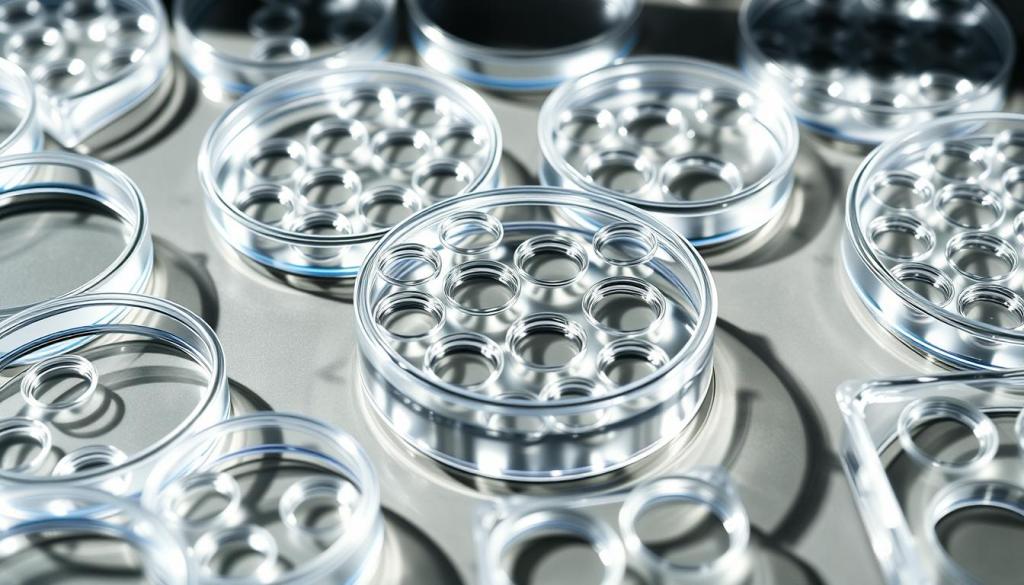
3D Cell Culture Plates
3D cell culture plates are new and offer better environments for cells. They support:
- Cell interactions that feel more natural
- Growth that’s closer to real tissue
- Research in cancer and regrowing tissues
| Plate Type | Surface Area | Well Configurations | Key Applications |
|---|---|---|---|
| Standard Tissue Culture | 1.9-84 cm² | 6, 12, 24 wells | Adherent Cell Growth |
| Microtiter | 1.1-10.5 cm² | 48, 96, 384 wells | High-Throughput Screening |
| 3D Cell Culture | Varies | Multiple formats | Advanced Cellular Research |
Applications of Well Plates in Laboratory Research
Well plates are now key tools in science, changing how we do experiments. They help researchers do complex tests with great accuracy and speed.
Drug Discovery Processes
Microtiter plates are vital in finding new medicines. They let scientists test many chemicals at once. This is done in 96-well and 384-well plates.
- Screen thousands of molecular compounds rapidly
- Evaluate potential drug candidates efficiently
- Minimize reagent consumption
- Maximize experimental throughput
Toxicology Studies
In toxicology, cell culture plates are crucial. They help scientists see how substances harm cells. These plates help measure how cells react to chemicals.
| Plate Type | Application | Key Advantage |
|---|---|---|
| 96-well plate | Cytotoxicity screening | High-density sample testing |
| 384-well plate | Detailed toxicity assessment | Reduced sample volume requirements |
Genetic Research Applications
Well plates are used a lot in genetic studies. They’re used for PCR and DNA sequencing. Their standard design helps get the same results over and over.
“Well plates have transformed genetic research by providing a standardized, efficient platform for molecular analysis.”
Well plates keep helping science grow. They let researchers explore new areas in medicine and biology.
Choosing the Right Well Plate for Your Experiments
Choosing the right multi-well plate is key for good lab research. It’s important to look at many factors for the best results. The right microwell plate selection can greatly affect your research’s quality and trustworthiness.
Critical Selection Considerations
When picking an assay plate, consider these important points:
- What your experiment needs
- How much sample you’ll use
- The method you’ll use to detect results
- Your budget
Compatibility with Experimental Protocols
Different well plates have their own benefits. You need to pick a plate that fits your experiment’s needs:
- 96-well plates work well for standard amounts (50-200 μL)
- 1536-well plates are good for small amounts (1-10 μL)
- Some plates have special surfaces for certain cell needs
Budgetary and Performance Considerations
Cost-effectiveness doesn’t mean you have to sacrifice quality. Think about:
- How the plate looks (black vs. white)
- The plate’s thickness for imaging
- The material it’s made of
Picking the right well plate can be the difference between success and failure in your experiments.
Companies like Greiner Bio-One and Porvair Sciences make specialized plates. They help researchers find the perfect plate for their studies.
Well Plate Dimensions and Volumes
Researchers need precise well plates for their experiments. Knowing the sizes and volumes of cell culture dishes and microplates is key for success in the lab.

Standard Sizes in the Market
Well plates come in many standard sizes for different research needs. The most common include:
- 6-well plates: 9.6 cm² per well
- 12-well plates: 3.5 cm² per well
- 24-well plates: 1.9 cm² per well
- 48-well plates: 1.1 cm² per well
- 96-well plates: 0.32 cm² per well
Volume Configurations
Volume capacity changes a lot among different well plates. Researchers can pick from various volume ranges:
- Minimal volume: 50-100 µL
- Standard volume: 100-500 µL
- Extended volume: 500 µL – 5 mL
Custom Options Available
Many makers offer special cell culture dishes and microplates. These custom options include:
- Specialized bottom shapes (flat, round, conical)
- Surface treatments for better cell adhesion
- Color variations for different needs
“Selecting the right well plate is critical for obtaining reliable and reproducible research results.” – Laboratory Research Expert
Researchers should think about their specific needs when picking well plates. This ensures the best performance and data quality.
Well Plate Care and Maintenance
Laboratory researchers know how vital it is to take care of cell culture and microtiter plates. Keeping these tools in good shape is key to reliable results and successful research.
Keeping tissue culture plates in top condition involves several important steps. These practices help protect your research and make your equipment last longer.
Proper Cleaning Techniques
Cleaning well plates needs careful attention. Here are some steps to follow:
- Rinse plates right after use with sterile water
- Use gentle, non-corrosive cleaners
- Stay away from rough materials that might scratch the plates
- Try UV treatment for extra sterilization
Storage Guidelines
Storing cell culture plates correctly is key to keeping them in good shape and preventing contamination:
| Storage Condition | Recommended Practice |
|---|---|
| Temperature | Room temperature or 4°C |
| Humidity | Low humidity environment |
| Protection | Sealed container to prevent dust accumulation |
Handling Protocols
Being careful when handling microtiter plates helps avoid contamination and damage:
- Always wear clean, sterile gloves
- Move plates gently
- Don’t touch the bottom or inside surfaces
- Use covers when not in use
Proper maintenance can extend a well plate’s life. Some researchers reuse them for up to a year with strict cleaning.
Remember, every step in caring for plates affects the quality and trustworthiness of your scientific work.
Innovations in Well Plate Design
Laboratory research is evolving fast with new multi-well plate technology. Scientists are creating advanced solutions. These changes are changing how experiments are done and how complex science is managed.
Today’s microwell plate designs are changing science with big tech leaps. Now, researchers have tools that make experiments more precise and quick.
Recent Technological Advancements
The newest assay plate tech brings big science boosts:
- Enhanced surface treatments for better cell adhesion
- Less pipetting mistakes with new designs
- Quicker sample ID
Eco-Friendly Material Developments
Now, making well plates is all about being green. Scientists use top-notch polypropylene. It’s good for:
- Chemical resistance
- Being tough
- Staying stable in temperature
Automation System Integration
Today’s multi-well plates work great with lab automation. They help with:
- Better screening
- More reliable results
- Quicker research
| Feature | Performance Metric | Improvement |
|---|---|---|
| Sample Identification | Speed | Up to 30% faster |
| Pipetting Accuracy | Error Reduction | Up to 30% reduction |
| Centrifugation Stability | Maximum G-Force | 6,000 x g |
These new features are a big step up for science. They make experiments more accurate and efficient.
The future of lab work is all about new tech and green design.
Troubleshooting Common Issues with Well Plates
Researchers often face problems when using microplates in cell-based assays. Knowing how to solve these issues can make experiments more reliable and successful.
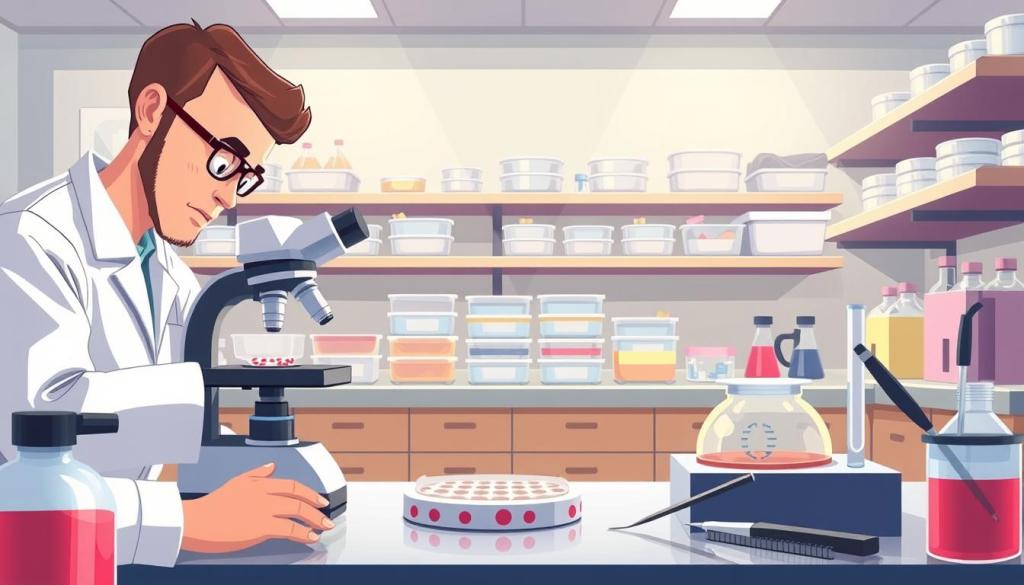
Lab experts need to be ready for various issues that can affect well plates and results.
Identifying Contamination
Contamination is a big problem in cell culture and microplate research. Look out for these signs:
- Unexpected color changes in growth media
- Unusual turbidity or cloudiness
- Visible microbial growth
- Sudden changes in cell morphology
“Preventing contamination is more effective than treating it after the fact.” – Laboratory Best Practices Guide
Dealing with Poor Cell Adhesion
Problems with cell adhesion can mess up cell-based assays. Here are some solutions:
- Selecting the right surface-treated well plates
- Optimizing coating techniques
- Checking cell density and seeding protocols
- Verifying media composition
Solutions for Uneven Cell Growth
Uneven cell growth can ruin results in microplate research. Here’s how to fix it:
- Ensuring uniform temperature distribution
- Using precise pipetting techniques
- Rotating plates during incubation
- Checking CO2 levels and humidity
By using these troubleshooting tips, scientists can reduce experiment errors and improve well plate research.
Regulatory Standards for Well Plates
Laboratory research needs precise standards for reliable scientific experiments. Cell culture and microtiter plates must follow strict rules. These rules ensure the accuracy and reproducibility of experiments.
Compliance Requirements in Research
Researchers using tissue culture plates must follow certain standards. The main rules include:
- ANSI/SLAS 1-2004 through 4-2004 standards
- International quality control protocols
- Specific laboratory safety guidelines
Quality Assurance Processes
Manufacturers of well plates have strict quality checks. These checks ensure their products are reliable. They include:
- Rigorous material testing
- Contamination screening
- Performance validation checks
Critical Certification Standards
Certifications are key to proving the quality of cell culture plates. Important certifications are:
- RNase-free certification
- DNase-free verification
- Pyrogen-free status
- DNA contamination assessment
“Precision in certification ensures the reliability of scientific research.” – Laboratory Standards Institute
The strict standards for microtiter plates help avoid errors. They make sure results are consistent and reliable in different labs.
Future Trends in Well Plates
The world of lab research is changing fast, with multi-well plates leading the way. New technologies are set to change how we do cell culture and experiments.
The global cell culture plates market is growing fast. It’s expected to jump from $2.21 billion in 2024 to $2.96 billion by 2029. This shows how much scientists need better assay plates for their work.
Emerging Technologies
New ideas are making microwell plates better:
- Organ-on-a-chip systems that mimic real biological settings
- Nanotechnology for better surface properties
- 3D cell culture platforms for more realistic studies
- Smart well plates with built-in sensors
Potential Market Growth
The well plates market is growing in many areas:
- Drug discovery, making up over 40% of the market
- Pharmaceutical research, with 43.2% market share
- Academic labs, with 29.1% of the market
Expected Innovations
Scientists look forward to big changes in multi-well plate tech, including:
- Custom plates for different cell types
- Better materials for cell growth
- Working with automated systems
- More focus on green, eco-friendly making
“The future of scientific research lies in the continuous refinement of our experimental tools” – Dr. Elena Rodriguez, Biotechnology Innovations Institute
The well plates market is expected to grow by 5.88% from 2024 to 2032. This growth will come from new tech and more research needs.
Conclusion: The Importance of Well Plates in Modern Science
Well plates have changed the game in science. They give researchers powerful tools for complex experiments. These dishes are key in many fields, from finding new drugs to studying genes.
Well plates do more than hold samples. They are a big step forward in science. They help save money on chemicals and make experiments more reliable. This lets scientists do many tests at once, speeding up their work.
Well plates will keep being crucial for new discoveries. They come in different sizes, from 96 to 1536 wells. This means scientists can pick the best size for their research. By using these tools well, scientists can make big strides in their work.
Key Research Innovations
The future of science depends on tools like well plates. They make it possible to do big, detailed studies. Scientists need to keep up with new tech and improve their methods to get the most out of these tools.
FAQ
What are well plates and why are they important in laboratory research?
Well plates are containers used in labs for cell culture and drug discovery. They help scientists run many tests at once. This makes research more efficient and accurate.
What materials are typically used to manufacture well plates?
Most well plates are made from polystyrene. It’s a plastic that works well with cells. Some plates have special coatings to help cells stick better.
How do I choose the right well plate for my specific experiment?
Choosing the right plate depends on your experiment. Think about the assay type, cell needs, and detection methods. Also, consider the plate’s material, surface, shape, and volume.
What are the different types of well plates available?
There are many types of plates. You have standard tissue culture plates and microtiter plates (96-well). There are also 3D cell culture plates and plates with different depths and treatments. Each is for a specific research need.
How can researchers prevent contamination in well plates?
To avoid contamination, use sterile techniques and work in a laminar flow hood. Wear the right gear and follow aseptic protocols. Choose plates that are free from RNase, DNase, and pyrogens. Proper storage and cleaning are key.
What innovations are emerging in well plate technology?
New advancements include better surface treatments and eco-friendly materials. There’s also integration with automated systems and technologies like organ-on-a-chip platforms. These innovations aim to improve research efficiency and accuracy.
How do surface treatments impact cell culture experiments?
Surface treatments greatly affect cell behavior in experiments. Treatments like plasma modification and protein coating can enhance cell adhesion. This helps maintain cell health and shape during experiments.
What regulatory standards apply to well plates?
Well plates must meet ANSI/SLAS standards. These ensure quality, accuracy, and performance. Manufacturers follow strict quality assurance and provide compliance certifications.
What volume configurations are available in well plates?
Well plates vary in volume, from microvolume to standard sizes. Some plates can handle nano to milliliter volumes. This variety meets different research needs.
How are well plates used in drug discovery processes?
In drug discovery, well plates are vital for high-throughput screening. They allow researchers to test many drugs at once. This helps in assessing toxicity, evaluating cellular responses, and optimizing drug leads.





Leave a Comment
Your email address will not be published. Required fields are marked *