



Ever wonder how a complex human body comes from tiny building blocks? The cell structure of human anatomy shows a world of biological engineering. It powers every part of our lives.
Humans have about 30 trillion cells, each a tiny living system. They range from tiny bacteria to large human cells. It would take about 10,000 human cells to cover a pinhead.
Learning about cell structure gives us deep insights into human anatomy. Our bodies have over 200 cell types, each with its own role. From keeping pH balance to sending signals, these tiny powerhouses keep us alive.
Key Takeaways
- The human body contains approximately 30 trillion cells
- Cells vary dramatically in size and function
- Over 200 distinct cell types exist in human anatomy
- Each cell operates as a complex, specialized biological system
- Cell structure is fundamental to understanding human health
Introduction to Human Cells
The human body is made up of trillions of cells. These cells work together to form the foundation of life. They are the building blocks of our bodies.
Cells are tiny but packed with amazing abilities. They have special parts that help them function. The cytoplasm, a jelly-like substance, surrounds these parts and helps with important processes.
Importance of Cell Structure
Learning about cell structure shows us how complex our bodies are. Cells are not just simple parts. They are complex systems with many parts:
- Nucleus: Contains genetic information (DNA)
- Mitochondria: Generates cellular energy
- Ribosomes: Synthesizes proteins
- Cytoskeleton: Maintains cell shape and movement
Overview of Cellular Composition
Our bodies have about 200 different cell types. Each cell is unique, from tiny sperm to large egg cells. They work together to help our bodies function.
Cells play a big role in keeping us healthy. Each cell is like a tiny ecosystem, doing its own job to keep us well.
Types of Cells in the Human Body
The human body is made up of eukaryotic cells that work together. There are about 50 to 100 trillion cells in our body. Each cell type has a unique role in keeping our systems running smoothly.
Learning about the different types of cells helps us understand how our bodies work. These cells are the foundation of life and keep us healthy.
Epithelial Cells: Protective Barriers
Epithelial cells cover the body’s surfaces, like the skin and organs. They do important jobs:
- Creating protective barriers
- Enabling absorption of nutrients
- Supporting secretion processes
Muscle Cells: Movement and Support
Muscle cells are divided into three main types:
- Skeletal muscle cells: Enable voluntary movements
- Cardiac muscle cells: Power heart contractions
- Smooth muscle cells: Line organs and blood vessels
Nerve Cells: Communication Networks
Neurons are key to the nervous system. The human brain has about 100 billion neurons. They send signals all over the body.
Blood Cells: Life-Sustaining Functions
Blood cells are vital for our health:
- Red blood cells: Transport oxygen
- White blood cells: Support immune responses
- Platelets: Enable blood clotting
Each cell type shows how cells work together to keep us alive. They are a testament to the amazing complexity of life in our bodies.
The Basic Unit of Life: The Cell
Cells are the basic building blocks of all living things. They show the complex nature of life. These tiny structures are key to life, handling important tasks that keep us alive.
Cells are complex units that do many vital jobs. They have special parts called organelles that work together. Each cell is like a tiny factory, making energy, processing nutrients, and managing genes.
Definition of Cellular Composition
The human body has trillions of cells, each with vital molecules. These include:
- Nucleic acids (DNA and RNA)
- Proteins
- Carbohydrates
- Lipids
Cellular Structure and Function
Organelles in cells do specific jobs to keep life going. Important ones are:
| Organelle | Primary Function |
|---|---|
| Mitochondria | Energy production |
| Nucleus | Genetic information storage |
| Ribosomes | Protein synthesis |
| Endoplasmic Reticulum | Protein and lipid processing |
Cells are dynamic systems that continuously adapt and respond to environmental changes, making them crucial for maintaining life processes.
Prokaryotic vs. Eukaryotic Cells
Cellular biology shows us how prokaryotic and eukaryotic cells differ. Both are key to life, but they look and work in unique ways. Knowing these differences helps us see how complex eukaryotic cells are in humans.

Eukaryotic cells are more advanced. They are bigger than prokaryotic cells, measuring 10 to 100 µm in diameter. Prokaryotic cells are much smaller, ranging from 0.1 to 5.0 µm.
Key Structural Differences
- Eukaryotic cells contain membrane-bound organelles
- Prokaryotic cells lack internal membrane structures
- Eukaryotic cells have a true nucleus with linear DNA
- Prokaryotic cells have circular DNA without a nuclear membrane
Cellular Complexity in Human Biology
In humans, only eukaryotic cells exist. These cells have important parts like mitochondria and a defined nucleus. Their complex structure allows for specialized functions in different tissues.
| Characteristic | Prokaryotic Cells | Eukaryotic Cells |
|---|---|---|
| Size Range | 0.1 – 5.0 µm | 10 – 100 µm |
| Nucleus | No membrane-bound nucleus | Membrane-enclosed nucleus |
| DNA Organization | Circular DNA | Linear chromosomal DNA |
| Organelles | No membrane-bound organelles | Multiple specialized organelles |
Eukaryotic cells likely came from prokaryotic ancestors through endosymbiosis. This change led to the creation of more complex life forms, including humans.
Cell Membrane and Its Functions
The cell membrane is a key part of cell structure in human anatomy. It acts as a protective barrier and controls how cells interact with the outside world. Its complex design shows the amazing complexity of life.
The plasma membrane is at the heart of cell structure. Scientists have found interesting facts about its makeup:
- It’s made up of about 50% lipids and 50% proteins by weight.
- Glycerophospholipids are the main building blocks.
- Cholesterol helps keep the membrane stable.
- Proteins embedded in the membrane are crucial for cell functions.
Membrane Structure: A Molecular Marvel
The cell membrane acts as a selective barrier, controlling what enters and leaves with great accuracy. Its phospholipid bilayer is a dynamic space where molecules can interact and communicate. This structure can form on its own, without needing extra energy.
Functional Significance in Cellular Processes
The cell membrane has several important roles:
- It keeps the cell intact.
- It controls what substances move in and out.
- It helps with cell signaling.
- It protects the cell’s internal parts.
The plasma membrane is not just a passive boundary, but an active participant in cellular communication and survival.
Membrane proteins are vital in human anatomy. With about one protein for every 50-100 lipids, they enable complex interactions essential for cell function.
Organelles: The Cell’s Machinery
Cell organelles are the tiny machines that keep cells running. They work together to carry out life’s basic tasks. This turns simple materials into vital functions for the cell.
Exploring cell organelles shows how life’s systems are incredibly precise. Each part has a special job to keep the cell healthy and working right.
Mitochondria: Cellular Power Plants
Mitochondria are key organelles for making energy. They turn food into ATP, the cell’s main energy source.
- Generate approximately 90% of cellular energy
- Contain unique genetic material separate from nuclear DNA
- Can replicate independently within cells
Ribosomes: Protein Synthesis Factories
Ribosomes are vital for making proteins. They are tiny machines found in the cytoplasm and attached to the endoplasmic reticulum.
Endoplasmic Reticulum: Cellular Transport Network
The endoplasmic reticulum is a complex network for moving and processing things in cells. It has two main types: rough and smooth, each with its own job.
| Organelle | Primary Function | Key Characteristics |
|---|---|---|
| Mitochondria | Energy Production | Contains own DNA, Multiple per cell |
| Ribosomes | Protein Synthesis | Free and membrane-bound types |
| Endoplasmic Reticulum | Protein Processing | Rough and smooth variants |
These organelles show the amazing complexity of cells. They work together to support life’s basic needs.
Stem Cells: The Foundation of Cell Diversity
Stem cells are key to understanding human biology. They are the basic building blocks of our bodies. These cells can change and grow, which is vital for our health.
The world of stem cells is full of complexity. These cells can turn into many different types of cells. They play a big role in how we grow and heal.
Types of Stem Cells
There are several types of stem cells:
- Embryonic Stem Cells (ESCs): These come from early embryos. They can become almost any cell type.
- Adult Stem Cells: Found in certain tissues, like bone marrow. They can change into fewer types of cells.
- Induced Pluripotent Stem Cells (iPSCs): Made by changing adult cells into a more versatile state.
Functions in the Human Body
Stem cells have important jobs in our bodies:
- They help repair and grow tissues.
- They support our development.
- They could help in new medical treatments.
Research has shown that human embryonic stem cells can grow a lot. They can double their number up to 400 times. This shows their huge potential for medical breakthroughs.
Cell Division: The Process of Growth
Cell division is key in human anatomy for growth, development, and keeping tissues healthy. It’s a vital process that keeps us alive. Every day, about 2 trillion cells in our body divide, showing how important it is.
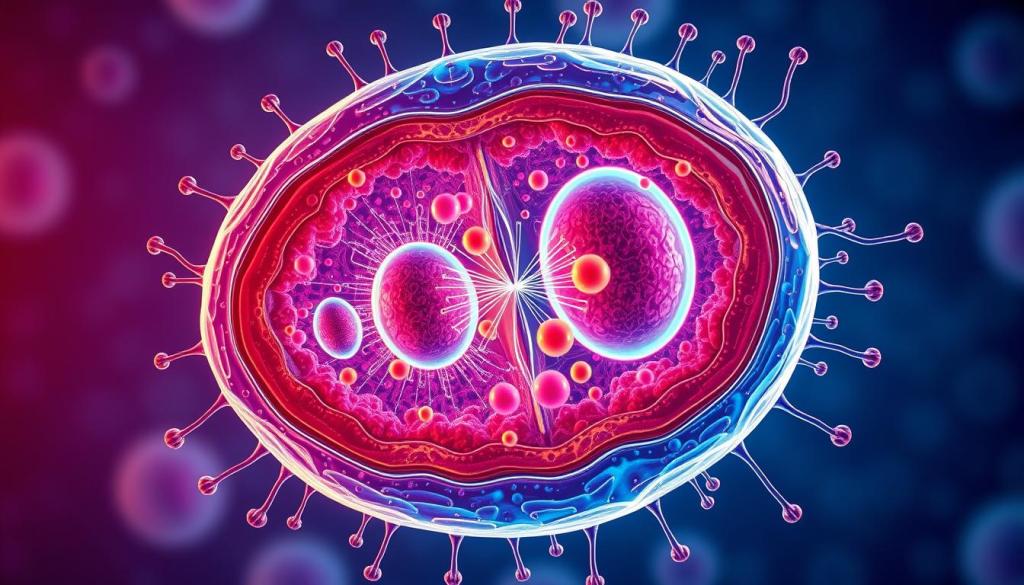
There are two main types of cell division: mitosis and meiosis. Each has its own role in how cells reproduce:
- Mitosis: Makes genetically identical daughter cells
- Meiosis: Creates cells with unique genetic information
Mitosis: Cellular Reproduction Mechanism
Mitosis has five key phases for accurate chromosome distribution. It splits a parent cell into two daughter cells, each with the same chromosomes. This is how adult tissues, like skin, keep regenerating.
| Cell Division Type | Daughter Cells | Chromosome Composition |
|---|---|---|
| Mitosis | Two identical cells | Diploid (two complete chromosome sets) |
| Meiosis | Four unique cells | Haploid (one chromosome set) |
Importance in Cellular Development
Cell division is essential for many biological functions. While some tissues like heart muscle and nerve cells can’t regenerate much, others keep replacing cells. An adult human has about 37 trillion cells, with division supporting growth and upkeep.
The Role of Cell Communication
Cell communication is key to how cells work together and keep our bodies healthy. Cells talk to each other using complex signals. This helps them work together and keep our bodies in balance.
Cells use many ways to communicate and work together. These networks help us respond to our surroundings, grow, and stay healthy.
Mechanisms of Cell Signaling
Cellular signaling happens through several important paths:
- Paracrine signaling: Affects cells nearby
- Endocrine signaling: Uses the blood system
- Autocrine signaling: Cells talk to themselves
- Direct signaling through gap junctions
Impact on Cellular Function
Cell communication is very complex. Cells can handle many signals at once. Each signal can lead to different actions. Receptor proteins are key in understanding these messages.
Studies show interesting facts about cell signaling:
- Signal molecules work at very low levels
- Receptors are very good at finding specific signals
- Response times vary from very fast to hours
Neuroscientists found that neurons can send signals up to 100 meters per second. This shows how fast cells can communicate in our bodies.
The Human Microbiome: A Cellular Community
The human body is more than just cells and tissues. It’s a complex ecosystem filled with microorganisms. These tiny beings play a big role in our health.
The human microbiome is a network of microorganisms inside and on our bodies. Scientists say there are more bacterial cells than human cells, a 3 to 1 ratio.
Defining the Microbiome
A typical human microbiome has some amazing facts:
- Approximately 100 trillion bacterial cells
- Around 1,000 different microbial species
- Collective microbiome genes estimated at 8 million
- Average microbiome weight of about 2.5 pounds
Relationship with Human Cells
Microbiome cells and human cells work together well. These microorganisms help with digestion, immune function, and even mental health.
| Microbiome Location | Estimated Microbial Species |
|---|---|
| Gut | Up to 1 trillion cells per milliliter |
| Mouth | 100-200 species per individual |
| Skin | Diverse microbial communities |
The Human Microbiome Project found our tiny friends have more genes than we do. This shows how important they are in understanding our bodies.
Aging and Cellular Function
The connection between cell structure and human biology is quite interesting. As we age, our cells change a lot. These changes affect our health and how our body works.
The aging process starts slowly, with organs losing their strength. Scientists have found important patterns in how cells age. These patterns greatly affect our health:
- Organs lose about 1% of their strength each year after 30
- Tissue mass goes down, causing rigidity and changes in structure
- Cells can’t regenerate as well as we get older
Cellular Aging Mechanisms
As we age, our cells go through big changes. Lipofuscin accumulation, a fatty brown pigment, builds up in tissues. This buildup leads to cell damage and less ability to function.
| Organ System | Aging Changes |
|---|---|
| Heart | Pumping capacity reduces from 10x to baseline sustenance |
| Liver | Regenerative capacity remains high (up to 70% structure replacement) |
| Muscles | Increased atrophy in skeletal, cardiac, and brain tissues |
Impact on Health
Aging affects many parts of our body. Our ability to break down drugs slows down, making us more sensitive to them. Changes in cells can also lead to weaker immunity, different hormone levels, and less strong organs.
- Neoplastic cells may develop with unusual shapes
- Recovery from illnesses becomes more challenging
- Bone density decreases, increasing fracture risks
Knowing how cells change with age helps us take better care of ourselves. We can make lifestyle changes and get medical care to stay healthy.
Future of Cell Research
Cell theory is growing with new research that changes how we see human anatomy. Recent studies show great promise in stem cell technology. This opens new ways for medical treatments.
Scientists are finding new methods to tackle complex diseases and regenerative treatments. These could change how we fight diseases.
Advances in Cell Biology
New biotechnologies like CRISPR and exosome-based therapeutics are changing cell research. Scientists found that induced pluripotent stem cells (iPSCs) can turn into many different cell types. This is a big step for personalized medicine.
These discoveries let us understand cells better and create targeted treatments. It’s a big chance to improve health care.
Implications for Medicine
The future of medicine depends on understanding and changing cells. Stem cell therapies could help with many diseases like neurodegenerative disorders and spinal cord injuries. This is a big deal for health.
As research goes on, rules and ethics will be key to using these discoveries in medicine. Cell theory keeps growing, helping us understand human biology better. This leads to new health solutions.
FAQ
What are cells and why are they important?
Cells are the basic units of life. They help keep us alive by making energy, processing nutrients, and passing on genes. In humans, cells form tissues, organs, and systems, making them key to health.
What types of cells are found in the human body?
Humans have many cell types. There are epithelial cells, muscle cells, nerve cells, and blood cells. Each type has a special job that helps our body work right.
What is the difference between prokaryotic and eukaryotic cells?
Eukaryotic cells, like those in humans, are more complex. They have a nucleus and organelles. Prokaryotic cells, found in bacteria, lack these features.
How do stem cells work in the human body?
Stem cells can become many cell types. They help in growth, repair, and regeneration. There are different stem cells, each with its own role in medicine.
What is the role of the cell membrane?
The cell membrane keeps cells stable and controls what enters and leaves. It’s made of phospholipids and proteins, acting as a barrier for the cell.
How do cells communicate with each other?
Cells talk to each other through signals and interactions. This helps them work together, grow, and function properly. It’s vital for our body’s health.
What is the human microbiome?
The human microbiome is a mix of microorganisms living with us. They help with digestion, immunity, and even mental health. It’s a big ecosystem that affects our well-being.
How do cells age?
Cells age due to telomere shortening and damage buildup. These changes can lead to diseases and declining health. Studying aging helps us find ways to stay healthy longer.
What are the future prospects of cell research?
Cell research is growing fast, with new areas like regenerative medicine. It could lead to better treatments, tissue repair, and a deeper understanding of biology.





Leave a Comment
Your email address will not be published. Required fields are marked *