


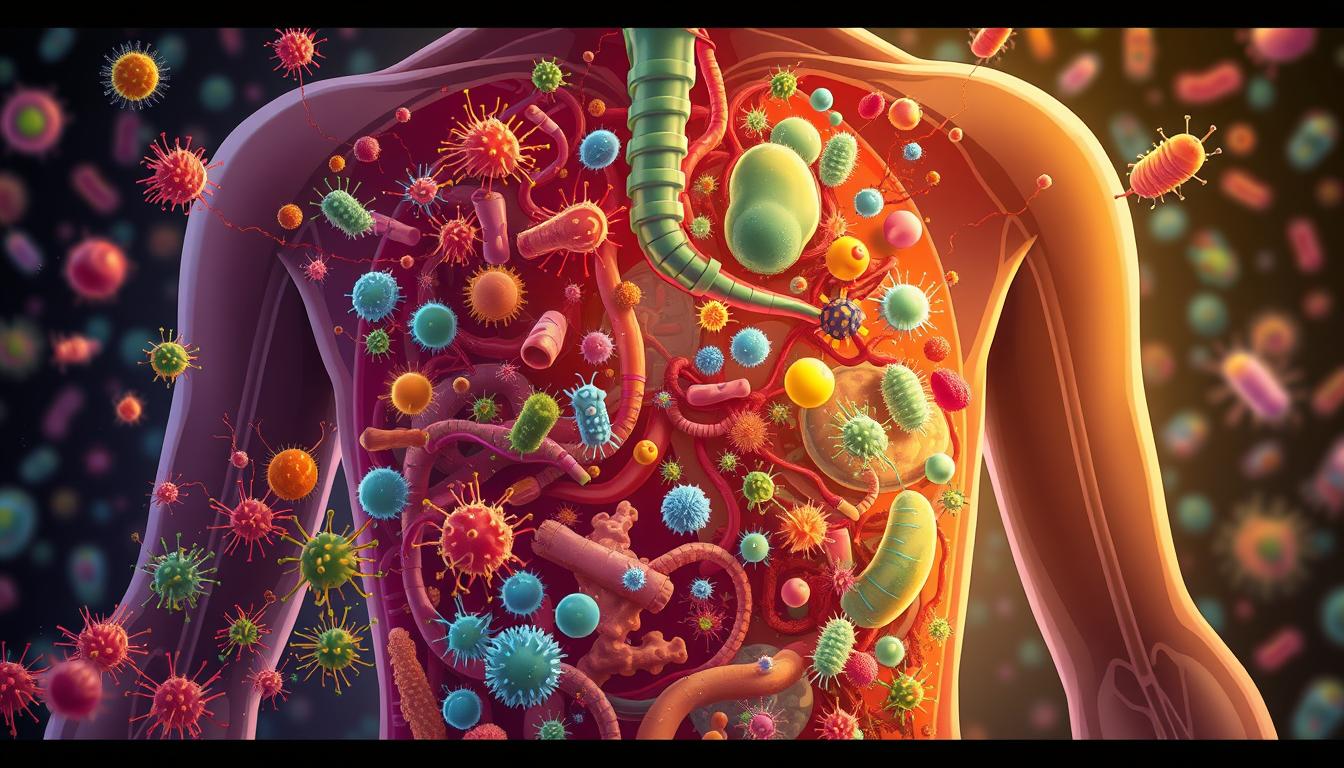
Have you ever thought about how tiny microorganisms could be key to understanding life? Bacteria, tiny powerhouses, outnumber human cells 10 to 1. They play amazing roles in ecosystems and human biology.
What do bacteria do besides living in our world unseen? These incredible organisms are vital to life, working hard in our bodies and ecosystems. They do more than just exist; they help make complex biological systems work.
Scientists have found over 10,000 different types of bacteria in our bodies. This shows how diverse and important these tiny creatures are. Humans have about 22,000 genes, but bacteria add around 8 million unique genes to the mix.
Key Takeaways
- Bacteria significantly outnumber human cells in the body
- Over 10,000 microbial species exist in human ecosystems
- Bacterial genes dramatically exceed human genetic complexity
- Microorganisms play crucial roles in health and environmental processes
- Bacterial diversity is essential for biological functionality
Overview of Bacteria and Their Importance
Bacteria are tiny life forms that are very important to us. They are single-celled and can be found almost everywhere. In fact, scientists say we have 10 times more bacterial cells in our bodies than human cells.
To understand bacteria, we need to know about their basic traits. These tiny organisms can live in extreme places, like deep in the ocean or in hot springs.
Definition of Bacteria
Bacteria are tiny, single-celled organisms without a membrane-bound nucleus. They have a few key features:
- Single-celled microorganisms
- Lack membrane-bound nucleus
- Reproduce through binary fission
- Can exist in various shapes: spherical, rod-like, spiral
Historical Significance in Science
The study of bacteria started in the 17th century. Anton van Leeuwenhoek was the first to see them with a microscope. His discoveries changed how we see life.
“The smallest living creatures are invisible to our naked eye.” – Anton van Leeuwenhoek
| Bacterial Discovery Milestones | Year | Scientific Impact |
|---|---|---|
| First Microscopic Observation | 1676 | Revealed existence of microorganisms |
| Germ Theory of Disease | 1861 | Connected bacteria to disease transmission |
| Antibiotic Discovery | 1928 | Transformed medical treatment |
Today, scientists are still learning about bacteria. They help our ecosystems, keep us healthy, and drive new technologies. Their ability to adapt and their wide range of functions make them crucial to our world.
Bacteria and Ecosystem Functionality
Microorganisms are key to keeping our planet’s ecosystems in balance. They play a crucial role in supporting life and environmental processes that we often overlook.
Bacteria are tiny but mighty, driving important ecological functions. They do more than just exist; they transform and recycle nutrients vital for life.
Role in Nutrient Cycling
Nutrient cycling is a vital service that bacteria provide to ecosystems. They break down complex organic matter, making essential elements available again.
- Decompose dead organisms and plant material
- Convert atmospheric nitrogen into usable forms
- Recycle carbon through intricate biochemical processes
“Bacteria are the invisible architects of our planet’s biological infrastructure.” – Environmental Science Consortium
Contribution to Soil Health
Bacteria are essential for healthy and fertile soil ecosystems. They improve soil structure, make nutrients more available, and help plants grow through complex interactions.
- Nitrogen-fixing bacteria enable plant nutrition
- Improve soil particle aggregation
- Enhance water retention capabilities
Fascinating scientific research shows that certain nitrogen-fixing bacteria can turn atmospheric nitrogen into forms like ammonium or nitrate.
Bacteria’s ability to adapt allows them to live in many places, from high mountains to deep oceans. They continuously perform vital ecological functions that keep life on Earth going.
Bacteria in Human Health
The human body is full of trillions of bacteria. They play key roles in our health. These bacteria create complex relationships within us.
Our bodies have a diverse mix of bacteria. Studies show bacteria outnumber human cells 10 to 1. No two people have the same mix of bacteria, making each microbiome unique.
Beneficial Bacteria: Probiotics
Probiotics are the good guys in our bodies. They help with important functions:
- Improving digestion
- Boosting the immune system
- Helping with mental health
- Controlling metabolism
“The microbiome is like a hidden organ within our body, constantly working to maintain our health.” – Microbiology Research Collective
Pathogenic Bacteria: Risks and Challenges
Some bacteria are harmful. They can cause diseases, posing challenges for doctors. The rise of antibiotic resistance is a big worry.
Studies have found interesting things about bacteria. They use 22 different ways to breathe, showing how complex our body’s chemistry is.
Learning about bacteria is a big area of research. It could lead to new discoveries about our health.
Industrial Applications of Bacteria
Bacteria are key in many industrial processes. They show how versatile these tiny microbes are. Their abilities help solve problems in many areas, showing us what bacteria can do.
Industrial biotechnology uses bacteria in new ways. It tackles big issues in waste, chemicals, and the environment.
Biodegradation and Waste Management
Bacteria are great at breaking down tough organic stuff. They help us manage waste in new ways. Here are some examples:
- Hydrocarbon-oxidizing bacteria clean up oil spills
- They break down industrial waste fast
- They speed up the breakdown of organic matter
Biotechnological Innovations
Bacteria help a lot in biotechnology. They are used in many industrial processes:
| Bacterial Species | Industrial Application | Key Contribution |
|---|---|---|
| Bacillus subtilis | Enzyme Production | Amylase Manufacturing |
| Clostridium species | Chemical Synthesis | Organic Compound Generation |
| Acetobacter | Food Preservation | Vinegar Production |
“Bacteria are nature’s microscopic engineers, transforming industrial processes through their remarkable biochemical capabilities.” – Environmental Biotechnology Research Institute
Bacteria are more than simple life forms. They are vital in solving big industrial problems. They show us their power in making our world more sustainable.
Bacteria in Agriculture
Bacteria are key in farming, changing how crops are grown and soil is managed. These tiny helpers are crucial for farming that’s good for the planet. They help plants grow and keep crops safe.
Soil is full of bacteria, with up to 10^10 bacteria per gram. These bacteria work together to make farming more productive. The area around plant roots, called the rhizosphere, is especially rich in diversity. It’s home to up to 52,000 different types of bacteria.
Nitrogen Fixation and Soil Fertility
Bacteria are vital for fixing nitrogen in the soil. This is important because plants can’t use nitrogen from the air. Bacteria like Azospirillum help by changing nitrogen into a form plants can use:
- Convert atmospheric nitrogen to ammonia
- Produce growth-stimulating phytohormones
- Enhance root development
Natural Pest Control Strategies
Bacteria also help protect crops from pests. For example, Bacillus thuringiensis makes proteins that kill certain insect larvae. This means farmers can use fewer chemicals to fight pests.
“Bacteria are nature’s agricultural engineers, working silently beneath the soil to support crop health and productivity.” – Agricultural Microbiologist
By using these bacterial benefits, farmers can farm in a way that’s better for the planet. This approach improves soil health, boosts crop yields, and cuts down on harm to the environment.
Bacteria’s Role in Food Production
Microorganisms play a key role in making raw ingredients into tasty and nutritious foods. They do more than just exist; they are vital in food production. Bacteria are the main agents of change.
For thousands of years, bacteria have been crucial in food preparation. They use their unique abilities to add complex flavors and preserve food naturally.
Fermentation Processes
Fermentation is a powerful process where bacteria turn sugars and starches into alcohol, acids, and gases. This creates unique flavors in foods all over the world.
- Yogurt production through bacterial cultures
- Cheese aging and flavor development
- Sauerkraut and pickled vegetable fermentation
- Sourdough bread manufacturing
Impact on Flavor and Preservation
Bacterial cultures help preserve food by making it acidic. This stops harmful microorganisms. They also add unique flavors and make food last longer.
| Food Product | Bacterial Species | Preservation Mechanism |
|---|---|---|
| Yogurt | Lactobacillus bulgaricus | Lactic acid production |
| Cheese | Streptococcus thermophilus | Protein breakdown |
| Kimchi | Leuconostoc mesenteroides | Acidification |
“Bacteria are nature’s most sophisticated food alchemists, transforming simple ingredients into culinary masterpieces.” – Food Science Research Institute
Learning about bacteria’s role shows their big impact on food worldwide. It shows how important microorganisms are for our nutrition.
Bacteria in Environmental Processes
Microbes actions are key to understanding how germs change our environment. Bacteria are powerful in fixing our planet and managing the climate. They show amazing skills in solving big environmental problems.
Environmental bacteria bring new ways to clean up our world. They can break down harmful pollutants and make dirty places clean again. They do this with amazing accuracy.
Bioremediation Breakthroughs
Bacteria have clever ways to clean up our environment. They do this in several ways:
- Degrading organic pollutants in soil and water
- Neutralizing toxic chemical compounds
- Restoring ecosystem health
Climate Change Mitigation Strategies
Bacteria play a big role in the climate. They help with carbon cycling and methane production. Their small actions can affect the whole environment.
| Bacterial Type | Environmental Function | Impact Potential |
|---|---|---|
| Nitrogen-fixing bacteria | Soil nutrient restoration | High agricultural productivity |
| Methanogenic archaea | Carbon cycle regulation | Climate change modulation |
| Extremophile bacteria | Pollution degradation | Environmental remediation |
“Bacteria are nature’s microscopic engineers, transforming environmental challenges into opportunities for restoration.” – Environmental Research Consortium
Scientists are always finding new uses for bacteria. They see their potential in solving environmental problems. The future of taking care of our planet might depend on understanding these amazing microorganisms.
Research and Advances in Bacteriology
The field of bacteriology is making huge strides, uncovering new insights into how single-celled microbes work. Recent findings are changing how we see bacteria and their uses in many fields.
New research is showing the amazing potential of bacteria, especially in medicine and the environment. Scientists are finding new ways to use the special abilities of single-celled microbes.
Innovations in Medical Research
Medical bacteriology is getting a big boost from new technologies. Some key advancements include:
- CRISPR/Cas9 genetic engineering techniques
- Precision DNA manipulation
- Advanced pathogen identification methods
“The future of medicine lies in understanding bacterial systems at their most fundamental level.” – National Institutes of Health Research Team
New Developments in Environmental Science
Environmental scientists are finding new uses for bacteria that could change how we approach sustainability. They are studying bacteria for their role in:
- Bioremediation processes
- Climate change mitigation strategies
- Ecosystem restoration techniques
| Research Area | Key Innovations | Potential Impact |
|---|---|---|
| Medical Bacteriology | PCR Techniques | Rapid Disease Diagnostics |
| Environmental Science | Bacterial Genome Mapping | Ecosystem Understanding |
| Genetic Engineering | CRISPR Technology | Precision Genetic Modifications |
By studying bacteria, scientists are finding new ways to solve big global problems. This puts bacteriology at the center of scientific progress.
The Future of Bacteria in Society
Bacteria research is opening up new ways to improve health, medicine, and the environment. These tiny organisms do much more than we thought, with functions that could change science. With most of Earth’s species being bacteria, they hold a wealth of new ideas.
Bacteria play a big role in solving big problems. Scientists are using them to find new medicines, with many drugs already coming from microbes. They’re studying bacteria’s genes to find new ways to solve health and environmental issues.
Implications for Health and Medicine
New medical ideas are using bacteria to create better treatments. Researchers are looking into how bacteria can fight diseases. The U.S. is leading in this area, working on new ways to explore microbes.
Sustainability and Environmental Stewardship
Bacteria research also helps the environment. Scientists are learning how bacteria can help with carbon sequestration and ecosystems. This could help fight climate change.
The Intergovernmental Panel on Climate Change says new farming methods with bacteria could cut carbon dioxide by 1,000 gigatons. This is a big step towards saving our planet.
FAQ
What exactly are bacteria?
Bacteria are tiny, single-celled organisms found everywhere on Earth. They can live in extreme places, like deep ocean trenches and hot springs. These microbes are key to many ecosystems and biological processes.
Are all bacteria harmful?
No, most bacteria are good or neutral. While some can make us sick, many help us stay healthy. They aid digestion, boost our immune system, and help in food production.
How do bacteria impact human health?
Bacteria have a big impact on our health. Good bacteria in our gut help with digestion and boost our immune system. But bad bacteria can cause infections and diseases, showing how important balance is.
What role do bacteria play in the environment?
Bacteria are vital for the environment. They help break down organic matter, improve soil, and support plant growth. They also help clean pollutants and manage carbon and methane.
How are bacteria used in industry?
Bacteria are used in many ways in industry. They help break down waste, produce medicines, and make biofuels. They’re also used in food processing and biotechnology.
Can bacteria help in agriculture?
Yes, bacteria are very helpful in farming. They fix nitrogen, improve soil, and control pests. They also help plants grow better and stronger.
What is the significance of bacterial fermentation?
Fermentation is key in making foods like yogurt and cheese. It adds flavor and texture and helps preserve food. This process is a big part of many cuisines around the world.
How are researchers advancing bacterial studies?
Researchers are working on new antibiotics and therapies. They’re also discovering new species and improving genetic engineering. They’re interested in personalized medicine and sustainable uses of bacteria.
What does the future hold for bacterial research?
The future looks bright for bacterial research. There’s hope for breakthroughs in medicine, sustainability, and biotechnology. Scientists are looking into using bacteria for eco-friendly materials and solving global challenges.
How do bacteria survive in different environments?
Bacteria are amazing survivors. They can change their ways, form protective layers, and even sleep when it’s tough. This lets them live in all sorts of extreme places.






Leave a Comment
Your email address will not be published. Required fields are marked *