


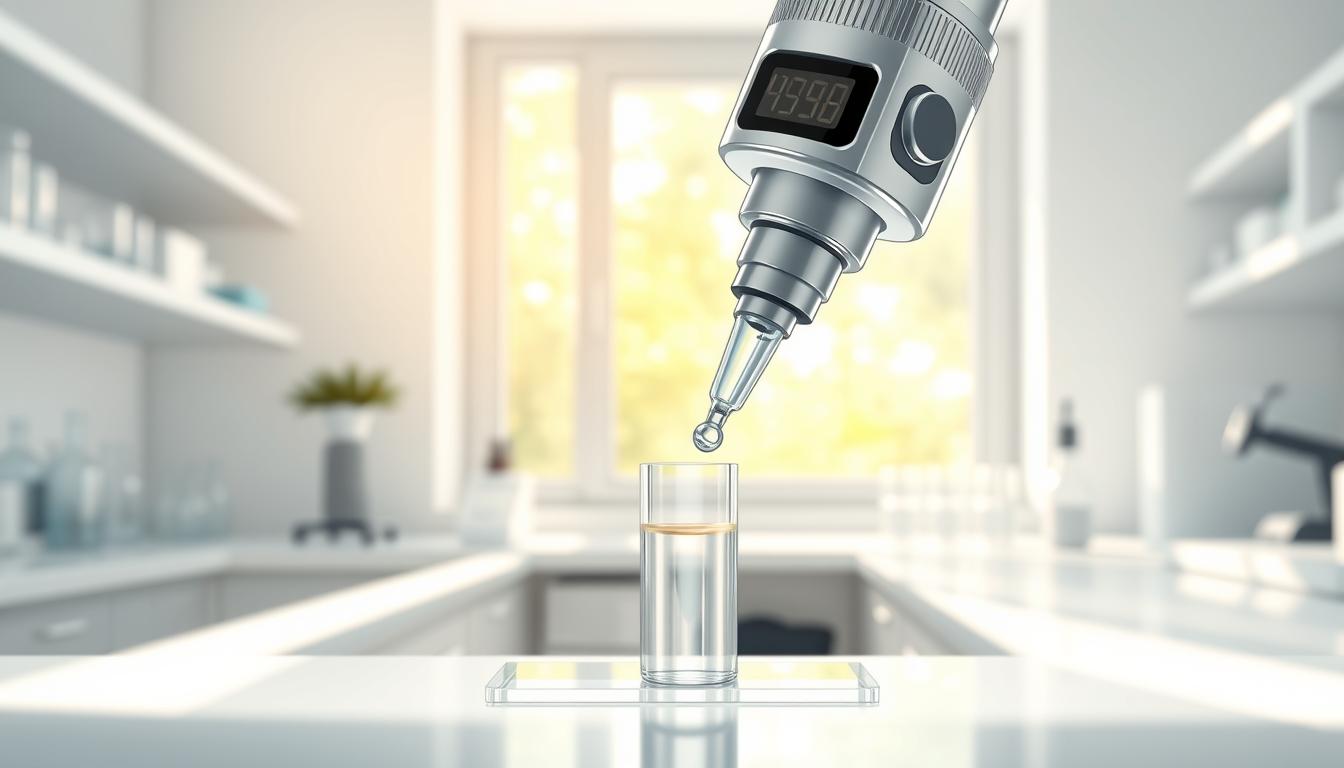
Ever wondered how scientists move tiny amounts of liquid with such precision? It’s like magic. But it’s not magic; it’s the art of laboratory measurement.
A pipette is a key scientific tool for measuring and moving liquids. It’s crucial in research, medical tests, and experiments where exact liquid handling is needed.
Lab experts use pipettes to make sure their experiments are accurate. They help move tiny amounts of liquid, from 0.5 μL to 1000 μL. This makes pipettes vital in many scientific fields.
In medical research and drug analysis, knowing how a pipette works opens up new insights. These tools are more than simple gadgets. They are the keys to major scientific breakthroughs.
Key Takeaways
- Pipettes enable precise liquid transfer in scientific settings
- Volume ranges span from microscopic 0.5 μL to 1000 μL
- Essential for maintaining experimental accuracy
- Used across multiple scientific and medical disciplines
- Critical for standardizing research protocols
Understanding the Function of a Pipette
Pipettes are key tools in science and medicine. They help measure and move tiny amounts of liquid with great accuracy. This is vital for precise experiments in many fields.
Scientists use pipettes for many important tasks. They help prepare chemical solutions and do detailed medical tests. These tools are crucial for reliable and repeatable experiments.
Overview of Pipette Uses
Pipettes have several important roles in labs:
- Precise liquid volume measurement
- Sample transfer between containers
- Dilution preparation
- Reagent dispensing
- Experimental solution creation
Importance in Medical and Scientific Labs
In labs, pipettes are essential. Good pipetting skills are key to accurate results. Electronic pipettes can measure from 0.5μl to 5ml, offering high precision.
Precision is the hallmark of scientific excellence, and pipettes are the instruments that make this precision possible.
Different fields use pipettes in their own ways. Biotechnology, chemistry, medicine, and natural sciences all need them. They help move tiny amounts of liquid with little error, leading to new discoveries.
Types of Pipettes Commonly Used
Laboratory professionals use different pipette types for precise liquid handling. Each type has its own features. This helps researchers pick the right tool for their experiments.

Scientists use various pipettes for specific needs. There are three main types:
- Manual Pipettes
- Electronic Pipettes
- Multi-Channel Pipettes
Manual Pipettes
Manual pipettes are the traditional choice in labs. They are handheld and let researchers move liquids precisely. They come in single-channel or multi-channel options, depending on the experiment.
Electronic Pipettes
Electronic pipettes bring new tech to liquid handling. They offer better accuracy and ease the strain of repetitive tasks. With digital displays and settings, they help measure volumes more consistently.
Multi-Channel Pipettes
Multi-channel pipettes speed up lab work. They can move liquids to many wells at once. This cuts down on time and error.
“Choosing the right pipette is crucial for maintaining experimental integrity and achieving reproducible results.” – Laboratory Research Standard
Different pipettes are used for various scientific tasks. From medical tests to molecular studies, the right pipette is key. Researchers must think about their needs when choosing pipetting tools.
Components of a Pipette
Pipettes are key tools in science, helping us measure with great precision. Knowing what makes them tick is vital for scientists. It ensures they work accurately in labs.
Pipette Body and Tip Design
The body of a pipette is its main structure for handling liquids. It’s designed to fit comfortably in your hand, making it easy to control. The tip is crucial for moving liquids around:
- It lets you measure liquids accurately
- It keeps liquids clean
- It makes transferring liquids smooth
Plunger Mechanism: The Heart of Liquid Dispensing
The plunger is what makes a pipette work. It’s what pulls and pushes liquids in and out of the tip. This part is key for getting the right amount of liquid.
“Precision begins with understanding the intricate mechanics of scientific instruments.”
Calibration Features for Consistent Performance
Calibration keeps a pipette working well over time. Today’s pipettes have special features for calibration. These let scientists:
- Check if the volume is right
- Adjust settings if needed
- Keep the instrument reliable
Most micropipettes can measure between 1 to 1000 microliters (μL). This range is useful for many scientific fields.
How to Use a Pipette Correctly
Learning to use a pipette well is key for getting exact results in labs. Using a pipette right can make your science experiments more accurate and reliable.
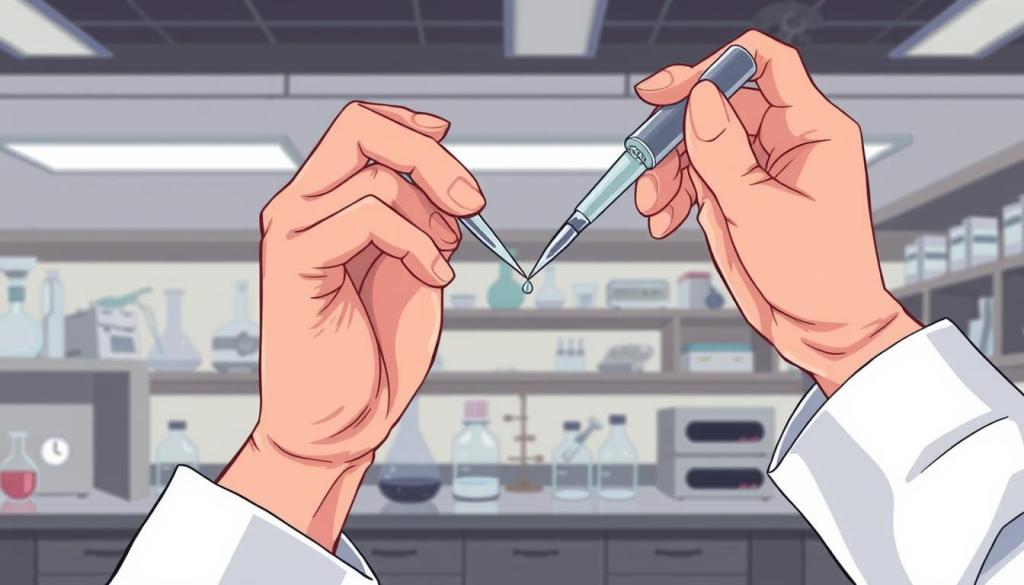
Getting pipetting right means paying close attention and following a set way. Scientists need to stick to the same steps to get consistent results.
Step-by-Step Usage Guidelines
- Pick the right pipette for your needs
- Make sure the pipette is in good shape and clean
- Set the volume you need with the pipette’s adjustment
- Use a good, matching pipette tip
- Hold the pipette at a 10-45 degree angle
- Dip the tip a little into the liquid without touching the bottom
- Push the plunger down smoothly and steadily
Common Mistakes to Avoid
- Wrong tip seating can lower accuracy by up to 0.5%
- Uneven plunger pressure messes up the volume
- Incorrect tip depth affects how liquid is moved
- Not rinsing tips well enough for thick liquids
“Precision in pipette usage is the hallmark of excellent scientific technique.”
It’s also important to think about comfort when using pipettes. Keeping a good posture and taking breaks helps keep your work accurate over long periods.
| Pipetting Technique | Accuracy Impact |
|---|---|
| Proper Tip Seating | Up to 50% accuracy improvement |
| Consistent Plunger Movement | Reduces measurement variations |
| Correct Angle (10-45 degrees) | Optimizes liquid transfer precision |
By following these tips and avoiding common errors, scientists can make their work more reliable and consistent.
Calibration and Maintenance of Pipettes
Precision is key in scientific research, and pipette calibration is vital. Scientists need well-maintained pipettes for reliable results. This ensures their experiments are consistent and trustworthy.
Lab experts know that keeping pipettes accurate is crucial. They follow strict maintenance and calibration schedules. The Clinical and Laboratory Standards Institute suggests calibrating every 3 to 6 months for the best results.
Importance of Regular Calibration
Calibration is important for several reasons:
- It ensures accurate liquid measurements
- It helps avoid mistakes in experiments
- It keeps scientific work honest
- It meets quality control standards
Maintenance Tips for Longevity
To keep pipettes in good shape, follow these steps:
- Clean them after each use
- Store them upright in racks
- Do regular functional tests
- Replace old seals and parts
“A well-maintained pipette is a scientist’s most reliable tool for precision.”
Different labs need different maintenance plans. They should create specific protocols based on how often they use the pipettes, the types of liquids, and the manufacturer’s advice. This helps keep the pipettes working well for longer.
Safety Considerations When Using a Pipette
Laboratory safety is key when using pipettes. Researchers must protect themselves and follow important safety rules. This helps avoid health risks and keeps experiments reliable.
Using pipettes safely involves many important steps. These steps help keep both the person using the pipette and the science safe. Up to 30% of pipette users face hand, finger, or shoulder pain from using them too much.
Personal Protective Equipment (PPE)
Important PPE for pipette use includes:
- Protective laboratory gloves
- Safety goggles or face shields
- Lab coat with long sleeves
- Closed-toe protective footwear
Handling Hazardous Materials
When working with dangerous materials, strict safety rules must be followed:
- Use chemical-resistant gloves
- Work within a fume hood
- Minimize aerosol formation
- Properly dispose of contaminated tips
“Safety is not an accident, but a deliberate and continuous process in scientific research.”
It’s also important to think about ergonomics when using pipettes. Experts suggest:
- Taking micro-breaks every 20-30 minutes
- Using lightweight electronic pipettes
- Rotating tasks to reduce strain
- Maintaining proper workstation posture
By following all safety steps, researchers can avoid injuries. They also make sure their science is accurate and reliable.
Comparing Pipettes to Other Measurement Tools
Laboratory professionals use many tools to measure liquids accurately. Pipettes are key for precise research. They are accurate and used in many scientific fields.
Knowing the differences between tools helps researchers pick the right one for their work.
Pipettes vs. Burettes
Pipettes and burettes have different roles in labs. Burettes are for titration, while pipettes are for transferring liquids.
- Burettes measure volumes with fixed lines
- Pipettes give precise volume control
- Burettes are for slow liquid pouring
- Pipettes are fast and accurate for liquid transfers
Pipettes vs. Graduated Cylinders
Graduated cylinders are basic tools, but pipettes are better for small volumes.
| Feature | Pipettes | Graduated Cylinders |
|---|---|---|
| Accuracy | Up to 4 significant figures | Less precise measurements |
| Volume Range | 0.5 μL to 5000 μL | 10 ml to 2000 ml |
| Best Used For | Precise microvolume transfers | Approximate volume measurements |
Researchers should think about their needs when choosing tools.
Precision in liquid measurement is the cornerstone of reliable scientific research.
Applications of Pipettes in Different Fields
Pipettes are used in many scientific fields. They are key tools in labs and research. These tools help move and measure small amounts of liquid very accurately.
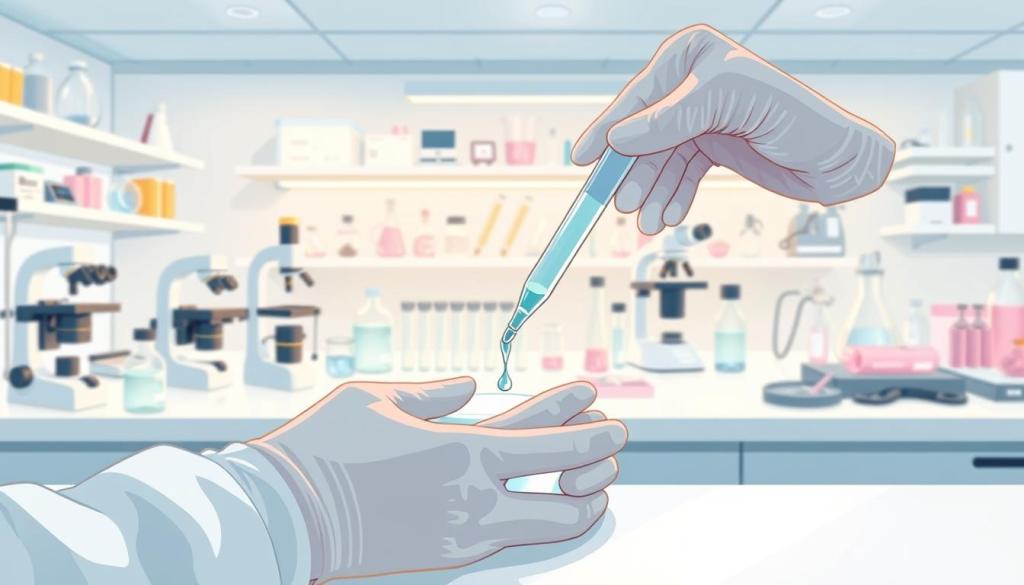
Scientists use pipettes in many places. They help get reliable results and keep science standards high.
Role in Medical Laboratories
Medical labs need pipettes for important tasks. These include:
- Preparing patient samples
- Doing blood tests
- Running complex tests
- Handling sensitive biological materials
Use in Research Settings
Research labs use pipettes in many areas. This includes:
- Molecular biology
- Cell culture
- Chemical analysis
- Genetic research
Precision in liquid handling is key to good science.
Applications in Education
Schools use pipettes to teach lab skills. Students learn by doing, getting ready for science careers.
| Field | Pipette Usage | Key Applications |
|---|---|---|
| Medical | Diagnostic Testing | Sample Preparation |
| Research | Molecular Analysis | Experimental Procedures |
| Education | Skill Development | Laboratory Training |
Pipettes are vital tools that connect theory with practice in many fields.
Advanced Pipetting Techniques
Laboratory experts use advanced pipetting techniques for precise scientific research. These methods are more than just moving liquids. They require special skills and knowledge to avoid mistakes and get accurate results.
When working with tiny samples, researchers need to know how to use pipettes well. Handling liquids with care is key. Even small mistakes can change the results of experiments.
Serial Dilution Methods
Serial dilution is a key technique in advanced pipetting. Scientists use it to make samples with different concentrations. They do this by slowly reducing the amount of sample.
- Requires extreme precision in pipette techniques
- Enables creation of precise concentration series
- Critical for generating standard curves
- Minimizes volumetric errors through careful liquid transfer
To avoid mistakes, researchers must keep the immersion depth and plunger pressure consistent. This is important during serial dilutions.
Reverse Pipetting Technique
The reverse pipetting technique is great for handling tricky liquids. It’s very useful for:
- Viscous solutions
- Samples prone to foaming
- Volatile organic compounds
- Low-volume transfers
Precision in pipette usage can reduce measurement errors to under 5% in optimized laboratory environments.
Using these advanced techniques, researchers can make their experiments more reliable. This leads to better data and results.
Future Trends in Pipette Technology
The world of lab technology is changing fast, with big steps in pipette tech. Automation is making liquid handling better and faster. Labs are getting smarter, with tools that help with complex tasks.
New pipette tech is all about smart connections and systems. Now, researchers can work together better with cloud-based tools. Also, new methods are safer and more precise, cutting down on errors.
Innovations in Design and Functionality
Today’s pipettes are designed to be easier to use and more tech-savvy. Automated systems help avoid injuries and make work faster. They can handle many samples at once, speeding up research.
The Impact of Automation in Laboratories
Automation is changing labs for the better, making them safer and more efficient. It helps track data better and reduces mistakes. As labs grow, these tech upgrades will keep science moving forward.
FAQ
What exactly is a pipette?
A pipette is a tool used in labs to measure and move small amounts of liquid. It’s key for precise work in science, medicine, and labs. It helps avoid mistakes when handling liquids.
What are the main types of pipettes?
There are three main types: manual, electronic, and multi-channel pipettes. Each has its own use and benefits. They meet different needs in labs.
How often should a pipette be calibrated?
Pipettes need calibration at least once a year. But, it depends on how often they’re used and the liquids handled. Regular checks keep measurements accurate and reliable.
What safety precautions are necessary when using a pipette?
Safety first! Wear gloves and lab coats. Use the right technique to avoid spills. Follow special rules for dangerous materials.
Can pipettes be used for different types of liquids?
Yes, pipettes work with many liquids. But, choose the right tips and consider the liquid’s properties. Some pipettes are made for specific liquids, like in molecular biology.
What makes pipettes more accurate than other measuring tools?
Pipettes are precise because of their design. They have calibrated settings and special tips. They’re better than other tools for small volumes in science.
How do electronic pipettes differ from manual pipettes?
Electronic pipettes are automated and easier to use. They have digital displays and can connect to systems for better tracking. They’re less tiring than manual ones.
What are some advanced pipetting techniques?
Advanced techniques include serial dilution and reverse pipetting. These are useful for precise work with viscous liquids. They help get accurate results in complex labs.
Where are pipettes most commonly used?
Pipettes are used in many fields. They’re key in medical labs, research, and education. They’re also used in pharmaceuticals and forensic science.
What future developments are expected in pipette technology?
Future pipettes will be more ergonomic and automated. They might connect to cloud systems for easier sharing and data management. Artificial intelligence could also improve their accuracy.






Leave a Comment
Your email address will not be published. Required fields are marked *