


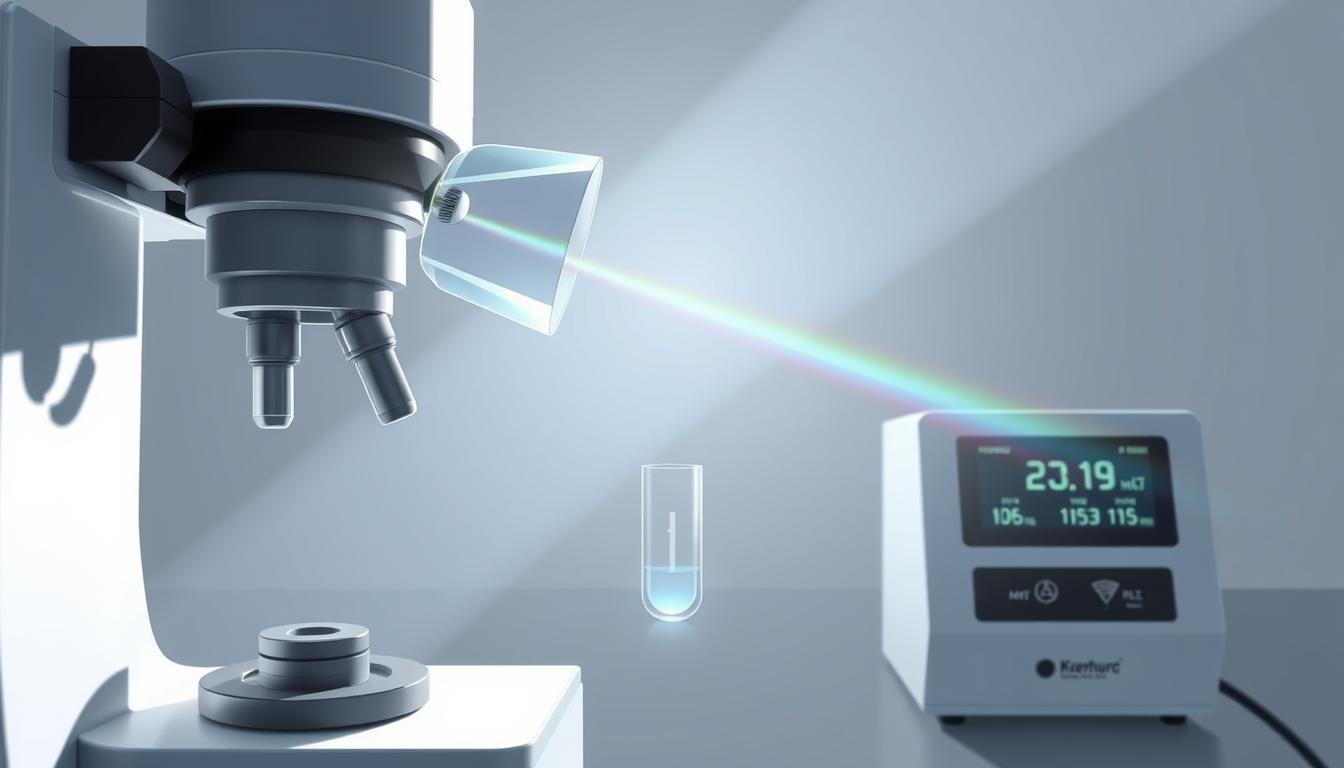
Ever thought about how scientists measure invisible light and matter interactions? In the world of spectrophotometry, absorbance is a key tool. It uncovers chemical secrets by measuring light absorption.
Spectrophotometry lets researchers see how much light a substance absorbs at certain wavelengths. Absorbance measures the ratio of light intensity before and after passing through a sample. This gives important clues about what’s in the material and how much of it there is.
Light absorption is more than just a scientific interest. It’s a crucial method used in many fields. By studying how substances react to electromagnetic radiation, scientists learn a lot about their chemical makeup and properties.
Key Takeaways
- Absorbance quantifies light absorption through a logarithmic measurement
- Spectrophotometry enables precise analysis of material properties
- Light absorption reveals critical information about chemical compositions
- Absorbance measurements span multiple scientific and industrial applications
- The technique provides non-destructive analytical insights
Understanding Absorbance and Its Importance
Spectroscopic analysis relies on precise measurements of light interaction with materials. Absorbance is key in understanding how substances interact with electromagnetic radiation.
Absorbance shows how much light a substance absorbs at a specific wavelength. Scientists use optical density to measure this light absorption. This gives them important information about molecular structures and concentrations.
Definition of Absorbance
Absorbance is defined by the equation A = -log(T), where T is transmittance. This equation helps researchers figure out how much light passes through a sample:
- An absorbance of 0 means 100% light transmission
- An absorbance of 1 means only 10% of light passes through
- An absorbance of 2 suggests merely 1% light transmission
Significance in Scientific Research
Molar absorptivity is crucial in quantitative analysis across many scientific fields. Researchers use absorbance measurements to:
- Determine sample concentrations
- Analyze molecular structures
- Investigate chemical interactions
“Absorbance is not just a measurement, but a window into the molecular world.” – Spectroscopy Research Institute
The Beer-Lambert Law, A = εlc, shows a linear relationship between absorbance, concentration, path length, and molar absorptivity. This principle is vital for precise scientific studies in biochemistry, environmental science, and materials characterization.
The Relationship Between Absorbance and Concentration
Understanding how absorbance and concentration are linked is key in science and chemistry. The Beer-Lambert law helps us measure how much of a substance is in a solution. This is important for research and analysis.
The Beer-Lambert law is a powerful tool for measuring concentration. It shows a direct link between how much light is absorbed and the amount of substance. Scientists use this to find out how much of a substance is in a solution.
Beer-Lambert Law Overview
The main equation A = εbc explains the relationship between several important factors:
- A: Absorbance of the solution
- ε: Molar attenuation coefficient
- b: Path length of the sample
- c: Concentration of the absorbing species
“The Beer-Lambert law transforms light absorption into a precise mathematical relationship, bridging spectroscopic observation and chemical concentration.”
Applications in Analytical Chemistry
Quantitative analysis uses the Beer-Lambert law in many fields. It helps researchers:
- Find out how much of a substance is in a solution
- Watch chemical reactions
- Learn about solution properties
| Field | Application | Measurement Technique |
|---|---|---|
| Environmental Science | Water quality analysis | Spectrophotometric concentration measurement |
| Pharmaceutical Research | Drug concentration verification | UV-Vis spectroscopy |
| Biochemistry | Protein and enzyme studies | Absorbance-based quantification |
The Beer-Lambert law is very useful in science. It gives accurate ways to measure concentration in many areas of study.
Types of Spectroscopy That Utilize Absorbance Measurements
Spectrophotometry is key in biochemistry, helping scientists study molecular structures. It uses different spectroscopic techniques. Each method gives unique insights into chemical makeup and elemental amounts.
UV-Vis Spectroscopy: Revealing Molecular Interactions
UV-Vis spectroscopy works in the 200-800 nm range. It gives researchers tools to analyze molecular interactions. This method is great for:
- Detecting concentration changes
- Identifying chemical structures
- Measuring light absorption in solutions
Infrared Spectroscopy: Probing Chemical Bonds
Infrared spectroscopy looks at longer wavelengths, from 2.5-25 μm. It lets scientists examine molecular vibrations and chemical bonds closely.
| Spectroscopy Type | Wavelength Range | Primary Applications |
|---|---|---|
| UV-Vis | 200-800 nm | Concentration analysis |
| Infrared | 2.5-25 μm | Chemical bond investigation |
Atomic Absorption Spectroscopy: Elemental Analysis
Atomic absorption spectroscopy is all about finding specific elements. It measures light absorption through vaporized samples. This method is precise for detecting trace elements in many fields.
“Spectroscopy transforms invisible molecular interactions into measurable scientific insights.”
How Absorbance is Measured
Spectrophotometry is key in many scientific fields. It helps scientists get detailed info from chemical samples. They use absorbance measurements for this.
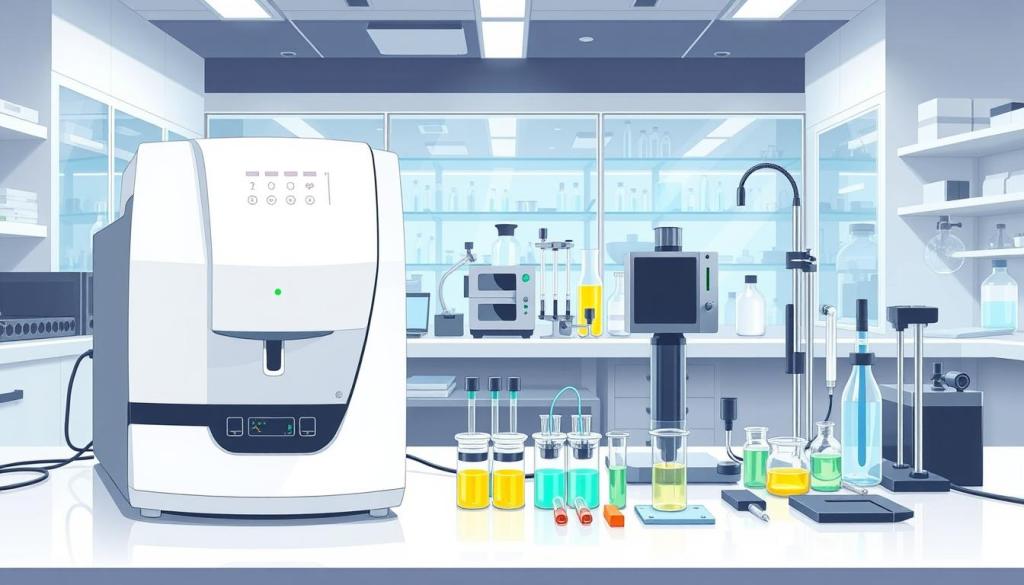
- Light source
- Monochromator
- Sample holder
- Detector
- Data processing unit
Equipment and Tools Required
Getting accurate absorbance needs special tools. Modern spectrophotometers have advanced features. The main tools are:
- Spectrophotometer with a range of 185-700 nm
- Calibrated glassware
- Precision pipettes
- High-purity solvents
Sample Preparation Techniques
Getting samples ready right is vital in spectrophotometry. Researchers must:
- Keep solution concentrations the same
- Reduce contamination
- Choose the right solvent
- Handle samples carefully to avoid damage
“Precision in sample preparation determines the accuracy of spectrophotometric measurements.”
Wavelengths range from 200 to 900 nm. Different molecules have specific peaks. For example, nucleic acids absorb at 260 nm, and proteins at 280 nm.
Factors Influencing Absorbance Readings
Spectroscopic analysis depends on precise light absorption measurements. It’s key to know what affects these readings for accurate results.
Wavelength Selection
Choosing the right wavelength is crucial. Different compounds absorb light at specific wavelengths. This makes wavelength selection a key part of spectroscopic analysis. The accuracy of measurements changes with different wavelengths.
- Select wavelengths specific to the analyte’s absorption characteristics
- Consider the molecular structure of the compound
- Optimize wavelength for maximum sensitivity
Interferences and Limitations
Many factors can interfere with light absorption. Spectroscopic measurements face challenges like:
- Light scattering
- Background noise
- Concentration-related limitations
Accurate measurements require careful consideration of potential interference sources.
Temperature and Solvent Effects
Environmental conditions greatly affect light absorption. Temperature and solvent properties change molecular energy levels. This impacts absorbance readings. Scientists must consider these factors for precise analysis.
- Maintaining consistent temperature
- Using standardized solvent conditions
- Calibrating instruments regularly
By understanding and controlling these factors, researchers can make their light absorption measurements more reliable.
Applications of Absorbance in Various Fields
Absorbance measurements are key in today’s science and industry. They help researchers gain insights in many areas through biochemistry and quantitative analysis.

Environmental Monitoring
Scientists use absorbance to find and measure pollutants in the environment. This helps them check the health of our water and air.
- Water quality assessment
- Pollutant concentration tracking
- Atmospheric contaminant detection
Pharmaceutical Analysis
Pharmaceutical experts use absorbance to check drug purity and consistency. These methods are quick and accurate for chemical checks.
“Absorbance measurements represent a cornerstone of pharmaceutical quality control” – Scientific Research Quarterly
Quality Control in Manufacturing
Manufacturing depends on absorbance for quality and consistency. It’s used in food, chemical, and other industries for valuable insights.
| Industry | Absorbance Application |
|---|---|
| Food Production | Color and composition verification |
| Chemical Engineering | Reaction kinetics monitoring |
| Beverage Manufacturing | Ingredient concentration analysis |
Absorbance’s wide use drives innovation in science and industry. It gives researchers powerful tools for detailed studies.
Interpreting Absorbance Data
Absorbance data is key for measuring concentration and doing quantitative analysis in science. Researchers use spectral graphs to learn about chemical makeup and how molecules interact.
To understand spectral graphs, scientists look at certain visual details. They use these to draw important scientific conclusions.
Understanding Spectral Graphs
Spectral graphs show important info about chemicals. They have:
- Peak positions that tell us about molecular structures
- Peak intensities that show concentration levels
- Spectral shape that tells us about molecular interactions
Calculating Concentrations from Absorbance
For precise concentration measurements, scientists use math. The Lambert-Beer law is a key tool for these calculations.
A = εlc: The mathematical foundation of concentration determination
For accurate concentration measurement, consider these:
- Keep absorbance values between 0.1 and 1.0
- Use the right path length measurements
- Make reliable calibration curves
| Measurement Parameter | Recommended Range |
|---|---|
| Absorbance Value | 0.1 – 1.0 |
| Path Length | 1 cm standard cuvette |
| Light Transmission | 10% – 90% |
Researchers must pick the right wavelengths and reference solutions for accurate analysis. By knowing these basics, scientists can get exact concentration measurements from absorbance data.
Advances in Absorbance Measurement Techniques
The field of spectrophotometry is growing fast. New discoveries and tech advancements are changing how we do biochemistry analysis. These changes are making our work more precise and easier to access.
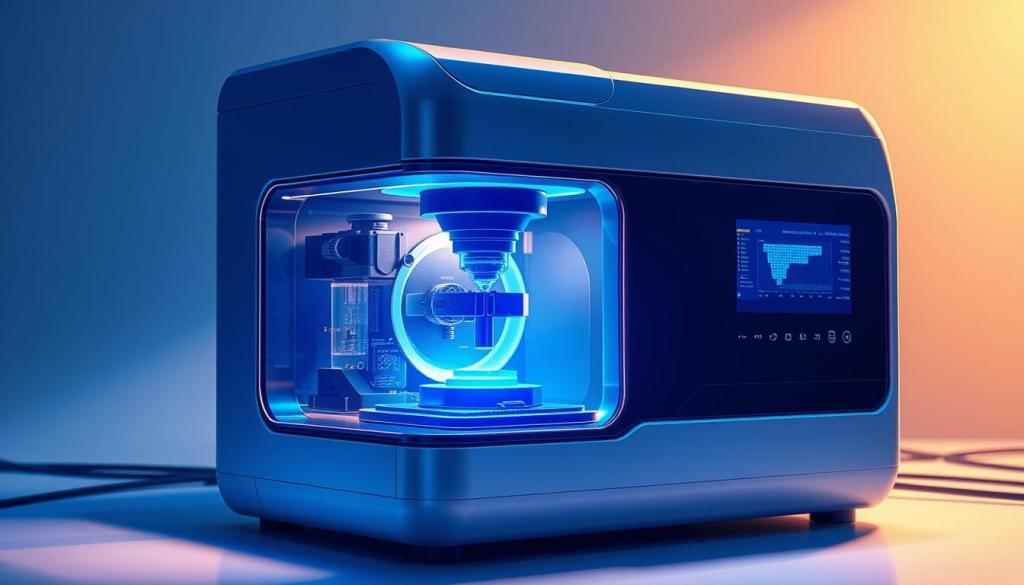
Scientists are seeing big improvements in spectroscopic equipment. The key advancements include:
- Miniaturized portable spectrophotometers for on-site analysis
- Advanced fiber optic technologies
- Microfluidic systems
- Nanotechnology for better sensing
Innovations in Spectroscopic Equipment
Today’s spectrophotometry tools are more sensitive than ever. Cutting-edge devices can spot tiny changes in concentration with great accuracy. This opens up new areas of study in many fields.
“The future of spectrophotometry lies in miniaturization and intelligent data processing” – Dr. Elizabeth Rodriguez, Spectroscopy Research Institute
Trends in Research and Development
Artificial intelligence is changing how we understand spectroscopic data. Machine learning can find patterns and insights that were hard to see before. These advances are leading to breakthroughs in biochemistry, especially in real-time and high-throughput screening.
Researchers are working on spectrophotometry methods that offer:
- Better resolution
- Quicker data collection
- Stronger computational tools
- Flexibility across different research areas
Future Prospects for Absorbance Measurements
The world of spectrophotometry is changing fast. New technologies are coming that will change how we do quantitative analysis in science. These new methods could make absorbance measurements more accurate and detailed.
Hyperspectral imaging and quantum sensing are leading the way. They offer new chances for deeper and more detailed spectroscopic analysis. Scientists think these advances will lead to big breakthroughs in many fields, from environmental monitoring to personalized medicine.
Emerging Technologies
Droplet microfluidics is an exciting new area in absorbance measurement. It lets researchers create tiny droplets for precise analyte screening. This method, combined with advanced optical detection, makes measurements more accurate and sensitive.
Potential New Applications in Science and Industry
The future of spectrophotometry is bright, with many new uses on the horizon. It could help in making new materials, protecting the environment, and improving healthcare. As computers get better at handling data, we’ll be able to understand complex spectroscopic information better. This will open up new ways for scientific discovery and innovation.
FAQ
What exactly does absorbance measure?
Absorbance shows how much light a sample absorbs. It tells us about the sample’s molecular makeup, how concentrated it is, and its optical properties. This is key in spectrophotometric analysis.
How is absorbance related to concentration?
Absorbance goes up with the concentration of a substance, thanks to the Beer-Lambert law. This lets scientists figure out how much of a substance is in a solution by measuring light absorption. It’s a powerful tool for chemical analysis.
What is the difference between absorbance and transmittance?
Transmittance is about how much light gets through a sample. Absorbance is about how much light is absorbed. Absorbance is the negative log of transmittance, making it more directly related to concentration.
In which scientific fields is absorbance measurement important?
Absorbance is key in many fields. These include biochemistry, environmental science, and pharmaceutical research. It also helps in food quality, materials science, and chemical analysis. It gives insights into molecular structures and concentrations.
What equipment is used to measure absorbance?
Spectrophotometers are used to measure absorbance. They have a light source, monochromator, sample holder, detector, and data system. Modern ones include microplate readers and automated systems for precise measurements.
What factors can affect absorbance measurements?
Several things can change absorbance readings. These include the wavelength, concentration, temperature, and solvent properties. Light scattering and chemical interferences also play a role. Proper sample preparation is essential for accurate results.
How is the Beer-Lambert law applied in practical analysis?
The Beer-Lambert law helps create calibration curves. By plotting absorbance against concentration, scientists can find unknown concentrations. This is very useful in environmental monitoring and pharmaceutical research.
What recent technological advances are improving absorbance measurements?
New tech includes miniaturized spectrophotometers and fiber optics. Microfluidics, nanotechnology, and AI are also being used. These advancements improve analysis and interpretation of spectral data.
Can absorbance measurements be used for complex multi-component samples?
Yes, advanced methods like derivative spectroscopy can handle complex samples. They help separate and identify different components in a single sample.
What are the limitations of absorbance measurements?
Limitations include the Beer-Lambert law’s failure at high concentrations. Light scattering and wavelength-dependent molar absorptivity can also affect results. Careful sample preparation is needed for accurate and reliable measurements.




Leave a Comment
Your email address will not be published. Required fields are marked *