


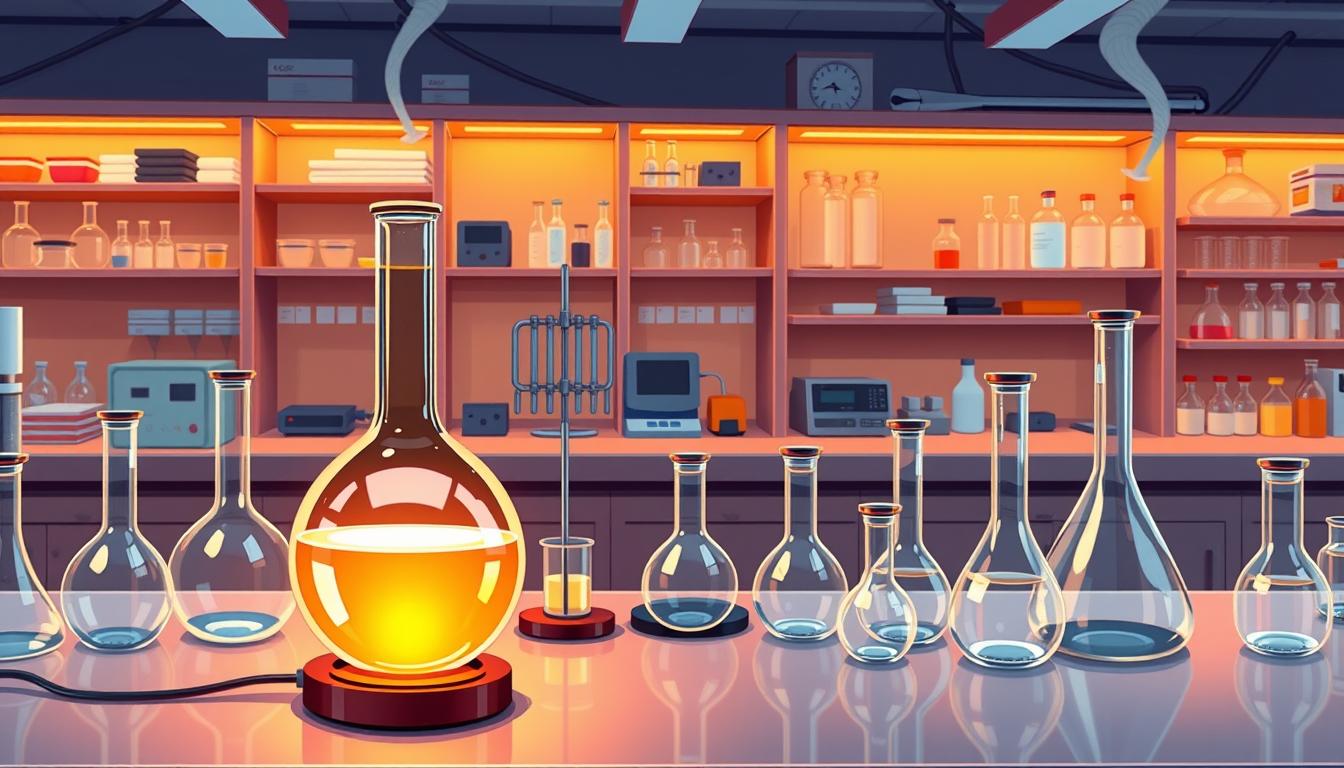
Ever curious about the special tools scientists use to discover new things? In chemistry labs, flasks are key to unlocking secrets. They are a big part of how scientists do their work.
Flasks are special containers for many scientific tasks. They are vital in labs, helping scientists do detailed experiments safely. Flasks help mix solutions and conduct complex reactions, making them heroes in science.
Chemical glassware, like flasks, is made to handle high temperatures and chemicals. Erlenmeyer flasks, for example, have a special shape. This shape helps prevent spills and makes mixing liquids easier during important lab work.
Key Takeaways
- Flasks are specialized containers in chemical laboratory equipment
- Different flask designs serve unique scientific purposes
- Flasks enable precise measurements and chemical reactions
- Materials like borosilicate glass provide durability and chemical resistance
- Flasks are critical for mixing, heating, and storing scientific solutions
Understanding the Function of a Flask in Chemistry
Chemistry labs use special containers for handling liquids and reactions. Flasks are key for these tasks, helping in many scientific fields.
Flasks are advanced glassware made for science. Their design is crucial for research and analysis.
Defining Laboratory Flasks
A flask in chemistry has unique features:
- A wider vessel body
- One or more narrow tubular necks
- An opening at the top for accessing the internal space
Basic Design and Components
A typical flask has important parts for its use:
- Body: Holds liquids or conducts reactions
- Neck: Narrow section for controlled pouring and connections
- Opening: For stoppers, thermometers, or other tools
Flasks are often made of borosilicate glass. This material is great because it’s very resistant to chemicals and heat. It’s perfect for tough scientific research.
Types of Flasks Commonly Used
Flasks are key tools in chemistry labs, each for its own use. Knowing what each flask does helps scientists pick the right one for their work.
Round-Bottom Flasks
Round-bottom flasks are great for heating and distilling liquids. They’re made of strong borosilicate glass. This makes them perfect for tough chemical tasks.
- Designed for boiling and distillation
- Made from borosilicate glass
- Excellent for uniform heating
Erlenmeyer Flasks
German chemist Emil Erlenmeyer created these flasks in 1861. They’re very useful in labs. Their shape helps a lot in chemical tests.
| Characteristic | Details |
|---|---|
| Shape | Cone-shaped with narrow neck |
| Volume Range | 50 mL to 2 L |
| Common Uses | Swirling, boiling, cooling, filtering |
Volumetric Flasks
Volumetric flasks are all about precision. They’re made to hold exact amounts. This is key for accurate chemical tests.
- Classified as Class A (precise) or Class B (standard)
- Typically round or pear-shaped
- Graduated with metric markings
- Available in standard volumes like 10 mL, 25 mL, 50 mL
Every flask type is vital for different lab tasks. This shows how detailed and precise chemistry research is today.
Key Uses of Flasks in Laboratory Settings
Chemical glassware is key in scientific research. It serves many important roles in labs. Flasks are versatile for handling liquids, helping scientists do complex work with ease.

Scientists use flasks for many important tasks in chemical research. These containers are designed for specific tasks, making them essential in labs.
Mixing and Heating Solutions
Flasks are vital for mixing and heating chemicals. Their shapes help scientists:
- Safely heat chemical mixtures
- Ensure even temperature
- Prevent spills
- Control chemical reactions
Borosilicate glass flasks are great for handling heat. Erlenmeyer flasks, with their conical shape, help mix chemicals well.
Measuring Precise Volumes
Measuring exact volumes is another key use of flasks. Volumetric flasks are very precise:
- Class A flasks are accurate to 0.2%
- Gradations help estimate volumes
- They meet various lab needs
These containers are crucial for making standard solutions and precise chemical tests.
Difference Between Flasks and Other Lab Equipment
Scientific tools are key in chemical processes. Each piece of laboratory equipment is made for a specific task. It’s important for researchers to know the unique features of each tool to pick the best one for their work.
There are many types of lab equipment, each with its own role in chemical research. While beakers and test tubes are common, flasks have special benefits in certain chemical processes.
Flasks vs. Beakers: Key Distinctions
Flasks and beakers are quite different in design and use:
- Shape: Beakers have a cylindrical shape with straight sides, while flasks have a narrower neck and wider bottom
- Precision: Flasks give more precise measurements than standard beakers
- Chemical reactions: Flasks are better for complex reactions because of their design
Flasks vs. Test Tubes: Comparative Analysis
Test tubes and flasks have different uses in labs:
- Volume capacity: Flasks can hold more substance
- Heat resistance: Flasks can handle higher temperatures
- Reaction complexity: Flasks support more detailed chemical processes
*”The right scientific tool can make all the difference in experimental precision and efficiency.”*
Knowing the differences between lab equipment helps researchers improve their work. This leads to more accurate results in their experiments.
Importance of Material in Flask Construction
Choosing the right material for chemical glassware is key in lab equipment design. The decision between glass and plastic containers affects the work’s quality, durability, and safety.
Chemical labs need materials that can handle harsh conditions. Borosilicate glass stands out as the top choice for containers. It has amazing properties:
- Thermal shock resistance up to 500°C (932°F)
- Superior chemical resistance
- High durability in intense research settings
Glass vs. Plastic Flasks: A Comparative Analysis
Glass flasks have big advantages in labs. Borosilicate glass is great at handling heat and chemicals. Plastic flasks, though light, can’t keep up with glass in complex experiments.
Chemical and Heat Resistance Considerations
Good lab glassware must resist chemicals and stay strong under high heat. Borosilicate glass is incredibly tough:
- Stands up to harsh chemical reactions
- Keeps shape at extreme temperatures
- Reduces contamination risks
Scientists look for materials that ensure accurate and safe experiments. The choice between glass and plastic depends on the experiment’s needs and chemical interactions.
How to Properly Handle Laboratory Flasks
Working with scientific tools needs precision and care. This is especially true when handling delicate equipment. Chemical processes require careful attention to get accurate results and keep experiments safe.

Safe handling of laboratory flasks involves several key techniques. These protect both the researcher and the tools:
- Always wear appropriate personal protective equipment (safety glasses, gloves)
- Inspect flasks for cracks or damage before use
- Handle flasks by their base or neck to prevent unexpected breakage
- Use specific carrying techniques for different flask types
Essential Safe Handling Techniques
Professional scientists know that proper flask management starts with understanding different equipment. Ground glass joints need special care. These connections can be damaged easily if not handled right.
Cleaning and Maintenance Protocols
Maintaining laboratory equipment means following systematic cleaning steps:
- Rinse flasks immediately after use with the right solvents
- Use specialized laboratory cleaning solutions
- Dry flasks completely to prevent water spots
- Store flasks in dust-free, temperature-controlled places
Borosilicate glass flasks, developed over 90 years by Corning, need careful maintenance. This keeps their thermal shock resistance and chemical durability. Proper cleaning helps these tools last longer and work better.
Common Experiments Utilizing Flasks
Flasks are key in many chemical processes. They are vital for complex scientific research. These versatile containers help scientists do detailed work with great accuracy.
Scientists use different flasks for various experiments. Each type has special designs and materials for specific needs.
Synthesis Reactions
In synthesis reactions, flasks help create new compounds. Researchers pick flasks that fit the chemical process. This ensures the reaction happens in a controlled way.
- Round-bottom flasks help heat evenly
- Borosilicate glass stands up to high temperatures
- Narrow necks cut down on evaporation
Titration Processes
Titration experiments need exact measurements and careful chemical mixing. Erlenmeyer flasks, made in 1861, are perfect for this. Their design makes them ideal for these tasks.
- Narrow necks help keep liquid in
- Flat base keeps things stable while mixing
- They seal well to prevent contamination
The American Society for Testing and Materials (ASTM) sets standards for these containers. This ensures they work well and consistently in research.
Innovations in Flask Design and Technology
The world of scientific tools is changing fast. New designs in chemical glassware and lab equipment are making a big impact. Modern flask technologies are breaking new ground, improving research methods.
Recent changes in flask technology have changed how scientists work. Now, they have advanced chemical glassware that’s more functional and precise.
Evolution of Laboratory Flasks
The development of laboratory flasks has seen big steps forward:
- Introduction of jacketed flasks with temperature control
- Advanced glass materials for better durability
- Integration of digital monitoring systems
- Smart flask technologies
Impact of New Materials and Technology
Scientific tools are getting a tech boost. New materials like reinforced borosilicate glass and innovative polymers are changing chemical glassware. These materials offer:
- Improved thermal resistance
- Greater chemical compatibility
- Enhanced structural integrity
- Less chance of contamination
Today’s lab equipment has digital sensors and monitoring systems. This lets researchers get accurate data in real-time. These tech advances are making research more efficient and reliable.
Safety Considerations When Using Flasks
Laboratory equipment needs careful safety rules to keep researchers safe and tools working right. When working with flasks, it’s important to watch out for dangers and keep the work area safe.
Personal Protective Equipment (PPE)
It’s key to protect yourself when working in the lab. Here’s what you need for flask handling:
- Safety goggles or face shields
- Chemical-resistant gloves
- Lab coat with long sleeves
- Closed-toe shoes
Proper Flask Disposal
It’s important to dispose of broken or dirty flasks the right way. Follow these steps to stay safe:
| Flask Condition | Disposal Method | Safety Precaution |
|---|---|---|
| Cracked Glass | Specialized glass waste container | Wrap in puncture-resistant material |
| Chemical Contamination | Chemical waste disposal protocol | Neutralize and decontaminate |
| Broken Flask | Hazardous waste collection | Use designated sharps container |
Don’t throw broken lab tools in the trash. The right way to handle them keeps everyone safe and the environment clean.
Safety in scientific research starts with careful attention and following lab rules.
Conclusion: The Role of Flasks in Chemistry Today
Flasks are key in science today. They help scientists measure and study things in detail. Flasks are more than just containers; they help us learn new things.
In labs, flasks do many important jobs. They help in making medicines and studying the environment. Volumetric flasks are especially precise, meeting strict standards for science work.
New tech is making flasks even better. Scientists are making flasks that can do more. Schools and labs will keep using these tools to find new things.
Summary of Key Functions
Flasks are used in labs for mixing, heating, cooling, and storing chemicals. They are very useful because they are precise and versatile. As science changes, so will the flasks used in labs.
Future of Flask Usage in Scientific Research
New tech will change flask design. We’ll see flasks made with advanced materials and digital features. Soon, flasks will be safer, more accurate, and better for complex studies.
FAQ
What is a flask in chemistry?
A flask is a piece of lab glassware used for many chemical tasks. It has a rounded or conical body and a narrow neck. These containers are key for mixing, heating, measuring, and storing chemical solutions in labs.
What are the most common types of flasks used in chemistry?
Common flasks include round-bottom flasks for heating and distillation. Erlenmeyer flasks are great for mixing and heating solutions. Volumetric flasks are used for precise volume measurements in analytical chemistry.
What materials are flasks typically made from?
Flasks are made from borosilicate glass or plastic. Borosilicate glass is best for its chemical resistance, heat tolerance, and durability. Plastic flasks are used for lighter weight or disposable needs.
How do flasks differ from beakers and test tubes?
Flasks have a special design with a narrow neck and precise volume markings. They are better for heating, mixing, and precise measurements than beakers and test tubes.
What safety precautions should be taken when using laboratory flasks?
When using flasks, wear safety goggles, lab coats, and gloves. Handle them carefully and avoid sudden temperature changes. Always check for damage before use and follow cleaning and disposal rules.
Can flasks be used for different types of chemical experiments?
Yes, flasks are very versatile. They can be used in synthesis reactions, titration, solution preparation, distillation, reflux reactions, and precise volume measurements in many scientific fields.
How do I choose the right flask for my experiment?
Choosing the right flask depends on your experiment, volume, chemical compatibility, heating needs, and precision. Consider the flask’s material, shape, volume, and special features like ground glass joints.
What are some recent innovations in flask technology?
New innovations include jacketed flasks for temperature control and flasks with digital sensors. There are also improved materials, enhanced chemical resistance, and ergonomic designs for better lab efficiency and safety.
How should laboratory flasks be cleaned and maintained?
Flask maintenance involves cleaning with lab detergents, handling ground glass carefully, drying properly, and storing in clean places. Avoid abrasive materials and always check for damage before use.
Are there alternatives to traditional glass flasks?
Yes, labs now use plastic flasks, metal containers, and digitally integrated systems. But, borosilicate glass is still the top choice for most chemical research due to its chemical resistance and thermal properties.




Leave a Comment
Your email address will not be published. Required fields are marked *