


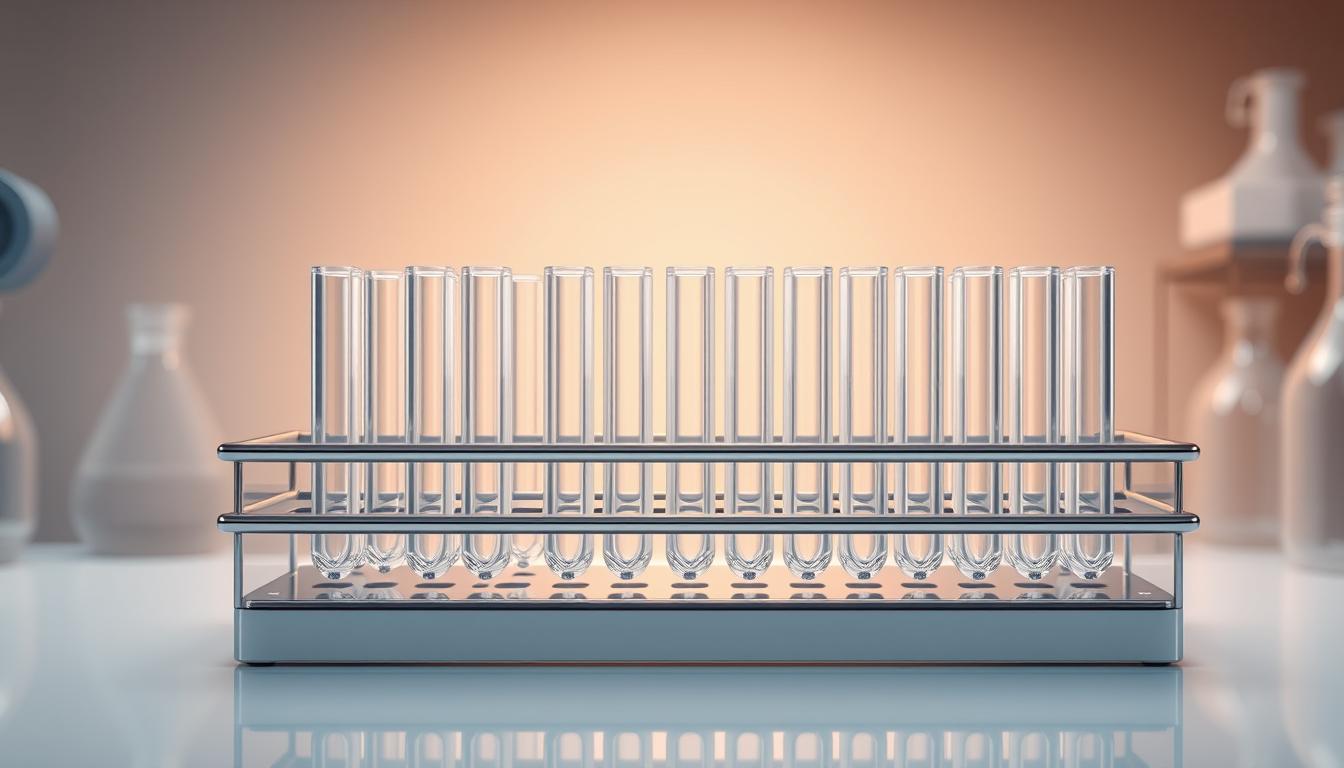
Ever thought about how scientists keep their experiments from turning into a mess? The test tube rack is key. It keeps everything organized and safe in the lab.
A test tube rack is a must-have in science labs. It holds test tubes upright and keeps them organized. These racks were invented soon after test tubes, becoming vital in many scientific fields.
Today, test tube racks come in many materials and styles. They’ve changed from simple wooden pegs to advanced organizers. You can find them in materials like wire, plastic, and even foam that floats in water baths.
But a test tube rack does more than just hold tubes. It helps prevent accidents, keeps samples safe, and makes experiments run smoother. This is true in chemistry, biology, and medical research.
Key Takeaways
- Test tube racks are essential for organizing and protecting scientific samples
- Modern designs prioritize functionality and safety in laboratory settings
- Materials range from wood to plastic, metal, and specialized foam
- Proper use of test tube racks significantly reduces laboratory accidents
- Different scientific fields require specialized test tube rack designs
Introduction to Test Tube Racks
Scientific research needs precise tools to run complex experiments. Test tube stands are key to organizing and managing materials. They change how researchers work.
Definition and Purpose
A test tube rack holds and organizes test tubes in labs. It keeps tubes stable, stops spills, and makes workspaces efficient. It’s vital for many types of research.
- Supports multiple test tubes at once
- Keeps tubes from rolling or tipping
- Makes setting up experiments easier
- Helps identify tubes quickly
Historical Context
The history of test tube racks mirrors scientific progress. Early scientists saw the need for better tube management. This led to designs that improved lab work.
“Organization is the foundation of successful scientific investigation” – Laboratory Research Principles
Key Features
Today’s test tube stands have features that boost lab efficiency. They support different tube sizes and materials.
- Has various hole numbers (8, 10, or 12)
- Can be stacked and connected
- Made from different materials (like metal or plastic)
- Can be sterilized in an autoclave
Test tube racks are crucial in science. They help researchers work with precision and order in their labs.
Types of Test Tube Racks
Laboratory professionals need versatile test tube organizers to keep their workspaces tidy. The right glassware rack can boost research productivity and help keep samples safe.
Material Variations in Chemistry Lab Supplies
Test tube racks are made from different materials, each with its own scientific use:
- Metal wire racks: Lightweight and heat-resistant
- Plastic racks: Affordable and come in various colors
- Polystyrene racks: Strong and resistant to chemicals
- Foam racks: Great for water baths
- Fiberglass racks: Keep their shape well in heat
Size and Capacity Configurations
There are many ways to organize test tubes in labs:
- Standard sizes: Hold 8, 10, or 12 tubes
- Interlocking cubes: Easy to arrange
- 1-well racks: Perfect for one tube
- Special vial racks: For smaller containers
Innovative Design Variations
Today’s chemistry lab supplies have advanced designs:
- Stackable racks: Save space
- Autoclave-safe polypropylene models
- Drying racks: Hold tubes upside down
- Systems that connect: Expand storage
“Choosing the right test tube rack is key for lab efficiency and sample safety.”
The design of test tube racks keeps getting better. This shows the ongoing effort to improve scientific tools. It helps researchers manage and preserve samples better.
Importance of Test Tube Racks in Laboratories
Test tube racks are key in making labs tidy and efficient. They help keep the work area safe, precise, and productive. This is crucial for any lab.
Organization of Lab Space
Good storage of test tubes is essential for a well-organized lab. Researchers use test tube racks to:
- Arrange test tubes neatly
- Avoid mixing up samples
- Make the workspace more efficient
- Save time looking for samples
Safety and Handling
Lab safety depends on using the right equipment. A well-made test tube rack helps avoid accidents by:
- Stopping spills
- Keeping glass tubes stable
- Lowering the chance of breakage
- Making it easier to move samples safely
*Proper organization through test tube racks can prevent thousands of potential laboratory incidents annually.*
Compatibility with Various Tubes
| Rack Type | Primary Usage | Key Characteristics |
|---|---|---|
| Metal Racks | Chemical Labs | Corrosion-resistant, durable |
| Wooden Racks | Medical/Clinical Labs | Quick sample access, efficient workflow |
| Plastic Racks | Biological Research | Lightweight, chemical-resistant |
Different labs need different test tube racks. Knowing this helps researchers pick the right equipment for their work.
How to Choose the Right Test Tube Rack
Choosing the right test tube holder is important. It affects how well your lab works and your results. Think about what you need before making a choice.

Material Considerations for Laboratory Equipment
The material of your test tube rack matters a lot. It affects how well it works and how long it lasts. There are three main types:
- Plastic: It’s light, doesn’t react with chemicals (60% of labs like it)
- Metal: It can handle high temperatures (40% of labs use it)
- Wood: It’s not used much because it can react with chemicals (less than 10%)
Evaluating Size and Storage Requirements
Size and design are key when picking a test tube rack. Think about these things:
- How many test tubes you need to hold
- Whether it should be horizontal or vertical
- How it fits in your workspace
| Rack Type | Capacity Range | Best Use |
|---|---|---|
| Small Rack | 5-10 tubes | Compact workstations |
| Medium Rack | 15-30 tubes | Standard laboratory settings |
| Large Rack | 40-60 tubes | High-throughput laboratories |
Quality and Performance Assessment
Focus on functionality when choosing a rack. Look for these things:
- Can it be sterilized?
- Is it resistant to chemicals?
- Is it stable and won’t slip?
- Is it easy to clean?
Experts say that spending more on quality lab equipment is worth it. It makes your work safer and more efficient.
Best Practices for Using Test Tube Racks
Keeping a lab safe and efficient is key. Test tube racks help a lot with this. Knowing how to use them right can stop accidents and help research succeed.
Proper Placement in the Laboratory
Where you put a test tube stand is very important. Here are some tips:
- Place racks on flat, stable surfaces
- Keep racks away from lab bench edges
- Ensure proper spacing between multiple racks
- Avoid placing near high-traffic areas
Cleaning and Maintenance Techniques
Cleaning glassware racks is important. It stops contamination and makes them last longer. Here’s what to do:
- Check racks before and after each use
- Clean with mild soap and water
- Disinfect using isopropyl alcohol
- Dry thoroughly before storage
Avoiding Common Mistakes
Knowing common mistakes helps avoid problems. Here are some tips:
| Common Mistake | Prevention Strategy |
|---|---|
| Overloading racks | Use the right rack size for tube sizes |
| Improper handling | Handle gently, avoid sudden moves |
| Neglecting organization | Label racks clearly and in order |
“Precision in equipment management is the foundation of successful scientific research.” – Laboratory Safety Expert
Following these tips can greatly lower accident risks. Regular upkeep and careful rack handling are crucial for a safe, efficient lab.
Test Tube Racks in Different Scientific Fields
Test tube racks are key in many scientific fields. They help researchers, teachers, and students in labs. These tools are essential for organizing and supporting various experiments.

Chemistry Laboratory Applications
In chemistry labs, test tube racks are vital. They keep tubes stable during experiments. This is important for heating, mixing, and storing chemicals.
Researchers use these racks to:
- Organize many chemical samples at once
- Stop spills and keep samples clean
- Do precise experiments with controlled temperatures
Biological Research Utility
Biological research needs careful sample handling. Test tube racks are crucial for storing and organizing these samples. They are used for:
- Storing DNA analysis samples
- Preparing protein purification
- Setting up cell cultures
Educational Laboratory Settings
Schools use test tube racks to teach lab skills. These tools help students learn:
- How to handle samples correctly
- Lab safety rules
- How to organize experiments
“A well-organized test tube rack is the foundation of successful scientific exploration.”
| Scientific Field | Primary Rack Function | Key Considerations |
|---|---|---|
| Chemistry | Reaction Support | Heat Resistance |
| Biology | Sample Storage | Contamination Prevention |
| Education | Skills Training | Safety Demonstration |
Knowing what each field needs helps pick the right test tube rack. This ensures the best results for each experiment.
Innovations in Test Tube Rack Design
Scientific tools are getting better, especially in how we store test tubes. Today’s lab equipment is designed with new ideas that change how scientists work. This makes their jobs easier and more efficient.
Ergonomic Features
Now, test tube racks are made to be comfortable and easy to use. Scientists can enjoy designs that help avoid tiredness and strain. Some key improvements include:
- Lightweight materials that make handling easier
- Contoured grips for better grip
- Lower height for easier reach and better view
Customizable Options
Today’s lab tools are all about being flexible. Labs can pick storage solutions that fit their exact needs.
| Customization Feature | Research Benefit |
|---|---|
| Modular Rack Systems | Works with different tube sizes |
| Interchangeable Compartments | Supports various experiments |
| Color-Coded Sections | Better sample organization |
Eco-Friendly Materials
Now, making lab tools is all about being green. Scientists can find racks made from materials that are good for the planet.
“The future of scientific research lies not just in technological advancement, but in responsible innovation.” – Laboratory Design Quarterly
Materials like polycarbonate and polypropylene are still favorites. They’re tough but gentle on the environment. They also handle chemicals well and can be cleaned many times without breaking down.
- Works from -86°C to +121°C
- Meets FDA and EU standards
- Can be reused and made in clean places
Comparisons with Other Lab Equipment
Scientists use many chemistry lab supplies for precise experiments. Knowing what each piece does helps them pick the best tools for their work.

Choosing the right equipment is key for good results. A test tube holder and glassware rack are crucial for keeping things organized.
Test Tube Racks vs. Beakers
Test tube racks and beakers are both important, but they’re used for different things:
- Test tube racks keep multiple test tubes in order
- Beakers are for mixing, heating, and measuring liquids
- Racks help prevent tubes from rolling or getting contaminated
Test Tube Racks vs. Multi-Well Plates
Each lab setting needs its own equipment:
- Test tube racks fit bigger tubes
- Multi-well plates are for doing lots of tests at once
- Racks are more flexible for handling samples one by one
When to Use Each Type
Choosing the right tool depends on what you need for your experiment:
- Use test tube racks for:
- Preparing individual samples
- Handling large amounts of liquid
- Storing samples temporarily
- Choose multi-well plates for:
- Doing many tests at once
- Small-scale experiments
- Following standard research methods
“The right tool can transform scientific investigation from challenging to seamless.” – Laboratory Research Professionals
Knowing the differences helps scientists improve their work. They can make their experiments more efficient and get better results.
Safety Standards and Regulations
Laboratory safety is key in scientific research. Test tube racks are crucial for a safe work environment. Knowing the safety rules helps researchers stay safe and protect their work.
Managing lab equipment well means following strict safety rules. A test tube stand is more than storage. It helps keep things organized and safe.
Compliance with Laboratory Safety
Labs must follow strict safety rules for test tube racks. Important rules include:
- Choosing materials that don’t react with chemicals
- Keeping rack surfaces clean and tidy
- Checking racks regularly
- Picking the right rack design for each lab
Recommendations for Handling Chemicals
When working with chemicals, be very careful with your test tube rack choices:
- Pick racks made from materials that resist chemicals
- Choose racks with stable, non-slip bases
- Use color-coding for different chemicals
- Always wear the right protective gear
Recommendations for Handling Biological Samples
Handling biological samples needs a lot of care. Choosing the right test tube rack can greatly lower contamination risks. Here are some tips:
- Use racks that can be sterilized in an autoclave
- Follow strict separation rules
- Choose racks with separate tubes
- Keep the temperature steady
“Safety in the laboratory is not an option – it’s a fundamental requirement for scientific integrity and researcher protection.”
Groups like the FDA and ISO keep updating lab equipment standards. This shows how important it is to keep up with safety rules for test tube racks and other lab gear.
Conclusion: The Role of Test Tube Racks in Lab Efficiency
Scientific research needs precision and organization. Test tube racks are key in the lab, making experiments better and easier to manage.
Choosing the right test tube organizer is crucial. Labs need good storage to keep samples safe and make experiments run smoothly.
Key Insights for Laboratory Success
- Optimize sample organization with strategic test tube rack placement
- Minimize contamination risks through proper storage techniques
- Enhance laboratory workflow with intelligent scientific apparatus selection
- Prioritize safety through systematic sample management
Critical Considerations for Lab Professionals
Lab management is more than just storing things. Thoughtful integration of test tube racks helps achieve research goals by:
- Keeping samples safe
- Making experiments more accurate
- Lowering the chance of contamination
- Improving research flow
Precision in laboratory organization is not an option—it’s a fundamental requirement for scientific discovery.
Researchers should think carefully when picking test tube racks. Knowing about materials, compatibility, and design helps them work best in different labs.
Future-Focused Laboratory Management
Investing in top-notch test tube organizers shows a dedication to science excellence. Today’s labs see how important good storage is for innovation and keeping high standards in experiments.
References for Further Reading
Researchers and lab professionals looking for more information on test tube storage and lab supplies have many resources. The scientific world offers detailed materials on managing lab equipment and new research methods.
Recommended Scientific Publications
Journals like the Journal of Laboratory Equipment and Laboratory Research Review share the latest in lab equipment. They publish articles on test tube technologies, design, and new scientific tools.
Online Learning Resources
Science Direct and ResearchGate have vast collections of lab technique papers. These sites let researchers access detailed research papers. This keeps them up-to-date on lab supplies and equipment management.
Academic Book Recommendations
Books like “Modern Laboratory Techniques” and “Comprehensive Guide to Scientific Equipment” dive deep into lab practices. They cover test tube storage, choosing the right equipment, and keeping research environments top-notch.
FAQ
What exactly is a test tube rack?
A test tube rack is a tool for holding and organizing test tubes. It keeps them stable and secure. This is important for scientists to arrange, store, and move test tubes safely during experiments.
What materials are test tube racks typically made from?
Test tube racks are made from metal, plastic, or wood. Each material has its own benefits. For example, metal is strong, plastic is resistant to chemicals, and wood is good for temperature control.
How do I choose the right test tube rack for my laboratory?
Choosing the right rack involves looking at several things. You need to check if the rack fits your test tubes, if it can handle chemicals, and how many tubes it can hold. Think about what you need for your experiments.
Are test tube racks used in different scientific disciplines?
Yes, test tube racks are used in many fields. This includes chemistry, biology, and medical research. They help organize samples and make experiments safer and more efficient.
What safety considerations are important when using test tube racks?
When using test tube racks, safety is key. Make sure the rack is stable and fits the chemicals you’re working with. Don’t overcrowd it and check if it can handle temperature and chemicals. Always follow safety rules in the lab.
How should test tube racks be cleaned and maintained?
Cleaning racks involves using the right disinfectants. Make sure to remove all chemical residues. Avoid harsh cleaners and store racks in a clean, dry place. Check them regularly for damage.
What recent innovations have improved test tube rack design?
New designs include ergonomic features and customizable options. They also use eco-friendly materials and are more resistant to chemicals. Modern racks are designed to be more organized and efficient.
Can test tube racks be used with different tube sizes?
Many racks can hold different sizes of tubes. They often have adjustable or multiple-sized slots. This makes them versatile for various experiments.
What is the difference between a test tube rack and a test tube holder?
A test tube rack is for holding multiple tubes at once. It’s used for storage and organization. A test tube holder is for holding one tube at a time. It’s used during experiments for handling tubes.
Are there specialized test tube racks for specific laboratory applications?
Yes, there are racks for special needs. For example, there are racks for temperature control, anti-corrosion, and refrigeration. There are also stackable racks to save space.






Leave a Comment
Your email address will not be published. Required fields are marked *