



Ever wondered how scientists test thousands of chemicals at once? It’s thanks to the well plate, or microplate. This labware has changed how we do science.
A well plate is a tool with many small wells in a grid. It lets researchers do complex tests quickly. They can test many things at the same time.
The first well plate was made in the 1950s by Dr. Gyula Takátsy. It had six rows of twelve wells. Since then, well plates have become key in many fields.
Today, well plates come in many sizes, but 96-well plates are the most used. They can hold tiny amounts to big ones. This makes them great for many scientific tasks.
Key Takeaways
- Well plates are standardized laboratory tools with multiple wells for scientific testing
- Configurations range from 6 to 1536 wells, with 96-well plates being most common
- Invented in the 1950s, microplates have revolutionized scientific research
- Polystyrene is the primary material used in well plate manufacturing
- Well plates support high-throughput screening in multiple research domains
1. Introduction to Well Plates
Microtiter plates are a big deal in biotechnology. They’ve changed how scientists do their work. These special plates let researchers do lots of experiments at once. This makes their work faster and more accurate.
Well plates are special tools for labs. They hold many samples in small spaces. You can find them in different sizes, like:
- 6 wells
- 12 wells
- 24 wells
- 48 wells
- 96 wells
- 384 wells
- 1536 wells
What Are Well Plates?
A well plate is a flat plate with lots of small wells. It’s used for testing samples in labs. These plates are made to help scientists do their work better.
“Well plates have transformed scientific research by enabling high-throughput screening and precise sample management.” – Biotechnology Research Institute
Importance in Laboratory Settings
Well plates are very important in labs. They help scientists in many ways. For example, they:
- Let scientists do many experiments at once
- Save on sample volume
- Help keep experiments the same
- Make it easy to measure volumes
| Well Plate Type | Number of Wells | Volume Capacity |
|---|---|---|
| 6-Well Plate | 6 | 2-5 mL per well |
| 96-Well Plate | 96 | 0.1-0.3 mL per well |
| 384-Well Plate | 384 | 0.03-0.1 mL per well |
Today’s well plates are made from strong materials. They’re clear and work well with many lab tools. Their exact size and quality make them key for scientists today.
2. Types of Well Plates
Laboratory researchers use different types of assay plates for various needs. Each well plate is designed for specific experiments.
Standard Well Plates
Standard well plates are widely used in scientific research. They are versatile and have:
- 96-well configuration
- Flat bottom design
- Consistent well volume of 360 µL
- Standard dimensions of 127.76mm x 85.48mm
Deep Well Plates
Deep well plates are great for biotechnology that needs more sample volume. They have:
- Increased well depth (up to 44.4mm)
- Volume capacities ranging from 350µl to 2ml
- Ideal for high-throughput screening
- Compatible with multiple liquid handling systems
Specialty Well Plates
Specialized assay plates meet unique research needs in various fields:
- PCR plates with enhanced thermal conductivity
- Cell culture plates with specific surface treatments
- Ultra-low attachment plates for sensitive cellular research
- Glass-bottom plates for microscopy applications

Researchers must carefully select well plates based on their specific experimental protocols and required specifications.
3. Well Plate Materials
Choosing the right material for well plates is key in biotechnology. Each material has its own benefits that affect lab results.
Common Materials in Labware Manufacturing
Well plates come in many materials, each suited for different lab needs. The main ones are:
- Polystyrene
- Polypropylene
- Cyclo-olefins
- Polycarbonate
- Glass
- Quartz
Material Characteristics and Advantages
Knowing what each material offers helps scientists pick the best for their work.
| Material | Key Properties | Primary Applications |
|---|---|---|
| Polystyrene | Temperature resistant (-112°F to high thermal cycling) | Standard cell culture, general lab work |
| Polypropylene | Chemical resistant, low protein binding | PCR, sample storage |
| Cyclo-olefins | High optical clarity | Microscopy, fluorescence studies |
| Glass/Quartz | Exceptional optical properties | High-precision spectroscopy |
The right material choice affects how well experiments work. It also impacts how well they can be seen and used with biotechnology tools.
“Material selection is not just a technical decision, but a critical factor in research success.” – Laboratory Research Insights
Manufacturing Considerations
Well plates are made in a few ways:
- Injection molding (polystyrene, polypropylene)
- Vacuum forming (softer plastics)
- Precision casting (glass and quartz)
Scientists need to think about material properties to get the best results in their experiments.
4. Well Plate Dimensions and Formats
Microplate design is key in lab research. The right size is crucial for success. Standardized formats make sure experiments work the same way everywhere.

Researchers use different well plate setups for their needs. The main types are:
- 96-well plates: Standard with 8 rows and 12 columns
- 384-well plates: More dense with 16 rows and 24 columns
- 1536-well plates: For very high-throughput work
Standard Plate Sizes
Microplate sizes are mostly the same. They measure 127.76 x 85.48 mm. This makes them work with most lab tools.
Multi-well Configurations
Each assay plate has its own special features:
- Flat-bottom wells: Best for cell cultures that stick to the bottom
- V-bottom wells: Great for precise liquid handling
- Round wells: Improve how fluids move
Equipment Compatibility
Today’s microplates work well with automated systems and robots. Their standard size helps researchers do lots of tests quickly and accurately.
“Precision in microplate design translates directly to research reliability” – Laboratory Engineering Principles
5. Applications of Well Plates
Well plates have changed scientific research a lot. They offer a flexible way to do many experiments. These cell culture plates are key in many fields, helping scientists do detailed studies well.
Biological Research Breakthroughs
Scientists use cell culture plates for big discoveries in biology. These special plates help them:
- Cultivate and observe cell growth patterns
- Conduct genetic modification experiments
- Study cellular interactions and responses
- Perform tissue engineering investigations
Chemical Assay Innovations
Well plates are also important for chemical analysis. They support many assays, like:
- Enzyme-linked immunosorbent assay (ELISA)
- Protein interaction studies
- Biochemical screening processes
- Molecular detection techniques
Drug Development Acceleration
Pharmaceutical researchers use well plates for quick screening. This makes finding new drugs faster. They can test many compounds at once.
| Research Area | Well Plate Application | Key Advantages |
|---|---|---|
| Biological Research | Cell Culture | Precise cellular observation |
| Chemical Analysis | Immunoassays | Rapid screening capabilities |
| Pharmaceutical Research | Compound Testing | Accelerated drug discovery |
“Well plates have transformed scientific research, providing researchers with powerful tools for complex experimental investigations.”
Microplates use between 10 and 1000 nano-liters per well. These tools are changing how we explore science in many areas.
6. Advantages of Using Well Plates
Well plates have changed lab work a lot. They make research more efficient and precise. Scientists can do complex experiments better than before.
Well plates are special because of their design. They help scientists do many things at once. This makes lab work easier in many fields.
High-Throughput Screening Capabilities
Well plates are great for doing lots of tests at once. They help researchers:
- Do millions of tests at the same time
- Save time and resources
- Make research more standard
- Use automated testing
Versatility in Experimental Applications
Well plates are very flexible. They work well in many kinds of research. Their design fits many different experiments.
| Well Plate Type | Research Applications | Sample Volume |
|---|---|---|
| 6-well plate | Cell culture, protein studies | 3-4 ml per well |
| 96-well plate | High-throughput screening, drug discovery | 0.1-0.2 ml per well |
| 384-well plate | Advanced molecular screening | 20-50 µl per well |
“Well plates represent a quantum leap in laboratory efficiency, enabling researchers to push the boundaries of scientific discovery.”
Today’s well plates have extra features. They can be gamma sterilized and have special coatings. These features make them even more useful in advanced research.
7. Proper Handling and Storage of Well Plates
Keeping microplate labware in good shape needs careful handling and storage. Scientists must follow strict rules to keep their samples reliable and of high quality.
Cleaning and Sterilization Protocols
- Use specialized laboratory-grade cleaning solutions designed for microplate surfaces
- Implement thorough rinsing techniques to remove chemical residues
- Utilize validated sterilization methods appropriate for specific labware materials
Sterilization methods change based on the plate’s material. Polypropylene plates can handle high temperatures, making them suitable for various sterilization methods.
Optimal Storage Conditions
Storing plates right is key to keeping samples safe and preventing contamination. Important storage tips include:
- Maintain consistent temperature control
- Protect plates from direct light exposure
- Use sealed storage containers
- Implement systematic tracking methods
“Precision in storage determines the reliability of scientific research” – Laboratory Best Practices Guide
Advanced labs use automated storage systems to better manage samples. These systems help protect labware from damage. Barcoding systems also help organize samples, reducing mistakes in complex research.
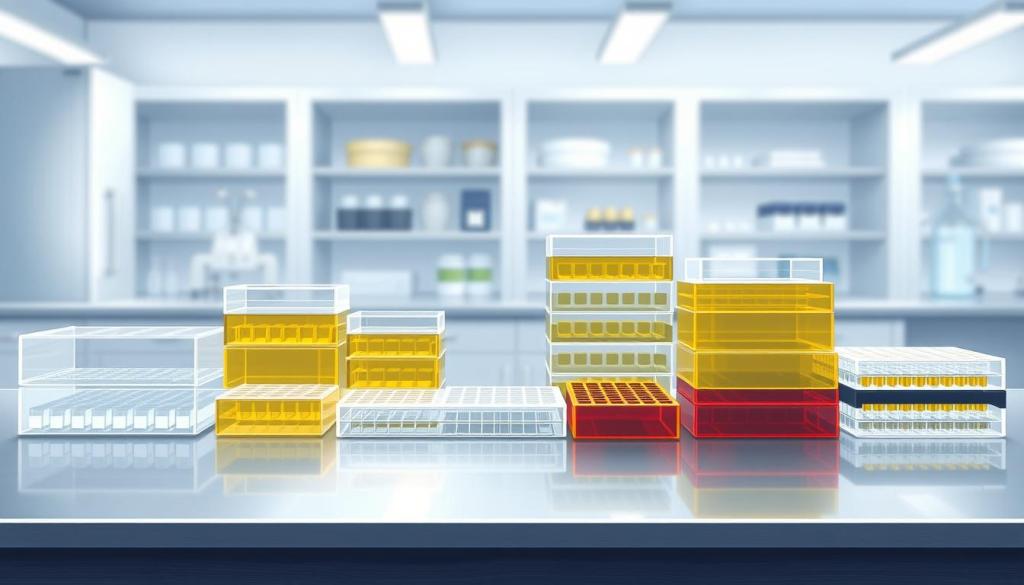
8. Tips for Choosing the Right Well Plate
Choosing the right cell culture or assay plate is key to success in experiments. Researchers need to look at several factors to get the best results.
- Experiment type and specific research requirements
- Sample volume capacity
- Optical properties needed for analysis
- Equipment compatibility
Evaluating Experimental Needs
Different cell culture plates have their own benefits. Researchers should think about:
- Well configuration: 96-well, 384-well, or 1536-well formats
- Bottom shape: U-bottom, V-bottom, F-bottom, or C-bottom
- Surface treatments for specific applications
Assessing Technical Compatibility
How well the plate works with lab equipment is important. Consider:
- Plate reader specifications
- Automated system requirements
- Material transparency for specific detection methods
“Precision in well plate selection can transform experimental outcomes.”
Today’s cell culture plates offer many options. They have special coatings and treatments for better results. Matching the plate to your research needs is crucial for success.
9. Innovations in Well Plate Technology
Biotechnology equipment is always getting better, especially with well plate technology. Scientists are making labware more advanced and efficient.
The world of well plate technology has changed a lot. This is thanks to new materials and engineering. Now, researchers have tools that help them work more precisely and quickly.
Advances in Material Science
New materials are being developed:
- Improved optical clarity for better microscopic observations
- Enhanced chemical resistance
- Superior thermal stability
- Increased biocompatibility
Improvements in Design
Designs are getting better too:
- Specialized well shapes for specific research applications
- Advanced surface treatments
- Optimized liquid handling capabilities
*”The future of scientific research lies in continually improving our fundamental tools and technologies.”*
New technologies are showing great promise in biotechnology. Open microfluidic devices are making research easier. They help reduce barriers and offer special benefits:
| Innovation Feature | Key Benefit |
|---|---|
| Higher Surface Area to Volume Ratio | Reduced cell culture media requirements |
| Rapid Injection Molding | High reproducibility and fast manufacturing |
| Multi-Cell Type Culturing | Simultaneous microscopic viewing |
These changes are big steps forward in labware design. They let researchers do more detailed and efficient experiments.
10. Conclusion
Well plates, or microtiter plates, are key in scientific research. They have changed how we do experiments in many fields. Now, scientists can do complex tests with great accuracy and speed.
Summary of Key Points
We’ve seen how well plates work. The 96-well plate lets scientists test 80 surfaces at once. This shows how versatile these tools are. They’re used in many studies, from viruses to bacteria, making experiments reliable and easy to repeat.
Future of Well Plate Usage in Laboratories
The future of microtiter plates is bright. New technologies are making them even better. Scientists can now do detailed tests with very little sample, saving money and time. As research methods get better, well plates will keep helping us learn more about life.
FAQ
What exactly is a well plate?
A well plate is a piece of lab equipment with many small wells in a grid. It’s usually made of plastic like polystyrene or polypropylene. These plates hold many samples at once, making it easy to run lots of tests in a small space.
What are the most common types of well plates?
Common types include standard plates (6, 12, 24, 96, and 384-well) and deep well plates for bigger samples. There are also specialty plates for cell culture, protein tests, or drug screening.
What materials are well plates typically made from?
Well plates are often made from polystyrene, polypropylene, and cyclo-olefins. Each material has special features like being clear, resistant to chemicals, and working well in different tests.
How are well plates used in scientific research?
Well plates are key in many research areas like cell culture and drug discovery. They help scientists work on many samples at once. This makes tests more efficient and reliable.
What should I consider when choosing a well plate?
When picking a well plate, think about what you need for your test. Consider the sample size, how clear it is, surface treatments, and if it works with your lab tools. Also, think about the type of test you’re doing.
How do I properly handle and store well plates?
To handle well plates right, keep them clean and sterile. Store them at the right temperature and protect them from damage. Always follow the maker’s instructions for cleaning, sterilizing, and storing.
What are the advantages of using well plates?
Well plates have many benefits. They help with quick testing, save on reagents, standardize tests, and make automation easier. They also let you do many tests at once in a small space.
Are there recent innovations in well plate technology?
Yes, there have been new developments. These include better materials, special well shapes, and surface treatments. There are also designs that make handling liquids easier and work well with new research tools.
What is the difference between a microplate and a well plate?
There’s no difference – microplate and well plate mean the same thing. They’re used in science to describe the same lab tool with many wells for samples.
Can well plates be used for different types of experiments?
Yes, well plates are very flexible. They’re used in many fields like molecular biology and medical diagnostics. Their ability to adapt makes them a key tool in science today.






Leave a Comment
Your email address will not be published. Required fields are marked *