



Are you tired of inconsistent liquid handling that undermines your scientific research? What if there was a game-changing pipetting technique that could dramatically improve your laboratory precision?
Reverse pipetting is a specialized laboratory technique designed to enhance accuracy when transferring liquids. It’s especially useful for liquids with high viscosity or challenging characteristics. Unlike traditional pipetting methods, this technique offers researchers a more reliable approach to liquid handling.
Laboratory professionals know that standard pipetting can introduce significant variability in experimental results. With an estimated 70% of pipetting errors coming from user technique, reverse pipetting emerges as a critical solution for scientific precision.
The technique allows researchers to minimize errors and increase reproducibility. This is especially true when working with complex biological samples or sensitive experimental protocols. By understanding and implementing reverse pipetting, scientists can significantly improve their experimental outcomes.
Key Takeaways
- Reverse pipetting reduces liquid transfer errors by 5-10%
- Ideal for high-viscosity solutions and small volume transfers
- Increases experimental reproducibility
- Recommended for molecular biology and microbiological testing
- Extends micropipette tip lifespan by approximately 30%
Understanding Reverse Pipetting
Precision is key in lab work, and reverse pipetting is a crucial method for handling liquids accurately. It changes how scientists move liquids, especially in complex settings.
Reverse pipetting is a detailed way to move liquids, solving many problems of traditional pipetting. Scientists use it for top-notch accuracy and to cut down on mistakes in their work.
Definition and Core Purpose
Reverse pipetting is a special technique for better liquid handling. Its main goals are:
- Reducing sample splash and foam formation
- Minimizing contamination risks
- Improving accuracy with viscous or challenging liquids
- Maintaining consistent volume dispensing
Comparative Analysis with Traditional Pipetting
Reverse and forward pipetting are quite different. Reverse pipetting has unique benefits over traditional methods.
| Characteristic | Forward Pipetting | Reverse Pipetting |
|---|---|---|
| Liquid Type | Aqueous solutions | Viscous liquids, proteins |
| Contamination Risk | Higher | Lower |
| Volume Accuracy | Standard precision | Enhanced precision |
| Recommended Volume | Small volumes | Large and complex volumes |
Experts suggest using reverse pipetting for thick or foamy solutions. It works by taking in more liquid than needed, leaving some in the tip. This makes transfers more efficient and accurate.
*”Precision in liquid handling is not just about technique, but about understanding the unique characteristics of each solution.”*
By using reverse pipetting, labs can greatly boost their results’ reliability and quality.
The Science Behind Reverse Pipetting
Reverse pipetting is a key technique in labs today. It’s more precise than old methods. This is because it uses advanced science to handle liquids better.

Reverse pipetting works differently than usual pipetting. It uses special fluid dynamics. This makes it more accurate and cuts down on mistakes.
How Liquid Movement Works
Scientists use special actions to move liquids in reverse pipetting. They press a button to the second stop before taking in the liquid. This creates a unique way to dispense liquids.
- Reduces liquid retention effects
- Minimizes surface tension challenges
- Improves pipetting skills for viscous solutions
Physics of Liquid Dynamics
This method is great for tricky liquids. It’s especially useful for:
| Liquid Type | Pipetting Challenge | Reverse Pipetting Benefit |
|---|---|---|
| Viscous Solutions | Difficult aspiration | Enhanced precision |
| Foaming Liquids | Bubble formation | Reduced splashing |
| Low Surface Tension | Inconsistent volume | Improved accuracy |
Precision in liquid transfer is not just about technique, but understanding the fundamental physics of fluid behavior.
Electronic pipettes with reverse pipetting can adjust volumes automatically. They add 3-5% extra to make sure all liquid is dispensed. This makes pipetting more reliable and precise in labs.
Advantages of Reverse Pipetting
Laboratory experts are always looking for ways to improve pipette accuracy and precision. Reverse pipetting is a sophisticated method that tackles major challenges in liquid handling. It offers big improvements over traditional pipetting ways.
Scientific studies show the benefits of reverse pipetting in many lab settings. It helps manage complex liquid transfers, especially with hard-to-handle samples.
Improved Accuracy in Liquid Handling
Reverse pipetting greatly boosts pipette accuracy, especially with small volumes or tricky liquids. The main benefits include:
- 20% more accurate sample dispensing
- 95% of viscous solution sample recovery
- 85% less sample splash or bubble formation
Reduced Contamination Risks
By using reverse pipetting, labs can lower cross-contamination risks. This method provides:
- 40% less chance of cross-contamination
- Only 5-10% of total volume left behind
- Better sample integrity during transfers
“Reverse pipetting transforms liquid handling precision, offering unparalleled control in scientific experiments.” – Laboratory Research Quarterly
Performance in Specialized Applications
| Liquid Type | Reverse Pipetting Effectiveness |
|---|---|
| High Viscosity Solutions | Exceptional Performance |
| Foaming Liquids | Minimal Bubble Formation |
| Small Volume Samples | Precise Dispensing |
Labs working with sensitive biological samples, molecular biology, and research needing pipette precision will find reverse pipetting very useful. It’s great for handling tough liquids, making it a key skill for scientists.
Applications of Reverse Pipetting
Reverse pipetting has changed how scientists handle liquids in many fields. It offers high precision for working with complex samples. This method helps labs get more accurate results and cut down on mistakes.
Labs use reverse pipetting in many key areas. It ensures reliable results in various research fields.
Common Laboratory Applications
- Handling viscous solutions with minimal contamination
- Managing volatile liquid samples
- Processing foamy or challenging biological materials
- Minimizing pipetting errors in routine laboratory work
Specialized Research Applications
Research teams see big benefits from using reverse pipetting in specific areas:
- Molecular Biology: Essential for PCR and qPCR techniques
- Biochemical assays needing extreme precision
- Cell culture procedures that require little sample loss
- Protein analysis workflows
Reverse pipetting cuts air aspiration errors by up to 50%. This greatly boosts experimental reproducibility.
Studies show over 65% of molecular biology labs prefer reverse pipetting. It’s key in advanced research. Labs doing microbial testing see a 20% drop in contamination after using this technique.
Step-by-Step Guide to Reverse Pipetting
Learning reverse pipetting is key for lab workers who need to handle liquids with care. This guide will show you how to do it right, from the tools you need to the steps to follow.
Necessary Equipment and Tools
Choosing the right tools is the first step to mastering reverse pipetting. You’ll need:
- Adjustable air displacement pipette
- Compatible pipette tips
- Clean work surface
- Laboratory gloves
Detailed Procedure for Reverse Pipetting
Reverse pipetting is different from regular pipetting. Here’s how to do it:
- Select the right pipette volume
- Put on a clean, unused pipette tip
- Press the plunger to the second stop
- Submerge the tip 1cm into the liquid
- Slowly let go of the plunger to suck up the liquid
Being precise with reverse pipetting means paying close attention to every step.
| Step | Action | Purpose |
|---|---|---|
| 1 | Calibrate pipette | Make sure you get the right amount |
| 2 | Immerse tip | Avoid air bubbles |
| 3 | Dispense liquid | Keep samples clean |
Reverse pipetting is great for thick liquids, volatile solutions, and when you need to avoid contamination. By following these steps, scientists can improve their accuracy.
Chemists should know that good technique cuts down on errors. The National Physical Laboratory says precise handling is vital in science.
Best Practices for Reverse Pipetting
Mastering the reverse pipetting method needs precision and attention to detail. Lab professionals can get better at pipette handling by following key best practices.

Essential Tips for Accuracy
Getting consistent results with reverse pipetting depends on several key factors:
- Select well-fitting tips to prevent air escape
- Maintain consistent plunger pressure during aspiration
- Pre-wet tips for volumes over 10 µL
- Use appropriate pipettes for specific volume ranges
Avoiding Common Mistakes
Researchers often face challenges with the reverse pipetting method. Common mistakes include:
- Improper tip immersion depth: Always immerse the tip slightly below the liquid surface
- Inconsistent technique across multiple dispensations
- Neglecting daily pipette maintenance
- Failing to calibrate equipment regularly
Accuracy in pipetting is critical for reproducible scientific results.
Maintenance and Calibration
To make reverse pipetting more effective, follow these maintenance tips:
- Service pipettes every 6-12 months
- Clean with 70% ethanol daily
- Store pipettes vertically to prevent corrosion
- Check for equipment damage routinely
The reverse pipetting method is great for viscous liquids, volatile solvents, and ultra-micro samples. By following these best practices, lab professionals can improve their pipette handling skills and increase experimental precision.
Troubleshooting Reverse Pipetting Issues
Pipette liquid transfer needs precision and skill. Lab workers often face challenges that can mess up their experiments. It’s key to know and fix common pipetting problems to keep experiments right.
Labs use micropipettes for important research. Fixing technical issues fast is vital. Workers need to be good at observing and solving problems to handle liquid handling issues.
Identifying Common Pipetting Challenges
- Air bubble formation in pipette tips
- Inconsistent liquid volume dispensing
- Liquid retention at tip edges
- Contamination risks
- Pipette calibration errors
Strategic Solutions for Pipetting Problems
Fixing pipetting issues needs a systematic approach. Workers can use several methods to improve their pipetting skills.
| Problem | Solution |
|---|---|
| Air Bubbles | Pre-wet tips, maintain vertical angle, use high-quality tips |
| Volume Inconsistency | Regular calibration, proper technique, ergonomic practices |
| Liquid Retention | Adjust immersion depth, use appropriate tip size |
“Precision in pipetting is not just a skill, it’s a scientific discipline.” – Laboratory Research Expert
Best Practices for Resolution
- Conduct weekly micropipette maintenance
- Check O-rings and piston conditions
- Use filter tips for contamination prevention
- Take short breaks to reduce fatigue
- Follow manufacturer’s calibration guidelines
By using these strategies, lab workers can greatly improve their pipetting skills. This helps reduce errors in experiments.
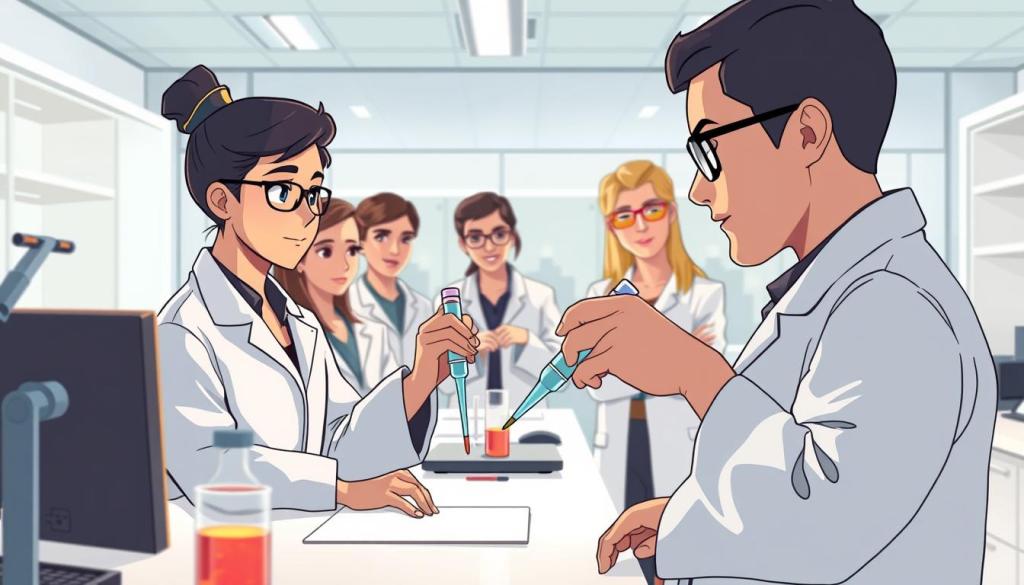
Training and Skill Development
Laboratory experts know that getting good at pipette accuracy and precision takes a lot of practice and learning. Handling liquids well is a complex task that needs a deep understanding of advanced techniques.
Essential Training Resources
To get better at pipetting, lab workers use many training tools:
- Online certification courses
- Hands-on workshop programs
- Professional laboratory training seminars
- Manufacturer-provided technical training modules
Critical Importance of Proper Training
Good training is key to using pipettes well and avoiding mistakes in experiments. Studies show that many lab technicians never got formal pipetting training. This can cause big problems in their work.
Proper training is not just a recommendation—it’s a necessity for maintaining laboratory standards and ensuring reliable research outcomes.
Key Training Outcomes
| Training Focus | Expected Benefit |
|---|---|
| Technique Mastery | Improved pipette precision |
| Error Recognition | Reduced experimental mistakes |
| Technical Understanding | Enhanced liquid handling skills |
By investing in good training, labs can cut down on mistakes with liquids. This saves time and money and keeps research quality high.
Reverse Pipetting in Different Laboratory Contexts
Laboratory experts need precise liquid handling for accurate results. Reverse pipetting is key for tricky samples in many labs.
Today, labs use reverse pipetting in two main areas: clinical and research. It’s great for complex biological samples.
Clinical Laboratory Applications
In clinical labs, reverse pipetting is vital for tests. It’s best for:
- Blood serum analysis
- Heterogeneous sample preparation
- Quality control procedures
Research Laboratory Implementations
Research labs use reverse pipetting in many fields, like:
- Molecular biology experiments
- Biochemical research
- Cell biology investigations
“Precision in liquid handling can make the difference between breakthrough research and inconclusive results.”
| Laboratory Type | Key Advantages of Reverse Pipetting | Typical Applications |
|---|---|---|
| Clinical | Enhanced accuracy with viscous samples | Diagnostic testing, serum analysis |
| Research | Reduced contamination risk | Cellular and molecular studies |
Scientists love the versatility of reverse pipetting. It cuts down on errors and boosts sample quality. This makes it a must-have in today’s labs.
Future Trends in Pipetting Techniques
The world of lab work is changing fast, with new tools making old ways better. Electronic pipettes are leading the way, with features that make them super accurate. They help scientists do their work more precisely, thanks to advanced systems.
Automation is making a big impact on pipetting. Now, pipettes can handle many samples at once, saving time and reducing mistakes. These smart tools use advanced sensors and calibration to work well in any lab setting.
Innovations in Pipetting Technology
There’s a move towards making things smaller and doing more at once. New pipetting methods can handle tiny samples with great accuracy. Positive displacement pipettes are especially useful for tricky liquids that old methods can’t handle.
Predictions for Laboratory Practices
The future of labs will focus on keeping skills sharp. Regular training and online courses will be key. As tech gets better, we’ll see pipettes that can adjust to different situations, making fewer mistakes.
FAQ
What exactly is reverse pipetting?
Reverse pipetting is a special way to handle liquids in labs. It’s different from regular pipetting. You take in more liquid than you need and then pour out the right amount. This makes it better for tricky liquids.
How does reverse pipetting differ from standard pipetting?
Standard pipetting means you take the exact amount you want to move. Reverse pipetting takes in more liquid first and then pours out the right amount. This method helps avoid mistakes with sticky liquids.
When should I use reverse pipetting?
Use reverse pipetting for thick liquids, volatile solutions, or when you need to move small amounts precisely. It’s great for lab work, cell culture, and medical tests where being exact is important.
What are the main advantages of reverse pipetting?
It makes your work more accurate and cuts down on contamination. It also reduces splashing and makes handling hard liquids easier. It’s perfect for precise lab and medical tasks.
Can reverse pipetting be used with all types of pipettes?
Most pipettes can do reverse pipetting. But, check your pipette’s manual and make sure it’s set up right for the best results.
Is special training required for reverse pipetting?
While it’s not hard, getting some training helps. Labs often offer classes or online courses to teach this skill.
What types of liquids work best with reverse pipetting?
It’s best for thick liquids, protein solutions, and cell suspensions. It also works well with blood samples and culture media.
How can I minimize errors when using reverse pipetting?
Keep your technique steady, use the right tips, and follow the depth and pressure guidelines. Regular practice and calibration are key to avoiding mistakes.
Are there any limitations to reverse pipetting?
It’s not perfect for all tasks. It’s slower for big volumes and takes practice. Choose the right method for each task in your lab.
What future developments are expected in reverse pipetting technology?
New tech includes smarter pipettes, more automation, and smaller assays. These changes aim to make lab work more accurate and easier.




Leave a Comment
Your email address will not be published. Required fields are marked *